Beyond Income and Accumulation
What does it actually mean for a society to become wealthy? The question appears simple until we look closely at what modern economics counts as wealth. A household may have a rising income but declining health; a city may accumulate enormous financial assets while losing clean air, open spaces and community life; a country may increase its productive output while exhausting its soil, groundwater and forests. At the individual level, we distinguish between income and wealth because we understand that a salary received this month is not the same thing as the assets accumulated over a lifetime. Yet at the level of society, we frequently collapse these distinctions and treat rising production, income and national wealth as if they were interchangeable. What if a society becomes richer in numbers but poorer in knowledge, relationships, ecological security or institutional capacity? Has it really become wealthier?
Modern economic thought has given us increasingly sophisticated ways of answering the material part of this question.
- Adam Smith located the wealth of nations in the productive capacity arising from the land and labour of society, while his analysis of capital, division of labour and exchange helped establish the foundations of modern economics.
- Marx subsequently shifted attention towards ownership, production and the accumulation of capital, while later economics developed increasingly refined distinctions between income, capital, assets, consumption and investment.
These developments are indispensable for understanding material prosperity. Yet there is a conceptual limitation when what can be priced, exchanged or recorded becomes easier to recognise than what sustains society without necessarily appearing in a market transaction. The economist can measure the value of a house, but not easily the knowledge of the family that maintains it; the market can price timber, but not necessarily the ecological system that produced the forest; national accounts can record the purchase of childcare, but not the enormous amount of unpaid care performed within households.
This is not an argument against measurement. It is an argument against confusing measurement with reality. Economics needs measurement precisely because resources are scarce and choices have consequences, but the things that are easiest to measure are not necessarily the things that matter most. Even Adam Smith’s conception of wealth was considerably richer than the caricature of economics as mere accumulation: he began with the capacity of a society to supply the necessities and conveniences of life through the productivity of its land and labour. The question, then, is not whether production matters—it clearly does—but whether production exhausts the meaning of prosperity.
The Indic Wisdom
An Indic inquiry takes us into an older and considerably more layered conception of possession and prosperity. The opening mantra of the Isha Upanishad states: “तेन त्यक्तेन भुञ्जीथा मा गृधः कस्यस्विद्धनम्”—enjoy through renunciation; do not covet what belongs to another (Isha Upanishad 1). The statement does not reject wealth. It challenges the assumption that possession automatically establishes rightful ownership or that unlimited acquisition is the natural purpose of economic life. Wealth exists within a larger moral order, and enjoyment is accompanied by restraint.
The Rig Veda makes the point even more socially. Rig Veda 10.117.5 observes that wealth moves from one person to another “like the wheels of a chariot”, while the preceding verses condemn the person who possesses food but refuses to share it with one in need. Wealth here is not imagined as something whose highest purpose is to remain concentrated. Its value is partly revealed through circulation, reciprocity and the capacity to sustain relationships. A person may possess much and yet be socially poor if his abundance produces no obligation towards others.
Kautilya’s Arthashastra provides another dimension because it treats wealth as a material and institutional system rather than simply private accumulation. Agriculture, mines, forests, cattle, roads, markets, reservoirs, trade, storage, taxation and productive settlements all enter the economic architecture of the Rajya. Kautilya even describes land and waterways as roads of traffic and identifies fields, forests, herds, mines and water systems among the economic foundations from which state revenue emerges (Arthashastra 2.6).
In the agricultural chapters, attention is given not only to crops but to seeds, rainfall, irrigation, labour, soil conditions and the appropriate use of different lands (Arthashastra 2.24).
This is significant because it presents wealth as a system of productive relationships. A field is wealth, but so is the water that sustains it; the seed is wealth, but so is the knowledge that enables its cultivation; the road is wealth because it connects production to exchange.
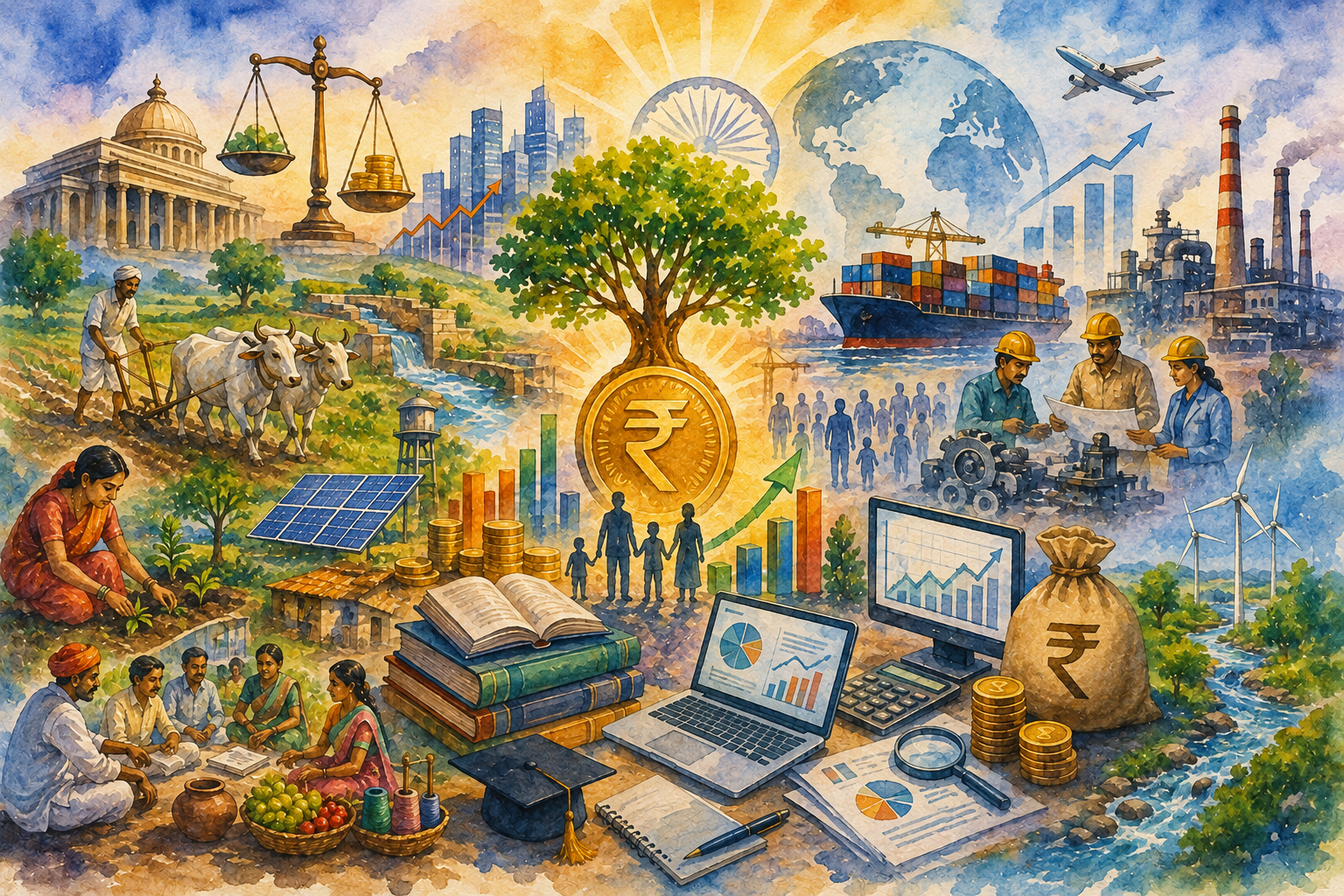
The same logic can be extended to forms of wealth that modern accounting struggles to see. A skilled artisan carries accumulated knowledge. A family may possess intergenerational skills that never appear on a balance sheet. A community may possess networks of trust that reduce transaction costs and enable cooperation. A healthy river supports agriculture, drinking water, fisheries, settlement and culture simultaneously. A language contains a stock of memory. A functioning institution contains accumulated social knowledge. These are forms of capital even when they are not always expressed as financial assets.
This is where the Indic idea of Artha becomes particularly important. Artha is one of the Purusharthas, and therefore wealth is neither rejected nor made absolute. It is one legitimate dimension of human flourishing, but it exists alongside Dharma, Kama and Moksha. The conceptual implication is profound: economic value cannot automatically become the supreme measure of human value. Wealth matters because human beings require material foundations for life, but the purpose of life cannot be reduced to the perpetual multiplication of those foundations.
Modern economics has itself moved in this direction. Amartya Sen’s capability approach challenged the tendency to evaluate well-being through income alone by asking what people are actually able to be and do. That was an important expansion of the economic imagination. Yet the Indic framework pushes the inquiry further: what should human beings be capable of doing, and what constitutes a flourishing life? Capability without purpose can still leave economics without an account of the good.
This also changes how we should think about inequality. The question is not simply how much wealth exists, but how wealth circulates, what it enables, and whether its accumulation strengthens or weakens the productive and social foundations of society. A society where a few possess enormous financial wealth while large numbers lack access to knowledge, health, secure livelihoods, ecological resources or social mobility may be financially rich and structurally fragile. Conversely, a society may possess relatively modest monetary wealth while retaining strong household knowledge, community institutions, ecological practices and social trust. Neither condition should be romanticised, but neither should be invisible to economics.
The deeper lesson is that wealth is not merely a stock of things one owns; it is a stock of capacities that allows life to reproduce itself and flourish. Financial capital is one form. Physical infrastructure is another. Human skill is another. Social trust, ecological health, cultural memory and institutional competence are others. The challenge for economics is to recognise their differences without pretending that everything can be converted into a single monetary number.
So perhaps the question should no longer be simply, “How much wealth does a society possess?”
We should ask:
What kind of wealth does it possess? Who can access it? How is it transmitted? Does it circulate? Does it regenerate? Does it create capability? Does it strengthen relationships? Does it preserve the ecological foundations of future production? And what happens when the pursuit of one form of wealth destroys another?
Because a society does not become truly wealthy merely when its balance sheet becomes larger.
It becomes wealthy when the resources—material, human, social, ecological and intellectual—through which life can flourish are preserved, renewed and transmitted across generations.
