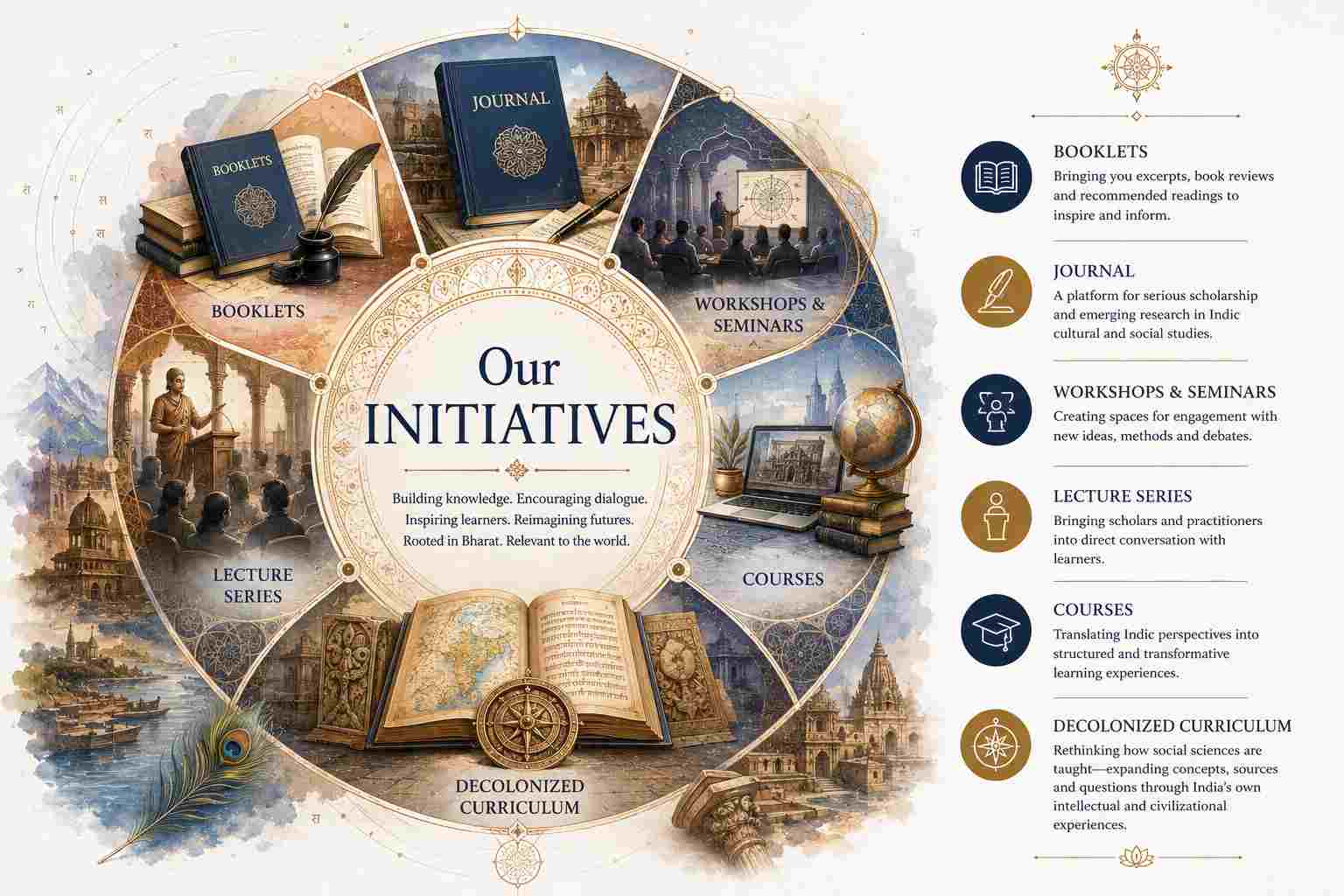
Our initiatives bring together knowledge creation, intellectual dialogue and accessible learning. Through our Booklets, we bring excerpts, book reviews and recommended readings to students and wider readers. Our Journal provides a platform for serious scholarship and emerging research in Indic cultural and social studies. Through Workshops and Seminars, we create spaces for researchers and students to engage with new ideas, methods and debates, while our Lecture Series brings scholars and practitioners into direct conversation with learners. Our Courses translate Indic perspectives into structured learning experiences, and our Decolonized Curriculum initiative seeks to rethink how the social sciences are taught—expanding their concepts, sources and questions through India’s own intellectual and civilizational experiences.
Our Initiatives
- Indic Social Studies booklets
- Indic Social Studies Journal
- Workshop & Seminars
- Lecture Series
- Indic Courses
- Curriculum
Indic Cultural and Social Studies Booklets
The Indic Cultural and Social Studies Booklets are educational publications designed to make the foundational ideas of Indic thought accessible to students, researchers, educators, and readers seeking to explore the Social Sciences and Humanities from a Bharatiya perspective. Each booklet brings together carefully selected excerpts from the works of eminent Indic thinkers, scholars, and knowledge traditions, allowing readers to encounter important ideas through primary texts rather than through secondary interpretations alone.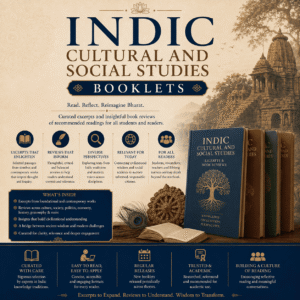
Published for educational and knowledge-sharing purposes, and not for commercial sale, these booklets are conceived as more than collections of readings. They are intended to serve as intellectual guides and starting points for further exploration. A reader may begin with a booklet to understand a particular concept, thinker, or theme and then use it as a pathway towards the wider body of literature, sources, debates, and research associated with it.
The aim is to create a carefully curated and academically useful series that helps bridge an important gap: while students of Social Sciences and Humanities are often introduced to concepts through established Western texts and theoretical frameworks, access to the primary works, categories, and intellectual vocabulary of Indic thinkers remains comparatively limited. These booklets seek to bring those sources closer to the learner—not as a replacement for existing scholarship, but as an invitation to read more widely, compare frameworks, question inherited assumptions, and discover alternative ways of understanding society, culture, politics, economy, knowledge, and human life.
Each booklet therefore functions as an intellectual gateway. It does not attempt to say everything about a subject; rather, it helps the reader discover where to begin, what to read, which questions to ask, and where deeper research may lead. In this sense, the series is designed not merely to provide answers, but to cultivate the habit of inquiry that allows learners to engage with Indic knowledge on its own terms.
Ultimately, the Indic Cultural and Social Studies Booklets seek to contribute to the gradual reconstruction of Social Sciences and Humanities through Bharatiya concepts, categories, sources, methodologies, and lived intellectual traditions. They are an effort to place the primary material in the hands of the learner and allow further study, debate, interpretation, and research to emerge from there.
Indic Cultural and Social Studies Journal
This special issue of the Indic Cultural and Social Studies Journal invites researchers, scholars, practitioners, and emerging academics to contribute to the growing field of Indic Social Studies by exploring society, culture, institutions, governance, economy, knowledge, and collective life through diverse civilizational perspectives. The issue is conceived as an open intellectual space for researchers to engage with Indic frameworks, examine their conceptual foundations, develop their own interpretations, question existing assumptions, and explore how Bharatiya categories and knowledge traditions can contribute to contemporary Social Sciences and Humanities.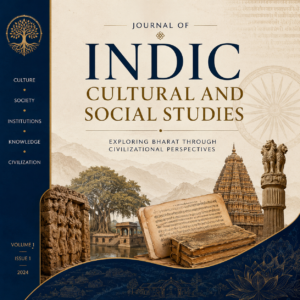
The journal welcomes work that does not merely describe Indic traditions, but thinks with them—bringing together theoretical inquiry, historical research, empirical studies, comparative analysis, field-based research, case studies, and practical or policy-oriented ideas. Researchers may examine established Indic concepts, recover neglected intellectual traditions, develop new frameworks emerging from Indian social experience, or place Indic and contemporary approaches in dialogue with one another. The objective is not to prescribe a single “Indic” interpretation, but to create space for multiple ideas, perspectives, debates, and methods emerging from the diversity of Bharatiya civilizational experience.
The issue particularly encourages researchers to ask new questions: How can Indian society be understood through its own categories? What happens when social institutions are studied from within their civilizational context rather than through borrowed theoretical assumptions? Can Indic concepts generate new analytical frameworks for contemporary problems? How can historical knowledge, lived traditions, empirical evidence, and practical experience inform the reconstruction of Social Studies? And where might new research lead when scholars are given the freedom to explore these questions seriously?
We therefore invite contributions from researchers at different stages of their academic journey—from established scholars to early-career researchers and emerging voices—who wish to contribute to this intellectual exploration. The journal welcomes rigorous and original scholarship that is willing to investigate, question, compare, reinterpret, and build. The larger purpose is to create a scholarly space where Indic perspectives are not merely studied as subjects of the past, but are explored as living intellectual resources capable of generating new questions, new frameworks, and practical possibilities for understanding society in the present.
Workshops, Seminars, Lectures, and Academic Dialogues
This section presents the Workshops, Seminars, Lectures, and Academic Dialogues organised by the Centre as spaces for collective learning, intellectual exchange, and the continuous development of Indic Cultural and Social Studies. The Centre believes that knowledge is not created in isolation; it grows through dialogue, questioning, disagreement, shared experience, and the meeting of diverse intellectual perspectives. Our workshops and seminars therefore bring together scholars, researchers, practitioners, educators, and students to examine contemporary questions, explore civilizational frameworks, share research, and develop new ideas rooted in the Bharatiya knowledge traditions.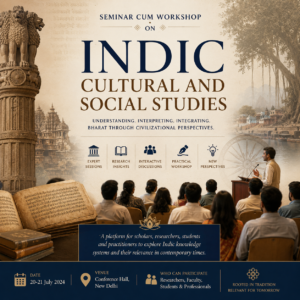
At the heart of these engagements is the idea of सह-अध्ययन and सह-चिन्तन—learning and thinking together. We invite scholars and institutions to collaborate with us, not simply to present their existing work, but to contribute their expertise, questions, methods, and experiences to the larger process of knowledge creation. Every collaboration offers an opportunity to expand what we know, question what we assume, and discover possibilities that may not emerge within the boundaries of a single discipline or individual scholar.
For us, a seminar is not merely an academic event where papers are presented and certificates are distributed. It is a यज्ञ. Every research paper, question, argument, observation, experience, disagreement, and new idea becomes an आहुति offered into that intellectual यज्ञ. The purpose of the gathering is therefore not to arrive at a single predetermined conclusion, but to create the conditions in which knowledge can emerge through collective inquiry.
We invite you to participate, collaborate, question, contribute, and build with us. Whether through a workshop, seminar, lecture, dialogue, field-based engagement, or a collaborative research initiative, we seek to create spaces where different disciplines and perspectives can meet and where the reconstruction of Social Studies through Bharatiya frameworks becomes a shared intellectual endeavour. The Centre provides the मंच; the यज्ञ belongs to all who bring their thought to it.
Lecture Series
The Centre’s Lecture Series is conceived as a space for the dissemination, dialogue, and continued development of knowledge in Indic Cultural and Social Studies. The series brings together distinguished scholars, researchers, practitioners, and thoughtful voices whose work can help us examine foundational ideas, contemporary questions, emerging research, and diverse civilizational perspectives in the Social Sciences and Humanities. Rather than treating lectures as one-way transmission of information, we see them as opportunities to bring ideas into conversation, expose learners to different intellectual traditions, and open new directions for research and inquiry.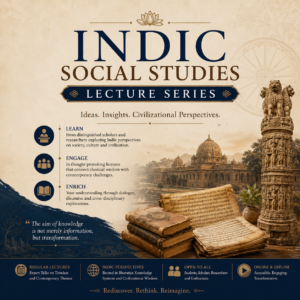
We invite scholars, institutions, researchers, and members of the wider academic community to become part of this growing intellectual conversation. If there is a scholar or practitioner whose work deserves to reach students and researchers, or if you believe a particular theme, research area, or emerging idea should become part of this dialogue, we welcome your suggestions and collaborations. The Centre is equally open to scholars who wish to share their own research and engage directly with learners and fellow researchers.
The Lecture Series is intended to become one of the Centre’s important avenues for knowledge dissemination—taking ideas beyond individual research papers and classrooms and bringing them into a wider community of learners, researchers, and practitioners. Our aim is to create sustained intellectual relationships rather than isolated academic events, allowing a lecture to become the beginning of further reading, discussion, research, and collaboration.
If you would like to recommend a speaker, propose a theme, or explore a collaborative lecture with the Centre, we invite you to write to us at socialstudies@indusuni.ac.in, with a copy to sameerpande.iiss@indusuni.ac.in. We look forward to building this series with scholars and institutions who share an interest in expanding the horizons of Social Studies through Bharatiya and civilizational perspectives.
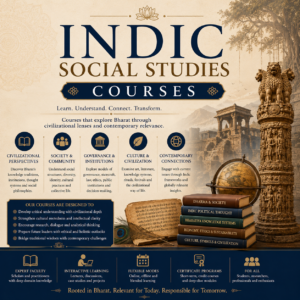
Decolonizing Curriculum
The Decolonizing Curriculum initiative is envisioned as a collaborative space for researchers, educators, practitioners, and students to critically examine how knowledge enters the classroom: Who decides what should be taught? Which texts become foundational? Which concepts determine how a subject is understood? What does the existing curriculum explain well, what does it leave unexplored, and how might it be enriched through Bharatiya knowledge traditions and civilizational perspectives? Decolonization, in this sense, is not simply about removing existing knowledge or replacing one intellectual canon with another; it is about expanding the possibilities through which knowledge can be organised, taught, questioned, and produced.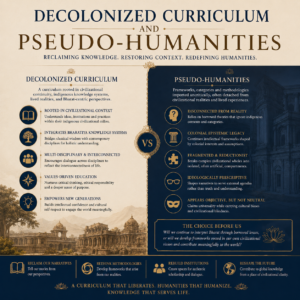
The initiative therefore begins with the curriculum itself as an object of research. Contributors are encouraged to study existing syllabi, textbooks, reading lists, conceptual frameworks, pedagogical practices, and disciplinary structures across the Social Sciences and Humanities. The purpose is to understand both their strengths and their limitations before asking how Indic categories, texts, intellectual traditions, regional knowledge systems, lived practices, and alternative methodologies can deepen the learning experience. The question is not merely what should be added?, but also how is a discipline constructed, whose categories organise it, and what other ways of knowing might allow us to see the same subject differently?
What makes this initiative distinctive is its commitment to a bottom-up approach to curricular reconstruction. Rather than producing another predetermined framework and asking universities, teachers, and learners to simply adopt it, the Centre seeks to create a space where researchers can experiment, compare, document, propose, test, and refine curricular possibilities. A researcher studying a regional institution, a teacher experimenting with an Indic concept in the classroom, a scholar recovering a neglected text, or a practitioner carrying generations of lived knowledge may each contribute something valuable to the reconstruction of a discipline.
Underlying this approach is our belief in the polycentric nature of knowledge. Knowledge does not emerge from one intellectual centre, one language, one institution, one text, or one authorized interpretation. Bharatiya civilization itself has sustained multiple śāstras, sampradāyas, regions, languages, practices, commentarial traditions, and sites of knowledge production that have continuously conversed, contested, adapted, and developed across time. A decolonized curriculum must therefore resist replacing one intellectual monopoly with another; instead, it should create conditions in which multiple centres of knowledge can enter into meaningful conversation.
The Decolonizing Curriculum initiative consequently invites every serious researcher to participate in this process—not merely by critiquing what exists, but by asking what can be built next. Through curriculum reviews, comparative studies, conceptual interventions, new reading lists, pedagogical experiments, course designs, case studies, and field-based insights, contributors can help develop curricula that are intellectually rigorous, contextually rooted, civilizationally informed, and open to plurality.
Ultimately, this is not a project to produce a single “Indic curriculum” from above. It is an attempt to cultivate an ecosystem of curricular possibilities from below, where teachers, researchers, institutions, traditions, and communities become participants in knowledge creation. Decolonization then becomes not an act of rejection, but a continuing process of recovery, dialogue, experimentation, reconstruction, and intellectual self-discovery.