Beyond Markets, Money and GDP
When we say “the economy”, what exactly are we talking about? A marketplace? Money? Production? Employment? Consumption? Banks and corporations? Government expenditure? GDP? The usual economics curriculum gives us a fairly clear answer: the economy is the system through which scarce resources are allocated among competing uses, goods and services are produced and exchanged, and individuals and institutions make choices under conditions of scarcity. It is an extraordinarily useful framework. But it also creates a question that is rarely asked at the beginning of the curriculum: what if economic life is larger than the market through which we measure it?
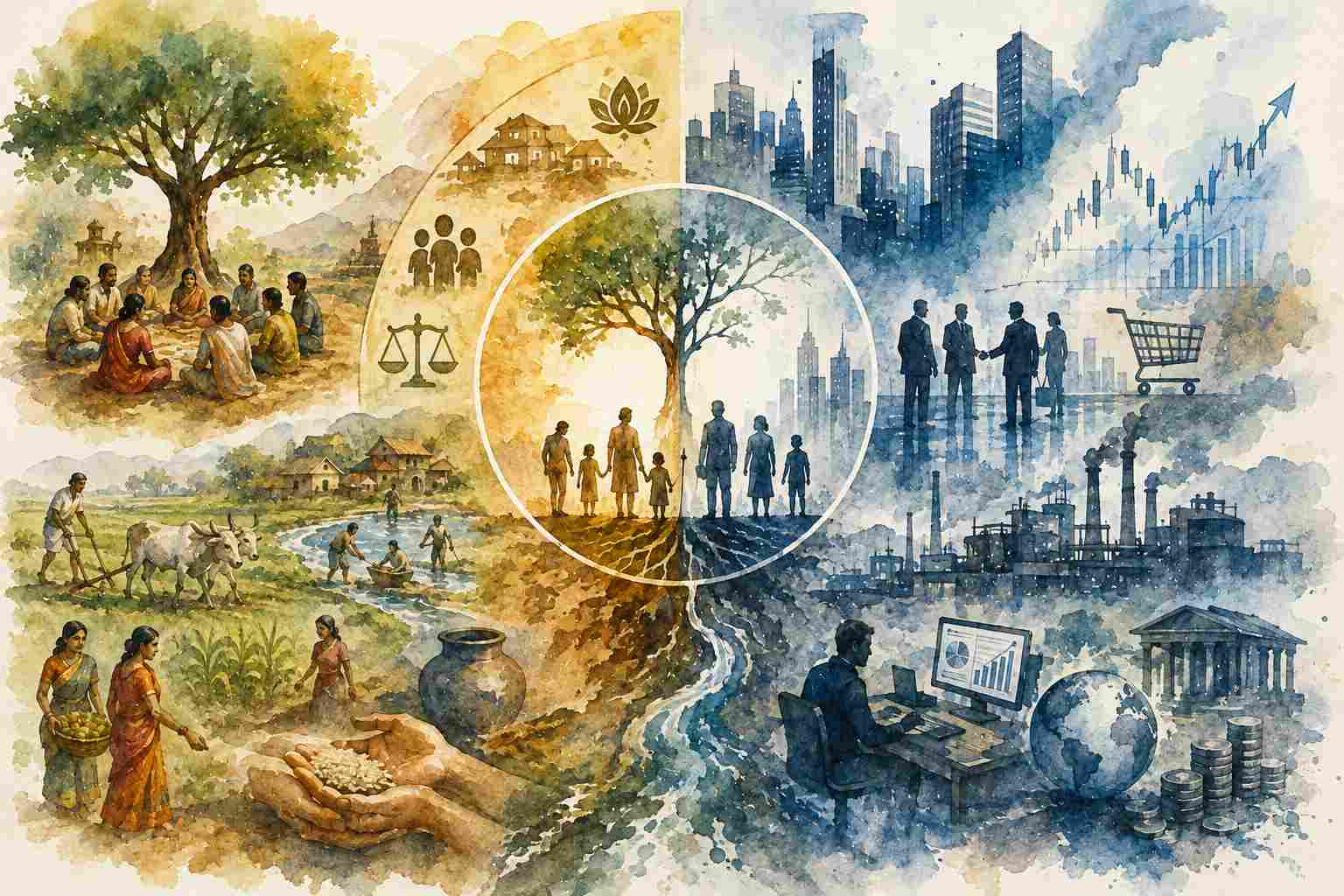
This question becomes especially important when we compare the intellectual traditions from which different economic concepts emerged. The comparison should not be made crudely as “East versus West”, because neither “the West” nor “the East” is intellectually uniform. Yet there is a genuine difference in emphasis between the modern European political economy that eventually produced economics as a specialised discipline and the older Indic conception in which economic activity was embedded within a wider order of society, polity, ethics, livelihood and nature. The issue is not to decide which civilisation was “right”. The issue is to ask what each intellectual tradition made visible—and what it made easier to overlook.
Two Starting Points
| Modern Western Economics | Indic Economic Drishti |
|---|---|
| Scarcity and choice | Artha within a larger order of life |
| Individual economic actor | Individual embedded in family, community and society |
| Market and exchange | Varta: agriculture, cattle-rearing and trade |
| Production and consumption | Production, livelihood, exchange and social reproduction |
| Price as a major coordinating mechanism | Price, custom, institution, community and state |
| Firm and market | Shreni, guilds, household, village and state |
| Capital and labour | Land, labour, knowledge, skills, institutions and natural resources |
| Utility and preference | Purushartha and the purposes of human life |
| Economic growth | Artha + Yogakshema + Lokakalyana |
| Nature often treated as a resource/input | Nature as a productive foundation requiring protection |
| Economy often analytically separated from society | Economy understood as embedded within social order |
| National accounts measure economic activity | Need to examine the whole social life of wealth |
The difference is not that one side had “economics” and the other did not. It is that the question called economics was framed differently.
Adam Smith famously begins The Wealth of Nations by stating that the annual labour of a nation supplies the necessities and conveniences of life, and he connects the abundance available to society with the skill, dexterity and judgement with which labour is applied. His discussion of the division of labour then demonstrates how specialisation can dramatically increase productive capacity. This is one of the great insights of modern economics: economic cooperation can emerge through specialisation and exchange even when individuals are pursuing their own interests.
But notice the analytical movement. The economic system becomes increasingly intelligible through labour → production → exchange → market → price → wealth.
This was an enormous intellectual achievement. Yet when that sequence becomes the universal starting point, we begin to ask a narrower set of questions: What is produced? At what cost? At what price? Who consumes it? What is the incentive? What is the return?
The Indic question can begin elsewhere.
Kautilya’s Arthashastra places Varta among the fundamental sciences and defines it through agriculture, cattle-breeding and trade. It connects these activities with grain, cattle, gold, forest produce and labour, and then links the economic base to the treasury and the capacity of the state. (Arthashastra 1.4).
That is already a very different picture.
The economy is not first imagined as an abstract market. It is a productive ecology consisting of land, agriculture, animals, forests, labour, commerce, state institutions and revenue.
And that difference matters.
What Is an Economic Actor?
Modern economics frequently begins with the individual making choices. The individual has preferences, faces constraints, calculates costs and benefits, and enters markets.
The Indic framework does not deny individual economic action. But it places the individual inside several overlapping relationships.
A farmer is not only a producer. He is also a member of a household. The household is part of a village. The village depends upon water, land and common infrastructure. The producer participates in exchange. The exchange takes place within institutions and rules. The economic activity generates revenue. Revenue supports political authority. Political authority has responsibilities towards the productive society.
Suddenly, the economy is no longer a chain of isolated transactions. It becomes a network of relationships.
This is visible in the Arthashastra’s extraordinary attention to the organisation of settlements, agricultural land, merchants, artisans, storage, taxation, commerce and production. Book II, for example, discusses agricultural produce, taxation, commerce and barter while also organising occupational and economic activity spatially within settlements.
The question therefore changes from:
“How does the individual maximise?”
to:
“How does a society organise productive life?”
Both are legitimate economic questions. But they are not the same question.
Is the Economy the Market?
This may be the most important conceptual difference.
Modern economics often treats the market as the central mechanism through which resources are allocated. Again, this is not without reason. Markets coordinate enormous amounts of information, allow specialisation, encourage innovation and enable exchange between strangers.
Adam Smith understood the importance of exchange so deeply that he linked the extent of the division of labour to the extent of the market. But the economy contains many things that do not pass through markets. A mother caring for a child creates value, but there is no market transaction. A farmer preserving traditional seed knowledge creates productive capacity, but no invoice is generated. A village maintaining a water system creates future economic value, but no GDP transaction necessarily records it. A teacher transmitting knowledge to the next generation creates human capability, but the social value cannot be reduced to the teacher’s salary. A family caring for an elderly person substitutes for a service that might otherwise have to be purchased. A community’s reputation can make economic exchange possible without appearing as an asset on a balance sheet.
This is precisely why the later work of Karl Polanyi becomes important. His analysis of the industrial transformation questioned the idea of the self-regulating market and examined the relationship between economic systems and social institutions.
In other words, even within Western intellectual history there emerged a critique of the idea that society could simply be understood through the market. The Indic perspective can therefore enter this conversation not as an exotic alternative, but as an older and differently organised way of asking the same difficult question.
The Economy Is Not Outside Society
Perhaps the most useful Indic contribution is the idea that economic activity cannot be completely separated from the moral and social architecture within which it operates.
Kautilya’s Arthashastra does not isolate economics into a department called “the economy”. Agriculture, trade, taxation, labour, forests, mines, infrastructure, law, security and administration are deeply interconnected.
This is why Artha is such a powerful category.
Artha means wealth, material prosperity, resources, capability and the means necessary for worldly life. But it is also one of the four Purusharthas. It therefore cannot simply become an unlimited command to accumulate. Economic life exists within a larger conception of human purpose.
This produces a fascinating contrast.
Modern reduction
Economy → Wealth → Income → Consumption
Indic expansion
Dharma → Artha → Kama → Moksha
The second does not deny material prosperity. It refuses to make material prosperity the entire meaning of human prosperity.
This is an important distinction for economics. If we assume that every increase in consumption represents progress, then more consumption is automatically good. If we instead ask whether consumption contributes to a meaningful and sustainable human life, the economic question becomes considerably more complex.
What About the State?
There is another major difference.
In much modern economic thinking, the state is frequently analysed as an external actor that intervenes in an otherwise functioning economic system: taxation, regulation, public goods, redistribution, monetary policy and welfare.
The Arthashastra presents a more integrated picture. Economic production is a foundation of state capacity, while state authority is responsible for protecting and developing productive activity.
Kautilya’s famous formulation makes the relationship explicit:
“In the happiness of his subjects lies the king’s happiness; in their welfare his welfare.” (Arthashastra 1.19).
This does not mean that the Arthashastra presents a modern welfare state. It does not. Its political economy is concerned deeply with revenue, discipline, security and state power. But it does demonstrate that economic prosperity and public authority were not treated as completely separate domains.
The state needs a productive society. Society needs an ordered political environment. The economy therefore exists inside a relationship between production, society and governance.
The Economy as an Ecosystem
This leads us to a much larger conception of economic life.
Modern statistical visibility
GDP → income → employment → consumption → investment → trade → inflation
These remain essential. But an Indic economic inquiry can place around them:
Land → Water → Food → Family → Knowledge → Community → Occupation → Institution → Trust → Ecology → Future Generations
Now the question becomes fascinating. Which of these are captured by GDP? Some are. Many are only partially captured. Some remain almost invisible. And yet without them, the visible economy may not function.
This is why saying that “GDP is incomplete” is not enough. The deeper problem is conceptual: what we decide to count depends upon what we first decide constitutes economic life.
East and West: Not Two Answers, but Two Windows
The purpose of a comparative civilizational approach should therefore not be to declare that “the East understood economics and the West did not”. That would simply replace one intellectual provincialism with another.
- Smith gives us an extraordinary understanding of productivity, specialisation and exchange.
- Marx forces us to confront ownership, labour and distribution.
- Keynes transforms our understanding of employment and macroeconomic instability.
- Polanyi reminds us that markets are embedded within social institutions.
- Sen expands economic development towards human capabilities.
These thinkers should remain in the curriculum.
But Kautilya should not have to enter the classroom merely as an historical curiosity. He should enter because he asks economics to see something else. His Varta brings agriculture, cattle-breeding and trade together. His economic administration connects production with state capacity. His treatment of land, forests, mines, markets and infrastructure demonstrates an economic system embedded in material geography. His attention to guilds and occupational organisation points towards intermediate institutions between individual and state. His treatment of Yogakshema connects acquisition, protection and enhancement. And his understanding of Artha places wealth within a larger conception of human purpose.
The question is therefore not:
“Which economic system is better—East or West?”
The more productive question is:
“What becomes visible when we place these intellectual traditions beside one another?”
Perhaps the Western tradition helps us understand the mechanisms of economic exchange with extraordinary precision. Perhaps the Indic tradition helps us ask more insistently about the social architecture within which those mechanisms operate. We need both questions. Because markets require institutions. Institutions require trust. Trust requires relationships. Relationships require social norms. Production requires ecological foundations. And prosperity requires a society capable of transmitting all of these across generations. So perhaps the economy is not simply where people buy and sell.
It is where a society produces, exchanges, distributes, consumes, saves, teaches, cares, cooperates, competes and reproduces the material conditions of its collective life.
And that brings us back to the question with which we began: Is everything that matters economically necessarily something that can be measured in a market?
The answer is clearly no.
The more difficult question is: If we know that the market captures only a part of economic life, why should the market remain the starting point from which the entire economy is taught?
That is where a decolonised Economic Drishti must begin—not by rejecting economics, but by asking whether we have made the economy smaller than the society it is supposed to serve.
