
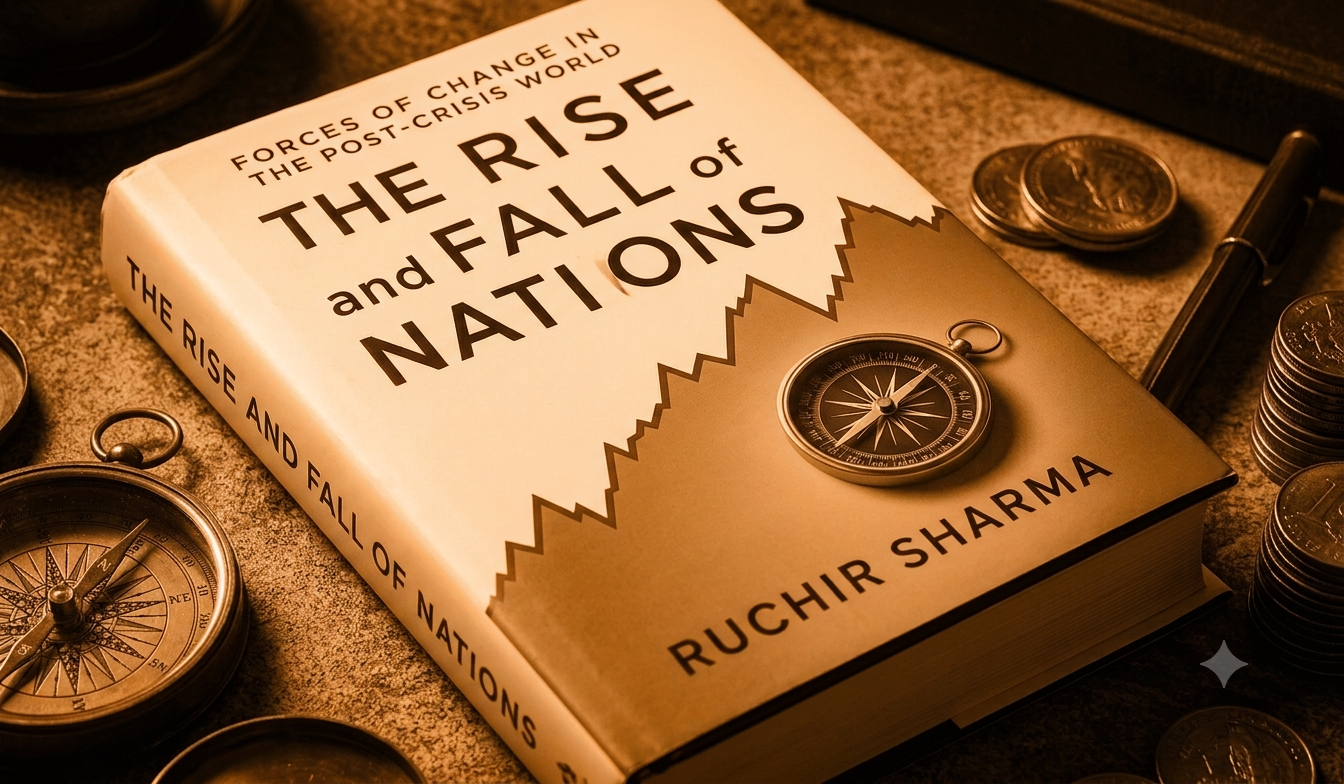
This is a book review of Ruchir Sharma’s ‘The Rise and Fall of Nations’
Economic growth is often explained through grand theories—capitalism versus socialism, democracy versus authoritarianism, or free markets versus state intervention. Ruchir Sharma’s The Rise and Fall of Nations deliberately moves away from such ideological binaries. Drawing upon decades of observing economies across continents, Sharma argues that nations rise and decline not because of immutable historical advantages but because of changing structural conditions. His central premise is straightforward: growth is cyclical, political success breeds complacency, and every economy must constantly renew itself.
The book identifies ten broad rules that help explain why some countries flourish while others stagnate. These rules are not deterministic laws but empirical patterns derived from comparative economic experience. Yet, while Sharma’s framework is persuasive, it remains largely embedded within the assumptions of modern political economy. An Indic civilizational perspective invites us to broaden the conversation. Economic vitality cannot be understood only through GDP, productivity, or demographics; it must also be viewed through the lenses of Dharma, social cohesion, civilizational continuity, and ethical statecraft.
Rule 1: People Matter More Than Population
Sharma argues that rapid population growth is not automatically an advantage. What matters is the proportion of productive workers, their skills, and their ability to generate wealth. Demographic dividends are temporary windows, not permanent guarantees.
Indic thought has never viewed human beings merely as demographic units. Society flourishes when individuals fulfil their Swadharma within an interdependent social order. Population becomes an asset only when education, values, family institutions, and social responsibility transform numbers into capable contributors. Demography without cultural capital ultimately becomes a burden rather than a dividend.
Rule 2: Beware the Burden of Debt
Excessive public and private debt eventually constrains growth. Nations borrowing beyond productive capacity often experience prolonged stagnation and financial crises.
Ancient Indian texts repeatedly caution against unsustainable obligations. Artha is meaningful only when pursued within the limits of Dharma. Wealth generated through productive enterprise strengthens society; wealth sustained through perpetual indebtedness weakens both state and citizen. Fiscal prudence is therefore not merely an economic necessity but an ethical principle of governance.
Rule 3: Inflation Is a Silent Destroyer
Persistent inflation erodes purchasing power, distorts investment decisions, and gradually undermines public confidence in institutions.
The Indic tradition consistently associates just governance with price stability and fair exchange. Kautilya emphasised regulation against hoarding, manipulation, and market distortions because economic justice directly affected political legitimacy. Stable prices preserve social harmony as much as economic efficiency.
Rule 4: Geography Alone Does Not Determine Destiny
Natural resources or strategic location provide opportunities but cannot substitute for good institutions and sound governance.
India’s own history illustrates this clearly. Civilizations emerged not merely because of geography but because communities developed institutions—guilds, temples, village republics, educational centres, and trade networks—that converted geography into civilization. Space acquires meaning only through organized human activity.
Rule 5: Manufacturing Still Matters
Countries that neglect productive manufacturing often struggle to sustain long-term prosperity. Services alone rarely generate broad-based employment.
Traditional Indian society never separated knowledge from production. Artisans, craftsmen, agricultural communities, merchants, and scholars formed interconnected economic ecosystems. Prosperity emerged through decentralised productive communities rather than excessive concentration in finance or consumption.
Rule 6: Political Stability Encourages Growth
Governments capable of maintaining policy continuity generally outperform those trapped in constant political instability.
Indic political thought distinguishes between mere political power and Rajadharma. Stability becomes meaningful only when rulers govern according to justice, restraint, and public welfare. Political continuity without ethical governance merely institutionalizes inefficiency.
Rule 7: Inequality Can Become a Structural Risk
Moderate inequality may accompany development, but excessive concentration of wealth eventually produces social and political instability.
Indic civilization historically recognised differences in occupation and function, yet simultaneously developed strong traditions of charity, redistribution, religious endowments, and community obligations. Wealth carried responsibility. Prosperity was expected to circulate through society rather than remain permanently concentrated.
Rule 8: Reform Must Be Continuous
Successful countries rarely stop reforming after one phase of economic success. Complacency often marks the beginning of decline.
The Indic worldview understands reality as dynamic rather than static. Renewal (Punarutthana) is a recurring civilizational process. Institutions survive by adapting while preserving foundational principles. Reform therefore should not imitate external models but emerge from indigenous strengths responding to changing circumstances.
Rule 9: Leadership Matters
Economic outcomes are shaped not only by institutions but also by political leadership capable of making difficult decisions at critical moments.
The Indian tradition places extraordinary emphasis on the qualities of leadership. From Kautilya to the Mahabharata, the character of the ruler determines the character of governance. Administrative competence, moral discipline, foresight, and the willingness to sacrifice personal gain remain essential attributes of statecraft.
Rule 10: Every Success Contains the Seeds of Decline
Perhaps Sharma’s most important insight is that nations decline when they begin believing their own success stories. Economic miracles are temporary unless continually renewed.
This observation resonates deeply with Indic philosophy. The doctrine of Kala reminds us that all worldly achievements are cyclical. Prosperity generates complacency unless balanced by self-discipline and continuous introspection. Civilizations endure not because they become powerful once, but because they repeatedly regenerate themselves across generations.
Conclusion
The Rise and Fall of Nations is one of insightful books on comparative political economy published in the last decade. Sharma avoids ideological dogmatism and instead offers practical indicators through which policymakers can understand national trajectories. His ten rules are valuable precisely because they emphasise patterns rather than predictions.
Yet, the book also reveals the limits of contemporary economic thinking. Nations are treated primarily as economic entities competing for growth. An Indic perspective reminds us that societies are simultaneously moral, cultural, civilizational, and spiritual communities. GDP, debt, inflation, and productivity undoubtedly matter, but they operate within a larger framework of social trust, family institutions, ethical governance, cultural continuity, and Dharma. Sustainable national rise is therefore not merely an economic phenomenon; it is ultimately a civilizational achievement.
Read together, Sharma’s empirical framework and the Indic civilizational lens complement one another. The former explains how economies grow; the latter asks why societies should grow, for whom they should grow, and what kind of civilization that growth ultimately sustains.
