
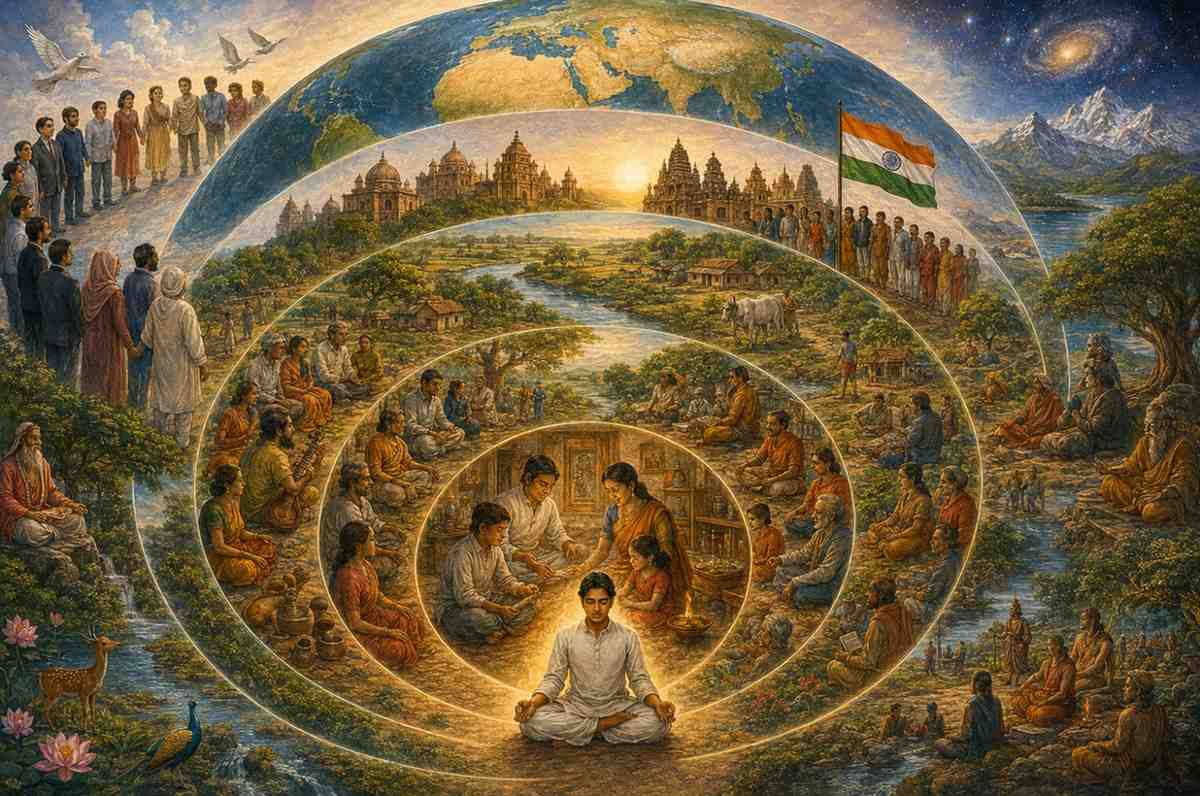
Modern political thought commonly begins with one of two assumptions. The first treats the individual as the primary unit of society; the second gives primacy to the collective, often represented by the State. The Sanātana model offers a different point of departure: society is constituted through relationships, and the individual and political order must both be understood within a wider ecology of belonging, responsibility, and mutual obligation.
This is not an argument against individual liberty, constitutional rights, or effective government. Rather, it argues that neither autonomous individuals nor state institutions alone can create the trust, care, moral formation, memory, and cooperation on which social life depends.
The false binary
Individualism often imagines society as an association formed by self-directing individuals in pursuit of rights, interests, and freedom. Statist or collectivist approaches, by contrast, can treat the social whole as primary and understand persons chiefly as members or instruments of that whole. Both perspectives identify something real, but each becomes inadequate when it treats one pole as the complete foundation of social existence.
No human being enters the world as an isolated individual. One is born into a family, learns language through others, receives care from elders, gains knowledge through teachers, encounters discipline and affection within relationships, and gradually becomes capable of participating in public life. Before one is a citizen, voter, worker, or consumer, one is already a child, sibling, student, neighbour, and member of a cultural community.
The primary social question, therefore, is not only, “What does the individual desire?” Nor is it merely, “What must the State regulate?” A more fundamental question is: What relationships enable persons and communities to flourish, and what responsibilities arise from those relationships?
A relational continuum
The Sanātana model may be expressed through the following continuum: Vyakti→Kuṭumba→Samaja→Janapada→Rashtra→Jagat
This should not be read as a ladder of domination, with one level simply controlling the next. It is better understood as a set of concentric and connected spheres. Every sphere has its own dignity and function, yet none exists in complete isolation.
| Sphere | Meaning | Social significance today |
|---|---|---|
| Vyakti | The person or individual | Moral agency, self-development, dignity, freedom, and responsibility |
| Kuṭumba | Family or household | Care, emotional security, intergenerational learning, and economic cooperation |
| Samāja | Society, community, associations | Trust, civic participation, occupational cooperation, and cultural continuity |
| Janapada | People rooted in a territory | Locality, ecology, regional culture, resources, and civic belonging |
| Rāṣṭra | Civilizational polity or nation | Public order, security, justice, shared memory, and constitutional institutions |
| Jagat | The wider world | Universal responsibility, ecological consciousness, and concern for humanity |
The individual, or vyakti, is not merely a rights-bearing atom. Indian intellectual traditions situate the person within the framework of puruṣārtha—dharma, artha, kāma, and mokṣa—and within life stages articulated through āśrama. These concepts do not erase individuality; they place individual aspiration within a moral and social horizon.
The next sphere is kuṭumba, the household or family. It is through the household that people ordinarily encounter care, dependency, mutual support, discipline, inheritance, memory, and the first forms of responsibility. Indian social thought has often treated family life as a significant moral and social institution rather than as a merely private domain outside public concern.
Beyond the family lies samāja: the world of neighbourhoods, voluntary associations, schools, guilds, religious institutions, professional communities, and cultural networks. This is where persons learn to cooperate with those who are not kin, negotiate disagreement, develop civic habits, and participate in shared institutions.
Janapada gives social life a territorial and ecological dimension. The term links jana—people—with pada—a settled footing or place. It reminds us that societies are not only formed through abstract legal institutions; they are also shaped by land, water, livelihood, local memory, language, ecology, and customary practices.
Rāṣṭra is the wider political-civilizational order. It includes the modern State but cannot be reduced to a bureaucracy, electoral cycle, or administrative machine. A rāṣṭra also carries collective memory, shared moral imagination, inherited symbols, and a sense of belonging across regional and social differences.
Finally, jagat prevents rāṣṭra from becoming a closed or hostile political container. The social imagination is widened beyond national interest toward humanity, the natural world, and the larger cosmic order.
The State within society
A central proposition of this model is that the State is not the creator of society. It is one of society’s necessary institutional expressions. Law, public security, welfare, courts, infrastructure, and administration are indispensable, but they cannot by themselves produce social trust, familial affection, civic virtue, cultural confidence, or neighbourly care.
Classical Indian political thought often does not draw a sharp modern distinction between State and society. Discussions of dharma, rājadharma, daṇḍanīti, household duties, and social order overlap, because political authority is expected to protect and sustain a wider moral and social order rather than simply exercise power.
This does not imply that the State should control every social institution in the name of dharma. On the contrary, the relational model requires limits. The State should protect persons from violence, exclusion, exploitation, and domination; it should secure justice and uphold constitutional rights. Yet it should not imagine that it can replace the family, community, school, civil society, and local institutions through administrative expansion alone.
The Śānti Parva’s discussion of rājadharma places heavy emphasis on the duties of rulers, public welfare, justice, and the maintenance of order. Political authority is legitimate not merely because it commands, but because it protects the people and sustains the conditions in which social life can endure.
Neither atomism nor collectivism
The Sanātana model differs from individualism because it rejects the image of the person as fundamentally self-created and socially prior. It differs from collectivism because it refuses to dissolve the person into family, community, caste, nation, or State.
Its central principle is mutual constitution: persons form communities, but communities also form persons. Families nurture individuals, but individuals must not be imprisoned by unjust family structures. Communities provide solidarity, but communities must not legitimise exclusion or hierarchy. The State protects the social order, but it must not absorb the whole of society.
This framework therefore requires a normative balance:
- The family should provide care without suppressing the dignity and agency of its members.
- The community should sustain solidarity without enforcing conformity or discrimination.
- The State should uphold justice without becoming socially totalising.
- The nation should cultivate belonging without producing hostility toward other peoples.
- The pursuit of personal success should remain connected to responsibility for the wider social world.
In contemporary terms, a relational society must be compatible with equality before law, dignity of women, freedom of conscience, caste justice, democratic participation, and protection of vulnerable groups. Tradition cannot be defended merely because it is old; it must be evaluated by whether it sustains human flourishing and dharmic responsibility.
Lokasaṅgraha and public responsibility
The Bhagavad Gītā offers a powerful ethical resource for this framework through the idea of lokasaṅgraha. In the Gītā’s discussion of action, Krishna connects personal conduct with the welfare and “holding together” of the world. Exemplary persons matter because their conduct influences the norms followed by others; action is therefore never merely private in its consequences.
Lokasaṅgraha does not demand that every person abandon private aspiration. Rather, it asks whether one’s work, wealth, knowledge, authority, and conduct contribute to or weaken the larger fabric of life.
For a teacher, lokasaṅgraha may mean treating education as character formation as well as examination preparation. For a businessperson, it may mean fair wages, ethical supply chains, and responsibility toward workers. For a citizen, it may mean resisting misinformation, participating in local institutions, and refusing to treat public space as somebody else’s responsibility. For an academic, it may mean making knowledge socially intelligible rather than confining it to professional circles.
The Gītā’s principle becomes especially important in an age where highly visible individuals—politicians, influencers, teachers, executives, and religious leaders—shape social conduct through example. Personal behaviour in the digital public sphere can either deepen trust and civility or intensify resentment, polarisation, and contempt.
Relevance for contemporary life
The relational model acquires renewed importance under conditions of urbanisation, migration, digitisation, work pressure, and weakening neighbourhood ties. Research on mental health in India has noted that changing family structures, urban lifestyles, migration, role changes, and reduced access to intergenerational support can increase stress and emotional vulnerability.
The response, however, should not be nostalgic idealisation of the joint family or rejection of urban and digital life. Nuclear families, mobility, women’s education and employment, individual choice, and new forms of association have expanded opportunities for many people. The task is to redesign social relationships so that modern freedom does not become isolation.
A contemporary Sanātana social imagination may take practical forms:
- Within families: Shared caregiving, respect for women’s autonomy, deliberate intergenerational contact, and attention to the emotional well-being of children and elders.
- Within neighbourhoods: Resident associations, libraries, local cultural programmes, mutual-aid networks, and spaces where neighbours can meet beyond emergencies.
- Within education: Pedagogy that joins employability with ethical reasoning, civic responsibility, ecological awareness, and cultural literacy.
- Within workplaces: Humane schedules, mental-health support, non-exploitative labour practices, and institutional cultures that recognise workers as persons rather than only as productive units.
- Within digital life: Responsible speech, restraint in forwarding misinformation, protection of privacy, and the use of technology to strengthen rather than replace real social ties.
- Within public policy: Decentralised institutions, effective local government, environmental stewardship, accessible health care, and public services that enable families and communities to support vulnerable persons.
The point is not to restore every older social form. Social forms must change. Villages become towns, joint households become nuclear households, occupations change, and communication technologies transform the experience of proximity. What must remain is the deeper principle that freedom and welfare are sustained through relationships of responsibility.
Janapada in an ecological age
The idea of janapada also has contemporary relevance in an era of ecological stress. Modern life often treats land as a commodity, water as an extractable resource, and locality as little more than real estate. Yet a community’s long-term existence depends on its relationship with soil, rivers, forests, food systems, public spaces, and local livelihoods.
Janapada encourages a place-based political ethic. It asks whether development strengthens the life-world of a region or merely extracts value from it. It asks whether urban planning produces liveable neighbourhoods, whether local water systems are protected, and whether economic development remains connected to ecological responsibility.
This approach does not oppose development. It insists that development be judged not only by aggregate income or infrastructure, but also by whether it preserves the conditions of social, cultural, and ecological continuity.
Rāṣṭra and Jagat
The concepts of rāṣṭra and jagat together provide a way to avoid two opposite errors: rootless universalism and aggressive nationalism. Rāṣṭra gives people a legitimate framework of political belonging, shared responsibility, historical memory, and public institutions. Jagat reminds them that no nation exists only for itself.
A healthy national consciousness should therefore strengthen constitutional responsibility at home while cultivating concern for humanity beyond borders. It should encourage cultural confidence without civilizational arrogance, and national cohesion without hostility toward minorities or other nations.
This wider orientation is consistent with the ethical thrust of lokasaṅgraha: action must be evaluated in relation to the larger world it helps sustain. Contemporary concerns such as climate change, pandemics, conflict, displacement, and technological disruption cannot be addressed through narrowly individual or purely national frameworks alone.
A living principle
The term Sanātana should not be understood as a claim that every historical institution associated with Indian civilisation is timeless, perfect, or beyond criticism. Such a claim would confuse continuity with immobility.
Sanātana, in this context, means continuity through adaptation. The enduring element is not a fixed social arrangement but a relational principle: human flourishing requires a moral order in which persons, families, communities, localities, political institutions, and the wider world remain connected through responsibility.
The central question of this model is therefore neither, “What do I get?” nor, “What must the State control?” It is:
“To whom am I related, and what do those relationships require of me?”
That question does not diminish freedom. It gives freedom a social purpose. It does not diminish the State. It places the State within the larger task of sustaining a just and flourishing society.
The Sanātana model begins neither with the isolated individual nor with the sovereign State. It begins with the relational reality of human life: Vyakti→Kutumba→Samaja→Janapada→Rashtra→Jagat
It is not a hierarchy of domination, but a continuum of belonging, responsibility, reciprocity, and shared flourishing.
