
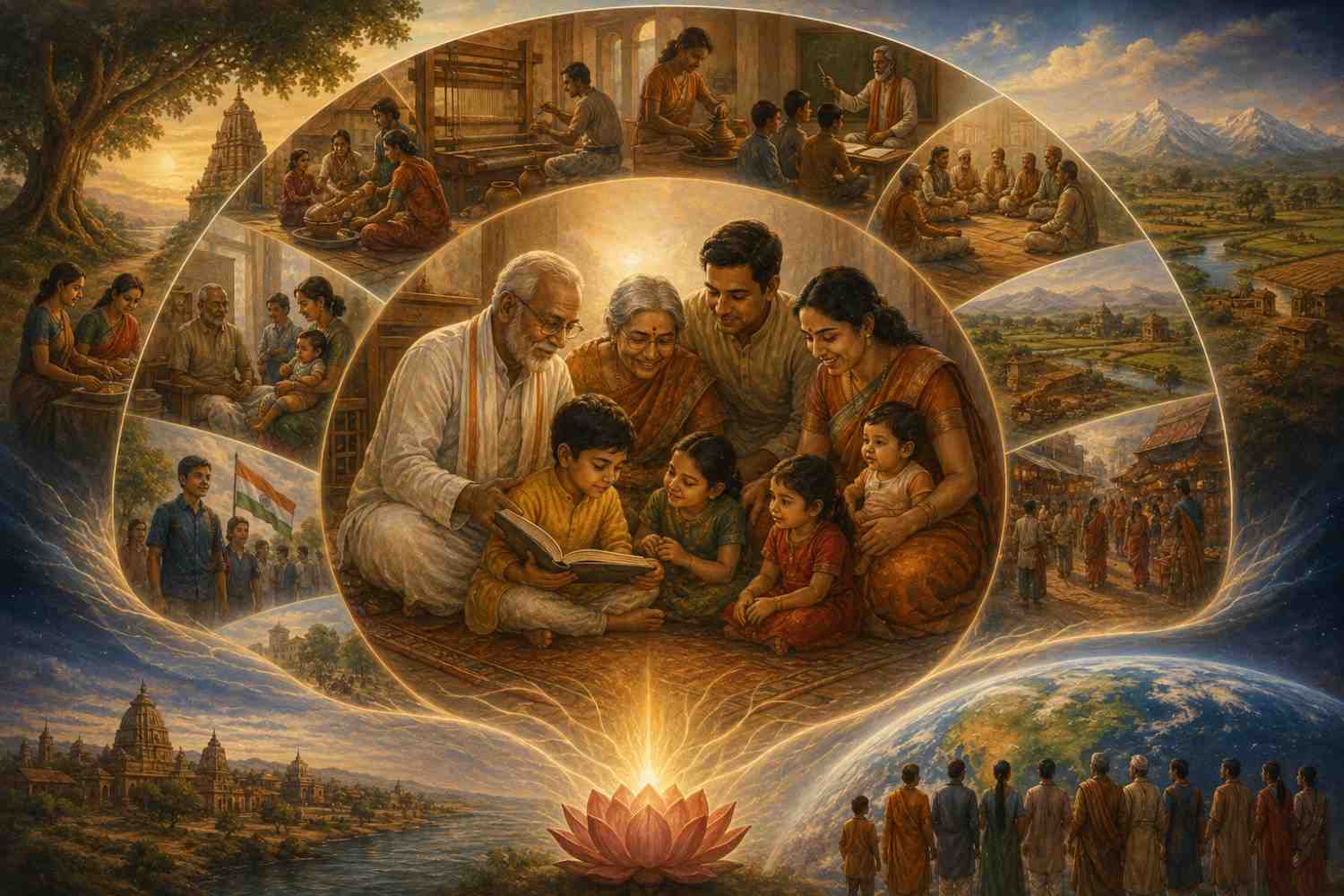
Re-centering the Kutumba in Social Theory
Why do we so often speak about the family as a “private” institution?
The question appears innocent, but it reveals something important about the assumptions built into modern social theory. The individual is frequently treated as the primary unit of society, while the family is located somewhere between the private household and the wider public world. Sociology, of course, has never ignored the family; family sociology is a substantial field in its own right. Yet the dominant conceptual tendency has often been to examine the family as one institution among many—alongside the economy, state, education and religion—rather than asking a more fundamental question:
What if the family is one of the institutions through which all these other institutions are reproduced?
This is the starting point for re-centering the Kutumba.
The argument here is not about “family values” in the conventional moralistic sense. It is about institutional function. The kutumba is not merely a private arrangement between individuals. It is a social institution that performs functions of education, welfare, economic cooperation, cultural transmission, demographic continuity and political socialization. It is, in a deeper sense, one of the primary mechanisms through which a civilization reproduces itself across generations.
Modern sociology itself provides grounds for taking this argument seriously. Scholars have long treated family as a major site of socialization and reproduction, while research in political science demonstrates that political orientations and civic dispositions are often transmitted across generations within families. Jennings, Stoker and Bowers, for example, found persistent evidence of parental influence on the political orientations of children, while also showing that later political experience can modify that inheritance.
The question, therefore, is not whether family matters.
It is what kind of institution we understand the family to be.
The Kutumba as the First School
Before a child encounters the school, university or state, the child encounters the family.
Language is first learned there. Behaviour is first observed there. Concepts of right and wrong, sharing and possession, respect and authority, care and responsibility are encountered through everyday interaction. Stories, food practices, festivals, rituals, memories and habits are transmitted not primarily through textbooks but through repetition and participation.
The family is therefore not merely a unit of biological reproduction. It is a pedagogical institution.
The child does not simply receive information from parents and elders. The child learns how to inhabit a social world.
This is particularly important in the Indic context because knowledge transmission has historically not been confined to formal educational institutions. The household could function as a site where language, occupation, ritual practice, craft, food traditions, stories and ethical dispositions were reproduced across generations. A.M. Shah’s classic study of the Indian family, for instance, specifically examined the household dimension of family life through fieldwork in Gujarat, reminding us that “family” and “household” cannot simply be treated as interchangeable abstractions.
The Family as an Economic Institution
The kutumba is also an economic institution.
Production, consumption, inheritance, care work, intergenerational transfers and the distribution of resources have historically been organized substantially through families and households. In many societies, family members constitute units of labour, enterprise and economic security.
This is particularly significant when considering societies in which formal welfare institutions developed relatively recently. Before pensions, insurance systems and extensive public welfare programmes, the family often carried responsibilities for children, the elderly, illness, unemployment and economic shocks.
This does not mean that the family was always harmonious or economically equitable. Families can reproduce inequality as well as solidarity. The point is analytical: economic life does not begin at the market.
It begins much earlier—in households where resources are produced, shared, saved, inherited and invested in the next generation.
The Family as Welfare Institution
The same principle applies to welfare.
Who cares for the child?
Who supports the elderly?
Who assists a family member during illness?
Who provides temporary support after economic failure?
Modern welfare states have increasingly institutionalized many of these functions. But the existence of public welfare does not make family welfare irrelevant.
Indeed, the family often remains the first layer of social security.
This suggests a useful distinction between formal welfare and relational welfare. The state provides rights and services through institutions; the family provides care through relationships. The two need not be competitors. A healthy society may require both.
The danger comes when social theory assumes that everything the family does can eventually be transferred to formal institutions without changing the nature of social life itself.
Care is not merely a service. Care is a relationship.
The Family as Cultural Archive
Perhaps the most civilizational function of the kutumba is its role as a cultural archive.
Archives normally make us think of manuscripts, libraries and museums. But civilization is preserved in many things that never enter an archive: the story a grandmother tells, the recipe a mother teaches, the festival a family continues to celebrate, the song learned from an elder, the craft taught to a child, the memory of migration, the pronunciation of a particular word, the family deity, the local custom.
These are forms of living memory.
The Bhagavad Gītā makes an unusually striking observation in its discussion of kula-dharma. In Chapter 1, Arjuna argues that the destruction of a family results in the destruction of its inherited traditions and duties. The verse therefore connects the continuity of the family with the continuity of practices transmitted across generations.
Whatever one’s interpretation of the Gītā’s larger argument, the sociological insight is remarkable: when the institution that transmits memory weakens, the memory itself can weaken. Civilizational continuity is therefore partly a problem of intergenerational transmission.
The Family as a Demographic Institution
The family is also where demographic change becomes social reality.
Birth rates, marriage patterns, fertility decisions, migration, household formation and intergenerational replacement are not merely statistical phenomena. They are experienced through families.
Demography tells us how populations change. The family helps explain why they change.
This is why demographic analysis that treats individuals as isolated statistical units can miss the institutional context in which demographic decisions are actually made. Family structures influence decisions about marriage, children, residence, inheritance, education and migration. Research on family systems likewise demonstrates relationships between family organization, economic conditions and broader socioeconomic structures.
The Family as Political Institution
And here the supposedly “private” family becomes unexpectedly political.
Political socialization does not begin when a young person first enters a polling booth. It begins much earlier—with ideas about authority, fairness, leadership, obligation, cooperation and conflict.
Research across generations has repeatedly demonstrated that families influence political orientations. Jennings, Stoker and Bowers found that parental political characteristics and family politicization significantly shape later political development, even though children remain active participants who can modify or reject inherited orientations.
The family therefore does not merely produce citizens biologically. It helps produce citizens socially and politically.
A child’s first understanding of authority may come from the household. The first experience of collective decision-making may occur within the family. The first argument about fairness may involve a sibling. The first experience of responsibility may involve caring for another person. Politics, in this sense, does not begin with the State. It begins with socialization.
From Family Reproduction to Civilizational Reproduction
This brings us to the central argument.
A civilization reproduces itself not simply through monuments, scriptures or political institutions, but through ordinary institutions capable of transmitting meaning from one generation to another.
The kutumba is one of those institutions.
It connects the biological generation of human beings with the cultural generation of persons. It transforms children into members of a social world. It transmits knowledge, habits, memories and responsibilities. It organizes care and economic cooperation. It shapes demographic patterns. It influences political orientations. And, most importantly, it creates continuity between generations.
This does not mean that every inherited practice deserves preservation. A civilizational approach cannot become an excuse for romanticizing the past. Families can also reproduce prejudice, exclusion, hierarchy and violence. Precisely because the family possesses such enormous formative power, it must remain open to ethical criticism and institutional reform.
But criticism should not require conceptual erasure.
The question should not be: “How do we liberate the individual from the family?”
Nor should it be: “How do we preserve every family tradition?”
The better question is: “What kinds of family relationships enable individuals, communities and civilizations to flourish?”
This takes us back to the Sanātana social continuum: Vyakti → Kutumba → Samāja → Janapada → Rāṣṭra → Jagat.
If the individual is the centre of experience, the kutumba is one of the first structures through which that individual becomes socially embedded. The family connects the person to society; society connects the family to institutions; and civilization survives when these connections remain capable of transmitting knowledge and responsibility.
The kutumba, therefore, should not be understood merely as a private household standing outside public life. It is a civilizational institution and perhaps that is the conceptual shift social theory needs: to stop asking only what the family does for its members and begin asking what the family does for society across generations. Because civilization does not reproduce itself only in universities, parliaments, courts and museums. It reproduces itself every day, in households, between generations, through relationships. And that is why the family is not merely where society lives. It is one of the places where society learns how to become itself.
