
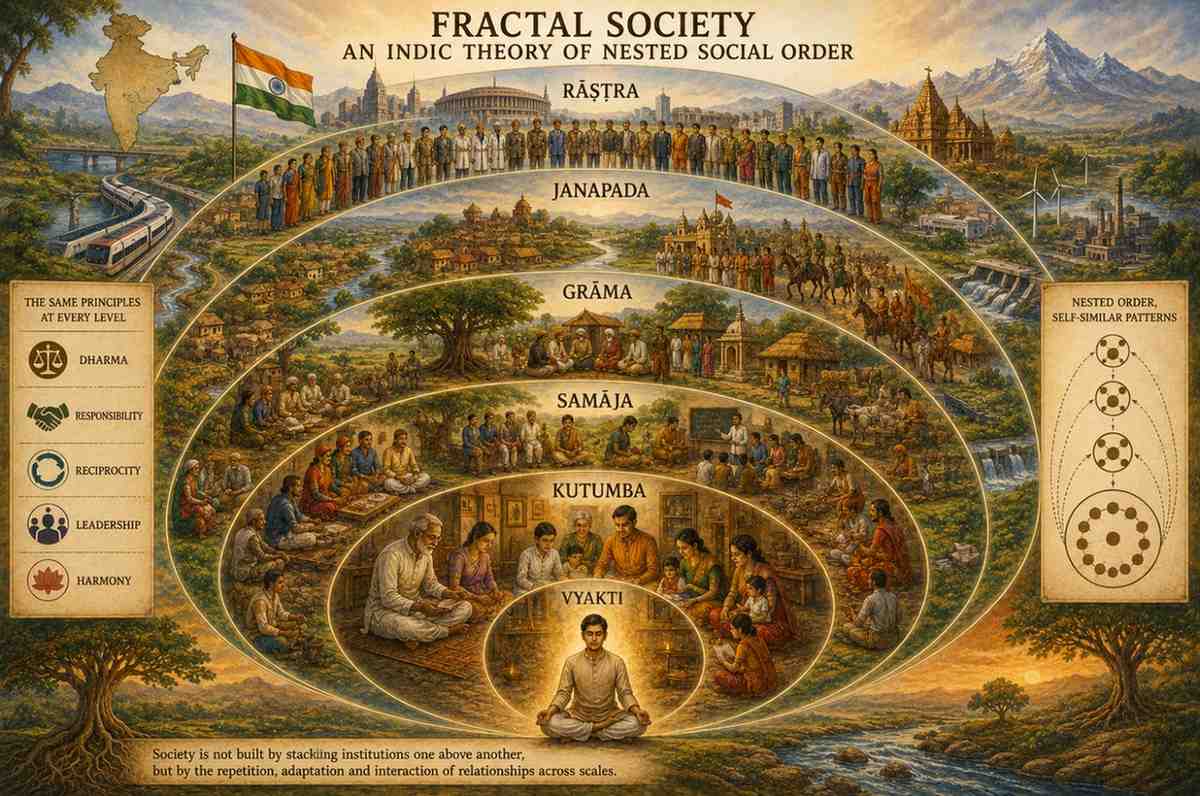
Why do the same social patterns repeat across different scales?
What if society is not simply a collection of separate institutions, but a series of nested relationships in which patterns of social order are reproduced at different scales?
This is the starting point of the idea of a Fractal Society.
The term fractal comes from mathematics and complexity science, where certain patterns display self-similarity across different scales. A small portion of a structure may resemble the larger structure of which it is a part. Social life is obviously not a mathematical fractal in the strict sense. The value of the analogy lies elsewhere: it allows us to ask whether certain principles of social organization recur as we move from the individual to larger social formations.
Consider the sequence: Vyakti ↔ Kutumba ↔ Samāja ↔ Grāma ↔ Janapada ↔ Rāṣṭra
At first sight, these appear to be entirely different levels of social organization. The individual is not a family; a family is not a village; a village is not a nation. Yet each contains relationships involving responsibility, leadership, cooperation, reciprocity, conflict and the maintenance of order.
The interesting question is therefore not whether these units are identical.
It is: Do similar principles organize relationships at each level?
From Individual to Civilization
Take responsibility.
An individual has responsibilities toward family. A family has responsibilities toward its members and the wider community. A community has responsibilities toward the locality in which it exists. A village has responsibilities concerning shared resources and institutions. A larger political community has responsibilities toward its citizens and future generations.
The scale changes.
The principle does not necessarily disappear.
The same can be said of reciprocity. Within a family, relationships involve giving and receiving. Communities develop mechanisms of mutual assistance. Villages historically depend upon forms of cooperation involving resources, occupations and institutions. At larger scales, political communities establish reciprocal relationships between citizens and institutions.
The structure is therefore not simply: individual → larger group → larger group → State.
It is more appropriately understood as: relationship → relationship → relationship → relationship.
Each larger level incorporates the previous one without completely eliminating it. This is what makes the idea of nested social order particularly useful.
The Indic Insight: Principles Before Structures
The Indic contribution to this discussion lies not in claiming that ancient Indians possessed a theory of “fractals” in the modern mathematical sense. That would be anachronistic. The proposition is more modest and more interesting: Indic social thought frequently understood order through principles that could operate across different domains of life.
Dharma is a particularly important example.
Dharma can regulate the conduct of the individual, but it also becomes relevant to family relationships, social obligations, kingship and wider forms of order. The specific dharma of an individual and the responsibilities of a ruler are obviously not identical. Yet the broader concern with appropriate conduct, responsibility and sustaining order connects them. Similarly, the idea of ṛta points toward an ordered reality in which different elements are not merely independent objects but participate in a larger order.
This suggests an important distinction: The levels are different; the principles can be related.
That is the foundation of the fractal analogy.
| Scale | Primary relationship | Recurring principle |
|---|---|---|
| Vyakti | Self and others | Responsibility |
| Kutumba | Family members | Care and reciprocity |
| Samāja | Communities and associations | Cooperation and norms |
| Grāma | People and locality | Shared responsibility |
| Janapada | Society and territory | Stewardship and order |
| Rāṣṭra | Citizens and civilization | Collective responsibility |
The table should not be understood as a rigid classification. Its purpose is to show how similar questions can reappear at different scales.
Nested Does Not Mean Hierarchical
This is an important qualification.
A nested system is not necessarily a hierarchy of domination.
The family contains individuals, but it should not therefore possess unlimited authority over them. The village contains families, but it does not automatically acquire unlimited authority over every aspect of family life. The State contains villages and communities within its political jurisdiction, but it should not therefore absorb society entirely.
This is where the fractal model becomes politically interesting.
If social order is genuinely nested, then higher levels should not necessarily destroy the autonomy of lower levels.
A healthy system requires coordination between levels rather than the complete absorption of one level into another.
This has an important connection with the Indic experience of distributed institutions. Family, community, guild, temple, village and other local institutions historically performed functions that were not simply extensions of centralized state authority. Their relationship with political power varied enormously across time and region, so one should avoid romanticizing the historical record. Nevertheless, the broader analytical point remains useful: social order can be produced by multiple interacting centres rather than a single sovereign centre.
Why Do Patterns Repeat?
The fractal analogy becomes especially powerful when we ask why similar patterns recur.
At every scale, human beings confront certain basic problems:
How should authority be exercised?
How should resources be shared?
How should conflicts be resolved?
How should responsibilities be distributed?
How should cooperation be maintained?
How should individual interests be reconciled with collective well-being?
These questions appear inside families, communities, institutions, villages and states.
The answers will obviously differ according to scale and context. But the problem-structure repeats.
This is precisely what makes the idea relevant to complexity science. Contemporary systems thinking emphasizes that complex systems often consist of interacting components nested within larger systems, where local interactions can generate larger patterns and where changes at one level can affect other levels.
The Indic insight we are exploring here is therefore not that society literally behaves like a mathematical fractal.
It is that social order may be recursive.
The individual learns patterns of cooperation in the family. The family participates in community life. Community institutions reproduce norms of cooperation. Those norms can influence larger political institutions. At the same time, changes at higher levels can reshape family and individual behaviour.
The relationship is therefore bidirectional.
The whole influences the parts.
The parts reproduce the whole.
The Problem of Fragmented Social Science
This perspective also challenges the way modern disciplines sometimes divide social reality.
- Psychology studies the individual.
- Sociology studies society.
- Political science studies the State.
- Anthropology studies culture and community.
- Economics studies exchange and production.
But the actual human being does not live inside these disciplinary compartments.
The individual carries family relationships into economic life. Communities influence political behaviour. Political decisions reshape households. Economic transformations alter family structures. Cultural norms influence institutions.
The same social reality is therefore operating simultaneously at multiple scales. A fractal approach does not seek to abolish disciplinary boundaries. It asks us to connect them.
Toward an Indic Theory of Nested Social Order
The real significance of this idea lies in what it allows us to ask.
If the same principles of dharma, responsibility, reciprocity, leadership and harmony appear at multiple levels of social organization, then perhaps society should not be understood as a collection of isolated units.
It should be understood as a nested order of relationships. This also changes how we think about social breakdown. A society may appear institutionally stable while its lower-level relationships are weakening. Conversely, strong families and communities may provide resilience when larger institutions experience disruption. The health of one level can therefore influence the resilience of the others.
This gives us a different conception of social stability. Stability is not simply the absence of conflict.
It is the capacity of interconnected levels to absorb change while maintaining meaningful relationships.
The Sanātana Model begins with: Vyakti → Kutumba → Samāja → Janapada → Rāṣṭra → Jagat.
The Fractal Society develops the next question: What if the principles governing these relationships recur across the entire continuum?
Then the individual is not merely a unit. The family is not merely a household. The village is not merely an administrative unit. And the nation is not merely a political container. Each is a nested expression of social order. Perhaps this is the deeper proposition of the Fractal Society: society is not built by stacking isolated institutions one above another. It grows through the repetition, adaptation and interaction of relationships across scales.
The smallest unit and the largest unit are not identical. But they may speak the same social language. And that language is one of relationship, responsibility, reciprocity and order.
