
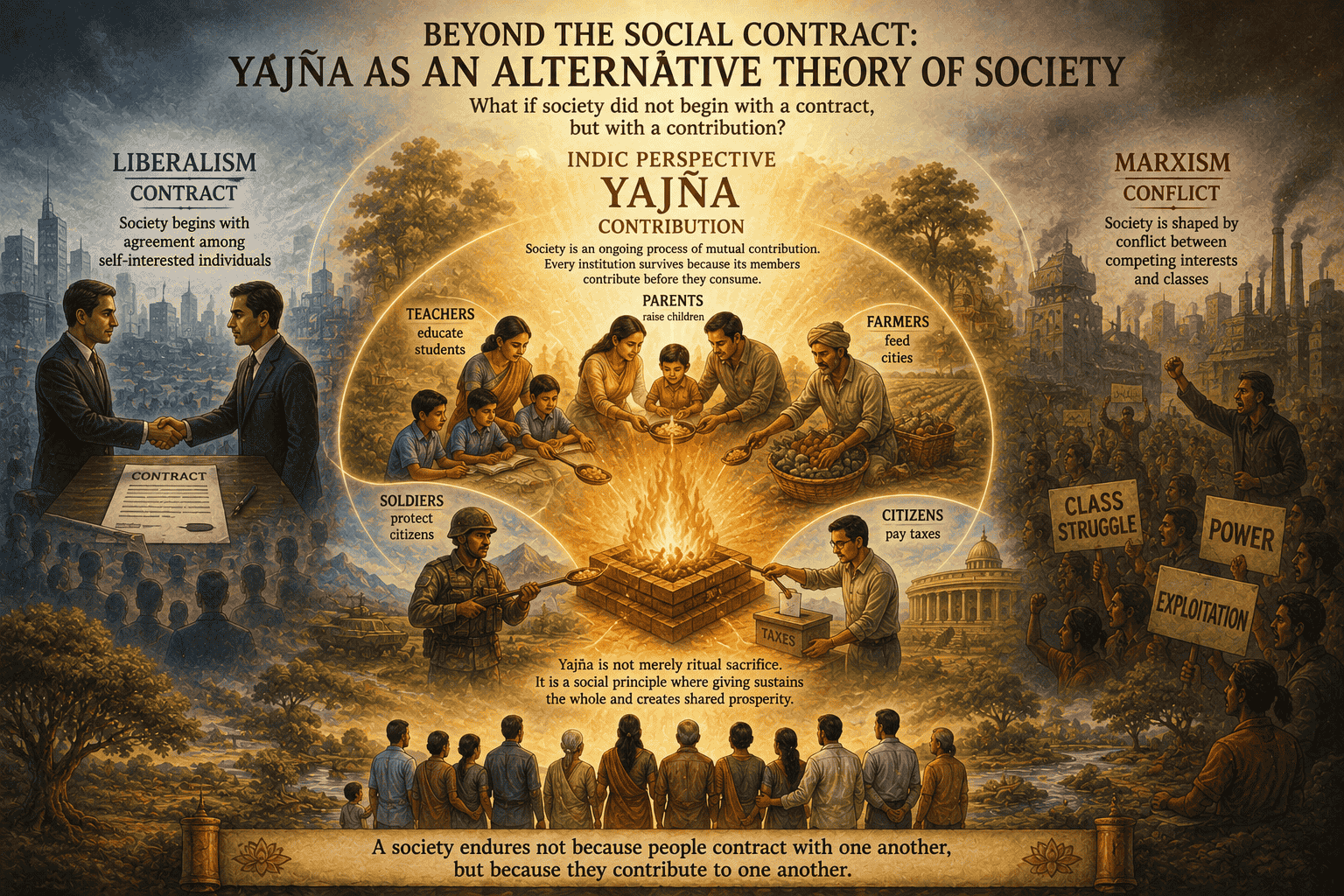
What if society did not begin with a contract, but with a contribution?
Much of modern social theory begins with a problem: why should individuals live together?
One answer is contract. Individuals, assumed to possess their own interests and freedoms, enter into arrangements that make collective life possible. Another answer is conflict. Society is structured by competing interests, and social change emerges through struggles over power and resources. But what if we began with a different question? Not “What do I get from society?”, but “What do I contribute to society?”
This is where the Indic idea of Yajña becomes intellectually interesting. Yajña is often reduced to the image of a ritual fire into which offerings are made. But its deeper conceptual significance can be read as a principle of reciprocal contribution: something is offered into a larger order, and that order sustains life in return. Society, from this perspective, is not merely an agreement between self-interested individuals. It is an ongoing process of giving, receiving and sustaining.
Think about ordinary social life. Parents raise children before those children can contribute anything in return. Teachers transmit knowledge that they themselves inherited from previous generations. Farmers produce food that feeds people they may never meet. Soldiers assume risks so that others may live in security. Citizens contribute taxes and public labour so that institutions can function.
None of these relationships can be adequately understood as simple market exchanges. The parent does not issue a contract to the infant. The teacher does not negotiate every lesson as a transaction. The farmer does not know every person who will eventually consume the food produced.
And yet society works. Why? Because social life depends upon contributions that precede consumption.
This gives us an interesting contrast:
| Social theory | Starting principle |
|---|---|
| Liberalism | Contract |
| Marxism | Conflict |
| Indic Yajña | Contribution |
The distinction is not absolute. Liberal societies obviously contain generosity and duty; Marxist societies also depend upon cooperation. Nor does Yajña eliminate questions of power, inequality or exploitation. Its value lies in offering a different starting lens through which society can be examined.
A society survives when its members do not merely ask what they can extract from it, but recognize what they must sustain for others. The idea becomes even more interesting when extended beyond individuals. Families contribute to communities. Communities sustain institutions. Institutions transmit knowledge. Farmers sustain cities. Citizens sustain the state. The state, in turn, has responsibilities toward society. Each level participates in a larger cycle. This is close to the broader Indic imagination in which action is connected to lokasaṅgraha—the holding together and welfare of the social world. The Bhagavad Gītā connects action with this larger social responsibility, suggesting that meaningful action cannot be evaluated solely by individual gain.
Yajña therefore gives us a provocative way of thinking about social order:
Society is not simply a contract among consumers of collective goods. It is a network of contributors sustaining one another across generations.
And perhaps this changes the question of citizenship itself. A citizen is not merely someone who possesses rights from the State. A citizen is also someone who contributes to the conditions that make those rights meaningful for others. The deeper challenge, then, is not to abandon contract or ignore conflict. It is to recognize something that both can overlook:
Before society can distribute what its members are entitled to receive, someone must first contribute what society needs to survive.
That is the question Yajña brings back into social theory: What if the foundation of society is not what we claim from one another, but what we willingly offer to sustain the whole?
