
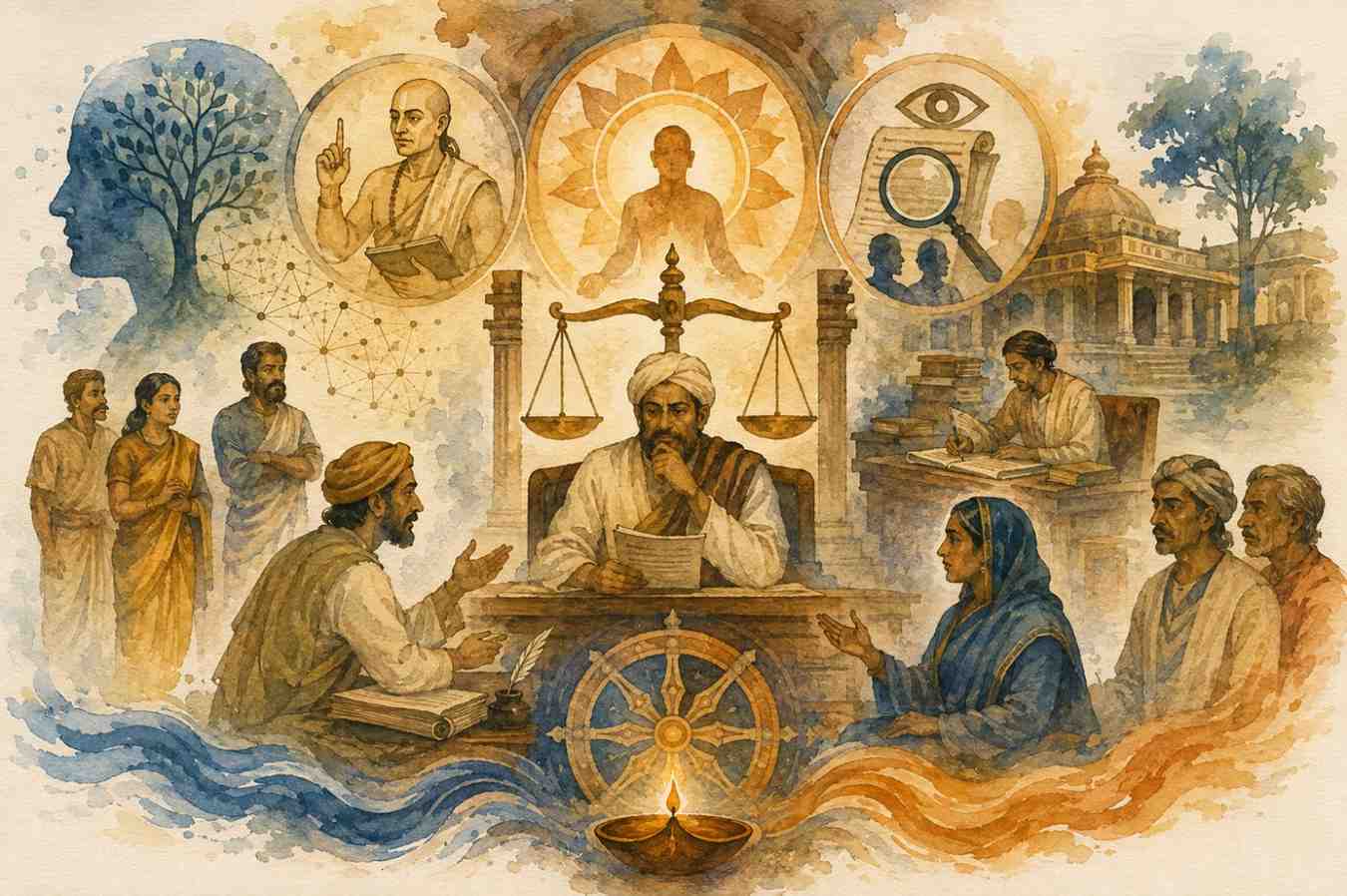
How Should Justice Be Done?
What happens when a legal system is confronted with a dispute? The obvious answer is: apply the law. A rule exists, facts are established, a procedure is followed, and a judgment is delivered. This is the familiar architecture of modern legal reasoning. But is justice really exhausted by the correct application of a rule?
Consider a simple question. Two people may appear before a court with the same legal claim, but their circumstances may not be identical. Evidence may be incomplete. Testimony may conflict. Documents may contradict lived possession. A rule may be clear, but its application may produce an outcome that appears disproportionate or unjust. At that point, the real problem is no longer simply What does the rule say? It becomes: What actually happened? What can we know about it? Which evidence should be trusted? How should competing claims be evaluated? And what constitutes a just decision?
This is where the Indic categories of Nyāya and Vyavahāra provide a useful conceptual entry.
Nyāya and Vyavahāra
The two terms should not be collapsed into a simple translation of “justice” and “law.” Nyāya has a much broader intellectual history. The classical Nyāya tradition is fundamentally concerned with reasoning, valid knowledge and the methods by which correct conclusions can be reached. It developed a sophisticated account of pramāṇa—reliable means of knowledge—and treated reasoning, doubt, inference, testimony, debate and determination as structured intellectual activities.
Vyavahāra, in the legal tradition of the Dharmaśāstras, refers to legal procedure and also to the lawsuit or judicial process itself. The Dharmaśāstra literature contains detailed discussions of courts, judges, witnesses, documents, possession, procedures and verdicts. By the time of Manu and especially Yājñavalkya, legal procedure had developed into a substantial technical field, including recognized titles of law and procedures leading toward adjudication.
The significance of bringing these ideas together is therefore not that ancient Indian jurisprudence somehow possessed a ready-made equivalent of the modern court system. The more interesting point is that justice requires both a conception of what is right and a disciplined method for determining what is true in a particular dispute.
Nyāya: Justice Begins with Knowing
A judgment cannot be better than the knowledge upon which it is based.
This sounds obvious, but it has profound legal implications. Before deciding who is right, the adjudicator must determine what happened. That requires evidence, testimony, inference, comparison, examination of claims and the elimination of error.
The classical Nyāya tradition’s concern with pramāṇa is therefore particularly relevant. Perception, inference, comparison and reliable testimony are treated as distinct means of acquiring knowledge.
This gives us an important sequence:
| Question | Judicial concern |
|---|---|
| What happened? | Establish the facts |
| How do we know? | Examine evidence |
| Can the claim be trusted? | Test testimony and sources |
| What follows from the evidence? | Reason and infer |
| What should be decided? | Reach a determination |
| How should the decision be implemented? | Apply procedure |
The point is not that a modern court should simply reproduce classical Nyāya epistemology. Rather, it is that the epistemic foundations of judgment deserve as much attention as the legal rule itself.
A judge does not merely apply law to facts. The judge must first determine the facts to which the law is to be applied.
And facts do not arrive in court by themselves.
They arrive through witnesses, documents, physical evidence, testimony, inference and competing narratives.
The question of justice therefore begins before the judgment.
Vyavahāra: Justice Must Become Procedure
If Nyāya directs attention toward sound reasoning and valid knowledge, Vyavahāra brings us into the practical world of disputes.
The Dharmaśāstra tradition’s treatment of vyavahāra demonstrates that Indian legal thought was not concerned only with abstract moral principles. It also developed technical discussions of lawsuits, courts, judges, witnesses, documents, possession, verdicts and appeals. Different venues of adjudication existed, with the royal court occupying the highest position in the hierarchy described in these sources.
This distinction is important.
A society cannot resolve disputes merely by proclaiming that justice is desirable. Justice needs institutions.
It needs procedures through which competing claims can be heard. It needs standards through which evidence can be assessed. It needs persons entrusted with adjudication. It needs mechanisms for correcting error. And it needs some relationship between the principles of justice and the procedures through which those principles are translated into decisions.
This can be represented as:
Principle → Evidence → Procedure → Judgment → Resolution
The absence of any one of these can weaken the whole process.
A principle without evidence becomes speculation.
Evidence without procedure can become arbitrary.
Procedure without judgment becomes mechanical.
Judgment without principles becomes discretion without direction.
The interesting contribution of the Nyāya–Vyavahāra relationship is precisely this insistence that truth, reasoning, procedure and justice cannot be completely separated.
The Problem of Mechanical Rule Application
Modern legal systems rightly value consistency. Similar cases should ordinarily be treated similarly. Rules protect citizens from arbitrary decisions and constrain judicial power. But consistency creates its own danger when it becomes mechanical.
Suppose a rule is applied correctly but the factual circumstances have been misunderstood. The decision may be legally consistent and yet substantively unjust. Or suppose the evidence is technically admitted but its reliability has not been properly examined. The procedure may have been followed while the truth remains obscured.
This brings us back to the central distinction:
Applying a rule is not identical to determining justice.
Rules provide structure. They do not eliminate the need for judgment. The classical Nyāya concern with doubt, reasoning, valid cognition, fallacious reasoning and determination is significant here. Nyāya’s intellectual apparatus was concerned not merely with reaching conclusions but with distinguishing reliable cognition from error and defective reasoning.
This is precisely the kind of intellectual discipline that any serious theory of adjudication requires.
Justice as Judgment, Not Mere Application
There is a temptation to think that greater objectivity means removing judgment from law. But law cannot completely eliminate judgment because facts themselves require interpretation, evidence requires evaluation, and rules sometimes require application to circumstances that legislators could not anticipate.
The better objective is therefore not law without judgment, but judgment disciplined by law, evidence and reason.
This is where Nyāya becomes especially valuable as a conceptual resource.
It reminds us that the question of justice cannot be separated from the question of knowledge.
Vyavahāra reminds us that knowledge must operate through institutions and procedures.
Together they suggest a more complete model:
Justice = Principle + Knowledge + Reasoning + Procedure + Judgment
This does not mean that these elements are mathematically interchangeable. Rather, it highlights their interdependence.
| Dimension | Fundamental concern |
|---|---|
| Nyāya | How do we arrive at justified knowledge and sound judgment? |
| Pramāṇa | What are reliable means of knowing? |
| Vyavahāra | How are disputes practically brought before and resolved by institutions? |
| Evidence | What supports a claim? |
| Reasoning | What follows from the evidence? |
| Adjudication | How should competing claims be evaluated? |
| Justice | What constitutes the appropriate and fair resolution? |
There is also a caution here. We should not romanticize the past or assume that every historical practice associated with Dharmaśāstra represents an ideal legal system for the present. Historical legal traditions were embedded in their own social and institutional contexts. The intellectual value of these traditions lies not in treating them as frozen templates, but in identifying conceptual resources that can provoke contemporary questions.
And perhaps that is precisely the value of an Indic legal drishti.
The modern legal imagination has become extraordinarily sophisticated in its development of legislation, procedure, constitutional review and institutional safeguards. Yet the deeper problem of adjudication remains surprisingly old: How do we distinguish truth from error, fairness from arbitrariness, and justice from the mere mechanical application of rules?
Nyāya begins with the discipline of knowing. Vyavahāra takes that discipline into the world of actual disputes.
Together, they invite us to see justice not as the final step of a legal process, but as the outcome of an entire chain of intellectual and institutional activity.
The judge must ask not merely, “What rule applies?”
The judge must also ask:
What happened?
How do we know?
Which evidence deserves confidence?
What reasoning connects the evidence to the conclusion?
What does fairness require in these circumstances?
Only then can the final question be approached:
Is justice achieved simply by applying a rule, or does justice require judgment about circumstances, evidence and fairness?
The Indic categories of Nyāya and Vyavahāra do not provide a simplistic answer. They provide something more valuable: a way of structuring the question itself.
