
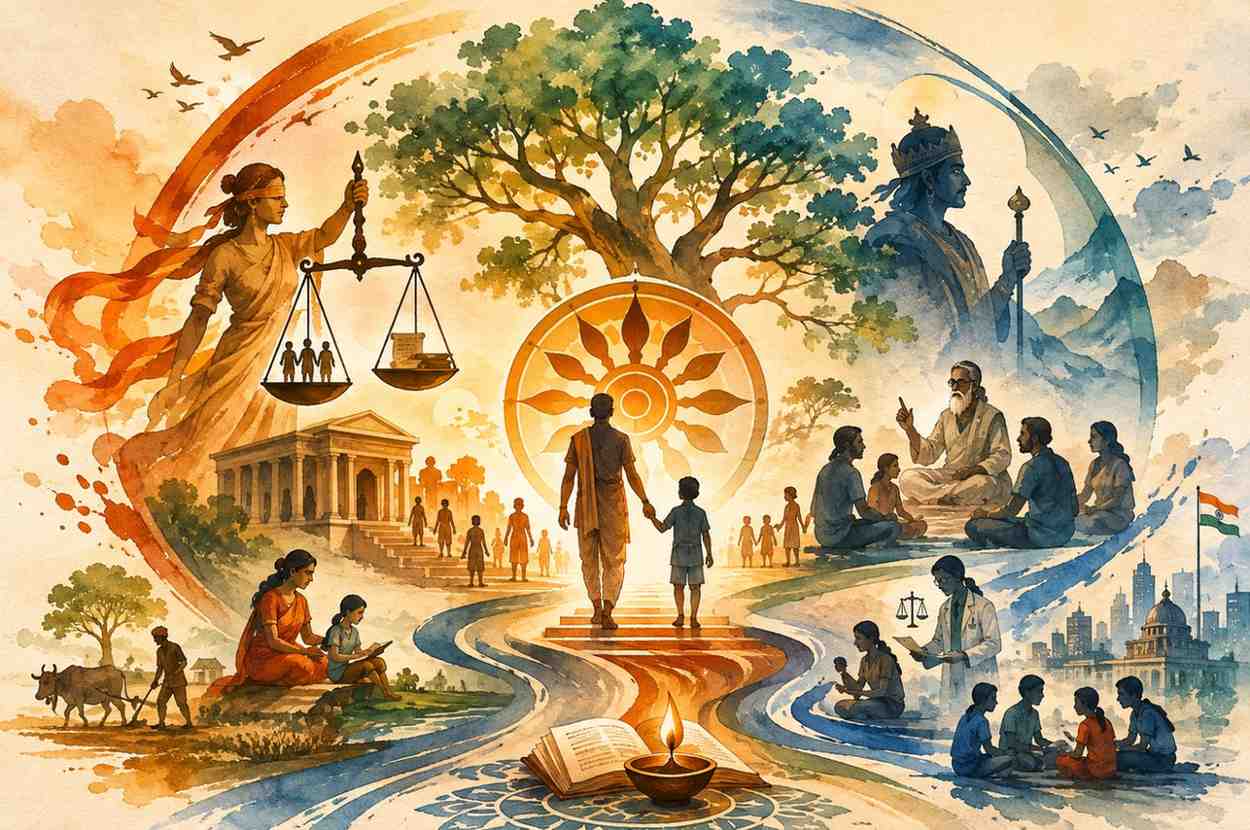
Justice, Duty and Social Order
What makes a law worthy of obedience?
The modern legal imagination usually begins with a fairly straightforward answer: a law is legitimate when it has been properly enacted, publicly promulgated and applied through recognized institutions. The rule of law is itself built around the idea that public authority should operate through established and predictable norms rather than arbitrary will.
But this immediately raises another question. Is social order sustained only because rules exist, or because people recognize reasons to follow them?
This is where Dharma becomes an important—and difficult—concept for legal thought.
To translate Dharma simply as “religion” is inadequate; to translate it simply as “law” is equally inadequate. Scholarly work on Hindu legal traditions has demonstrated that dharma operates across legal, ethical and social domains, particularly in the Dharmaśāstra literature. Donald Davis, for instance, argues that the relationship between dharma and law is central to understanding Hindu legal traditions. The very range of translations—law, duty, order, ethics—indicates the problem: Dharma occupies a conceptual space that modern disciplines tend to divide among several categories.
Perhaps the better starting point is not to ask, “What is the Hindu equivalent of law?” but:
What happens when social order is understood not merely through rules, but through that which sustains right conduct and relationship?
The distinction is crucial.
From Rule to Responsibility
A legal rule generally tells us what may or may not be done. It is externally articulated and, ultimately, enforceable through institutions of authority. Dharma can operate differently. It asks a person to consider what ought to be done in relation to one’s position, circumstances, relationships and responsibilities.
This does not make Dharma an absence of rules. The Dharmaśāstra traditions contain extensive rules concerning conduct, dispute resolution, inheritance, marriage, property, kingship and other areas of social life. Indeed, vyavahāra, or legal procedure, became an important part of this literature.
The distinction, therefore, is not:
- Law = rules
- Dharma = no rules
It is closer to:
| Rule-centred question | Dharmic question |
|---|---|
| What does the rule say? | What is the appropriate conduct? |
| What is legally permitted? | What is right in this context? |
| What is my entitlement? | What is my responsibility? |
| Who has authority? | What limits should authority observe? |
| What happens when a rule is violated? | What sustains social order in the first place? |
This is why Dharma cannot simply be inserted into a modern legal textbook as another word for “law.” It asks us to rethink the purpose and foundation of normativity itself.
Modern jurisprudence has long struggled with a related question. Legal positivism distinguishes the existence of law from its moral merit: a norm can be legally valid without necessarily being morally good. Other traditions of legal philosophy ask whether law’s authority depends upon justice, morality or legitimate political obligation. The debate continues because the problem is fundamental: why should human beings obey law?
The Dharmic question begins from a somewhat different direction. It does not necessarily ask only whether an authority has the power to command. It asks about right conduct within an ordered world of relationships.
The Individual Is Not Alone
This becomes especially significant when we think about the individual.
Modern legal systems necessarily protect individuals as bearers of rights. This is indispensable for preventing arbitrary power. But the individual of legal theory can sometimes appear as an abstract individual—detached from family, community, occupation, social relationships and inherited responsibilities.
The Dharmic imagination begins differently.
A person is situated.
One has responsibilities as a parent, child, teacher, student, ruler, citizen, neighbour or professional. The question is therefore not merely “What can I claim?” but also “What is expected of me?”
This is where kartavya and dharma intersect, without being identical.
A society cannot be sustained by legal enforcement alone. Parents care for children; teachers teach; neighbours assist one another; citizens maintain public spaces; professionals uphold standards; communities preserve institutions. Most of these actions occur not because a police officer is standing nearby, but because people recognize some responsibility toward others.
This is the deeper social significance of Dharma.
The law can compel conduct. Dharma seeks to cultivate conduct.
And that distinction matters enormously.
If every social obligation requires external enforcement, society becomes increasingly dependent upon the state. But if people internalize responsibility, social order can operate through trust, habit, character and shared norms. The legal system remains necessary, but it does not have to carry the entire burden of social life.
Dharma and the Limits of Authority
There is another, perhaps more politically significant, dimension.
If Dharma is understood as merely “the rule imposed by the ruler,” it loses its distinctive meaning. Rājadharma is precisely interesting because it frames kingship itself through duty. Scholarship on rājadharma notes that it concerned the ruler’s obligations as well as governance and statecraft.
The ruler therefore does not stand outside the normative order.
Power has a duty.
This is a very different proposition from saying simply that the ruler makes the law.
The question becomes: What should the ruler do with power? Protection, justice, welfare, adjudication and maintenance of order become part of the ruler’s responsibility. The authority of the state is therefore connected to an obligation toward society.
Interestingly, historical scholarship has also shown that ancient Indian traditions of statecraft (nīti) and Dharmaśāstra were not simply one undifferentiated system. Mark McClish’s work demonstrates that traditions of statecraft developed alongside Dharmaśāstra and were subsequently incorporated into it through concepts such as rājadharma.
This is precisely why we should resist romantic simplifications.
Dharma was not a ready-made constitutional code waiting to be rediscovered. It was a complex and historically evolving normative tradition. Its value for contemporary thought lies not in copying ancient rules, but in recovering questions and categories that modern legal language may overlook.
Internal Obligation and Social Order
Here lies perhaps the most important distinction.
A rule says:
“Do this because the law requires it.”
An internalized obligation says:
“I should do this because I recognize it as my responsibility.”
The two can produce identical behaviour. But socially, they are very different.
A person who does not litter because a fine exists behaves differently from someone who does not litter because public space is understood as a shared responsibility. A citizen who respects another’s freedom only because punishment exists behaves differently from one who recognizes the dignity and freedom of the other.
The first depends heavily upon enforcement. The second depends upon social consciousness.
This does not mean that every internal norm is good. Traditions can preserve injustice as well as wisdom. Social pressure can become oppressive. Customs can violate dignity. That is precisely why Dharma cannot simply be equated with whatever a society happens to practice.
The question must remain critical:
Does a particular norm actually sustain justice, dignity and social order?
That is where Dharma becomes a field of ethical reasoning rather than merely a catalogue of inherited customs.
Beyond Law versus Morality
Perhaps the most productive way to approach Dharma is therefore to move beyond the simple binary of law versus morality.
Law provides institutional structure. Morality provides ethical evaluation.
Dharma invites us to think about the relationship between conduct, responsibility, social order and the larger conditions that allow life to flourish.
The question is not whether modern law should be replaced by Dharma. It should not.
Nor should Dharma be treated as a synonym for religion, morality or law.
Instead, Dharma can function as a civilizational category for asking what law alone cannot answer:
What kind of conduct sustains society?
What responsibilities accompany authority?
What obligations arise from relationships?
When does obedience become unjust?
What makes an institution worthy of respect?
And what happens when technically legal conduct begins to undermine the very social order that law is supposed to protect?
This brings us back to our central question:
What if the foundation of social order is not only obedience to rules, but an understanding of responsibility?
Perhaps the deepest contribution of Dharma to contemporary legal thought is not another set of rules.
It is the reminder that a society cannot legislate its way into goodness.
Rules can restrain violence. Courts can resolve disputes. Constitutions can protect rights. Institutions can punish violations. But no legal system can function indefinitely without people who possess some internal sense of responsibility toward one another.
Law can establish the outer architecture of order.
Dharma asks what kind of conduct makes that order worth sustaining.
And that is why the question “Is law only about rules?” deserves to remain open.
