
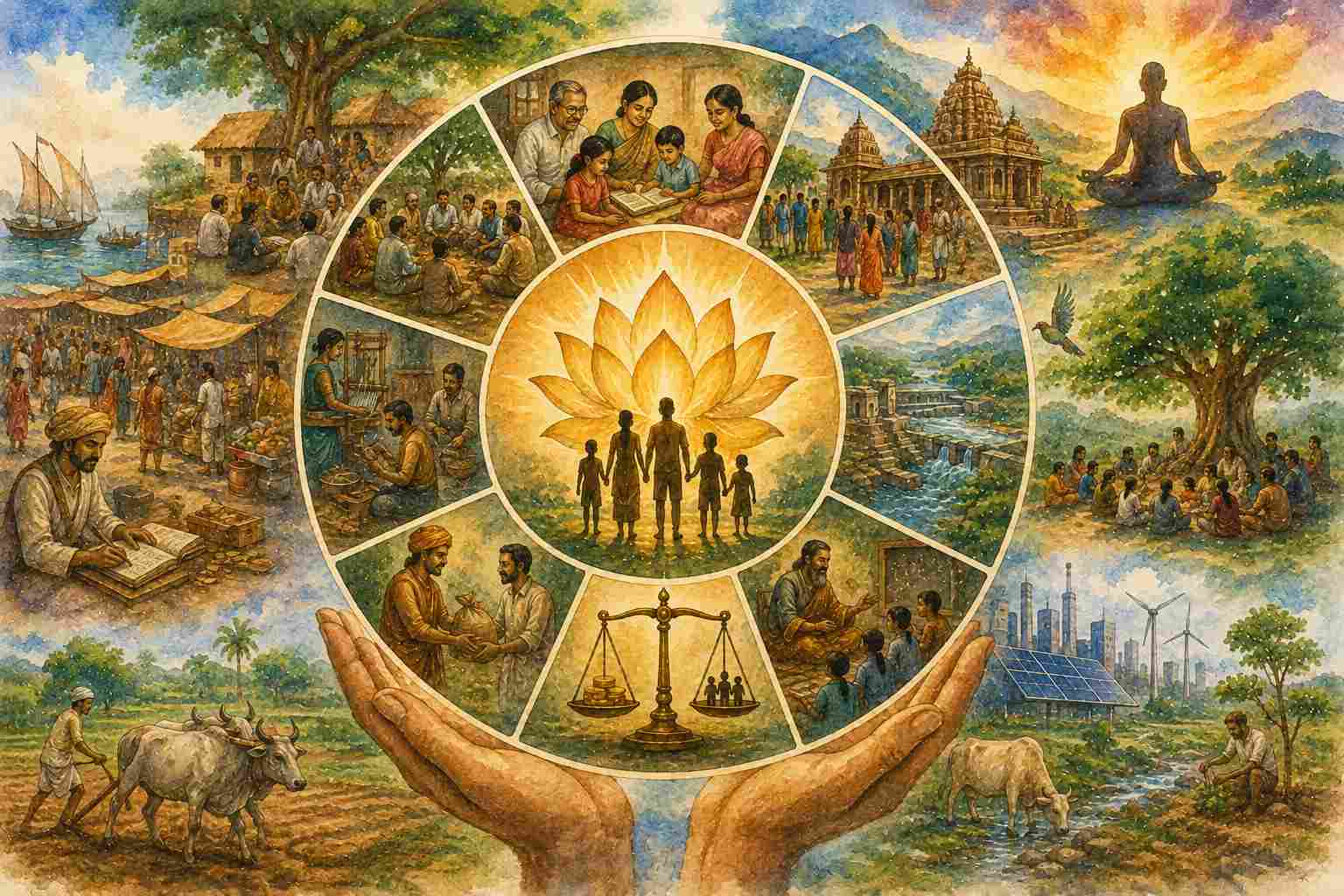
Can Economics Be Separated from Society?
Modern economic theory often begins with an abstraction: the individual economic actor. This individual has preferences, faces scarcity, compares alternatives and chooses the option that maximizes utility or benefit. From millions of such decisions emerge prices, markets and economic outcomes.
This analytical model, commonly associated with Homo Economicus, has been enormously useful. It helps explain incentives, exchange and rational choice. Yet its limitations become obvious when we examine actual human economic behaviour. Why do people sacrifice profit for family obligations? Why do traders maintain relationships that survive temporary losses? Why do business communities invest in temples, schools and public institutions? Why do people save not only for themselves but for future generations? Why do firms accept lower profits to preserve reputation?
Economic actors do not live in a vacuum. They enter markets already shaped by family, community, law, trust, custom, religion and moral expectations. The central argument of the Indic theory of embedded economy is therefore not that rational choice is irrelevant. It is that economic rationality itself is socially formed. Before an individual enters the market, he already belongs to relationships that influence what he considers valuable, legitimate, trustworthy and desirable.
In this sense, the economy is not separate from society. It is one of the ways society organizes its material life.
From the Isolated Individual to the Relational Actor
The most important shift is from the autonomous economic individual to the relational economic person.
Consider a merchant. His economic decisions are not shaped only by price. His family may provide initial capital. His community may provide credit and information. His reputation determines whether others trust him. His employees depend upon his decisions. Religious or ethical institutions may shape what forms of profit he considers legitimate. His social status may depend partly upon his contribution to collective institutions.
The economic individual is therefore embedded in a web of relationships.
This was particularly visible in South Asian commercial history. Economic historian Tirthankar Roy argues that before modern property and commercial law became widely available, business organization was substantially an extension of social organization. Communities and collectives framed and enforced rules of economic cooperation, while collectives managed property, resources, training and negotiation.
The Indic contribution begins here. The economy was not imagined primarily as an autonomous market surrounded by society. Market activity was itself conducted through social institutions.
The Shreni: Economic Organization as Social Organization
The ancient shreni provides one of the strongest historical examples.
A shreni was not simply a collection of individuals who happened to produce similar goods. Merchant and artisan associations possessed internal rules, collective responsibilities and, in some cases, significant economic autonomy. Historical research describes merchant guilds as corporate, self-governing organizations whose regulations could be recognized by local authorities.
This distinction is crucial. In the abstract market model, an individual producer enters the market and competes independently. In the shreni model, the producer was also located within a corporate social body.
Rules concerning professional conduct, membership and collective responsibility could emerge through the group itself. Later legal traditions discussed the internal rules of shrenis, while Gupta-period evidence records corporate rights and disciplinary procedures within such associations.
Economic identity was therefore not merely individual. A person’s craft was connected with training, reputation, collective standards and institutional belonging. The shreni was simultaneously an economic institution and a social mechanism.
The Indic question was therefore not simply, “What does the individual maximize?”
It was also, “What obligations arise because economic activity is conducted through relationships?”
A Remarkable Case: Guilds as Financial Institutions
The Nasik inscriptions demonstrate how deeply economic and non-economic institutions could be connected.
An inscription records that Uṣavadāta created a permanent endowment of 3,000 silver coins for the support of Buddhist monks. The capital was deposited with two weavers’ guilds at stipulated rates of interest, while the income was used to provide necessities for the monastic community.
This single arrangement connected four different spheres.
A donor provided capital. Guilds used or managed the capital. Economic activity generated returns. The returns supported a monastic institution.
In a modern framework, these would often be treated as separate sectors: finance, industry, philanthropy and religion. Here, they formed one institutional circuit.
The significance of this example should not be exaggerated into a claim that ancient India had a modern banking system in every respect. It did not. But the inscription clearly shows that guilds could function as trusted intermediaries for long-term financial arrangements and that economic capital could be embedded in wider social and religious purposes.
This is the core meaning of embedded economy. The destination of capital was shaped not only by its financial return but by the social institutions to which it was connected.
Wealth Did Not End at the Market
The Mandsaur silk-weavers’ inscription provides another powerful example.
A guild of silk weavers had accumulated wealth through its craft. The inscription records that the guild used wealth acquired through silk weaving to construct a temple to the Sun at Daśapura and later participated in its repair.
The economic activity of the guild was therefore connected to an institution outside the narrow sphere of production.
A modern reading might classify the temple as “religious” and weaving as “economic.” But the inscription itself reveals how artificial such a separation can become. Wealth produced through a craft moved into the construction and maintenance of a public cultural institution.
The same relationship appears across many historical settings. Temple endowments could support agriculture and irrigation, while temple patronage in Kakatiya Andhra, for example, was associated with agricultural expansion and the development of irrigation facilities. The temple was not the “economy,” but neither was it external to economic life. Economic institutions supported temples, and temples could stimulate agricultural, artisanal and social activity. Society did not consist of watertight compartments.
The Household Was Also an Economic Institution
The modern economic imagination frequently begins with the individual or the firm. The Indic and South Asian historical experience requires us to examine another unit: the household.
Capital, property, labour, consumption, inheritance and business continuity were frequently organized through family relationships. The joint household was not merely a private emotional unit. It could also operate as a structure for managing property and coordinating economic activity.
T. N. Madan’s work on the Hindu household, for example, examines household income, spending, collective and individual incomes, joint property ownership and inheritance as interconnected aspects of the household institution.
This creates an economic logic that cannot be reduced to the preferences of an isolated individual.
A business decision may be made for the next generation rather than immediate consumption. Property may be understood through collective claims. Individual earnings may support dependents who are not economically productive in the narrow sense.
The economic actor therefore cannot always be understood as an individual maximizer. He or she may be a member of a Kutumba economy.
This remains relevant today. Even contemporary Indian household savings, family businesses, informal credit networks and intergenerational property arrangements often reveal the persistence of economic decisions that make little sense if the individual is treated as the only relevant unit.
Trust, Reputation and the Social Foundations of Exchange
The market requires trust long before any contract is signed.
A trader needs information about the reliability of another trader. A lender must assess whether a borrower is likely to repay. An employer needs confidence in workers. Customers depend upon reputation. Modern economies can reduce some of these uncertainties through contracts, courts, ratings and regulatory institutions. But historically, communities themselves often performed these functions.
Merchant groups and other collectives created systems of reputation, cooperation and mutual responsibility. Roy’s work shows that the rules of business could be framed and enforced through collectives linked with community, family and guild structures.
This produces a critical insight. Markets do not create all the trust they require. They consume social trust that often originates outside the market.
An economy cannot function through price alone if no one trusts weights, contracts, products, currency or promises. Economic institutions therefore depend upon cultural and ethical capital that conventional economic measurement struggles to capture. This is where an Indic theory becomes particularly relevant. Dharma can be understood here not as a replacement for economic institutions but as a language for the legitimacy of relationships. A transaction is never merely about exchange. It also raises questions about obligation, trust, responsibility and the consequences of action.
Ecology Was Part of Economic Capacity
An autonomous market model can also make nature appear as an external input. Land, water and forests become resources entering production.
The Indic embedded model begins from a different observation: the economy is physically located within ecological systems. Agriculture cannot be separated from soil. Livestock cannot be separated from grazing systems. Trade cannot be separated from transport routes and material resources. Human prosperity depends upon ecological regeneration.
This is why historical resource systems in Bharat are important. Economic institutions were connected with irrigation, tanks, forests, community resources and local management systems. The Sudarshana Lake, repeatedly repaired across political periods, illustrates how the maintenance of water infrastructure was essential to wider economic life.
Ecology was not an environmental “sector” separate from the economy. It was one of the material foundations of economic activity. The Indic contribution is therefore not simply to add ecology to economics as another variable. It is to recognize that there is no economy outside the ecological systems that sustain it.
Beyond the Autonomous Market
The Indic theory of embedded economy can therefore be summarized through a broader analytical model.
| Autonomous Economic Model | Indic Embedded Economy |
|---|---|
| Individual is the primary unit | Individual exists within relationships |
| Market is analytically autonomous | Market is embedded in social institutions |
| Exchange is primarily contractual | Exchange also depends on trust and reputation |
| Capital seeks financial return | Capital may simultaneously sustain social institutions |
| Firms are economic units | Guilds and communities combine economic and social functions |
| Nature is an input | Ecology is a foundation of economic continuity |
| Ethics are external constraints | Ethical legitimacy shapes economic relationships |
This does not mean that every historical Indian economic institution was harmonious, just or free from conflict. It was not. Communities could exclude. Guilds could restrict entry. Social institutions could create hierarchy. An Indic framework must not romanticize historical arrangements.
The argument is analytical rather than nostalgic.
The historical evidence demonstrates that economic activity in Bharat frequently operated through institutions that simultaneously possessed social, cultural, ethical and economic functions. Guilds could manage wealth and professional conduct. Merchant networks could extend across regions while retaining institutional identities. Households organized property and labour. Temples received economic endowments and participated in agrarian development. Merchant networks such as the Ayyāvoḷe Five Hundred connected different commercial centres through wider institutional networks rather than functioning merely as isolated traders.
What Is the Indic Answer to Homo Economicus?
The Indic answer is not an alternative fiction called Homo Dharmicus.
That would merely replace one abstraction with another. The deeper contribution is to abandon the idea that economic behaviour can be explained by one motivation or one unit of analysis. Human beings seek gain, but they also seek security, status, family continuity, reputation, belonging and meaning. They act individually, but they also inherit institutions and obligations. They participate in markets, but they depend upon relationships that markets did not create.
The economic person is therefore embedded, plural and relational. This produces a new question for economic research.
Instead of asking only how incentives shape individual choices, we can also ask: Which institutions make particular forms of economic behaviour possible? Who produces trust? Who trains skilled workers? Who maintains ecological resources? Who supports individuals during economic failure? Who preserves knowledge across generations? How do family, community, guild and ethical norms influence the movement of capital?
These are not questions outside economics. They concern the hidden infrastructure of economic life. The Indic theory of the embedded economy therefore does not reject markets, prices or rational choice. It asks economics to recognize what lies beneath them.
The market is not suspended in empty space. It stands upon institutions that precede the transaction and often survive long after the transaction ends.
An economy may become more efficient while destroying its communities. It may become wealthier while weakening its families. It may expand production while exhausting the ecological and moral foundations upon which future production depends. The Indic framework asks us to see this relationship clearly. Economic life is not merely embedded in society as a matter of history. It must remain socially and ethically embedded if the conditions of long-term prosperity are to survive.
The real alternative to Homo Economicus, therefore, is not another idealized economic individual. It is the recognition that the economic actor has never been alone. Every act of production and exchange is sustained by relationships—with family, community, institutions, ecology and ethical norms.
To study those relationships is to move from the theory of an autonomous economy toward a genuinely civilizational economics.
