
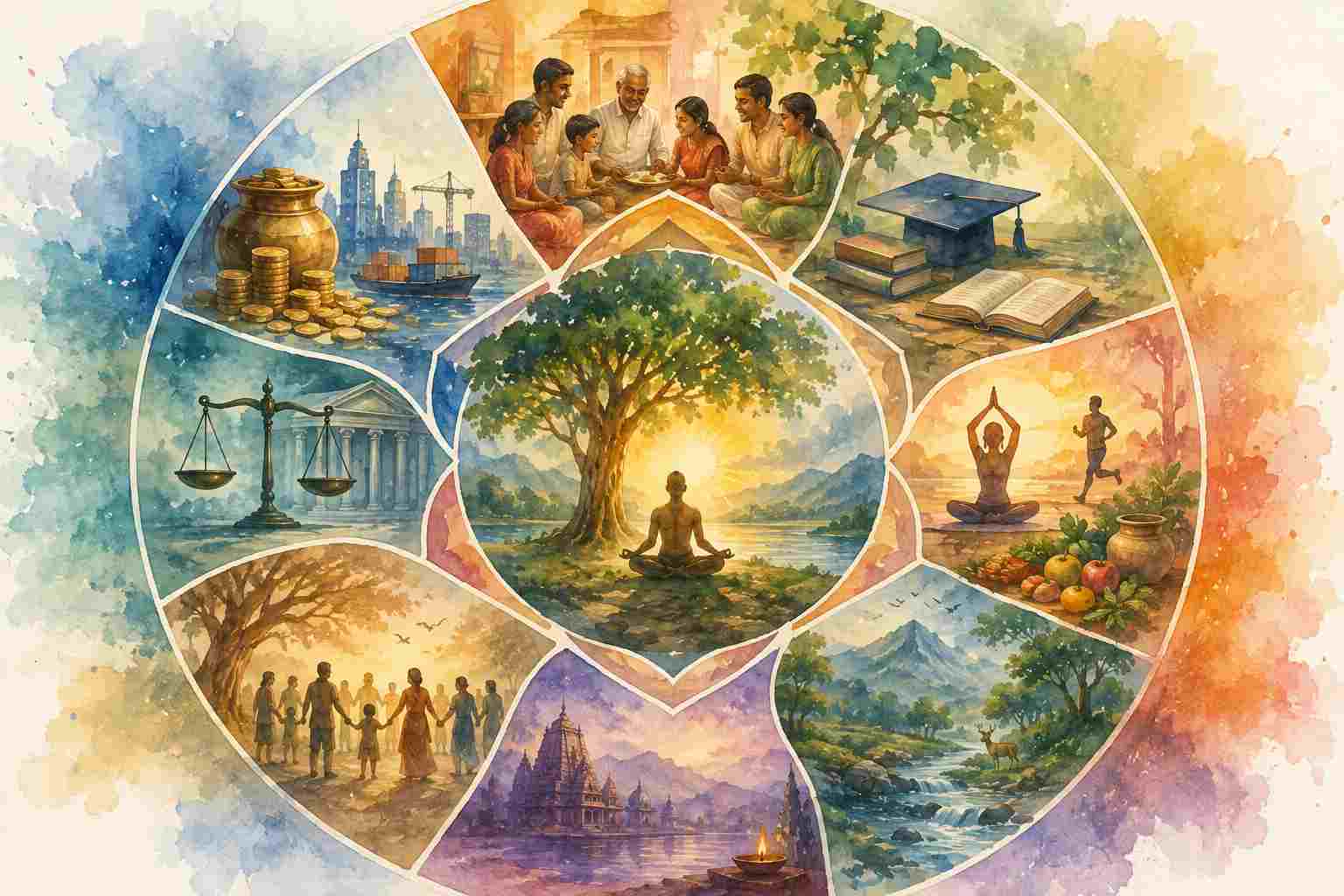
What is wealth?
The modern answer is usually numerical. We measure prosperity through income, consumption, production, capital accumulation and economic growth. These measures are important. A civilization cannot ignore material deprivation, unemployment, poverty or productive capacity. But can income alone tell us whether a society is truly prosperous?
A country may grow wealthier while families become unstable. Consumption may increase while trust declines. Production may expand while ecological systems deteriorate. People may possess greater purchasing power while experiencing deeper intellectual, social or spiritual emptiness.
This reveals a fundamental problem in modern measures of prosperity: wealth has increasingly become identified with the things people possess rather than the conditions that allow individuals and societies to flourish.
Indic thought provides a wider framework through the Purusharthas: Dharma, Artha, Kama and Moksha. These are not four economic indicators. They represent four interconnected dimensions of human aspiration. Their relationship allows us to develop a Multidimensional Theory of Prosperity.
Artha: Material Wealth Is Necessary
Artha represents material prosperity, resources, livelihood and the means required for life. It is therefore mistaken to imagine Indic thought as hostile to wealth. Poverty was not idealised as an economic condition. Individuals, families and societies required resources for security, education, institutions and social life.
But Artha was never presented as the complete purpose of human existence.
This distinction matters. Income can measure the quantity of economic resources available to a person. It cannot measure what those resources are doing to the larger life of the individual and society.
A person may have greater income but no health. A family may possess property but lack stability. A society may produce enormous wealth while destroying its ecological foundations.
Artha is necessary. It is not sufficient.
Dharma: The Question of How Wealth Is Created
If Artha asks how wealth is acquired and sustained, Dharma introduces the question of responsibility.
How is wealth produced? How are workers treated? What happens when economic activity harms communities? Can profit justify every form of extraction? What obligations do the capable have towards those who are less capable?
Dharma prevents prosperity from becoming a purely quantitative idea.
An economy cannot be called prosperous merely because wealth exists. We must also ask whether its economic relationships sustain trust, responsibility and social stability.
This does not mean that every economic decision has a simple moral answer. Rather, it means that economic life cannot exist outside moral questions.
Kama: Prosperity Must Be Lived
Kama reminds us that human life includes happiness, desire, beauty, relationship and enjoyment.
A civilization does not become prosperous merely because its citizens are economically productive. Human beings also seek meaningful relationships, cultural participation, art, beauty and fulfilment.
This expands our understanding of wealth. Leisure, cultural life and the capacity to enjoy one’s existence are also dimensions of prosperity.
An individual with a high income but no time, relationships or joy may be economically successful. Whether that person is truly prosperous is a different question.
Moksha: Freedom Beyond Possession
The fourth dimension, Moksha, introduces perhaps the most radical challenge to a purely economic definition of wealth.
If prosperity is understood only through accumulation, then the human being becomes trapped within an endless cycle of possession. More becomes the permanent objective. Moksha introduces the idea that human flourishing also requires freedom from excessive attachment.
This does not mean abandoning Artha or Kama. The Purusharthas do not demand that material life disappear. They prevent any single dimension from becoming absolute. A civilization becomes unhealthy when wealth dominates everything else. Moksha reminds us that the human being is greater than the things he possesses.
Towards a Multidimensional Theory of Prosperity
The Purusharthas allow us to reconstruct prosperity as a wider civilizational condition.
| Dimension | Indic Foundation | What Prosperity Requires |
|---|---|---|
| Material Wealth | Artha | Income, livelihood, property and productive capacity |
| Ethical Wealth | Dharma | Character, trust, responsibility and justice |
| Human Fulfilment | Kama | Family, relationships, beauty, culture and happiness |
| Inner Freedom | Moksha | Meaning, self-knowledge and freedom from excessive attachment |
| Knowledge Wealth | Vidya | Education, wisdom and intellectual capacity |
| Health Wealth | Sharira | Physical and mental well-being |
| Ecological Wealth | Prakriti | Sustainable land, water and ecological balance |
| Social Wealth | Samaja | Stable families, communities and institutions |
The purpose of this framework is not to reject income or economic growth. It is to place them within a larger understanding of human prosperity.
Conclusion
A society is not prosperous merely because its GDP rises. The more important question is: What is happening to the human and civilizational conditions surrounding that wealth?
Are people healthier? Is knowledge expanding? Are families stable? Is trust increasing? Are communities capable of cooperation? Is ecological destruction becoming irreversible? Do individuals possess the material security necessary to live with dignity? Do they also possess meaning?
The Purusharthas suggest that prosperity cannot be reduced to one dimension. Artha without Dharma may produce wealth without responsibility. Kama without balance may become endless consumption. Moksha without the material foundations of life can become disconnected from social reality.
A genuinely prosperous civilization must therefore create balance.
Wealth is not simply what a society earns. Wealth is the total capacity of a civilization to sustain material security, ethical relationships, human fulfilment, knowledge, health, ecological balance and the inner freedom of its people.
That is the starting point for a Multidimensional Theory of Prosperity. The question is no longer merely how much wealth a civilization produces. It is whether that wealth enables civilization itself to flourish.
