What Do Our Economic Statistics Actually Measure?
Economics has become extraordinarily good at counting. We can measure GDP, inflation, employment, consumption, exports, imports, savings, investment, productivity, poverty, inequality, fiscal deficits, public debt, household expenditure and financial wealth with increasing precision. We can tell whether an economy has grown, whether prices have risen, whether employment has expanded and whether household consumption has increased. But there is a more fundamental question that statistics alone cannot answer: are we measuring everything that makes a society prosperous?
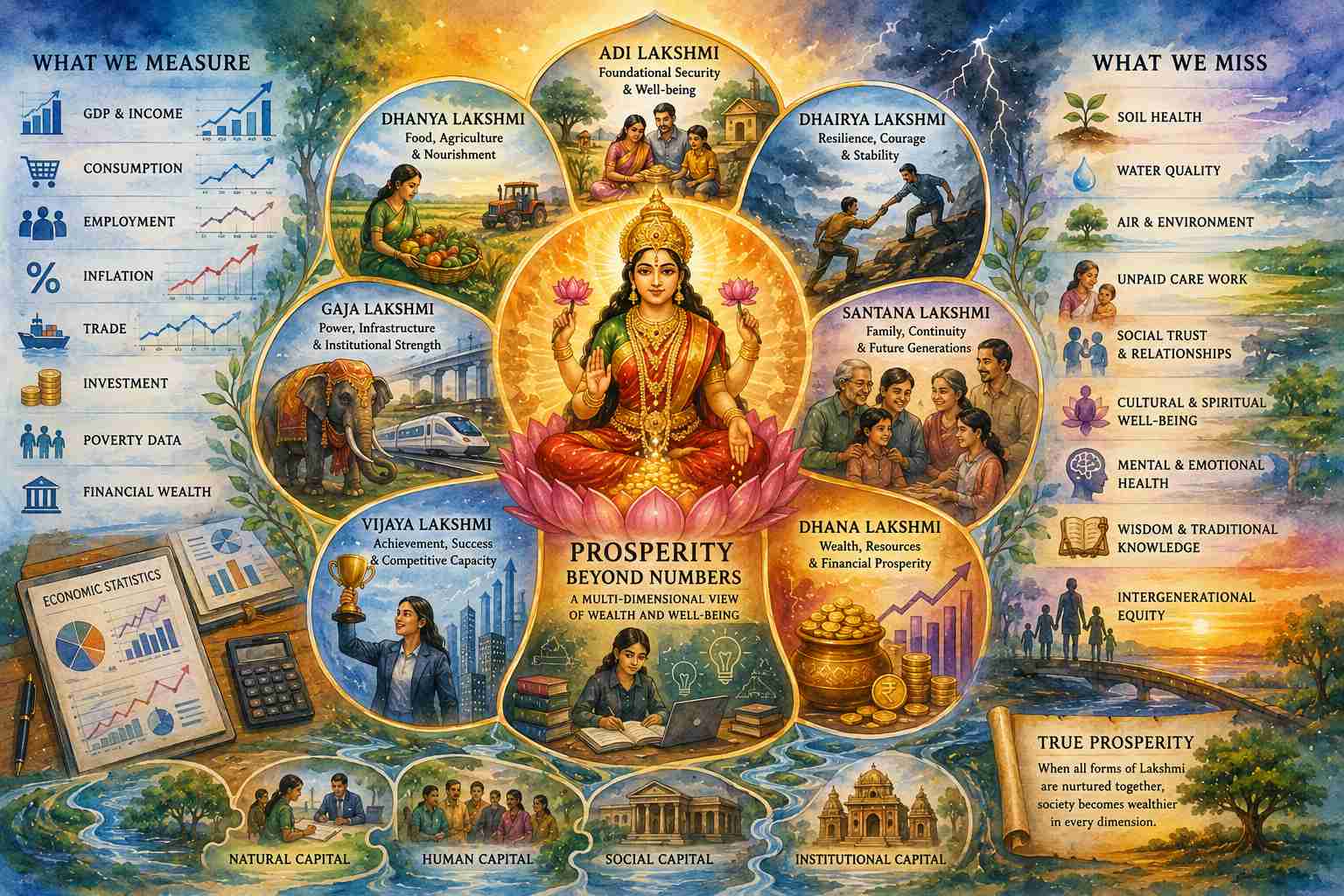
This is where the idea of Ashtalakshmi becomes intellectually interesting—not as an ancient substitute for GDP, nor as an attempt to force a religious framework into an economic spreadsheet, but as a civilizational lens through which we can interrogate the assumptions behind economic measurement itself. The widely circulated Ashtalakshmi Stotram presents eight forms as Adi Lakshmi, Dhanya Lakshmi, Dhairya Lakshmi, Gaja Lakshmi, Santana Lakshmi, Vijaya Lakshmi, Vidya Lakshmi and Dhana Lakshmi; other traditions use slightly different combinations, so the framework should not be treated as a single universally fixed list. The intellectual possibility lies in asking: if prosperity has eight dimensions, what happens when modern economics measures only some of them directly?
The question becomes even more interesting because contemporary economics itself has begun moving beyond GDP.
- The World Bank’s Changing Wealth of Nations now measures produced capital, human capital, renewable and non-renewable natural capital and net foreign assets, explicitly arguing that GDP alone cannot tell us whether the productive base of an economy is being strengthened or depleted.
- The OECD’s How’s Life? framework similarly includes income and wealth, jobs, housing, health, knowledge and skills, environment, work-life balance, social connections, civic engagement, safety and subjective well-being. The movement is therefore already underway.
The question is whether an Indic framework can take this conversation further.
An Economic Map of Ashtalakshmi
| Lakshmi | Civilizational dimension | What modern statistics measure | What remains under-measured |
|---|---|---|---|
| Adi Lakshmi | Foundational security, life and order | Poverty, income, housing, social protection | Meaning, civilizational security, social stability |
| Dhanya Lakshmi | Food, agriculture, nourishment | Crop output, food prices, consumption, nutrition | Soil vitality, seed diversity, food culture, food autonomy |
| Dhairya Lakshmi | Courage, resilience, capacity to withstand shocks | Savings, insurance, debt, unemployment, disaster data | Social resilience, psychological resilience, community capacity |
| Gaja Lakshmi | Power, productive capacity, infrastructure, institutional strength | Infrastructure, investment, capital stock, public finance | Institutional capability, strategic autonomy, collective capacity |
| Santana Lakshmi | Continuity, family, future generations | Fertility, population, dependency ratios, human capital | Intergenerational transmission, care, family capital |
| Vijaya Lakshmi | Achievement, success, competitive capacity | Productivity, exports, innovation, growth | Civilizational confidence, long-term capability |
| Vidya Lakshmi | Knowledge, learning, wisdom | Literacy, enrolment, degrees, R&D, skills | Quality and purpose of knowledge, inherited knowledge systems |
| Dhana Lakshmi | Monetary and material wealth | Income, GDP, assets, savings, consumption | Distribution, circulation, ethical use and social purpose |
This is not just a classification exercise. It reveals something uncomfortable: modern economic statistics are not necessarily wrong; they are incomplete because they were designed to answer particular questions. The problem arises when we mistake the answers to those questions for a complete description of prosperity.
Dhana Lakshmi: The Wealth We Already Know How to Count
Dhana Lakshmi is perhaps the easiest dimension for modern economics to recognise.
- GDP, national income, household wealth, savings, investment, capital formation, bank deposits, financial assets, consumption expenditure and tax revenues all attempt to tell us something about material prosperity.
India’s Household Consumption Expenditure Survey, for example, is explicitly designed to collect information on household consumption and expenditure and is used to assess economic well-being, poverty, inequality and social exclusion.
But even here there is a distinction between income, wealth and prosperity. GDP is a flow; wealth is a stock. The World Bank makes this distinction explicitly: GDP records economic activity over a period, while wealth accounting examines the assets that make future production possible.
Dhana Lakshmi therefore gives us the familiar economic question—how much do we possess?—but it does not by itself answer how securely that wealth is held, how it circulates, what it produces, or what it does to society.
Dhanya Lakshmi: What Happens When Food Becomes a Number?
Modern economics measures agricultural output, food prices, food consumption, nutrition, imports, exports, agricultural income and productivity. These are essential. But Dhanya Lakshmi asks us to look at something deeper: what is the condition of the food system itself?
A tonne of grain is measurable. The fertility of the soil that produces it is harder to capture. A market price for seed is measurable. The knowledge of farmers about local varieties is much harder to price. Food expenditure can be counted. The cultural knowledge of how food is prepared, preserved, shared and consumed is largely outside conventional economic accounts.
The United Nations’ environmental-economic accounting framework is moving precisely towards this missing territory by measuring environmental assets, ecosystem services, land, water, energy, timber, fish, soil and other natural inputs and stocks. But an Indic economic framework would push the question further: is food merely a commodity, or is it part of the reproductive capacity of society?
Dhanya Lakshmi therefore connects economics with agriculture, nutrition, ecology, culture and intergenerational food security.
Dhairya Lakshmi: Can an Economy Absorb a Shock?
This is one of the most neglected dimensions of economic measurement.
An economy can have high GDP and still be fragile. A household can have high income and still collapse under a medical emergency, job loss or debt shock. A village can have modest monetary income and yet possess strong mutual support systems that allow families to survive crises. What, then, is economic resilience?
Modern statistics measure some components: household savings, debt, insurance coverage, unemployment, fiscal capacity, food stocks, foreign-exchange reserves and disaster losses. But the deeper capacity of a community to absorb, adapt and recover is much harder to capture.
Dhairya Lakshmi therefore introduces a different economic variable: the capacity to withstand disruption without losing the ability to reproduce economic and social life.
That means resilience should perhaps be measured at the household, community, institutional, ecological and national levels—not simply through financial reserves.
Gaja Lakshmi: Wealth Requires Productive Power
Gaja Lakshmi, traditionally associated with elephants, abundance, royal power and auspicious prosperity, can be read analytically as the question of productive and institutional capacity. What enables a society to turn resources into sustained prosperity?
Modern economics already measures infrastructure, machinery, factories, roads, ports, electricity, telecommunications, capital formation and public investment. The World Bank’s wealth accounts explicitly recognise produced capital as one of the major foundations of future wealth.
But there is another form of productive power: institutional capability. Two societies can possess similar physical infrastructure and generate radically different outcomes because their institutions differ in competence, trust, coordination and implementation capacity.
Gaja Lakshmi therefore asks not simply “How much capital do we possess?”, but “How much capability does our capital create?”
Santana Lakshmi: Can Prosperity Reproduce Itself?
This may be the most disruptive question for contemporary economics.
Economics usually treats population through labour supply, dependency ratios, fertility rates, migration, human capital and demographic dividends. But Santana Lakshmi asks a larger question: can one generation transmit sufficient material, intellectual, social and cultural capital to the next?
This brings the family into economics.
Who raises children? Who transmits language? Who teaches habits? Who provides care during illness and old age? Who transfers skills that never appear on a formal curriculum? Much of this work takes place outside markets.
India’s 2024 Time Use Survey makes the point dramatically. Among participants in unpaid activities, women spent an average of 363 minutes per day on unpaid activities compared with 123 minutes for men; across all persons aged six and above participating in unpaid activities, the average was 278 minutes.
International statistical agencies now recognise unpaid domestic and care work as an important component of official labour statistics, but it remains largely outside conventional production measures.
The question is not merely about gender. It is about what kind of economic value exists outside the market.
Santana Lakshmi therefore forces economics to see the household not simply as a consumption unit, but as a site of production, reproduction, care and intergenerational capital formation.
Vidya Lakshmi: Can Knowledge Be Counted as Wealth?
Modern economics has increasingly recognised human capital. Education, skills, experience and health are treated as productive assets, and the World Bank estimates human capital as a major component of national wealth. India also has extensive statistical systems for education: UDISE+, AISHE and other administrative datasets capture schools, enrolment, teachers, infrastructure and educational participation.
But Vidya Lakshmi raises a harder question: is knowledge valuable only when it increases future earnings?
What happens to knowledge that produces social capability rather than immediate income? What about traditional ecological knowledge, craft knowledge, community memory, philosophical knowledge, language, music, ritual knowledge or knowledge of local environments?
A degree is measurable. Wisdom is much harder to measure.
This does not mean that wisdom should be given an arbitrary monetary value. It means that economics should recognise that knowledge systems can be productive without being reducible to labour-market returns.
Vijaya Lakshmi: Prosperity Must Have the Capacity to Succeed
Vijaya Lakshmi introduces achievement, capability and the capacity to prevail in a competitive and uncertain world. Modern economics captures this through productivity, exports, innovation, research, entrepreneurship, competitiveness and technological advancement.
But victory cannot mean only winning the market today.
A society may have strong exports while becoming dependent on foreign technology. It may have rapid growth while weakening domestic skills. It may attract capital while losing strategic autonomy. It may produce more while becoming less capable of producing essential goods during a crisis.
Vijaya Lakshmi therefore asks us to distinguish between short-term economic success and long-term economic capability.
Adi Lakshmi: The Dimension Statistics Find Hardest to See
And then comes Adi Lakshmi.
If the other seven dimensions describe particular forms of prosperity, Adi Lakshmi reminds us that prosperity rests upon a foundational condition of existence itself. In an economic interpretation, this can be approached through basic security, social stability, ecological foundations, institutional continuity and the conditions necessary for human life.
This is where the framework begins to exceed conventional economics.
The modern statistical system can tell us how much a society produces. It can increasingly tell us about health, education, environment, social connections and subjective well-being. The OECD, for instance, now explicitly measures social connections, civic engagement, environmental quality and subjective well-being alongside material conditions.
Yet there remains no single integrated statistical language for civilizational continuity, meaning, shared purpose, inherited knowledge and the capacity of a society to reproduce its deeper social order.
The Missing Statistics
This is perhaps the most important conclusion of the Ashtalakshmi exercise.
It would be unfair to say that modern economics measures only GDP. It does much more. Contemporary statistical systems now measure natural capital, human capital, unpaid work, social connections, trust, subjective well-being and ecosystem services. The OECD’s framework, for example, explicitly includes social capital, while its research notes that the measurement of social capital remains difficult because there is still limited agreement on definitions and internationally comparable indicators.
The World Bank similarly acknowledges that wealth accounts do not measure broad human welfare and that social capital and critical natural capital require complementary indicators.
So the problem is no longer simply “GDP is incomplete.”
The deeper problem is that our statistical architecture is fragmented.
What We Count vs. What We Struggle to Count
| Strong statistical coverage | Growing but incomplete coverage | Still difficult to capture |
|---|---|---|
| GDP & income | Natural capital | Family capital |
| Consumption | Human capital | Civilizational memory |
| Employment | Unpaid work | Social trust at community level |
| Trade | Ecosystem services | Intergenerational transmission |
| Investment | Subjective well-being | Wisdom and lived knowledge |
| Inflation | Social connections | Cultural continuity |
| Poverty | Institutional trust | Meaning and purpose |
| Financial wealth | Resilience | Dharma / responsibility |
The challenge, therefore, is not to throw away GDP, national accounts or modern statistical methods. That would be intellectually childish. The challenge is to ask whether we can construct a richer economic dashboard in which Dhana is not allowed to swallow Dhanya, Vidya, Santana, Dhairya, Gaja and Vijaya.
That is the real value of putting Ashtalakshmi over economic statistics.
It does not tell us that an ancient framework has already solved modern economics. It tells us something more useful: perhaps our questions are still too small.
- A society needs money, but it also needs food.
- It needs food, but it also needs knowledge.
- It needs knowledge, but it also needs the courage and resilience to survive shocks.
- It needs productive power, but it also needs families and institutions capable of transmitting prosperity.
- It needs victory and competitiveness, but it also needs a foundation upon which victory remains meaningful.
- And it needs wealth—but wealth that does not destroy the very conditions that make wealth possible.
The World Bank’s wealth accounting has already arrived at a strikingly similar statistical insight: sustainable progress requires monitoring whether the underlying stock of wealth is being accumulated or depleted, not merely whether GDP is rising. The Ashtalakshmi lens takes this one step further by asking whether the stock of prosperity itself has multiple dimensions that cannot all be reduced to a financial balance sheet.
Perhaps, then, the future of economics should not be GDP versus tradition, nor Western economics versus Indic economics. It should be a more difficult and productive question:
Can we build an economic science capable of counting not only what a society produces, but what allows that society to flourish, reproduce, withstand shocks, transmit knowledge, sustain nature and remain prosperous across generations?
That would not be a rejection of economics. It would be an expansion of what we believe the economy is actually for. And perhaps that is the deeper lesson of Lakshmi: wealth is not one thing. Prosperity has architecture.
The question before Indic Economics is whether we are ready to measure it.
