
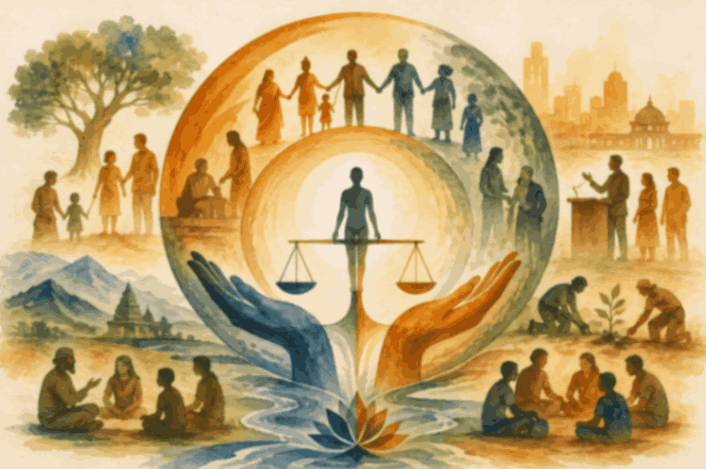
What sustains the social world in which rights can actually be enjoyed?
Beyond the Rights–Duties Divide
Modern constitutionalism has given us a powerful language with which to speak about human dignity: rights. The right to equality, liberty, speech, religion, property, privacy and participation in public life has become central to the moral vocabulary of the modern democratic state. This development is neither trivial nor dispensable. Rights protect the individual from arbitrary power; they create spaces of freedom within which human beings can think, speak, associate and pursue meaningful lives.
Yet there is a question that modern legal and political discourse does not always ask with sufficient seriousness: what sustains the social world in which these rights can actually be enjoyed?
A right does not exist in a social vacuum. The right to education presupposes institutions and persons capable of providing education. The right to life presupposes duties of non-violence and protection. The right to privacy presupposes restraint on the part of others. The right to a clean environment presupposes collective responsibility toward ecological systems. Even the right to freedom of expression assumes that others will not respond to every disagreement through violence. In other words, rights require a social infrastructure of responsibility.
This is not an argument against rights. It is an argument against understanding rights in isolation.
The distinction matters because there is a tendency in contemporary public discourse to imagine society as a collection of rights-bearing individuals who approach the state with claims. The citizen becomes primarily a claimant; the state becomes primarily an institution obligated to deliver; and society itself begins to appear almost invisible between the two. But what happens to the relationships that make social life possible—family, community, neighbourhood, professional associations, institutions, traditions and shared public spaces? Who sustains them? And what happens when every social relationship is increasingly described in the language of entitlement while fewer relationships are described in the language of obligation?
The problem is not that rights have become too important. The problem is that responsibility has become comparatively under-theorized.
This is precisely where the rights–duties relationship deserves reconsideration.
Legal theory itself offers a useful starting point. Wesley Hohfeld’s influential analysis demonstrated that legal relations are fundamentally relational. In its most precise form, a claim-right held by one person corresponds to a duty borne by another. If X has a claim against Y, then Y has a corresponding obligation toward X. Hohfeld’s framework is more sophisticated than the popular statement that “every right has a duty,” because not every legal liberty or power has a corresponding duty in the same sense. Nevertheless, its central insight remains important: Rights are embedded in relationships, not floating attributes detached from other persons.
This immediately changes the question.
Instead of asking only, “What are my rights?”, we must also ask, “Who must act, or refrain from acting, for this right to become meaningful?”
Consider something as fundamental as freedom of speech. The right protects an individual’s capacity to express an opinion. But the social existence of that freedom requires more than constitutional text. It requires institutions capable of protecting dissent, citizens capable of tolerating disagreement, public norms against violence, and individuals willing to recognize that another person’s freedom of expression does not disappear merely because the expression is unpleasant to them. A constitutional right may be legally guaranteed, but its social sustainability depends upon corresponding cultures of restraint and responsibility.
Interestingly, the Universal Declaration of Human Rights itself does not construct rights as completely detached from social obligation. Article 29 explicitly states:
Everyone has duties to the community in which the free and full development of personality is possible, and that the exercise of rights and freedoms is subject to considerations including the rights of others, morality, public order and the general welfare in a democratic society.
This is an important reminder. The rights tradition itself contains a recognition that freedom requires a social context.
The question, then, is not rights or duties.
It is rights through duties, duties for rights, and rights within relationships.
The Bharatiya idea of kartavya
This distinction becomes particularly significant when we turn toward the Bharatiya idea of kartavya. Kartavya is often translated simply as “duty,” but the translation can conceal an important dimension. The idea is not merely that an external authority commands an individual to perform an obligation. It points toward an understanding of conduct in which a person’s position within a network of relationships generates responsibilities. One does not exist only as an abstract individual. One exists as a child, parent, teacher, student, citizen, neighbour, professional, member of a community and participant in a larger social order. Each relationship carries expectations of appropriate conduct.
This relational conception is visible in the broader Indic vocabulary of dharma. Dharma cannot simply be reduced to law, religion or morality in the modern sense. It concerns the ordering of conduct in relation to circumstances, relationships and responsibilities. The question is not merely “What am I entitled to?”, but also “What is appropriate for me to do?”
That shift is subtle but profound.
A society organized entirely around claims can become increasingly litigious, competitive and transactional. A society organized entirely around duties, however, can also become dangerous if duties are imposed without rights, accountability or protection against arbitrary authority. The challenge is therefore not to replace the rights-based framework with a duty-based framework. The challenge is to reconnect the two.
This is where the Bharatiya tradition can enter the conversation—not as a nostalgic alternative to modern constitutionalism, but as a conceptual resource.
The idea of lokasaṅgraha
The Bhagavad Gita offers an especially important point of departure. Krishna’s teaching to Arjuna is not an invitation to escape from social responsibility in pursuit of individual liberation. In Chapter 3, Krishna invokes King Janaka and others who attained perfection through action and instructs Arjuna to act with lokasaṅgraha in view. The Gita Supersite’s translation renders this as performing one’s duties while keeping the prevention of society from going astray in view.
कर्मणैव हि संसिद्धिमास्थिता जनकादयः |
लोकसङ्ग्रहमेवापि सम्पश्यन्कर्तुमर्हसि ॥ ३.२०॥
The idea of lokasaṅgraha is particularly significant for a discussion of the good society. Action is not evaluated only by what it produces for the individual actor. It is also evaluated by what it does to the larger social order. Krishna further argues that the conduct of exemplary persons influences others: what the respected do becomes a standard that society follows.
Here, duty acquires a distinctly social dimension.
One performs one’s kartavya not merely because someone else has imposed a rule, but because one’s conduct participates in the maintenance of a larger order.
Gandhi brought this idea into modern political vocabulary with remarkable clarity. He wrote, “The true source of rights is duty.” He went further, arguing that if duties are discharged, rights will not be far to seek. Gandhi was not rejecting rights. His concern was that a political culture obsessed with claiming rights without cultivating responsibility could become socially destructive. For him, rights and duties were not competing moral currencies; properly understood, they were interconnected.
This is particularly relevant to the question of the good society.
What is a good society? Is it simply one in which individuals possess a large number of legally protected rights? Surely rights are indispensable. But can we stop there? Imagine a society with excellent constitutional protections but declining trust, weakening families, neglected public spaces, ecological irresponsibility, widespread evasion of civic obligations and an unwillingness to accept any responsibility beyond one’s private interest. Would we call such a society flourishing?
Conversely, a society in which people are told constantly to perform duties while being denied basic rights would hardly qualify as just.
The good society therefore requires a balance that is more difficult—and more interesting—than either extreme.
Rights protect the dignity of the person. Duties sustain the relationships within which that dignity can be realized.
This distinction also helps us understand the Indian Constitution in a more nuanced manner. The Constitution explicitly protects Fundamental Rights in Part III, while Part IV-A, introduced through the Forty-Second Amendment in 1976, articulates Fundamental Duties in Article 51A. These duties include respecting constitutional institutions, protecting the sovereignty and integrity of India, promoting harmony, preserving cultural heritage, protecting the environment, developing scientific temper and striving for excellence; the list was later expanded to include the duty of parents or guardians regarding education of children aged six to fourteen.
Notice the remarkable range.
The constitutional duties are not merely about obeying the government. They concern culture, environment, scientific inquiry, public property, social harmony, national integrity and excellence. In other words, they describe some of the conditions required for collective life itself to function.
Yet there is an important constitutional distinction that should not be ignored: Fundamental Duties are generally non-justiciable, unlike Fundamental Rights. Their significance therefore lies substantially in their normative and civic function rather than in treating them as a mechanism for automatically cancelling or suspending someone’s rights. Scholarly discussions of Article 51A similarly emphasize its role in clarifying the relationship between citizenship, rights and responsibilities.
This distinction is crucial because otherwise the language of duties can itself become authoritarian.
If the state says, “You have duties,” and uses that claim to silence legitimate dissent, then kartavya has been transformed from an ethical principle into an instrument of coercion. That is not the argument being made here.
The deeper proposition is almost the opposite: A healthy society should cultivate responsibility before the state needs to enforce it.
A parent does not care for a child merely because a statute commands parental responsibility. A teacher does not educate only because a regulation specifies a job description. A citizen does not preserve public property merely because a penalty exists. A neighbour does not help another person because the Constitution has created a legal claim for every possible act of kindness.
Society survives through millions of such actions that law cannot—and perhaps should not—fully regulate.
This is where kartavya becomes analytically useful. It directs attention toward the social foundations beneath formal law.
A right to public space does not maintain the park; citizens who refrain from destroying it do. A right to education does not teach the child; teachers, parents and institutions do. A right to a healthy environment does not plant a tree; people and institutions that accept ecological responsibility do. A right to dignity does not create mutual respect automatically; social conduct does.
The law can establish the framework. Society must still perform the relationship.
This also explains why the expansion of rights does not necessarily produce the expansion of freedom in practice. If responsibility declines simultaneously, the exercise of one person’s freedom can increasingly become the source of another person’s insecurity. Freedom without restraint can become domination by another form. A right exercised without recognition of the rights of others ceases to contribute to a shared order.
The challenge, therefore, is not to ask whether rights should come before duties or duties before rights as if we are choosing between two competing lists.
The more fruitful question is: What social architecture allows rights and duties to reinforce one another?
The Indic idea of kartavya offers one possible entry into that question. It begins with the recognition that human beings are relational. The individual does not enter society as a completely detached unit and then negotiate every obligation from scratch. Relationships precede many of our choices. Family precedes the modern contract. Community precedes many formal institutions. Language precedes individual expression. Knowledge is inherited before it is individually produced.
Freedom, therefore, is not necessarily the absence of obligation.
Sometimes freedom is made possible by obligation.
The freedom of a child depends upon the responsibility of parents and teachers. The freedom of citizens depends upon institutions that exercise restraint. The freedom of future generations depends upon the ecological responsibility of the present. The freedom of one community depends upon its recognition of the dignity of another.
This leads us back to the central question: Can rights remain sustainable when they are separated from the duties that make social life possible?
Perhaps the answer is that rights cannot be made sustainable by rights alone.
A civilization requires individuals who know what they may claim, but also what they owe. It requires institutions capable of protecting rights, but also communities capable of sustaining responsibility. It requires law to prevent injustice, but also social ethics that prevent every relationship from becoming a legal dispute.
The objective, then, should not be to construct a society beyond rights.
It should be to construct a society beyond the rights–duties divide.
A good society is neither one in which the individual disappears into collective obligation nor one in which society dissolves into competing individual claims. It is one in which rights protect the person, duties sustain relationships, institutions secure justice, and individual freedom contributes to the flourishing of the whole.
That is perhaps the deeper promise of kartavya: not the suppression of rights, but the social conditions that allow rights to become meaningful.
Astu!
