“The ideas are drawn from Hindu cultural categories… because they illuminate variations which escape the notice of conventional social science.” — McKim Marriott, India Through Hindu Categories (1990)
What happens when we stop asking only, “How can we apply existing social-science theories to India?” and begin asking a more uncomfortable question: “What concepts can emerge from India itself?”
This is the starting point of the Indic Cultural and Social Studies Frameworks.
A framework is not a rigid theory, a ready-made answer, or a replacement for established social science. It is a way of seeing—a conceptual arrangement that helps us decide what to look for, what relationships to examine, what questions to ask, and what may remain invisible when we approach society through a different lens.
For too long, the Indian social world has often been approached through categories developed elsewhere and subsequently treated as universal. Yet societies are not laboratories in which one conceptual model can simply be applied everywhere. Every civilization develops ways of understanding relationships, institutions, authority, economy, culture, community and the individual. The task, therefore, is not to reject Western social science, but to create the intellectual confidence to think alongside it, argue with it, and, where necessary, think beyond it.
The frameworks developed here emerge from precisely this effort. They seek to place Indic categories, civilizational experience and contemporary social-scientific inquiry in conversation. They are exploratory rather than dogmatic; analytical rather than merely descriptive. Their purpose is to generate new questions—and eventually, new explanations.
These frameworks have emerged through sustained discussions and intellectual exchanges involving Dr. Ritendra Sharma, Dr. Sameer Pande and Aravindan Neelakandan. They represent an ongoing attempt to develop a vocabulary through which Indian social and cultural realities can be examined on their own terms, while remaining open to comparison, criticism and refinement.
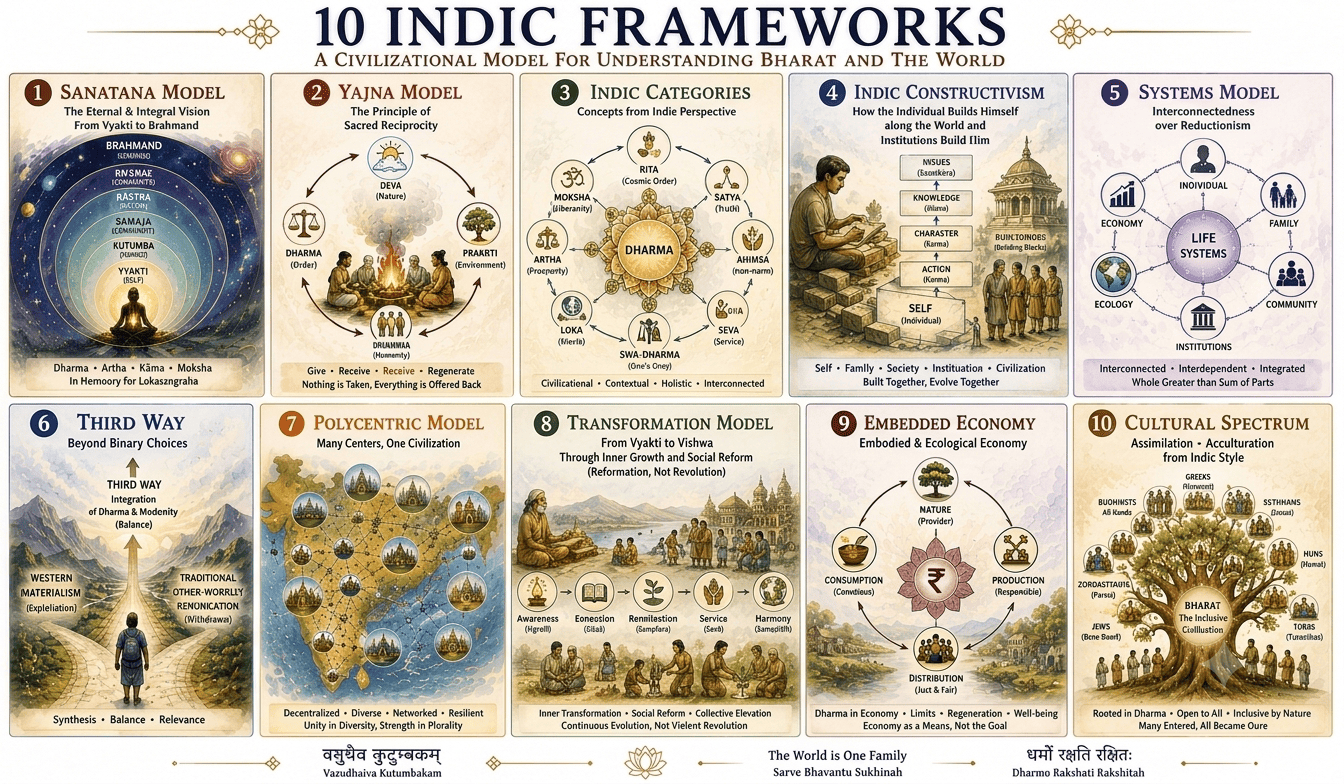
The collection includes:
1. Sanātana Model of Society
2. Yajña Model of Social Harmony
3. Indic Social Categories
4. Indic Constructivism and Navigation of the Individual through Society
5. Systems Model of Society
6. The Third Way Beyond the Binaries
7. Decentralized Autonomy and Local Resource Systems
8. Holistic Transformation over Revolution
9. Indic Concept of Embedded Economy
10. A Cultural Spectrum: Assimilation, Appropriation and Alienation — the Panchamrutam Model
Together, these are not presented as the final word on Indian society. In fact, that would defeat their very purpose.
They are an invitation to ask better questions.
Can Indian social realities generate theory? Can civilizational categories become analytical tools? Can we study society without assuming that one civilization’s experience provides the universal template for all others?
That is the intellectual journey these frameworks invite us to undertake.
