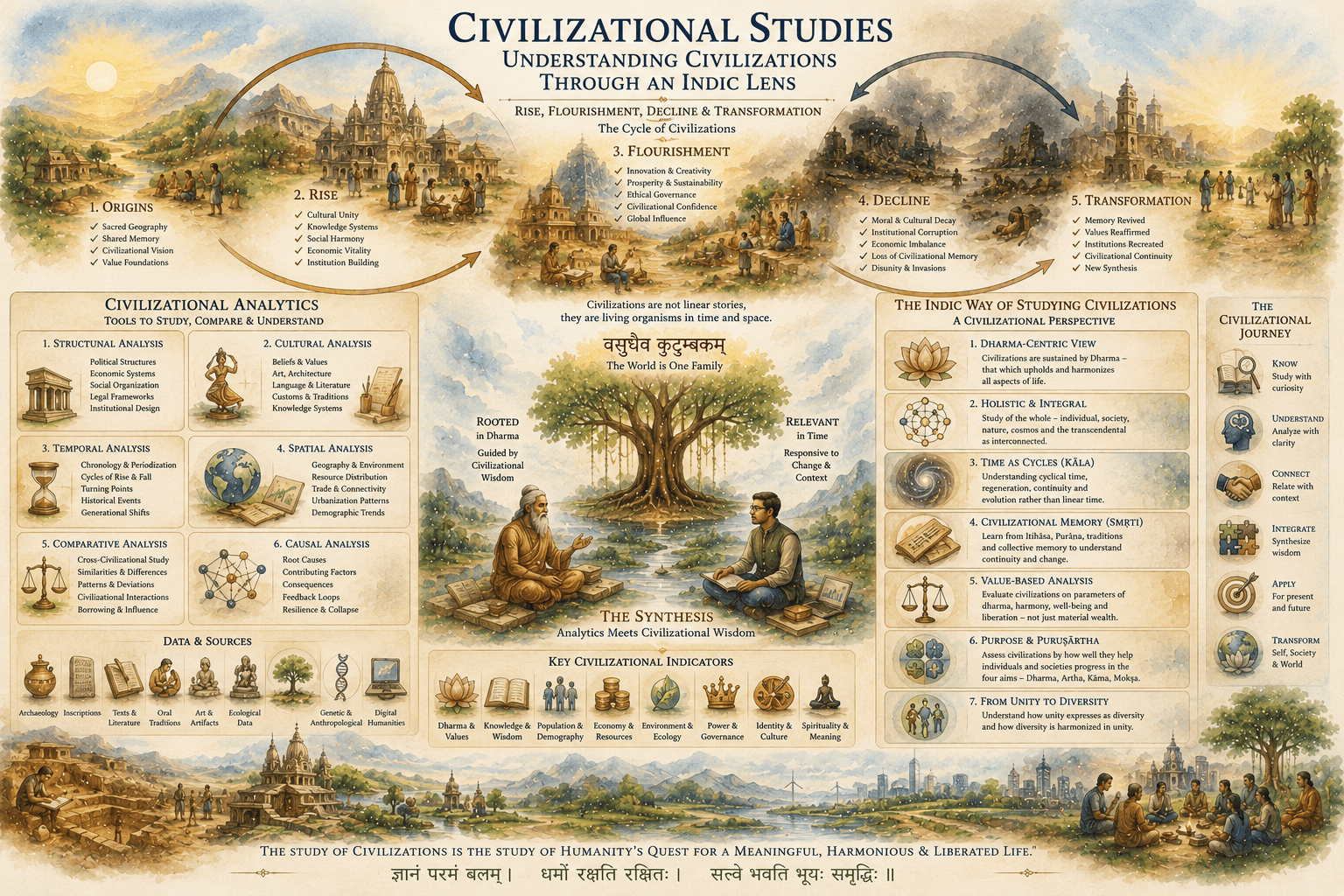
Civilizational Studies: What Are We Actually Studying?
What if a civilization is not simply a territory, a kingdom, a religion, a language, an economy or even a particular culture, but something much larger—a long and continuing process through which a people learns how to understand life, how to organise collective existence, how to relate to the land it inhabits, how to transmit knowledge from one generation to another, how to remember its past, how to respond to change and, perhaps most importantly, how to decide what kind of life is worth living? If this is even partly true, then the first problem before Civilizational Studies is not to produce another definition of civilization, but to ask whether we have been looking at civilization through categories that are too small to contain it.
This is where an Indic दृष्टि becomes particularly important, because the Indic intellectual traditions do not seem to begin their reflection on collective life by asking us to separate everything into neatly bounded compartments and then study each compartment independently. The question is not whether there were distinctions between the individual and society, between human beings and nature, between knowledge and action, or between political authority and social institutions—there certainly were—but whether these distinctions were understood as completely disconnected domains. The Vedic imagination repeatedly brings us back to relationship, order, participation, knowledge and continuity, and this gives us a different way of beginning the study of civilization.
In the Saṃjñāna Sūkta, for example, the Ṛgveda says,
“सं गच्छध्वं सं वदध्वं सं वो मनांसि जानताम्”
move together, speak together, let your minds come to a shared understanding—and then speaks of a common mantra, common samiti, common intention and common heart in the following mantras. (Ṛgveda 10.191.2–4). What is significant for our purpose is not merely that this is a beautiful hymn about unity; it is that collective life is imagined through relationship, deliberation, shared purpose and participation, which immediately takes us beyond the idea of society as simply a collection of individuals occupying the same geographical space.
What makes a collection of people into a civilization?
This raises the first question that Civilizational Studies must ask: what makes a collection of people into a civilization? A population can occupy a territory, a state can exercise political authority, an empire can expand across continents, a language can spread across regions and an economy can generate enormous wealth, but none of these things by itself explains why a particular way of life can remain intelligible to people separated by centuries. A king can die without taking the civilization with him; a dynasty can disappear while its language, stories, institutions and memories continue; a political boundary can be redrawn while pilgrimage routes, family traditions, festivals, philosophical ideas and social practices continue to connect people across that new boundary. This means that if civilization is our object of study, we have to look at something that exists at a scale larger than the political moment and deeper than the institution that happens to dominate that moment. Civilization is fundamentally transgenerational, because what makes it a civilization is not simply that people live together now, but that one generation receives something from another, transforms some of it, preserves some of it, forgets some of it and passes something forward to the next.
The Indic sources give us another important clue when we turn from collective life to the question of order. The Vedic idea of ṛta cannot simply be collapsed into the modern word “order”, because its semantic and ritual contexts are considerably richer, but it does allow us to begin asking whether social life was imagined as something existing within a larger order rather than as an arrangement created entirely through human institutions. The Atharvaveda’s Pṛthvī Sūkta is particularly revealing in this regard, because its very first mantra speaks of:
“सत्यं बृहदृतमुग्रं दीक्षा तपो ब्रह्म यज्ञः पृथिवीं धारयन्ति”
truth, the great ṛta, initiation, austerity, brahman and yajña uphold the earth (Atharvaveda 12.1.1). Whatever interpretive tradition one adopts around this mantra, it presents us with a civilizational imagination in which the earth, human discipline, knowledge, truth, ritual and order are not completely unrelated subjects. This is precisely the kind of relationship that a civilizational approach should be capable of seeing, because the moment we divide these elements into “religion”, “environment”, “ethics” and “social organisation”, we may become very good at describing the parts while losing sight of the civilizational relationship that connects them.
The same Pṛthvī Sūkta becomes even more striking when it describes the relationship between human beings and the earth through the famous declaration,
“माता भूमिः पुत्रोऽहं पृथिव्याः”
“Earth is my mother; I am her son” (Atharvaveda 12.1.12). We can read this as a religious statement, an ecological statement, a poetic statement, a metaphysical statement or an ethical statement, but the civilizational question is perhaps more interesting than any one of these classifications: what happens to a society when its relationship with land is understood not merely in terms of ownership, extraction and political sovereignty, but also through kinship, responsibility and belonging? The question does not ask us to romanticise the past or claim that every society that invoked the earth as mother automatically treated its environment perfectly; rather, it asks whether the categories through which a civilization understood its relationship with the earth can themselves become objects of serious social inquiry.
This is why Civilizational Studies cannot simply be another name for ancient history. Ancient history can tell us what happened in a particular period; political history can tell us who ruled; economic history can tell us what was produced and exchanged; social history can tell us how groups were organised; intellectual history can tell us what thinkers wrote, and environmental history can tell us how human beings interacted with ecological systems, but civilization asks us to look at the relationship between these histories across time. It asks why a particular conception of life produced particular institutions, how those institutions transmitted or transformed that conception, how economic and ecological conditions altered social organisation, how political changes affected cultural memory, and how communities responded when the inherited order encountered circumstances for which it had no ready-made answer.
This also means that the individual cannot be treated merely as an isolated unit within civilizational analysis. The individual is born into a family, enters a language before consciously choosing one, inherits stories before developing a historical theory, learns practices before becoming an anthropologist of those practices, inhabits a landscape before thinking about ecology and receives moral categories long before deciding whether to accept or reject them. The civilization therefore exists partly in these processes of transmission, often so ordinary that we fail to notice them. A child learning a language, a family preserving a ritual, a teacher transmitting a text, a community maintaining a festival, a craftsman teaching an occupation, a pilgrim travelling along an inherited route or a village maintaining a water system may appear to be unrelated activities when examined separately, yet together they can constitute the infrastructure through which a civilization continues to remember itself.
The Taittirīya Upaniṣad gives us a particularly important example of this relationship between knowledge and transmission. At the conclusion of the student’s education, the teacher does not simply say that the student has acquired sufficient information; the instruction is:
“सत्यं वद। धर्मं चर। स्वाध्यायान्मा प्रमदः”—speak truth, practise dharma, do not neglect svādhyāya.
(Taittirīya Upaniṣad 1.11.1)
— and the same passage insists that one should not neglect svādhyāya-pravacana, study and teaching. There is a civilizational insight here that deserves much more attention: knowledge is not complete merely because it has been acquired by an individual; knowledge becomes part of continuity when it is lived, reflected upon and transmitted. The student therefore becomes not merely a recipient of knowledge but a link between generations.
And perhaps this gives us another way of understanding why civilization cannot be reduced to monuments. A monument can survive while the meaning that produced it disappears; a manuscript can remain preserved while nobody reads the intellectual world within it; a festival can continue while the ideas that once gave it meaning become obscure; a language can remain formally alive while its conceptual vocabulary gradually disappears from ordinary thought. If we are serious about studying civilization, then preservation alone cannot be our measure of continuity. We have to ask whether the relationships of meaning and transmission remain alive.
This is also where the question of change becomes unavoidable, because civilization cannot mean that everything remains exactly as it was. If that were the definition, no living civilization could ever exist. Languages change, political institutions change, economic systems change, technologies change, cities move, social practices transform and new intellectual debates emerge, yet a civilization may continue because continuity does not require sameness. The more useful question is therefore not, “Did the civilization remain unchanged?”, but “What changed, what continued, and what allowed the two to coexist?” This is perhaps one of the most important questions that an Indic approach can contribute to Civilizational Studies, because the Bharatiya experience presents an extraordinarily long historical field in which continuity and transformation repeatedly occur together.
Here again, the Vedic sources themselves should prevent us from imagining the Indic tradition as some frozen and perfectly uniform system. The Ṛgveda contains reflections on cosmic questions, speech, social cooperation, marriage, wealth, ritual, nature, conflict, knowledge and many other aspects of human existence, and even within the Vedic corpus we encounter different questions, metaphors and modes of inquiry rather than one single intellectual formula. The Nāsadīya Sūkta asks questions about the origin of existence in Ṛgveda 10.129, while the Saṃjñāna Sūkta in 10.191 reflects upon collective deliberation, and the Akṣa Sūkta in 10.34 reflects upon the destructive attraction of gambling. The point is not that these hymns constitute a modern social-science textbook; they clearly do not. The point is that a civilization’s primary sources can contain multiple ways of questioning human existence, and our task is to understand those questions in their own contexts rather than forcing them prematurely into categories we already possess.
This is where an Indic civilizational drishti becomes different from merely adding a few Sanskrit quotations to an otherwise conventional theory of civilization. The deeper shift is methodological and epistemic: instead of beginning by assuming that the categories developed by modern disciplines are the only legitimate categories through which social reality can be understood, we allow the civilization itself to tell us what it considered important. What did it understand by order? What did it consider a meaningful life? What relationships did it consider constitutive of society? How did it understand knowledge? What was the relationship between individual aspiration and collective responsibility? How did it understand land? How were obligations transmitted? What institutions carried memory? What happened when inherited practices encountered new circumstances? These are civilizational questions, and the answers need to be reconstructed through texts, inscriptions, archaeology, institutions, oral traditions, demographic evidence, material culture and lived practices rather than simply assumed in advance.
This is also why Civilizational Studies should not become an exercise in civilizational pride. If we approach civilization only to prove that “ours was greatest”, we have already stopped studying and started celebrating. The purpose of an Indic approach is not to manufacture a golden past, because a civilization that needs to be protected from historical criticism is not intellectually strong enough to become the basis of serious research. We should be able to recognise extraordinary achievements and serious failures at the same time, examine continuity without denying transformation, acknowledge internal diversity without pretending that conflict never existed, and study inherited institutions without assuming either that they were perfect or that they were worthless simply because they belonged to the past.
The real intellectual opportunity lies elsewhere: Can we study a civilization through the categories that mattered to the people who lived within it, while also subjecting those categories to evidence, comparison and critical inquiry? Can we allow the primary sources to complicate our assumptions rather than merely using them to confirm what we already believe? Can we study ṛta without immediately translating it into a modern equivalent, study dharma without reducing it to “religion”, study yajña without limiting it to ritual, study samiti without assuming that it is simply a modern political assembly, and study svādhyāya-pravacana as a possible model of knowledge transmission rather than merely as an educational quotation? These are not exercises in linguistic purity; they are attempts to understand the intellectual architecture from within before comparing it with intellectual architectures that developed elsewhere.
Once we begin to look this way, Bharat itself becomes a particularly important field of civilizational inquiry, not because it should automatically be declared unique or superior, but because its long historical continuity allows us to investigate questions that cannot be studied adequately through the rise and fall of dynasties alone. How did knowledge survive political change? How did communities preserve identity across regions? How did institutions adapt? How did sacred geography connect distant places? How did languages and literary traditions transmit memory? How did economic networks interact with cultural networks? How did ecological practices shape settlement? How did philosophical disagreement coexist with civilizational continuity? And perhaps most importantly, what exactly continued when so many things around it changed?
These questions take us naturally towards the next stage of Civilizational Studies, because once we stop seeing civilization as a monument and begin seeing it as a continuing system of transmission and relationships, we are forced to ask what keeps that system alive. If civilization depends upon relationships among knowledge, family, community, institutions, economy, ecology, memory and meaning, then what happens when some of those relationships weaken? Does civilization immediately collapse, or can other institutions compensate? Can continuity survive through distributed networks rather than through one central authority? Can a civilization absorb enormous political, technological and economic change without losing its civilizational identity? And when continuity begins to weaken, how would we even recognise it?
These are questions that cannot be answered by looking only at kings, wars and political boundaries. They require us to look at the hidden architecture of civilizational continuity. That is where the next conversation begins. For now, however, perhaps we need only hold on to one proposition: civilization is not simply what a society has; it is what a society is able to remember, transmit, renew and make meaningful across generations. And perhaps this is the most useful starting point for an Indic Civilizational Studies: not to ask first “How great was this civilization?”, but to ask “How did it understand life, how did it organise relationships, how did it transmit what it considered valuable, and how did it continue to become itself while the world around it changed?”
That is what we are actually studying.
