
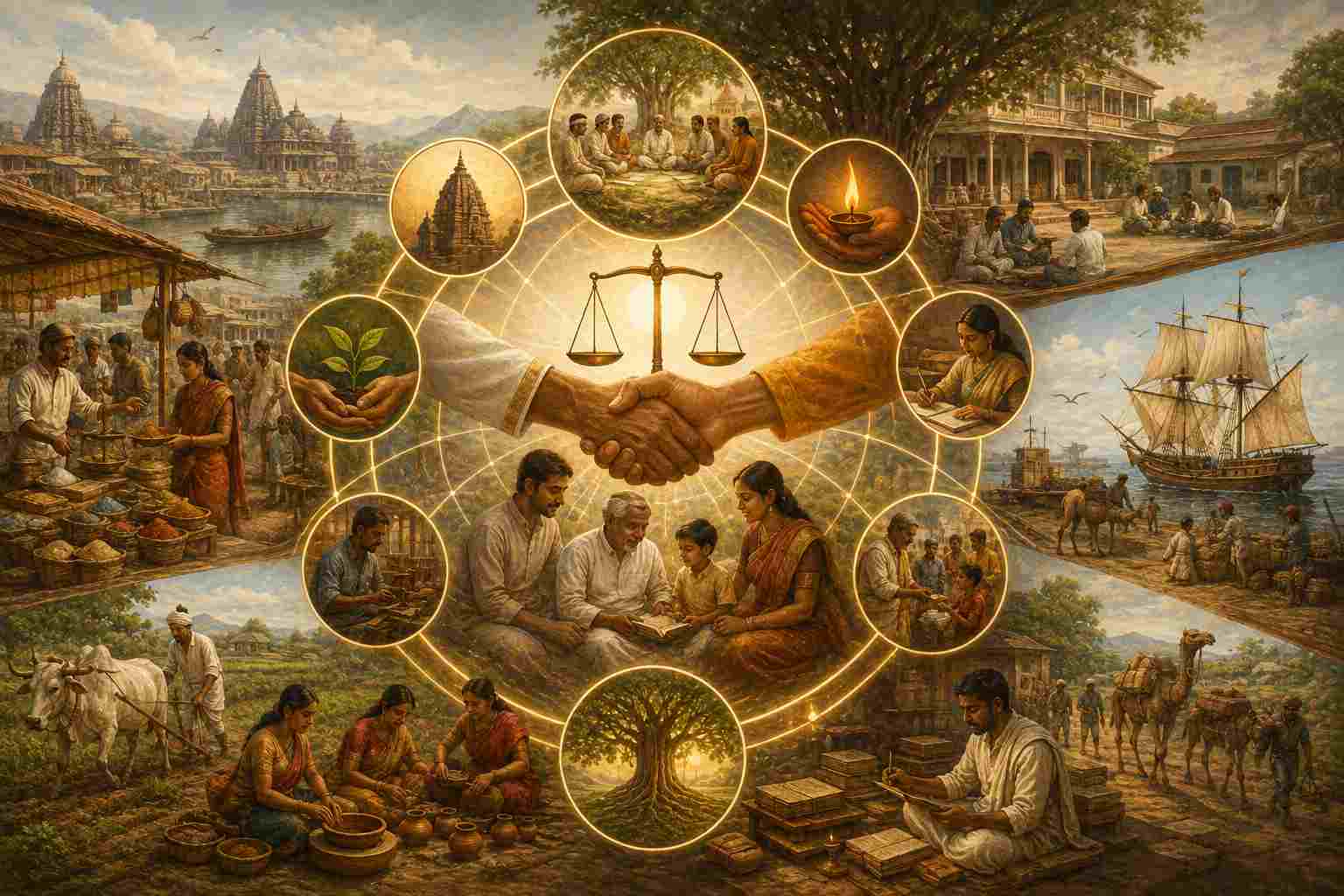
What keeps markets healthy?
The usual economic answer is familiar: contracts, prices, competition, regulation and the protection of property rights. All of these matter. But they are insufficient. A contract can specify obligations, yet it cannot produce trust by itself. A law can punish fraud after it occurs, but it cannot ensure that every economic relationship begins with good faith. A market may create exchange, but it cannot explain why people are willing to transact with one another in the first place.
Markets function because society exists, not the other way around.
This is the central argument of the Embedded Economy framework. Economic activity is not suspended above society as an autonomous sphere. It remains embedded within families, communities, ethical norms, reputational systems, religious values and institutions of reciprocity. When these structures are strong, markets acquire a form of social ecology. When they weaken, markets may continue to operate, but transaction costs, mistrust and exploitative behaviour increase.
The history of Bharat offers numerous examples of this principle.
Markets Within Dharma
In ancient Bharat, economic life was rarely imagined as entirely separate from moral life. Artha was one of the Purusharthas, but its pursuit existed within the larger civilizational framework of Dharma. Wealth was necessary, but the means of acquiring it and the responsibilities associated with it remained morally significant.
The Arthashastra, often interpreted only as a work of political realism, demonstrates the extent to which economic activity required supervision. Kauṭilya discusses weights and measures, adulteration, fraud, price manipulation and market officials. Trade was not left to an abstract self-regulating mechanism because the state understood that economic exchange depended upon standards of reliability and public trust.
This did not eliminate profit. The Arthashastra was not hostile to commerce. Its deeper implication was that markets could not remain socially healthy when dishonesty destroyed the conditions of exchange.
The Dharmashastra literature similarly connected economic activity with social responsibility. Trade, lending, inheritance and contracts were part of a wider normative universe. The moral foundations of the economy were therefore not an external addition to market activity. They helped define the legitimacy of economic conduct itself.
Guilds and the Economy of Reputation
Ancient and early medieval India developed complex commercial associations known as shrenis. These were not simply collections of producers. Guilds organised economic activity, regulated quality, preserved skills and, in some cases, accumulated col
lective resources and participated in financial transactions.
The Nasik inscriptions of the early centuries CE record deposits made with guilds, the interest from which supported religious or charitable purposes. Such examples demonstrate that economic associations could possess social and religious responsibilities beyond the immediate production of profit.
Why was this possible? Because the guild created an intermediate structure between the individual and the state. A merchant did not function merely as an isolated economic actor. He belonged to a network whose reputation could affect his economic credibility.
This is the importance of reputation. A modern contract can identify a legal breach. But in societies where long-term relationships and repeated transactions dominate, reputation performs an additional function. The dishonest trader risks not merely a single transaction but the trust accumulated over time. Economic life therefore depends upon a form of social memory. People remember who honoured their commitments. Communities remember who cheated. Networks remember who can be trusted.
Markets cannot generate this memory entirely through price.
Trade Beyond the Village, Trust Beyond the Family
The scale of Indian commerce also demonstrates that embeddedness does not mean economic isolation. Indian merchants participated in extensive trade networks across the Indian Ocean and Southeast Asia. Roman coins found in South India, inscriptions, port archaeology and literary evidence all demonstrate long-distance commercial connections.
Yet long-distance trade increased rather than eliminated the importance of trust.
A merchant crossing the Indian Ocean could not rely upon immediate state enforcement in every port. Trade depended upon commercial networks, intermediaries, community connections and shared norms. The family and community often provided the relationships through which commercial trust travelled across geographical distance.
The merchant therefore carried more than goods. He carried a reputation.
This principle continued in later Indian commercial networks. Merchant communities often developed sophisticated systems of credit and banking, including instruments such as the hundi. Their operation depended upon networks of trust extending across regions. A piece of paper had value because a social network stood behind it.
This is perhaps the clearest historical example of the Social Ecology of Markets: economic instruments function because social relationships make them credible.
Bhakti and the Moral Economy
The relationship between spirituality and economy also becomes visible in the Bhakti traditions. The temple was not merely a religious institution. In many regions, it became connected with land, craft production, patronage, food distribution and social organization.
Religious institutions could therefore function as nodes within economic life. Donations created redistributive networks. Festivals generated economic activity. Pilgrimage connected local economies to wider cultural networks.
But the deeper principle lay in the moralisation of wealth.
The Bhakti traditions repeatedly raised questions about greed, accumulation and social responsibility. Wealth was not necessarily rejected, but its moral purpose was questioned. Economic life remained connected with ideas of dāna, service and obligation.
The Jain and Vaishya traditions provide another important example. Jain ethical principles such as ahimsa, aparigraha and restraint influenced the moral world of commercial communities. Business success could coexist with philanthropy, education and the building of community institutions.
The point is not that every merchant behaved ideally. Historical communities, like modern corporations, were capable of competition and exploitation. The significance lies in the fact that economic success existed within an ethical vocabulary that could question its own excesses.
Family and Reciprocity
Perhaps the most underestimated institution of economic life is the family.
Families transmit skills, occupational knowledge, capital and trust. In many commercial communities, business relationships extended through kinship networks across generations. The family reduced uncertainty because economic actors possessed knowledge about one another that no formal contract could fully capture.
Reciprocity also mattered.
Not every exchange could be immediately calculated. Communities survived through relationships of assistance, obligation and mutual support. In agrarian societies, labour exchange, seasonal cooperation and shared management of common resources often depended upon social norms rather than direct market contracts.
This does not mean such systems were always equal or free from hierarchy. They were not. But they reveal an important fact: economic life was sustained by institutions that were not themselves primarily economic.
What Happens When the Social Ecology Weakens?
Colonial economic transformation provides an important contrast. New legal institutions, centralized administration, commercial agriculture and the expansion of global markets changed older economic relationships. Some changes increased mobility and opportunity; others weakened local institutions and customary arrangements.
The problem was not that markets expanded. The problem emerged when economic transformation became disconnected from the institutions that previously generated social responsibility and local accountability.
This raises a contemporary question.
Can contracts, algorithms and regulations replace trust?
They can reduce uncertainty, but they cannot entirely eliminate the need for moral behaviour. A society of universal mistrust becomes economically expensive. Every transaction requires greater verification. Every relationship demands surveillance. Every institution requires increasingly complex enforcement.
A healthy market therefore requires an invisible infrastructure.
The Social Ecology of Markets
The Embedded Economy framework proposes that markets depend upon multiple layers of non-economic life.
| Social Foundation | Economic Function |
|---|---|
| Trust | Reduces uncertainty |
| Ethical norms | Discourage fraud and exploitation |
| Family | Transmits capital, skills and long-term responsibility |
| Reputation | Creates accountability beyond formal law |
| Reciprocity | Enables cooperation where contracts are insufficient |
| Community networks | Extend trust across economic relationships |
| Religious and cultural values | Provide moral limits and social responsibility |
The economy is therefore not simply a machine for allocating resources. It is a social ecology. Just as an ecological system depends upon relationships among multiple organisms, a market depends upon relationships among institutions that do not appear on a balance sheet.
The market requires society to remain healthy.
A civilization that destroys trust in pursuit of economic efficiency may eventually discover that trust itself cannot be efficiently reconstructed. A society that treats family, community, morality and culture as economically irrelevant may weaken the very foundations upon which long-term economic cooperation depends. The future of the Embedded Economy therefore does not require abandoning markets. Bharat’s own history demonstrates the opposite: trade, profit, long-distance commerce and private enterprise can flourish within a broader moral and social order. The real challenge is to remember what markets themselves cannot create.
Contracts can record an obligation, but they cannot create the character to honour it. Prices can organize exchange, but they cannot produce trust. Wealth can circulate through society, but society determines whether wealth remains connected to responsibility.
Markets are embedded because human beings are embedded. And the health of an economy ultimately depends upon the health of the society that makes economic life possible.
