
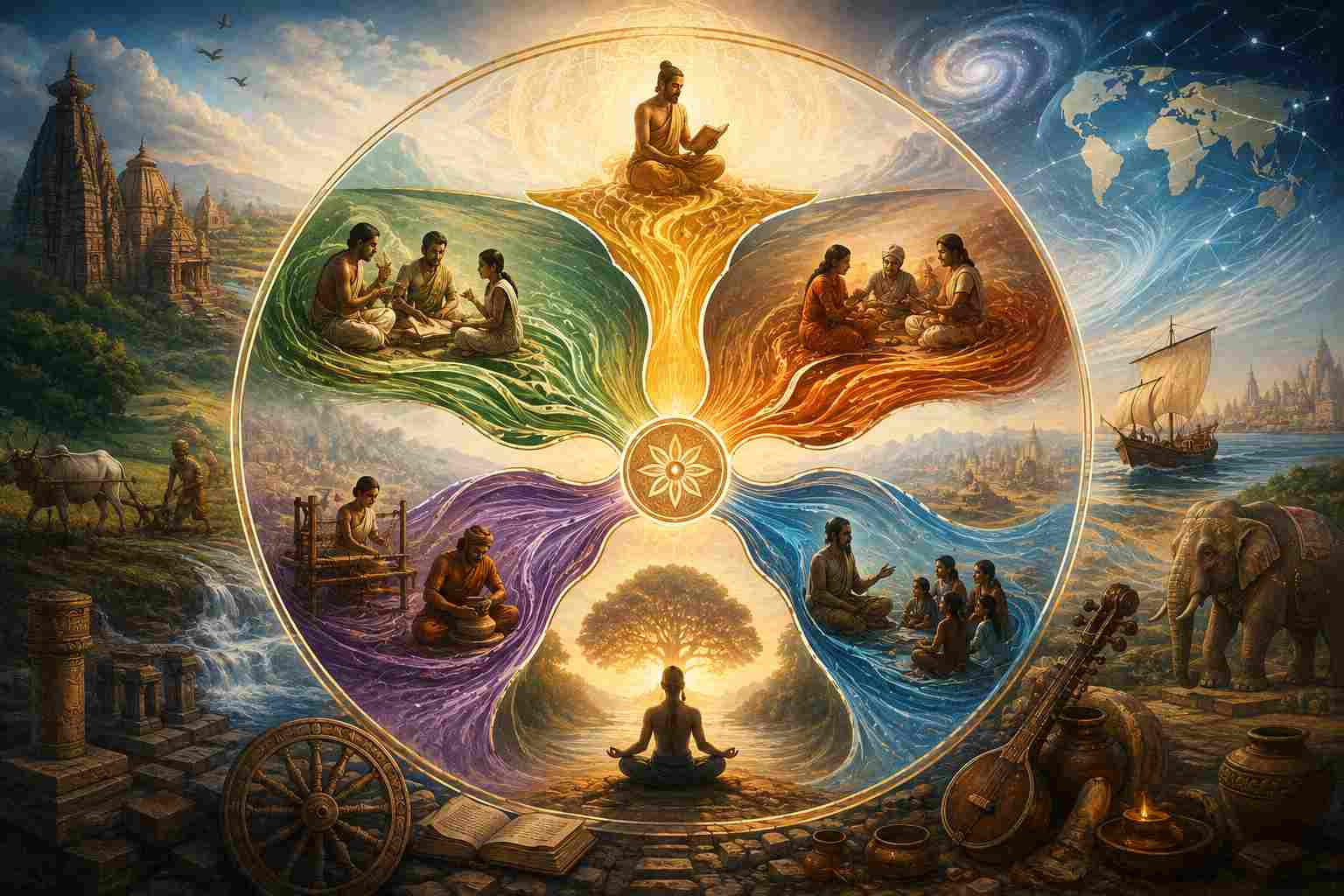
How does a civilization respond when it encounters something foreign?
The question has become increasingly important in an interconnected world where cultures, technologies, ideas, religions and institutions constantly move across boundaries. Yet much of the discussion remains trapped within a binary. A civilization either assimilates the external influence or resists it. It either opens itself or protects itself. It either changes or remains unchanged.
But can living civilizations really be understood through only these two responses?
The history of Bharat suggests otherwise. Civilizations do not always face the external with either unconditional acceptance or complete rejection. Between these extremes exists a wide range of responses. An idea may be accepted as it is. It may be adapted to local conditions. It may be transformed through indigenous categories. It may become integrated into a larger civilizational order. Or it may be rejected altogether.
This continuum can be understood through the Panchamrutam Model of Civilizational Exchange.
The name draws from Panchamrutam, the mixture of five elements that together create a transformed whole. The metaphor is significant. Civilizational exchange is not simply a matter of keeping or rejecting what comes from outside. Different elements can enter a civilizational space and undergo different processes. The external is not merely consumed. It is processed.
Beyond the Binary
Assimilation and resistance represent only the extreme ends of a larger spectrum. Assimilation assumes that the external becomes part of the receiving culture. Resistance assumes that the external remains outside. But what happens when a civilization receives an idea and changes it before adopting it? What happens when a foreign practice survives but acquires an entirely different meaning? What happens when the external becomes so deeply integrated that its foreign origin ceases to determine its civilizational role?
These questions require a wider framework.
The Panchamrutam Model proposes five possible civilizational responses: Acceptance, Adaptation, Transformation, Integration and Rejection. These should not be understood as a rigid historical sequence. A civilization may respond differently to different influences at the same time. The model instead provides a continuum through which civilizational encounters can be studied.
1. Acceptance
The first response is acceptance. A civilization may recognise value in an external idea, technology or practice and adopt it with relatively limited modification.
Acceptance does not necessarily mean submission. Every civilization must learn from beyond itself. A civilization incapable of accepting anything external may become intellectually stagnant. Knowledge does not become false merely because it emerges elsewhere.
The important question is whether acceptance takes place through civilizational agency. Is the civilization choosing to receive something because it considers it useful, or is it accepting it because the external has become the unquestioned standard of legitimacy?
The difference between learning and imitation begins here.
2. Adaptation
The second response is adaptation. The external enters, but it is modified according to the needs of the receiving society.
A political institution, technology or intellectual practice may not function in exactly the same manner when transferred from one civilizational context to another. The receiving culture therefore adjusts it to its own social structures, language and institutions.
Adaptation is one of the clearest demonstrations of civilizational agency. The civilization does not simply ask, “Should we accept or reject this?” It asks, “How can this work within our conditions?”
3. Transformation
Transformation represents a deeper process.
Here, the external influence is not merely adjusted. It is reinterpreted through the civilizational categories of the receiving society. Its original form changes, and it may acquire a meaning that its culture of origin did not intend.
Language plays a particularly important role in this process. Translation is never merely the replacement of one word with another. Concepts are placed within new intellectual worlds. They interact with existing categories and undergo transformation.
This is why civilizational exchange cannot be measured merely by tracing origins. Something may come from outside and yet become something substantially different after entering another civilizational system.
4. Integration
Integration occurs when the external becomes part of the larger civilizational order.
The integrated element no longer remains a disconnected foreign object. It develops relationships with existing institutions, practices and forms of life. It finds a place within the civilizational structure without necessarily destroying that structure.
This is where the strength of a civilization becomes most visible. Integration requires internal confidence. A weak civilization may either reject everything external out of fear or imitate everything external out of insecurity. A confident civilization can place the external within a larger order.
Integration, however, is not the same as assimilation. Assimilation can imply the disappearance of one identity into another. Integration allows the external to participate in a larger whole while retaining some distinct characteristics.
5. Rejection
Finally, a civilization may reject an external influence.
Rejection is not always evidence of backwardness or isolation. Every civilization requires the capacity to say no. If acceptance is necessary for learning, rejection is necessary for self-preservation. The question is whether rejection emerges from informed civilizational judgment or from fear. An external influence may conflict fundamentally with existing ethical principles, destroy social institutions or produce cultural alienation. In such circumstances, resistance may itself become a creative civilizational act.
The capacity to reject is therefore as important as the capacity to accept.
The Panchamrutam Model and the Cultural Spectrum
The Panchamrutam Model expands the Cultural Spectrum by explaining what happens at the moment of encounter. The Cultural Spectrum studies the possible consequences of cultural interaction, including assimilation, acculturation, appropriation and alienation. The Panchamrutam Model examines the civilizational response that helps determine which direction the encounter may take.
| Civilizational Response | Nature of the Process | Civilizational Purpose |
|---|---|---|
| Acceptance | Receiving the external | Learning |
| Adaptation | Modifying it to local conditions | Relevance |
| Transformation | Reinterpreting it through indigenous categories | Civilizational agency |
| Integration | Situating it within the larger whole | Continuity |
| Rejection | Refusing the external influence | Preservation |
The deeper lesson is that civilizations do not need to choose permanently between assimilation and resistance. A mature civilization develops the capacity to respond differently to different encounters. It can accept without surrendering. It can adapt without merely imitating. It can transform without losing agency. It can integrate without dissolving itself. And when necessary, it can reject without becoming isolated.
Civilizational strength, therefore, lies not in permanent openness or permanent resistance, but in the capacity to decide how every external influence should enter the larger civilizational order.
