
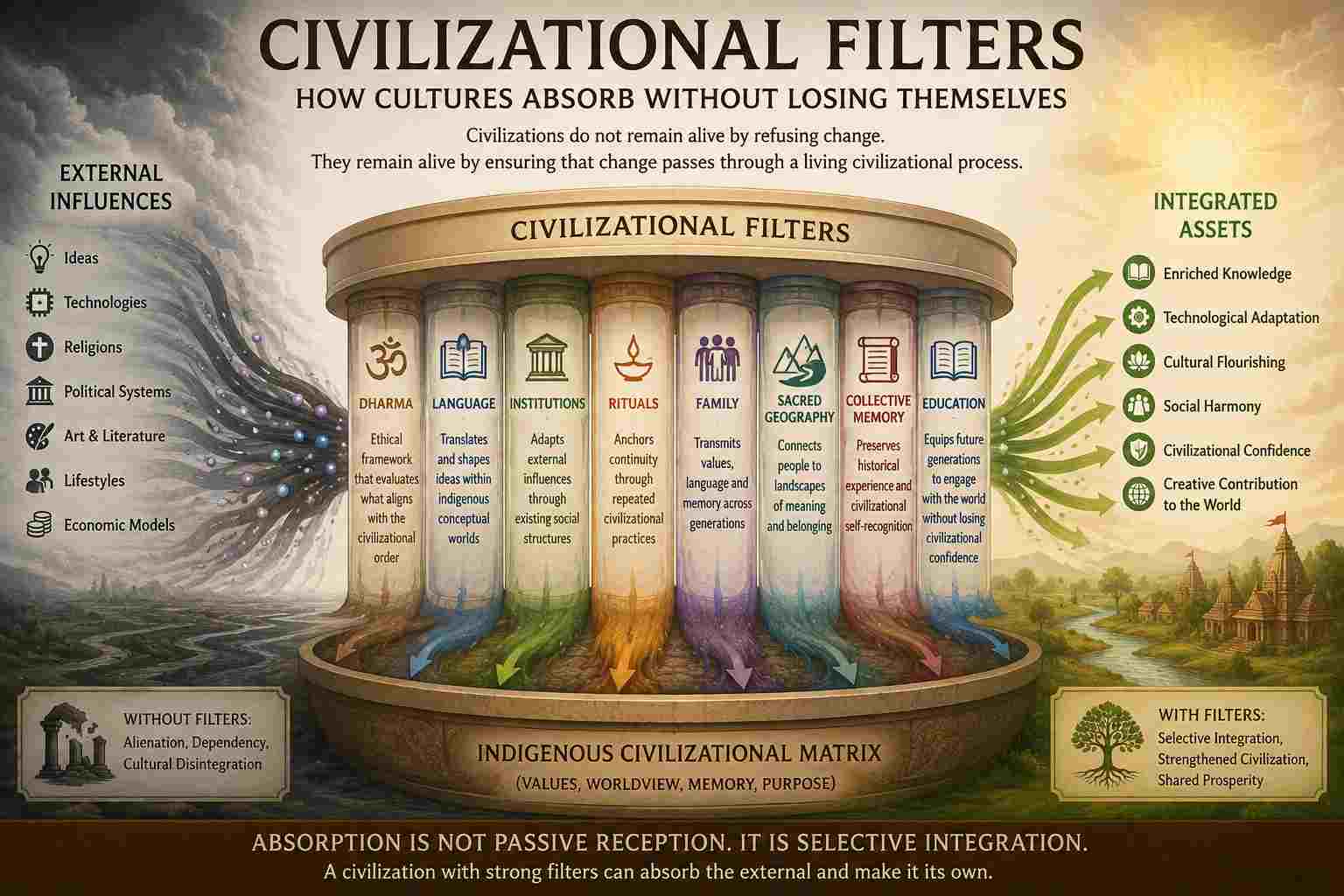
Why do some civilizations absorb foreign influences and emerge stronger, while others experience cultural disintegration?
The history of civilizations makes one thing clear: no civilization develops in complete isolation. Ideas travel. People migrate. Languages meet. Technologies spread. Religions encounter one another. Political institutions cross boundaries. Food, clothing, music, knowledge and artistic forms move from one society to another.
Cultural contact, therefore, is not exceptional. It is a permanent condition of civilizational history.
The real question is different. What happens when the foreign enters the civilizational space? Why does one civilization absorb an external idea, transform it and make it part of its own larger cultural world, while another gradually begins to lose its internal coherence? Why does foreign influence sometimes become a civilizational asset and at other times become a source of alienation?
The answer cannot simply be “openness” or “closedness.” A civilization that accepts everything without distinction may eventually lose its own internal coherence. A civilization that rejects everything foreign may become incapable of responding to a changing world.
The real civilizational capacity lies in selective integration.
This is where the idea of Civilizational Filters becomes important. Absorption is not passive. When a living civilization encounters an external influence, it does not merely receive it. It examines, translates, adapts, modifies and situates it within an existing civilizational structure. A civilization survives not because nothing enters it. It survives because it possesses the capacity to decide what can enter, how it will enter and what it will become after entering.
The Problem of Cultural Contact
Within the Cultural Spectrum, the encounter between two cultures does not automatically produce a single outcome. Cultural contact can lead towards assimilation, acculturation, appropriation, alienation or fragmentation. But these outcomes do not emerge merely because two cultures have met.
Something happens in between. That “something” is the process through which a civilization evaluates and responds to the external.
Consider two civilizations encountering the same foreign language, technology or intellectual system. One may adopt it while retaining its own conceptual world. Another may gradually begin to treat the foreign language as intellectually superior and its own as inadequate. The first has absorbed an instrument. The second may be moving towards alienation. The external influence is not necessarily different. The civilizational response is different.
This is why the Cultural Spectrum requires an additional concept. We must not only study what happens after cultures meet. We must also examine the internal mechanisms through which civilizations process cultural contact. These mechanisms may be called Civilizational Filters.
Civilizational Filters Are Not Walls
The word “filter” should not be confused with a wall. A wall prevents entry. A filter allows movement but does not permit everything to pass unchanged. This distinction is essential.
A civilization without filters may absorb every external influence in its original form. Over time, its own language, institutions, knowledge traditions and collective memory may lose their capacity to organize social life. The external does not merely add to the civilization; it begins to replace the internal.
A completely closed civilization faces another problem. It may reject useful ideas simply because they are foreign. Such rigidity can produce intellectual stagnation and eventually make the civilization incapable of adapting to new circumstances. Civilizational strength therefore lies neither in complete openness nor complete isolation. It lies in the ability to ask:
- Can this influence be absorbed?
- Does it conflict with the civilization’s fundamental ethical and social order?
- Can it be translated into indigenous categories?
- Will it strengthen existing institutions or gradually replace them?
- Can it be adapted without creating alienation from civilizational memory?
These questions reveal that absorption is an active civilizational process.
1. Dharma as an Ethical Filter
The first and perhaps most important filter in the Indic context is Dharma.
Dharma does not function as a simple command to accept or reject everything. Its significance lies in providing a broader framework for evaluating action, relationship and social order. The external is therefore not assessed merely according to its novelty or power. It can be examined according to whether it can be situated within a larger ethical and civilizational framework.
This is one reason why foreign influences can enter a civilization without necessarily becoming its ultimate source of legitimacy. The external may be useful. It may be powerful. It may even transform social practice. But usefulness alone does not automatically determine its place within the civilization. Dharma provides the possibility of evaluation.
A civilization capable of evaluation can absorb. A civilization that loses the capacity to evaluate may only imitate.
2. Language as a Filter of Thought
Language is not merely a means of communication. It is one of the primary structures through which a civilization thinks. When an external idea enters through another language, a civilization faces an important question: Can this idea be translated into its own conceptual world?
Translation is not a mechanical process. A word may travel from one language to another, but the concept does not always remain identical. Through translation, the civilization begins to interpret the external through its own categories.
This is a form of civilizational agency. If translation disappears, however, a different process may begin. The foreign language can become the exclusive medium through which intellectual legitimacy is determined. Indigenous languages may gradually lose their ability to generate knowledge. Eventually, a civilization may continue speaking its own languages in daily life while thinking about politics, economics and society almost entirely through categories developed elsewhere.
This is not simple cultural exchange. It can become epistemic alienation. Language therefore acts as a filter because it determines whether the external is merely imported or intellectually processed.
3. Institutions as Filters
Civilizations do not exist only in ideas. They live through institutions.
Family, community structures, educational traditions, local bodies, religious organizations and systems of social authority all shape how new ideas enter society. An external practice that enters a civilization does not immediately encounter an empty population. It encounters existing institutions. These institutions can adapt the external.
A new technology may be absorbed differently by different family structures. A foreign intellectual system may be taught differently depending upon the educational framework. Political ideas may take different forms when they encounter local institutions.
This is why the weakening of institutions has consequences beyond administration. When institutions collapse, the civilization loses some of its capacity to process external influences. The individual becomes more directly exposed to global cultural power without the mediating structures that previously created continuity and belonging.
The result may not be assimilation in the ordinary sense. It may be something more subtle: alienation without conscious cultural conversion.
4. Ritual and Family: Filters of Everyday Continuity
Ideas alone do not hold civilizations together. Civilizations are reproduced through repeated practice.
Ritual is one such mechanism. It creates continuity across generations through recurring acts, festivals, symbols and shared forms of participation. A person may encounter new ideas while remaining connected to a larger civilizational rhythm.
The family performs a similar function. Civilizational memory is rarely transmitted only through formal education. It is transmitted through language at home, stories, food, practices, ceremonies and relationships between generations. The family can therefore function as a filter between the expanding external world and the developing individual.
When these everyday structures weaken, external influences enter more directly. This does not mean every change is destructive. But it means that the mechanisms through which a civilization traditionally interpreted change may themselves become weaker. The problem is therefore not foreign influence by itself. The problem is foreign influence entering a society whose internal filters have already lost their capacity to operate.
5. Sacred Geography and Collective Memory
Civilizations also live through geography.
Sacred places, pilgrimage routes, rivers, mountains and historically remembered landscapes create a connection between culture and physical space. They remind communities that they do not exist merely in the present. Their identity is connected to a remembered geography extending across generations.
Collective memory performs a similar function. A civilization that remembers its past does not necessarily become trapped by it. Memory provides a reference point through which change can be understood. The civilization can ask whether something new represents continuity, adaptation, rupture or loss. Without memory, however, every generation becomes easier to redefine.
The external then appears not as one possibility among many but as the only available horizon. This is why civilizational memory is not simply about remembering ancient achievements. Its deeper purpose is to preserve the capacity for self-recognition.
6. Education and the Reproduction of Filters
Perhaps no filter is more important for the future than education. Every civilization must decide what its next generation needs to know in order to participate in the world without becoming alienated from itself. Education determines whether the civilizational filters remain living structures or become museum objects.
A society can preserve its rituals and festivals while educating its young to believe that its own intellectual traditions possess no analytical value. It can celebrate its past while training every generation to think that serious knowledge comes only from elsewhere. Such a civilization may retain cultural symbols while losing epistemic confidence. Education must therefore perform a difficult task. It must enable engagement with the world without producing intellectual dependency. It must create openness without civilizational amnesia.
Absorption, Alienation and the Cultural Spectrum
The concept of Civilizational Filters allows us to understand the Cultural Spectrum more clearly. When two cultures meet, assimilation may occur when the external becomes incorporated into the larger civilizational order. Acculturation may emerge through mutual exchange and adaptation. Appropriation can occur when one culture extracts from another without adequate relationship or context.
But when civilizational filters weaken, the movement can shift towards alienation.
A society begins to consume external forms without processing them through its own ethical, linguistic and institutional structures. The individual may become disconnected from collective memory. The family may no longer transmit continuity. Indigenous languages may lose intellectual authority. Education may reproduce only external categories.
The final result may be fragmentation. Thus, the Cultural Spectrum is not simply a sequence describing what cultures do to each other. It also describes what happens within a civilization when its capacity to process cultural contact changes.
Conclusion: Selective Integration as Civilizational Capacity
The question is not whether a civilization absorbs foreign influences. Every major civilization does. The real question is whether it possesses the internal capacity to absorb without losing itself.
| Civilizational Filter | What It Evaluates or Preserves | When the Filter Weakens |
|---|---|---|
| Dharma | Ethical and civilizational orientation | External power becomes the primary measure |
| Language | Conceptual translation and intellectual continuity | Epistemic alienation |
| Institutions | Social adaptation and continuity | Direct cultural displacement |
| Ritual | Repeated civilizational practice | Weakening of everyday continuity |
| Family | Intergenerational transmission | Loss of cultural memory |
| Sacred Geography | Civilizational connection to space | Territorial and historical detachment |
| Collective Memory | Capacity for self-recognition | Civilizational amnesia |
| Education | Reproduction of civilizational confidence | Intellectual dependency |
A civilization does not remain alive by refusing change. It remains alive by ensuring that change passes through a living civilizational process. This is the central argument of Civilizational Filters: absorption is not passive reception. It is selective integration.
The strongest civilizations are therefore not necessarily those that reject the foreign. Nor are they those that surrender to every powerful influence. Their strength lies in a more difficult capacity: they can receive without merely imitating, translate without losing meaning, adapt without abandoning memory and integrate without dissolving their civilizational self.
That may be the difference between cultural growth and cultural disintegration. A civilization with strong filters can absorb the external and make it its own. A civilization that loses its filters may continue to receive—but it no longer knows what it is receiving, why it is receiving it or what it is gradually becoming.
