When does cultural exchange become cultural alienation?
Every society changes through contact. Languages borrow words, cuisines absorb new ingredients, technologies transform everyday life and ideas travel across borders. Globalization has merely accelerated a process that has existed throughout human history. Bharat itself has never developed in complete isolation. Its history is marked by trade, migration, intellectual exchange and cultural encounters extending far beyond the subcontinent.
Therefore, the question is not whether cultures should change. They always do.
The more important question is whether a society remains capable of interpreting change through its own civilizational categories. Can it receive new influences without losing its own vocabulary for understanding life? Can it adopt new technology without assuming that its older knowledge has become meaningless? Can a generation participate in a global world without becoming alienated from the family, language, history and traditions that formed it?
This distinction between change and alienation is at the heart of the tenth Indic framework.
Cultural Change Is Not Cultural Alienation
Modern discussions often treat cultural change as a simple opposition between tradition and modernity. A society is either changing and becoming modern, or resisting change and remaining traditional. This framework is inadequate because cultures rarely operate in such a simple manner.
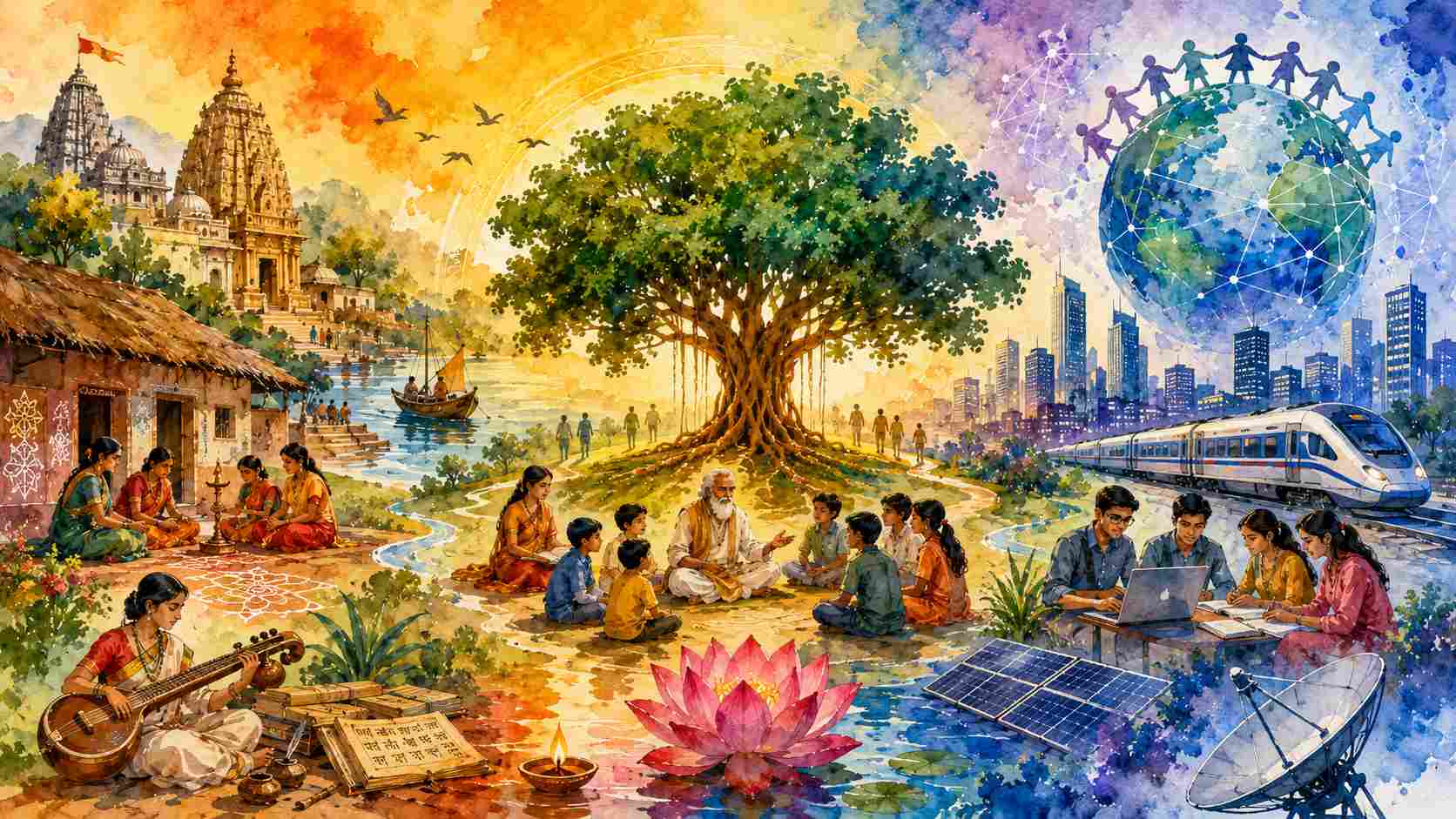
A society can modernize while maintaining cultural continuity. It can adopt new technology without abandoning its language. It can participate in global markets while preserving local institutions. It can encounter new ideas and still interpret them through its own intellectual traditions.
Bharat itself provides a long history of such processes. Different communities adopted external influences but did not necessarily lose their civilizational location. New forms were often translated into existing social and cultural vocabularies. Foreign ideas could be debated, adopted, transformed or rejected. Cultural life did not remain frozen, but neither did every encounter automatically produce alienation.
The difference lies in the ability to interpret.
A society that receives an external influence and places it within its own civilizational understanding is participating in cultural exchange. A society that begins to believe it has no categories of its own through which to understand the world may experience something deeper.
It may experience alienation.
Alienation begins when change no longer emerges through an active relationship with one’s own civilizational inheritance. The inherited vocabulary becomes embarrassing, irrelevant or intellectually invisible. The society continues to live, consume and produce, but it loses confidence in the categories through which it once interpreted itself.
This is why cultural alienation cannot simply be measured by external appearances. Wearing new clothes does not automatically produce alienation. Speaking a global language does not automatically produce alienation. Using foreign technology certainly does not produce alienation.
The more serious question is whether these new forms gradually make the society incapable of understanding itself without external categories.
The Difference Between Adoption and Dependence
A society may borrow something without becoming dependent upon the worldview from which it emerged. This distinction is crucial.
English may become a language of global communication without replacing every indigenous language of knowledge and emotion. Modern medicine can coexist with traditional knowledge systems. New technologies can transform education while older modes of learning and transmission continue to have meaning. Global forms of music, food and entertainment can enter society without eliminating local traditions.
The problem emerges when the imported framework becomes the only legitimate framework through which society understands itself.
At that point, adoption begins to turn into intellectual dependence.
This is particularly significant in postcolonial societies. Political decolonization does not automatically produce cultural or intellectual decolonization. A society may regain political sovereignty while continuing to describe itself primarily through categories developed elsewhere. Its own concepts survive as cultural objects but lose the ability to function as intellectual tools.
This produces a peculiar condition. A civilization may possess a long intellectual history and yet become unable to use that history to interpret contemporary problems.
It knows its traditions. But does not think through them. It preserves its vocabulary. But does not develop it. It celebrates its past. But does not use its inherited categories to understand its present. This is one of the most important forms of alienation in a global age.
Can Cultural Resilience Be Measured?
We often measure societies through economic indicators. We measure growth, income, literacy, health and infrastructure. These measurements are necessary. But they tell us very little about a society’s capacity to maintain cultural continuity while undergoing rapid transformation.
Two societies may experience similar levels of economic development but possess very different levels of cultural resilience.
One may modernize while maintaining strong language, family and institutional continuity. The other may experience increasing economic integration alongside a rapid loss of intergenerational knowledge and historical consciousness.
Both may be developing. But are they developing in the same way?
The tenth Indic framework therefore proposes that cultural resilience must become an object of measurement. This does not mean reducing civilization to a simple score. Human cultures are too complex for that. However, it is possible to identify indicators that help us understand whether a society retains the capacity to transmit its civilizational life across generations.
Language Continuity
Language is one of the most visible indicators of cultural resilience. When a language disappears, a society does not merely lose a communication system. It may also lose metaphors, memories, categories of thought, oral traditions and ways of experiencing the world.
The important question is not whether people learn global languages. Multilingualism has historically enriched Bharat. The concern begins when younger generations lose the ability to access their own languages altogether.
Can they speak the language of their grandparents? Can they read its literature? Can knowledge be created in that language? The answers reveal something about cultural continuity.
Family and Ritual Continuity
The family is one of the primary sites of cultural transmission. Stories, food practices, rituals, relationships with elders and collective celebrations often move from one generation to another through family life rather than formal institutions.
Ritual participation also performs an important social function. Rituals create temporal continuity by connecting individuals to shared calendars, festivals and collective memory. They may change over time, but their continued participation reveals whether cultural life remains embedded in everyday social relationships.
The relevant question is therefore not whether every tradition survives in exactly its old form. It is whether families and communities continue to transmit something.
Historical Consciousness and Knowledge Transmission
A society can lose its civilizational continuity even while preserving monuments and festivals. Continuity also requires memory.
Do younger generations know the history of their own society? Can they distinguish between civilizational memory and political mythology? Do they understand the intellectual traditions, debates and transformations that produced their present?
Historical consciousness is important because alienation often begins with a rupture in time. The past becomes something unrelated to the present. A society begins to imagine itself as having suddenly appeared in the modern world.
Knowledge transmission raises a related question. Are traditional bodies of knowledge merely preserved as heritage, or can they continue to participate in contemporary intellectual life? A civilization becomes increasingly vulnerable when its knowledge traditions are reduced to museum objects while all contemporary thought must arrive from elsewhere.
Continuity requires more than preservation.
It requires intellectual use.
Institutional Continuity and Civilizational Confidence
Cultural life also requires institutions. Families alone cannot preserve everything. Educational institutions, religious organizations, local communities, artistic traditions and knowledge networks all play a role in carrying civilizational life forward.
The continuity of an institution does not mean that it must remain unchanged. Institutions may need to adapt to new social conditions. The more important question is whether they retain the capacity to transmit knowledge, memory and social relationships.
This is closely connected to civilizational confidence.
Civilizational confidence should not be confused with cultural arrogance. A society does not demonstrate confidence by claiming that it is superior to everyone else. Genuine confidence is the ability to encounter other civilizations without either blindly rejecting them or automatically considering one’s own traditions inferior.
An insecure civilization often moves between two extremes: imitation and defensiveness. It either assumes that everything external is superior or treats every external influence as a threat. A confident civilization can learn without surrendering. It can preserve without becoming static. It can criticize its own traditions without losing the ability to understand them.
This may be the most important indicator of cultural resilience.
From Cultural Change to Cultural Resilience
The tenth Indic framework therefore shifts the discussion from cultural change to cultural resilience. Change is inevitable. Alienation is not.
A society becomes resilient when it possesses the capacity to receive, interpret, adapt and respond to new influences while maintaining continuity with its own civilizational memory. It becomes vulnerable when that capacity weakens.
The proposed indicators—language continuity, family traditions, ritual participation, historical consciousness, institutional continuity, knowledge transmission and civilizational confidence—should therefore be understood as a framework rather than a rigid index. Together, they can help us ask a deeper question about contemporary societies:
Are we merely changing, or are we losing the ability to remain ourselves while changing?
This distinction is particularly important in a global age. Globalization is unlikely to reverse. Cultures will continue to interact at unprecedented speed. The challenge is not to build walls around civilizations. A civilization that completely isolates itself may become as intellectually stagnant as one that completely abandons its inheritance.
The challenge is to maintain the ability to enter into dialogue without losing one’s own voice.
The Sanātana perspective developed throughout these Indic frameworks offers one possible way of understanding this challenge. Continuity does not require the permanence of every form. A living civilization changes, adapts and responds. But it must retain the relationships, memories and categories through which it can regenerate itself.
The real measure of cultural resilience, therefore, may not be how successfully a society prevents change. It may be how successfully it ensures that change does not sever the relationship between generations. A global civilization will influence us. The real question is whether we will still possess the civilizational vocabulary to interpret that influence.
Alienation begins when a society loses that capacity. Continuity survives when it can change without becoming a stranger to itself.This is the final question of the ten Indic frameworks: Can a civilization remain connected to its own civilizational self while participating fully in a changing world?
The answer will not be found in rejecting globalization or worshipping tradition. It will depend upon something more difficult: the capacity to build a modern future while remaining capable of remembering, interpreting and renewing the civilizational inheritance that makes that future meaningful.
