
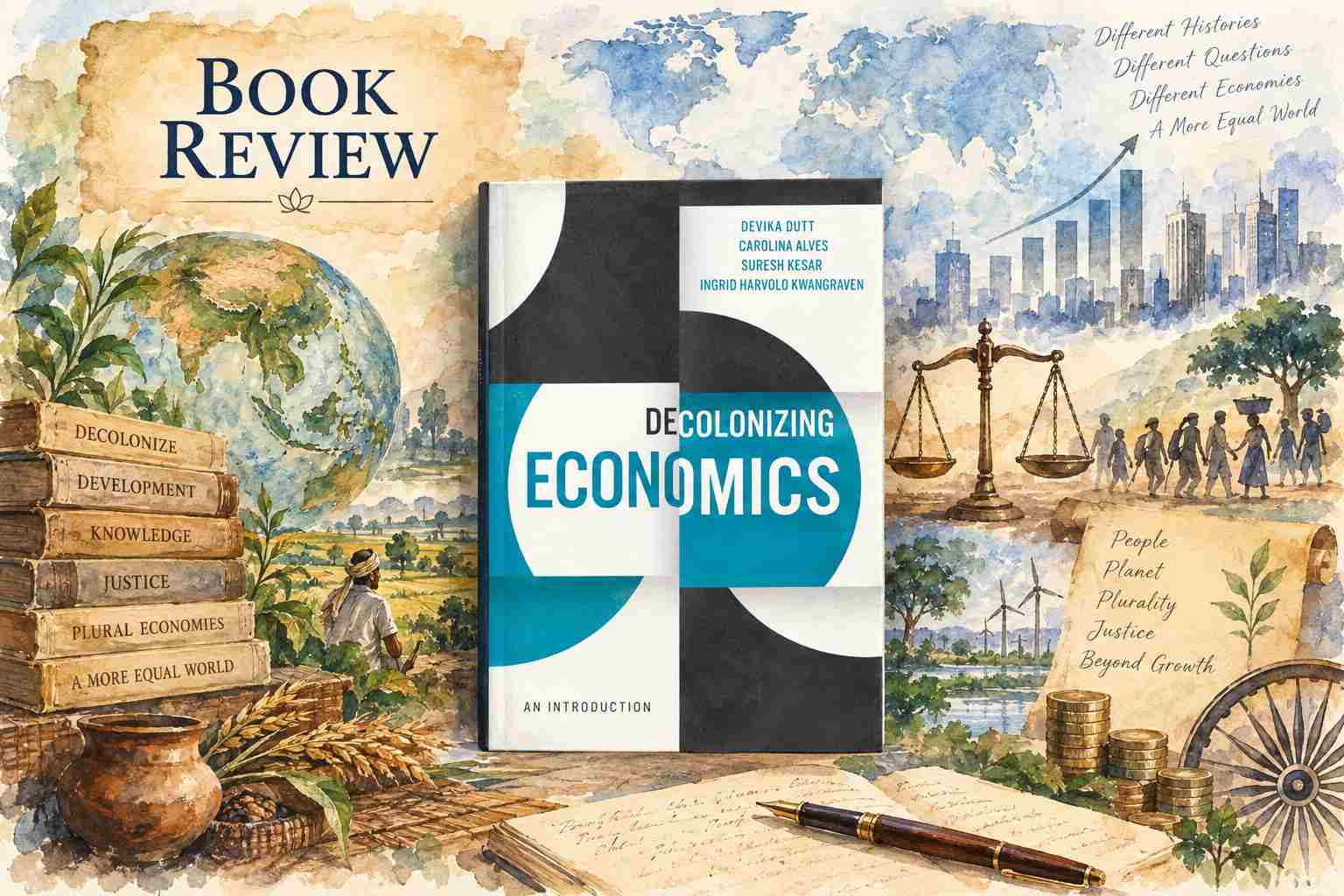
A book review of Decolonizing Economics
[Book is By Devika Dutt, Carolina Alves, Surbhi Kesar & Ingrid Harvold Kvangraven (Polity Press, 2025)]
The Book review is by Shailja Tewari
Most of us treat economics the way we treat physics as a neutral science that simply describes how the world works. Supply meets demand, markets find their balance, and growth happens because people work hard and use resources wisely. Decolonizing Economics asks a simple but disruptive question: what if this “science” was never neutral to begin with? What if it was built to describe only one part of the world that is Europe and its former colonies of settlement and then quietly presented as a universal truth for everyone else?
The four authors, all trained in heterodox economics departments and connected through a scholarly network called D-Econ, do not write this book as detached observers. They write as economists who felt something was missing in their own education, and went looking for it. What they found fills nine chapters, and it ranges from Adam Smith’s Scotland to British-ruled India, from Cold War Washington to the streets of apartheid South Africa. Here is what each chapter has to say.
The book opens by pointing out something surprising: economics has enormous power over how the world is run, but very little diversity in who gets to shape it. The authors cite research showing that nearly 90 percent of authors published in the world’s top economics journals are based in the United States or Western Europe. Even the economist Dani Rodrik, very much a mainstream figure, has written about this imbalance. He praised how fieldwork in Kenya helped Joseph Stiglitz develop a Nobel Prize-winning theory, and how time spent in Nigeria shaped Albert Hirschman’s famous ideas. But the authors point out the problem hiding in Rodrik’s own words: he calls these places “unfamiliar” and their economic behaviour “anomalous”, as if the rest of the world is the exception, and only the West is the rule.
This chapter also gives us the book’s most powerful home-grown example: the debate over caste-based reservations in India. Once economics frames every policy question in terms of “efficiency,” the conversation about reservations shifts to whether they cause a loss of merit or misallocation of resources, instead of asking why entire communities were shut out of opportunity in the first place. The deeper structural work of scholars like B.R. Ambedkar, who wrote about caste as a system of organized inequality, simply does not fit into this framework.
How is Economics Eurocentric?
The second chapter takes on the most cherished origin story in economics: that capitalism began in England because free markets, private property, and Enlightenment-era rational thinking naturally led to progress. Adam Smith’s 1776 book The Wealth of Nations is usually treated as the founding document of this story, especially his idea of the “invisible hand”, the notion that individuals pursuing their own self-interest end up benefiting society as a whole.
The authors offer a very different account. Capitalism, they argue, was not a natural outcome of trade and technology. It required the violent uprooting of ordinary people from common land in England, a process the historian E.P. Thompson described it in his book The Making of the English Working Class. The historian Eric Williams, in his classic Capitalism and Slavery, showed how profits from slavery funded England’s shipbuilding industry and helped power its Industrial Revolution. The book adds a striking number: by 1801, colonies were contributing roughly 6 percent of Britain’s entire GDP.
For Indian readers, the most familiar example arrives here. British land-title reforms in colonial India are shown not as a neutral, modernizing step, but as a tool that let dominant landholding groups seize formal ownership over land that had long been cultivated by farming communities who then lost their traditional claims once ownership was reduced to paperwork (a process the scholar Kancha Ilaiah has written about). A similar pattern shows up with tribal common land: the moment it is given a formal market “title,” it becomes vulnerable to being taken over by those with more money and power.
The chapter closes by rescuing some forgotten thinkers. Long before Adam Smith, Chinese philosophers had already described something close to free-market thinking, calling it wu-wei a concept later translated into French as laissez-faire. The 14th-century Arab scholar Ibn Khaldun wrote about the benefits of dividing labour long before it appeared in European economics. And from India itself, the political leader and economist Dadabhai Naoroji had, by the late 1800s, already developed his own “drain theory”, a detailed argument that British rule was not developing India, but systematically draining wealth out of it. Even the famous economist Joseph Schumpeter admitted there is a “great gap” in the official history of economic ideas. This chapter is essentially an attempt to fill that gap back in.
If Chapter 2 is about capitalism’s real history, Chapter 3 is about how the study of that history got squeezed into a much smaller box. In the 1800s, economists like Adam Smith, David Ricardo, and Karl Marx were doing what was then called “political economy”, a field that took politics, history, and social class seriously. Over time, thinkers like William Stanley Jevons, Léon Walras, and Alfred Marshall pushed the field towards mathematics, believing economics could become as precise as physics. This is known as the “marginalist revolution,” because it introduced the idea of “marginal utility” : the extra satisfaction gained from consuming just one more unit of something.
The authors argue this shift wasn’t just about better tools, it was political. During the Cold War, when capitalism and socialism were competing for the world’s future, mathematical, “neutral-looking” economics was extremely useful to Western governments, because it made capitalism’s outcomes appear automatic and efficient rather than the result of choices and power struggles. Institutions like the RAND Corporation funded research that fit this mould, while economists sympathetic to socialism were pushed out of universities. The chapter also takes aim at economics textbooks. It quotes the famous economist Paul Samuelson, who once said, “Let those who will write the nation’s laws, if I can write its textbooks,” to make the point that textbooks shape how millions of students see the world, often more powerfully than actual policy debates do.
This chapter four is one of the most gripping chapters in the book. It tells two very different origin stories for “development economics” , the field devoted to studying poverty and growth in poorer countries. The standard story begins with U.S. President Harry Truman’s 1949 speech, where he promised American scientific and technical help to “underdeveloped areas. But long before Truman’s speech, leaders from newly independent and colonized nations were already demanding a fairer global economy. At the 1944 Bretton Woods conference, where the World Bank and IMF were created, delegates from Latin America, India, and China pushed hard for the interests of poorer nations to be represented, a Mexican delegate famously told John Maynard Keynes, in effect, that development mattered just as much as Europe’s post-war reconstruction.
This alternative vision was crushed, often violently. The book documents how the CIA backed coups and assassinations against left-leaning leaders across the developing world during the Cold War, including the killing of Congo’s Patrice Lumumba in 1961 and the coup against Chile’s Salvador Allende in 1973. Later, in the 1980s, the IMF and World Bank pushed “Structural Adjustment Programs” onto indebted countries, forcing privatization and deregulation, which the book notes often failed to reduce poverty and, in many places, made it worse.
The chapter ends with a critique of a very modern trend: the rise of Randomized Controlled Trials (RCTs) in development economics, made famous by economists Esther Duflo, Abhijit Banerjee, and Michael Kremer, who won the Nobel Prize in 2019 for this work. RCTs treat poverty as a series of small, fixable problems, does a cash transfer change behaviour? but the authors argue this approach quietly drops the bigger historical question of why poverty and inequality between nations exist in the first place.
Having spent four chapters describing the problem, chapter 5 turns towards possible answers, starting with what is called “heterodox economics” a broad umbrella covering Marxist economics, post-Keynesian economics, feminist economics, and dependency theory, among others. These traditions share one important habit: they begin their analysis with power and class, not with an imaginary, perfectly rational individual.
The authors give three simple, powerful examples. First, on wages: standard economics assumes that in a “tight” job market, workers automatically gain more power. Heterodox economists point out that employers hold structural power regardless, because they own the product of the worker’s labour echoing the economist Michał Kalecki’s argument that governments sometimes prefer some unemployment specifically because full employment gives workers too much bargaining power. Second, on global money: the book shows that the world’s currencies are not equal, but arranged in a hierarchy, with the US dollar at the very top. It gives the striking example of the CFA Franc, a currency still used by many former French colonies in Africa today, whose value and rules are still tied to old colonial arrangements, not free economic choice. Third, on discrimination: instead of blaming individual prejudice, heterodox scholars including Harold Wolpe’s classic analysis of apartheid in South Africa, study how entire economic systems are designed to keep certain groups locked into cheap, exploitable labour.
Chapter Six is the theoretical heart of the book, where the authors lay out their own framework. They are careful to avoid two traps. The first trap is pretending that European economic ideas are universal truths that apply everywhere unchanged. The second trap, just as dangerous, is swinging too far the other way and romanticizing everything “traditional” or “native” as automatically better, which the influential Egyptian economist Samir Amin warned was really just “inverted Eurocentrism” wearing a different mask. The authors call for something they name “radical universalism”, ideas that are rooted in local, lived realities but that can still speak to shared human struggles across the world. As an example, they point to the Haitian Revolution of 1791–1804, when enslaved people overthrew their colonizers and built the first nation in history to legally guarantee universal freedom, arguably a more genuine origin point for the modern idea of human freedom than anything written in Europe at the time.
This chapter also introduces the concept of homo economicus, the imaginary “rational economic man” who sits at the centre of most economic models, always calculating, always self-interested. The authors argue this figure is not neutral at all: it quietly assumes a particular kind of person, usually male, modern, and Western as the standard against which everyone else is measured and found lacking.
In chapter 7 the book gets specific, showing decolonized economics in action through the work of dependency theorists, mostly from Latin America, but with lessons that apply directly to India and other post-colonial economies. The Argentine economist Raul Prebisch, who coined the term “periphery” in 1944, showed that countries exporting raw materials (like cotton or minerals) tend to get poorer terms of trade over time compared to countries exporting manufactured goods, a pattern now known as the Prebisch-Singer thesis. This insight led directly to the creation of CEPAL, a Latin American research institution built specifically to study development from the viewpoint of poorer countries, rather than borrowing theories built for rich ones.
The book also introduces the idea of “super-exploitation,” developed by the Brazilian theorist Ruy Mauro Marini, describing how workers in poorer countries are often paid even less than what’s needed to sustain their basic wellbeing, not an accident, but a structural feature of how the global economy is organized. Another Latin American scholar, Vânia Bambirra, extended this idea to show how working-class women face a “double” burden, exploited both as workers and as women, an early and often-overlooked example of what we would now call intersectional thinking. The economist Branko Milanovic is cited for a striking modern statistic: unskilled workers’ wages in rich countries can be around ten times higher than in poorer countries, even where the actual productivity gap is far smaller.
The eighth chapter is the book’s most practical chapter, aimed directly at classrooms. The authors argue that decolonizing an economics course does not mean throwing away every European thinker or adding a few token names to a reading list. Instead, it means teaching students to question theory at three levels: to think critically within a single theory, to compare competing theories against each other, and to ask bigger questions about why certain ideas became “the canon” in the first place while others were pushed aside.
They give a wonderful worked example using comparative advantage, the classic trade theory developed by David Ricardo, which says countries benefit by specializing in what they produce best and trading for everything else. The authors suggest teaching this theory alongside the fact that Ricardo was himself a wealthy landowner who opposed tariffs on imported grain (the “Corn Laws”), a reminder that even the most “neutral-sounding” economic theory can serve a particular set of interests. They also point out, sharply, that Indian scholars who studied caste as a structural economic force, B.R. Ambedkar, Kancha Ilaiah, and Anand Teltumbde — remain almost entirely missing from economics syllabi, even in departments that consider themselves progressive or “heterodox.”
The book ends on a note of honesty rather than celebration. The authors admit that “decolonization” has become fashionable, you can now buy t-shirts with the word printed on them, or attend corporate diversity workshops that use the term while leaving real power structures completely untouched. They borrow a sharp phrase for this, “fake decolonization” to describe the watered-down, marketable version of an idea that was originally meant to challenge deep inequality.
Real decolonization, they insist, is not comfortable, and it does not end with a better reading list. It is a political project connected to real struggles happening in the world the book pointedly notes how universities that were eager to talk about “decolonizing curricula” often reacted very differently when students protested against the war on Gaza, showing the limits of decolonization as mere language.
The book closes without offering a tidy, finished alternative to mainstream economics and it says so itself. Its authors describe their work as only “laying the seeds” for something larger, an invitation for the next generation of economists, especially those from the parts of the world that mainstream economics has spent two centuries speaking about rather than listening to, to keep building.
Summary:
Decolonizing Economics is a book written by economists who love the subject enough to be frustrated by how narrowly it has been taught. Its biggest strength is refusing to treat “the Global South,” including India, as a passive case study waiting to be explained by theories built somewhere else. Instead, it treats thinkers like Dadabhai Naoroji, B.R. Ambedkar, Raúl Prebisch, and Ruy Mauro Marini as economists in their own right who were doing rigorous, original theoretical work, simply from a vantage point the mainstream discipline chose not to look from.
Readers looking for a finished, ready-made alternative to standard economics textbooks may come away wanting more, the authors are candid that this is a starting point, not a destination. But as an invitation to ask a very old, very simple question: who gets to decide what counts as economic knowledge? In this argument the book succeeds completely.
