
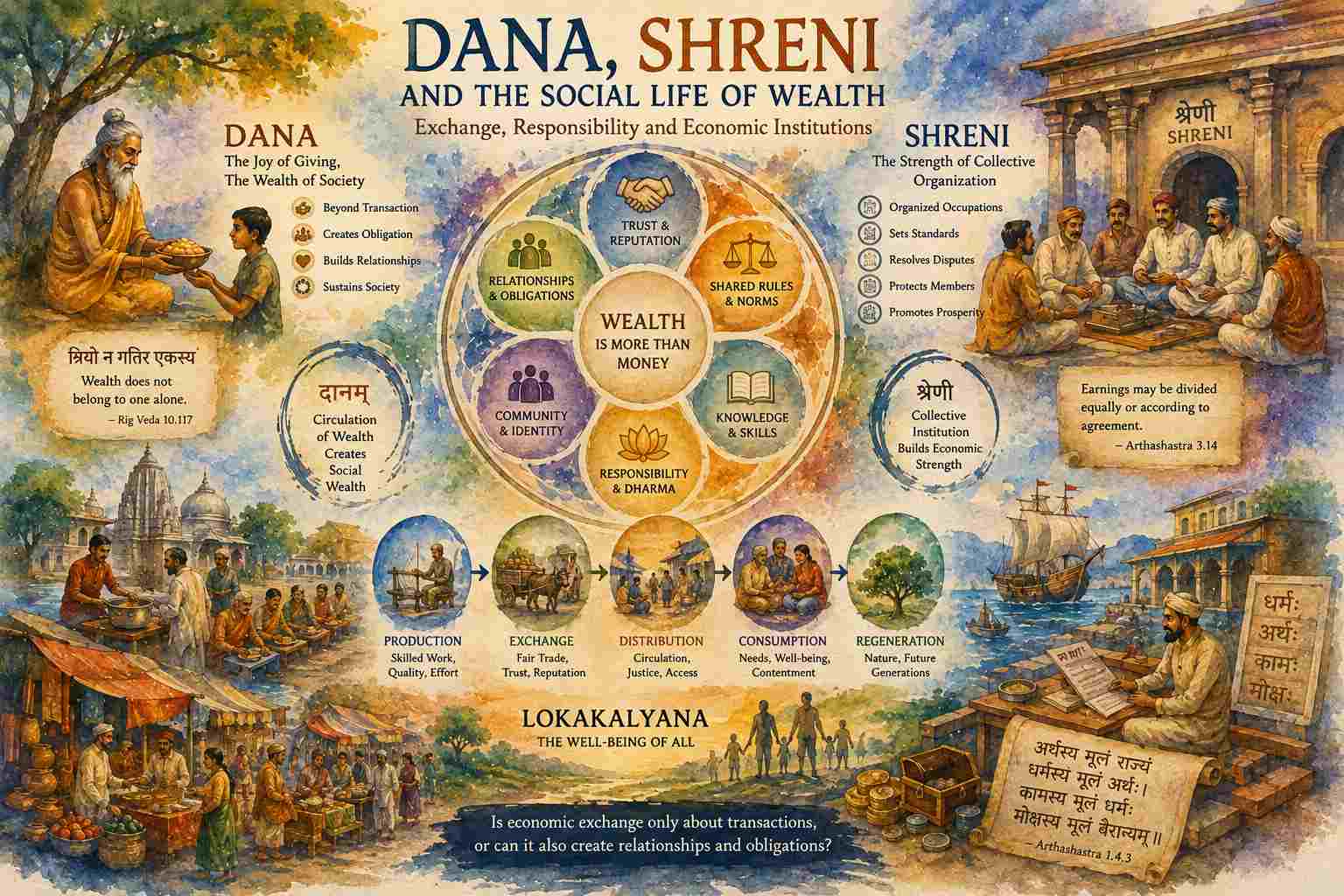
Exchange, Responsibility and Economic Institutions
What happens to our understanding of an economy when we stop imagining economic life as a collection of isolated transactions between buyers and sellers? Modern economics has developed an extraordinarily powerful vocabulary for explaining prices, incentives, markets, contracts, competition and allocation of resources. Yet behind every transaction stands a relationship of trust, reputation, obligation and expectation. A market exists because people believe that goods will be delivered, contracts will be honoured, measurements will be fair and promises will mean something. The economy therefore does not operate before society; it operates through society.
This is where two Indic institutions and ideas—Dana and Shreni—open an interesting economic inquiry. They represent two very different dimensions of wealth. Dana concerns the movement of wealth beyond immediate reciprocal exchange, while Shreni represents the organisation of economic activity through collective institutions. Neither should be romanticised as an ancient equivalent of modern philanthropy or corporations. Their significance lies in showing that economic behaviour can simultaneously create material value, social relationships and institutional obligations.
The modern economic tradition has often treated exchange primarily through the logic of mutual benefit. Adam Smith famously explained how individuals pursuing their own interests could contribute to social prosperity through exchange and division of labour. His insight remains foundational. But the market cannot explain every form of economic relationship. A parent educating a child, a community maintaining a water body, a wealthy person establishing a charitable endowment, an artisan teaching an apprentice, or a guild maintaining standards cannot be adequately understood as ordinary market transactions. Something other than price is operating.
The Indic category of Dana makes this visible. The Rig Veda 10.117 offers one of the clearest early reflections on the social responsibility of wealth. It observes that wealth moves from one person to another “like the wheels of a chariot” and criticises the person who possesses food but refuses to share it with one in need. The economic significance is not simply that charity is morally desirable. It is that wealth acquires social meaning through its movement. Wealth that circulates can sustain relationships; wealth that becomes completely detached from social responsibility can become socially destructive.
This does not mean that Dana should be inserted into a modern economic model as another form of consumption. Its logic is different. A market exchange normally involves an expectation of equivalent return; Dana deliberately disrupts that equivalence. It creates obligation, gratitude, merit, relationship and social responsibility without requiring an immediate commercial return. The economic question consequently becomes larger: what kinds of economic activity are necessary for society even when they cannot be explained through the price mechanism?
The history of Shreni takes us in another direction. Kautilya’s Arthashastra recognises merchants belonging to trade guilds and gives them a differentiated legal position based partly upon their trustworthiness and established standing (Arthashastra 3.12).
In Book III, Kautilya also discusses guilds of workers and cooperative undertakings, stating that earnings could be divided equally or according to prior agreement (Arthashastra 3.14).
This is important because the Shreni was not simply a group of people who happened to work in the same occupation. Historical scholarship identifies guilds of merchants and artisans as institutions that regulated aspects of production, occupational standards, trade and internal organisation. Some guilds accumulated substantial resources and acted as custodians of religious and philanthropic endowments.
The economic institution therefore stood between the individual and the state. That is precisely what is often missing when we imagine the economy through only two actors: individual and state.
The Shreni suggests a third space—the economic community.
An artisan did not necessarily operate simply as an isolated entrepreneur selling a product to an anonymous consumer. He could belong to an occupational institution that carried standards, reputation, knowledge, obligations and collective interests. Kautilya’s discussion of cooperative work is particularly revealing because it recognises that people could combine their labour and agree upon how earnings would be distributed. Economic organisation therefore did not require every relationship to be mediated by either a state bureaucracy or an impersonal market.
And this changes how we understand trust.
A modern market often attempts to solve the problem of trust through contracts, regulation, certification, courts, ratings and financial guarantees. These are essential because strangers increasingly transact with strangers. But historically, economic communities could generate trust through reputation and repeated relationships. The Shreni itself became part of the identity and credibility of its members. Contemporary scholarship on ancient Indian guilds notes their role in maintaining professional standards, regulating quality and organising collective economic activity.
This creates an intriguing comparison with modern economics.
The Individual Market Model
Individual → Transaction → Price → Contract → Enforcement
Whereas an embedded economic institution can operate through:
The Shreni Model
Individual → Community → Reputation → Shared Rules → Trust → Exchange
The second does not eliminate markets. It makes markets possible within a social architecture.
There is another important dimension. Guilds could accumulate wealth not merely for their members but for collective purposes. Historical evidence discussed by the Indian Knowledge Systems programme at IIT Gandhinagar notes that guild resources could include member contributions, profits, gifts and fines, while expenditure could include production, transport, security, distribution of profits and philanthropic or religious activities; permanent deposits could also support religious and charitable purposes through their returns.
Here the distinction between private wealth and social wealth begins to blur.
A guild’s surplus could strengthen the guild itself, support its members, finance economic activity and simultaneously contribute to a wider social or religious institution. This is not quite the modern corporation, not quite a cooperative, not quite a charity and not simply a private business. It is a reminder that economic institutions can have multiple purposes simultaneously.
And perhaps this is the larger lesson.
The contemporary economic imagination often separates production, exchange and social responsibility into different compartments. The firm produces. The consumer consumes. The government redistributes. The charity gives. But historical economic institutions were sometimes more integrated. The same institution could produce goods, train people, enforce standards, protect members, accumulate capital, resolve disputes and contribute to community welfare.
This does not mean that such institutions were always equitable or that every Shreni functioned identically. Nor should we project modern ideas of democracy, corporate governance or social justice backwards onto them. Their value for contemporary inquiry lies precisely in their difference.
They allow us to ask: Must an economic institution choose between profitability and social responsibility?
- Can reputation function as economic capital?
- Can communities generate forms of economic governance that neither markets nor states can provide alone?
- Can wealth circulate through society without destroying incentives for production?
- And can economic institutions create not merely transactions, but relationships capable of sustaining economic life over generations?
This is where Dana and Shreni become more than historical curiosities. Together they reveal two complementary movements of wealth: Dana asks what wealth does when it moves beyond the self; Shreni asks what happens when economic activity is organised beyond the isolated individual.
One creates social circulation. The other creates institutional cooperation. Together they challenge a narrow understanding of the economy as merely production + exchange + consumption.
Perhaps the economy is also trust + reputation + knowledge + reciprocity + obligation + community.
And if that is true, then the most important economic question is no longer simply:
“What is the price of this transaction?”
It is also:
“What kind of relationship, institution and society does this transaction create?”
That is the beginning of an Economic Drishti—one in which wealth is not merely accumulated, exchanged and consumed, but embedded within the social world that gives economic life its continuity.
