
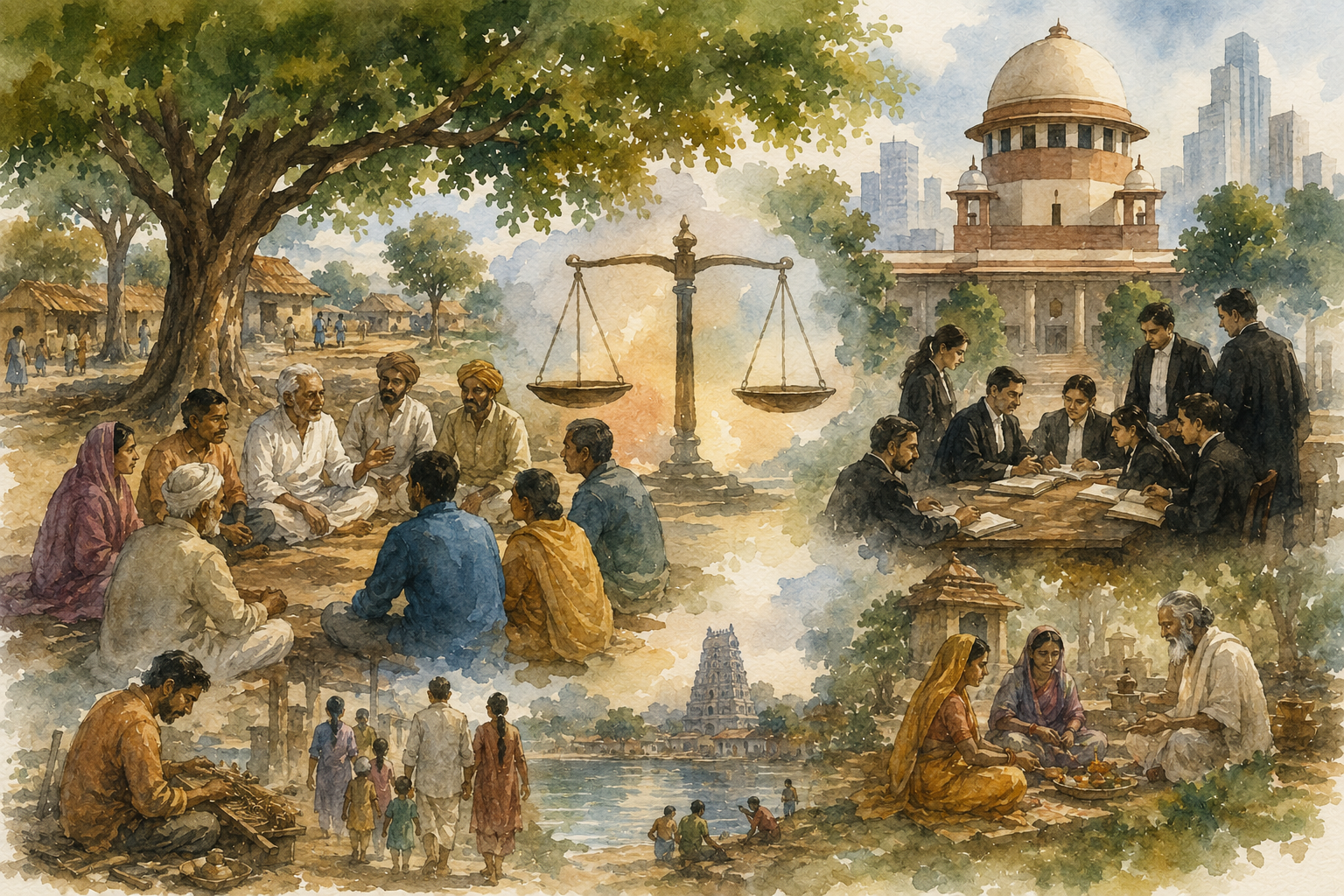
Beyond the Written Constitution
What if the law of a society is larger than the laws written in its books? What if the actual experience of justice is shaped not only by legislatures and courts, but also by family, community, custom, occupation, local institutions, social expectations and inherited practices? These questions take us beyond the familiar understanding of law as a collection of formally enacted rules and towards a more difficult proposition: law does not operate in an empty social space. It enters a society that already possesses relationships, institutions, norms, memories and mechanisms for resolving disagreement. To understand law, therefore, one must understand the society within which law lives.
Modern legal education often begins with statutes, constitutions, judicial decisions and formally recognised institutions, and rightly so, because written law provides an essential framework of authority and accountability. Yet the existence of a law on paper does not necessarily tell us how people actually behave. A regulation may be perfectly clear and still remain ineffective if it conflicts with social practice, institutional capacity, economic realities or the expectations of the community. Conversely, practices that possess no formal statutory recognition may continue to regulate everyday behaviour because people consider them legitimate, familiar or socially binding. The difference between law as written and law as lived is therefore not a marginal question; it is central to understanding how legal order actually functions.
This becomes particularly important in Bharat, where social organisation historically operated through multiple institutions rather than through a single central authority. The family, village, occupational association, community institution, temple, guild, religious establishment and local assembly could each perform functions connected with social regulation and dispute resolution. The existence of such institutions does not mean that formal political authority was absent; rather, it suggests that social order was distributed across several overlapping centres of responsibility. A dispute could therefore be approached through different institutional pathways depending upon its nature, the people involved and the norms applicable to the particular community.
The classical Indian legal vocabulary itself points towards this plurality. Dharma, Vyavahara, Achara and Lokachara do not simply describe one uniform body of legislation; they open a field of inquiry into the relationship between principles, judicial procedure, established practice and local custom.
The Manusmriti, for example, recognises “custom of the country” (desha-dharma), “custom of the caste or community” (jati-dharma) and family or local practices among sources relevant to social conduct (Manusmriti 8.41; 2.12).
Kautilya’s Arthashastra similarly presents legal disputes within a structured institutional setting involving judges, evidence, witnesses, documents, customary practices and established norms (Arthashastra, Book 3).
These sources should not be romanticised or treated as if they constitute a modern constitution in ancient language; their significance lies precisely in showing that Bharatiya legal thought developed its own sophisticated questions about the relationship between rule, practice, authority and social order.
This raises an important problem for the contemporary law curriculum. If students encounter Indian law primarily through categories inherited from colonial legal institutions and modern Western jurisprudence, they may become highly competent in interpreting statutes while remaining less familiar with the intellectual traditions through which Indian society historically understood justice, obligation, custom and dispute. Decolonising the curriculum, therefore, cannot mean simply removing European thinkers and replacing them with Indian names. That would merely change the reading list. The deeper task is to ask whether the questions through which law is taught are themselves sufficiently capable of explaining Indian social reality.
Consider customary dispute resolution. It is tempting to classify community mechanisms simply as informal alternatives to the “real” legal system, but such a distinction may conceal more than it reveals. Why did people approach community institutions? When did they prefer them to formal courts? What kinds of disputes could communities resolve themselves? What made a decision socially acceptable? When did customary authority become oppressive or exclusionary? When did formal law intervene, and with what consequences? These are simultaneously legal, sociological, anthropological and historical questions, and they demonstrate why Law and Society cannot be studied through legal texts alone.
The same applies to the relationship between courts and communities. A court may deliver a legally valid judgement, but implementation depends upon social realities. A law may prohibit a practice, yet the practice may continue. Another law may introduce a new institution, yet society may adapt it according to existing expectations. Between legislation and behaviour there is therefore an entire social world that the lawyer must learn to see.
This is where an Indic approach can contribute something more substantial than a search for “ancient equivalents” of modern legal concepts. It can encourage students to examine Dharma and law, custom and statute, community and state, duty and right, justice and social order as interconnected questions. It can also force us to confront uncomfortable realities: inherited practices were not always just, community authority was not always benign, and formal law has sometimes been necessary precisely because existing social arrangements were unequal or oppressive.
The objective, therefore, is not to romanticise customary law or reject the modern legal system. It is to develop a more complete understanding of legal pluralism and lived legality, in which the written law is studied alongside the society that receives, interprets, negotiates, resists and transforms it.
Perhaps the most important question for a decolonised law curriculum is therefore not simply “What does the law say?”
It is: “How does law actually become a living force within society—and how can Bharat’s own legal, social and intellectual traditions help us understand that process?”
