From Economic Growth to Shared Well-being
What is the point of having a prosperous economy if prosperity does not translate into the well-being of society?
The question sounds almost obvious, yet much of modern economics has trained us to answer prosperity through aggregates: GDP, per-capita income, investment, productivity, consumption, exports, fiscal capacity and employment. These indicators are indispensable because an economy that cannot produce, exchange, save and invest cannot sustain a high standard of living for long. But they remain indicators of economic activity, not necessarily of the quality of collective life produced by that activity. A country can grow rapidly while households become indebted, ecological resources are depleted, care burdens increase, communities weaken and the benefits of growth become concentrated. The real economic question, therefore, is not simply how much an economy produces, but what that production enables society to become.
This question becomes especially important when we examine the intellectual history of economics. Adam Smith’s Wealth of Nations is often reduced in contemporary discussions to the “invisible hand” and self-interest, although Smith’s own account of wealth was considerably broader. He wrote that people are rich or poor according to their ability to command the necessities, conveniences and enjoyments of life, and he connected the wealth of a nation with the productive powers of its labour.
The important point is that Smith was asking how society could increase its capacity to provide the material conditions of life. Later economic thought increasingly developed sophisticated methods for measuring output, income, capital and productivity. Keynes brought employment and aggregate demand to the centre of macroeconomic analysis; Marx placed production, ownership and distribution within a theory of historical change; development economists examined capital formation and structural transformation. These contributions remain essential. But the danger begins when the means through which economic capacity is generated become confused with the final purpose of economic life.
The history of development economics makes this tension particularly visible. For a long time, development was strongly associated with industrialisation, capital accumulation, rising productivity and increasing national income. Even where economists recognised poverty and inequality, the central policy question often remained how to expand the productive capacity of the economy. Amartya Sen’s capability approach represented an important correction by asking us to look beyond income and examine the freedoms and capabilities people actually possess—the lives they are able to live and the choices they are able to make. This was a major expansion of economic reasoning. Yet an Indic approach can take the question one step further: capability for what kind of life, within what social order, and with what responsibilities towards others and the future?
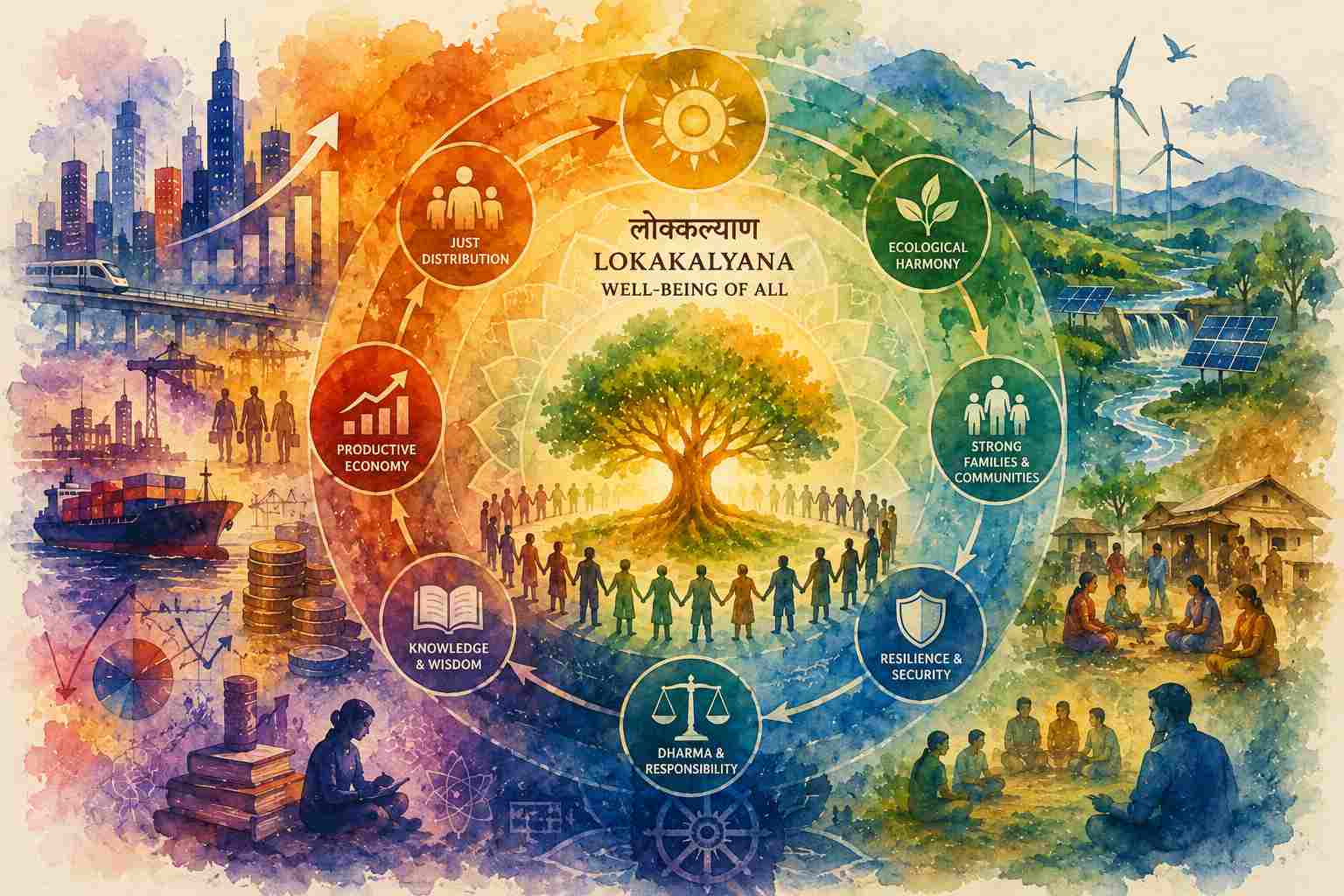
This is where Lokakalyana becomes useful as an economic lens. It should not be presented as though Kautilya himself used Lokakalyana as the technical equivalent of modern welfare economics. Rather, it is a contemporary Indic formulation that allows us to bring together several ideas found across the tradition: praja-hita, yogakshema, Dharma, Artha and Lokasangraha. The economic significance of this vocabulary is that it refuses to isolate prosperity from the condition of the society that produces and sustains it.
Kautilya’s Arthashastra provides perhaps one of the clearest demonstrations of this embedded understanding of economics. In the famous statement from Arthashastra 1.19.34, the ruler is told:
प्रजासुखे सुखं राज्ञः प्रजानां च हिते हितम् ।
नात्मप्रियं हितं राज्ञः प्रजानां तु प्रियं हितम् ॥
“In the happiness of his subjects lies the king’s happiness; in their welfare his welfare.”
What makes this economically significant is what follows. Kautilya immediately connects the ruler’s active discharge of duties with the root of wealth being activity. Wealth is therefore not treated as something detached from governance and social productivity. The ruler must maintain the conditions under which economic activity can take place, because a prosperous Rajya depends upon productive people, productive land, functioning institutions and secure exchange.
The Arthashastra makes this even clearer when it describes the state’s economic responsibilities. Kautilya discusses agriculture, mining, forests, cattle-breeding, commerce, roads, market towns and reservoirs as interconnected components of economic organisation. The agricultural administration pays attention to seeds, water availability, cultivation methods, different types of land and irrigation. This is not “economic growth” in the narrow modern statistical sense. It is an attempt to maintain the productive ecology of society.
There is a particularly important concept in Arthashastra 1.4.3: योगक्षेम (yogakṣema). Kautilya describes Daṇḍanīti in relation to securing yogakṣema for the domains of knowledge and economic activity, while defining the process through a sequence of obtaining what is not yet obtained, protecting what has been obtained, increasing what is protected, and appropriately deploying what has matured.
This sequence offers a remarkably useful economic logic:
The Kautilyan Economic Cycle
Alabdhalābha
Acquire what is not yet obtained
↓
Labdhasya Parirakṣaṇa
Protect what has been obtained
↓
Rakṣitasya Vardhana
Increase what has been protected
↓
Vṛddhasya Tīrthe Pratipādana
Put accumulated strength/wealth to proper use
This is considerably more sophisticated than simply saying “grow GDP.” Growth is only one stage. What is produced must be protected; what is protected must be enhanced; and what has accumulated must ultimately be placed into productive and appropriate channels.
And here lies a profound economic question for the present: what happens when an economy maximises production while simultaneously destroying the assets upon which future production depends?
If soil fertility declines, is agricultural output alone enough to call agriculture prosperous? If a family earns more but spends less time caring for children and elders, is its welfare necessarily higher? If a city produces more while losing clean air, water and public space, has its prosperity increased? If a country becomes richer but increasingly dependent on external sources for critical technologies, energy or food, has its economic capability necessarily strengthened?
These are not anti-growth questions. They are questions about the quality and durability of growth.
The Indic economic imagination is particularly useful here because Artha is not the whole of Purushartha. Wealth is a legitimate and necessary human pursuit, but it exists within a larger framework of Dharma, Kama and Moksha. The implication is not that economics should become theology; rather, it is that economic life cannot be assumed to contain its own ultimate purpose. An economy can answer the question of how to produce more, but society must still answer the question of why more should be produced and what that production is ultimately meant to serve.
This also changes how we think about distribution. Modern economics has sophisticated theories of inequality, redistribution and welfare, but an Indic economic lens introduces the idea that prosperity must remain connected to the social fabric through which it is created. The Rig Veda 10.117 presents a striking reflection on wealth and sharing: “Riches come now to one, now to another, and like the wheels of cars are ever rolling.” The hymn criticises the person who possesses food but refuses to share it with one in need.
Wealth, in this formulation, is not condemned; stagnant wealth is questioned. Its social value is partly realised through circulation and the ability to sustain relationships.
This gives us a different understanding of economic prosperity. We normally ask whether income is rising. We should also ask whether economic capacity is circulating through society. Is productivity creating livelihoods? Are markets creating opportunities? Is capital producing further productive capacity? Are households becoming more secure? Are communities becoming more capable? Are the poorest able to participate meaningfully in economic life? Are natural resources being regenerated sufficiently for the next generation?
A Lokakalyana Economic Dashboard
| Dimension | Conventional economic indicator | Deeper question |
|---|---|---|
| Production | GDP, productivity | What is being produced and for what purpose? |
| Income | Per-capita income, wages | Can people actually live well from that income? |
| Employment | Labour-force participation, unemployment | Does work provide security, dignity and capability? |
| Distribution | Gini, poverty, consumption | Is prosperity circulating sufficiently through society? |
| Capital | Investment, capital formation | Does today’s investment create tomorrow’s productive capacity? |
| Nature | Resource extraction, environmental accounts | Is the productive ecological base being regenerated? |
| Household | Consumption and income | What unpaid care and knowledge sustain the household? |
| Future | Savings, debt, public finance | What is being transmitted to the next generation? |
| Social capacity | Limited conventional measures | Are communities becoming more capable of collective action? |
This is where the Indic perspective should not be misunderstood as a rejection of modern economic statistics. We need GDP. We need inflation. We need employment data. We need productivity statistics. We need national accounts. Without measurement, economic policy becomes rhetoric. The problem is not measurement; the problem is measurement without a sufficiently large conception of what matters.
Indeed, contemporary economics is already moving in this direction. Sen expanded development towards capabilities and freedoms, while contemporary wealth accounting increasingly examines human and natural capital alongside produced capital. The movement is intellectually significant because it recognises that an economy is not merely a flow of transactions but a stock of capacities that must be maintained across time.
The Indic contribution can therefore be neither “GDP is bad” nor “ancient India already had modern welfare economics.” Both claims would be intellectually weak. The more interesting proposition is that Indic categories can help us ask questions that conventional economic measurement has historically found difficult to formulate.
- What is the economic value of a functioning family?
- What is the productive value of social trust?
- What is the wealth embedded in traditional knowledge?
- What is the cost of ecological degradation that appears nowhere in the price of a commodity?
- What is the value of resilience when a society faces a crisis?
- What is the economic significance of intergenerational continuity?
- And perhaps the most difficult question: what should an economy maximise?
- If the answer is simply output, then GDP is sufficient as the principal compass.
- If the answer is consumption, then purchasing power becomes the principal objective.
- If the answer is individual capability, we move towards Sen.
But if the answer is the sustained flourishing of society, then we need a much larger economic architecture—one that can hold together production and distribution, wealth and responsibility, markets and society, prosperity and ecology, present consumption and future capacity.
That is the space in which Lokakalyana can become an Indic economic concept. Not a rejection of growth. Not a rejection of markets. Not a romantic return to the past. But a deeper question about what growth is growing. Because an economy is not prosperous merely when its numbers become larger.
An economy is prosperous when its people become more capable of living well, its productive foundations become stronger, its wealth circulates through society, its natural resources remain capable of regeneration, and its prosperity can be transmitted to those who have not yet been born.
That is the economic question that Lokakalyana places before us: not merely “How much has the economy grown?” but “What has that growth done for the life of the loka?”
