Rethinking Growth, Progress and Human Well-being
What if the most important question in economics is not how fast an economy grows, but what that growth is supposed to achieve? Modern economics has made growth one of the principal measures of national progress, and with good reason: production creates employment, raises incomes, expands the resource base of the state and can dramatically improve material conditions. Yet somewhere along the way, growth and development began to appear almost interchangeable. GDP rises, therefore the country is developing. Per-capita income rises, therefore people are better off. Industrialisation advances, therefore society is progressing. But can an economy become larger while the lives of its people become more insecure, its ecological foundations weaker, its communities fragmented and its inequalities deeper? Does economic growth automatically mean social progress?
The conventional development curriculum has a history that deserves examination.
- Adam Smith shifted attention towards productivity, division of labour and the creation of wealth;
- Ricardo developed powerful explanations of distribution and comparative advantage;
- Marx placed production, property and class relations at the centre of historical transformation;
- Keynes demonstrated the importance of aggregate demand, employment and state intervention during economic instability.
These thinkers gave economics analytical tools of enormous importance. The problem emerges when particular historical experiences become universal developmental pathways. The most explicit example is W. W. Rostow, whose Stages of Economic Growth described societies moving from a “traditional society” through the “preconditions for take-off” and “take-off” towards technological maturity and high mass consumption. The implicit question becomes: how quickly can every society become like the societies that industrialised first?
That is precisely where decolonising economics requires more than adding Indian examples to an existing syllabus. We must ask whether development itself has been defined too narrowly. GDP measures market production, but even standard economics recognises that it leaves out unpaid household work, leisure, environmental quality, health outcomes and many dimensions of human well-being. Amartya Sen’s capability approach made an important departure by shifting attention from income towards people’s substantive freedoms and capabilities—the actual opportunities people possess to lead lives they value. Yet even here, an Indic inquiry can ask a further question: what is the good life towards which those capabilities are directed?
This is where the Arthashastra offers an important intellectual counterpoint. Kautilya does not treat economic life as an isolated sphere concerned only with accumulation. Agriculture, mining, forests, trade, taxation, labour, storage, infrastructure, treasury management and public order appear as interconnected dimensions of statecraft. The Arthashastra even describes public prosperity, abundant harvests, flourishing commerce and freedom from calamities as conditions contributing to the prosperity of the treasury (Arthashastra 2.6). Agriculture receives detailed administrative attention, including seed, cultivation, irrigation and agricultural organisation (Arthashastra 2.24). The economy is therefore not imagined as an abstract machine producing numbers; it is embedded in land, production, livelihood, exchange, institutions and political responsibility.
Even more revealing is Kautilya’s statement on the relationship between public welfare and political prosperity: “In the happiness of his subjects lies his happiness; in their welfare his welfare” (Arthashastra 1.19). This is not a modern welfare-state theory, and it should not be presented as one. Its importance lies elsewhere: the prosperity of the political order is connected to the condition of the people who sustain it. Wealth has a social purpose.
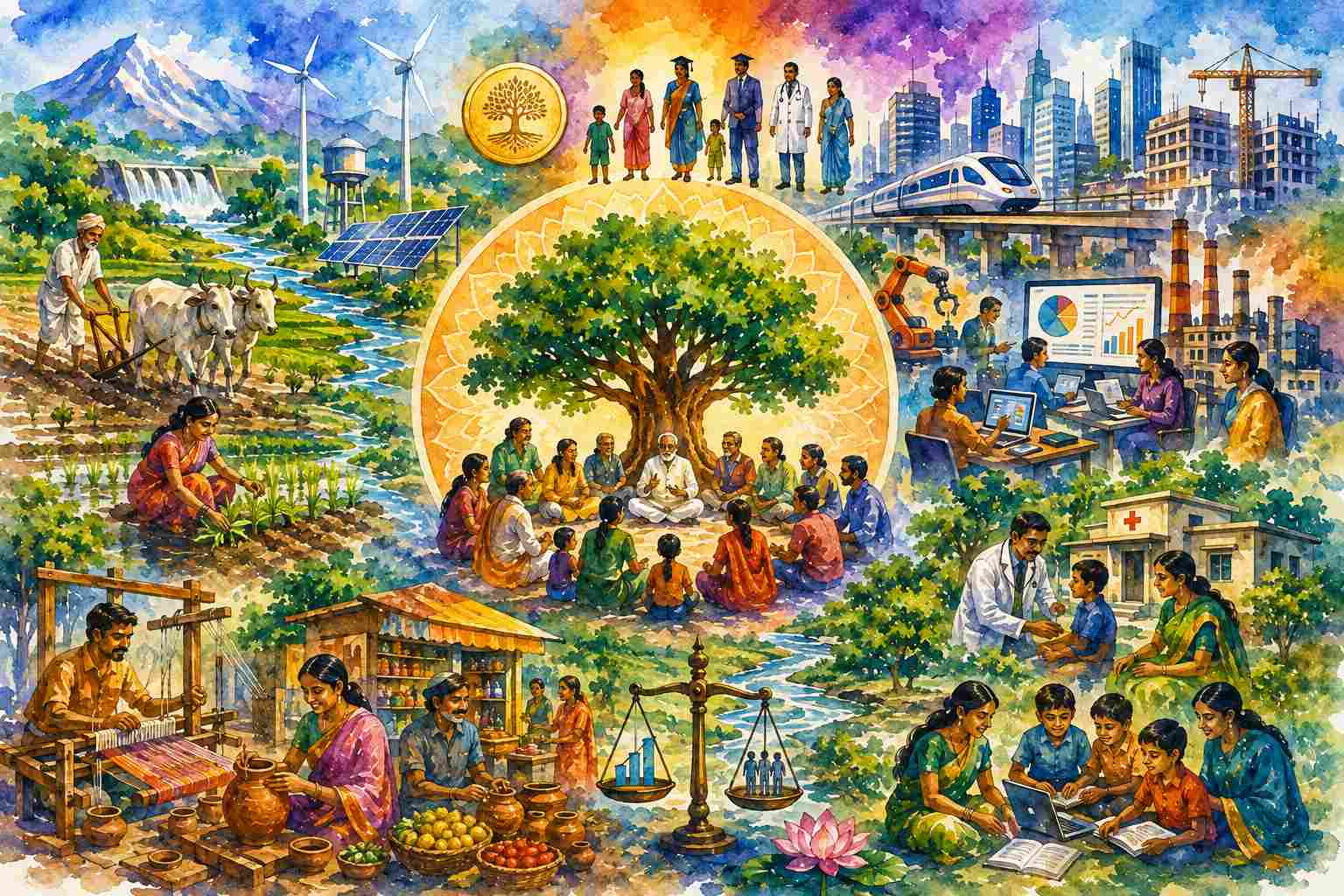
This gives us a different starting point for development economics. Instead of asking only how much an economy produces, we can ask whether it generates productive livelihoods, resilient communities, capable institutions, ecological security, social stability and conditions for human flourishing. The distinction matters because an economy can increase output by consuming the natural capital on which future production depends, by replacing community-based activity with costly market transactions, or by increasing productivity while leaving large sections of society without meaningful livelihoods. GDP may record the transaction; it does not necessarily record the civilizational cost.
The Indic framework also complicates the assumption that material prosperity is the sole or final objective of economic life. Artha is a Purushartha, but it exists alongside Dharma, Kama and Moksha. This does not mean rejecting wealth; quite the opposite. It recognises wealth as necessary for social and individual life while refusing to make accumulation the complete definition of human flourishing. Economics, from this perspective, must ask not only “How much wealth?” but “Wealth for what?” and “Within what ethical and social order?”
This is where our curriculum needs to move from development as imitation to development as inquiry. Bharat need not reject industrialisation, technology, markets, entrepreneurship or global trade; nor should an Indic approach romanticise poverty or assume that everything inherited from the past was economically desirable. The challenge is more intellectually demanding: to determine which forms of growth strengthen society, which weaken it, which create genuine capability, which create dependency, and which preserve the ecological and institutional foundations required for future prosperity.
Perhaps development should therefore be understood not as a single ladder on which every civilization climbs towards the same destination, but as a civilizational question about how a society creates and sustains conditions for flourishing.
The central economic question is consequently not: “How quickly can we grow?”
It is: “What kind of growth enables people to live well, society to remain resilient, nature to regenerate, and future generations to inherit greater—not merely larger—prosperity?”
That is where an Indic economics of development can begin.
