
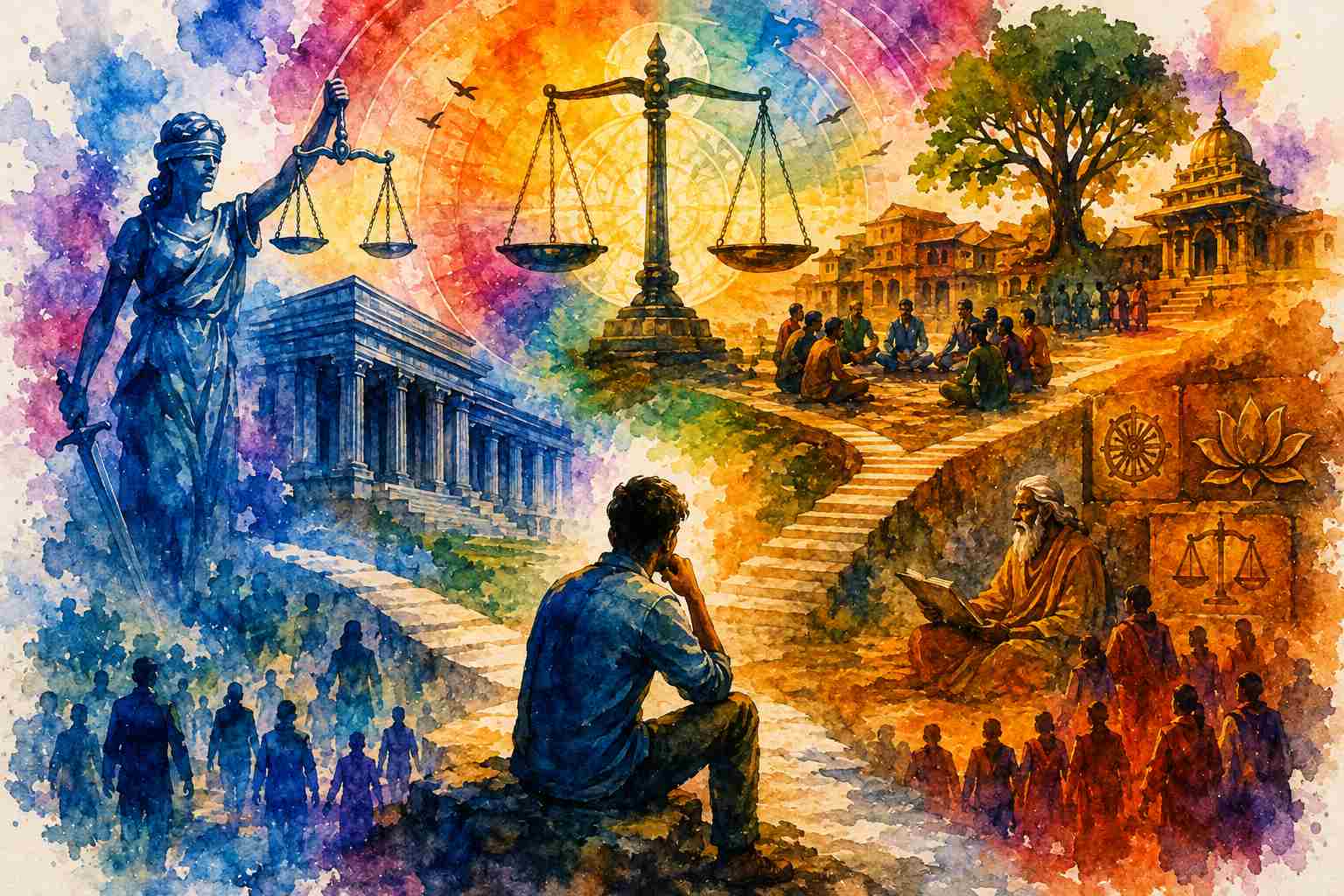
Rethinking Universal Ideas of Rights and Justice
What happens when we ask a deceptively simple question: what is justice? Modern legal education often presents justice through a vocabulary that appears universal—rights, liberty, equality, autonomy, dignity, due process and non-discrimination. These principles have enormous normative importance, particularly because they provide legal protection against arbitrary power and oppression. But their historical formation is not identical to the history of humanity itself. The modern language of rights developed through particular intellectual and political struggles in Europe and was subsequently universalised through constitutionalism and international law. The Universal Declaration of Human Rights of 1948, for instance, emerged from the devastation of the Second World War and was drafted through contributions from people representing different cultural, legal and philosophical backgrounds. Its history itself reminds us that universality was a project of deliberation, not a concept that emerged from nowhere.
The problem, therefore, is not to reject human rights. It is to ask a more intellectually demanding question: can something be universal without being culturally uniform?
The contemporary legal curriculum frequently teaches justice through the language of the individual—what rights does a person possess, what liberty can the state restrict, what protection does the individual receive against another individual or against the state? This is an indispensable dimension of justice. Yet it can become incomplete when the individual is imagined primarily as an autonomous legal unit rather than as a person situated within relationships of family, community, occupation, society, nature and future generations. An Indic legal imagination begins with a different possibility: perhaps justice concerns not only what one is entitled to receive, but also what one is responsible for sustaining.
This is where the distinction between rights and Dharma becomes analytically important. Dharma should not be translated simply as “law” or “religion”; it operates across a much wider semantic field involving order, duty, conduct, obligation and that which sustains a particular form of life. The Manusmriti describes the sources of Dharma through Śruti, Smṛti, established good conduct (sadācāra) and what is agreeable to oneself when properly considered (Manusmriti 2.12).
This is significant because justice is not imagined as something generated exclusively by the sovereign legislature. It emerges through a layered relationship between textual knowledge, inherited interpretation, social practice and ethical discernment.
The contrast can be made clearer.
| Modern rights-centred vocabulary | Indic Dharma-centred inquiry |
|---|---|
| What are my rights? | What is my Dharma? |
| What may the state not do to me? | What should authority do, and what must it not do? |
| Individual autonomy | Person within relationships |
| Equality before law | Justice according to Nyaya and Dharma |
| Rights of individuals | Duties and obligations alongside rights |
| Universal legal standard | Principles interpreted through context |
| Written law | Shruti, Smriti, Achara, Vyavahara and institutional practice |
| Justice as protection | Justice as protection and social order |
| State as principal duty-bearer | State, community, family and individual as overlapping bearers of responsibility |
This does not mean that the Indic tradition had no concept of individual protection. Nor does it mean that every customary institution was just. Quite the opposite: a serious Indic approach must be capable of examining injustice within inherited institutions rather than romanticising everything described as “traditional”. The important point is that the grammar of justice was not identical to the modern grammar of rights.
The classical legal tradition repeatedly distinguishes between Dharma and the procedures through which disputes are adjudicated. The category of Vyavahara concerns judicial procedure and the resolution of disputes, while Dharma provides a larger normative framework. This distinction is important because it prevents us from assuming that justice is merely the mechanical application of a written rule. A legal decision must operate within a broader conception of order, evidence, conduct and responsibility.
The famous statement “धर्म एव हतो हन्ति धर्मो रक्षति रक्षितः” — “Dharma, when destroyed, destroys; Dharma, when protected, protects” (Manusmriti 8.15) captures an important civilizational intuition. Justice is not merely an instrument used by an external authority to regulate society; the integrity of the normative order itself must be protected. The ruler, judge and citizen are all located within that order. The question is therefore not simply whether a person possesses a legal right, but whether the exercise of power—whether by the state, community or individual—is consistent with the order that makes social life possible.
This gives us an interesting way to reinterpret equality. Modern law often approaches equality through the principle that similarly situated persons should receive equal legal treatment and that arbitrary discrimination must be prohibited. The Indic tradition can add another question: equal according to what relationship, duty and context? This should not become an excuse for arbitrary differential treatment. Rather, it invites us to examine whether justice sometimes requires attention to circumstance rather than mechanical uniformity. Dharma is therefore not simply equality or inequality; it is the question of appropriate conduct within a particular moral and social context.
The same problem appears with the modern idea of liberty. If liberty means complete freedom from social obligation, then an Indic conception will appear restrictive. But if liberty means the capacity to act responsibly within a meaningful social order, the relationship changes. The Bhagavad Gita repeatedly frames action through Dharma rather than through an isolated conception of individual preference. In Gita 3.35, Krishna states: “श्रेयान् स्वधर्मो विगुणः परधर्मात्स्वनुष्ठितात्”—one’s own Dharma, even if imperfectly performed, is better than another’s well performed. The verse is not a legal theory of occupational rights; its significance for social thought lies in the recognition that duty is relational and situated rather than infinitely interchangeable.
There is also an important corrective here for both sides. A rights-only framework can become excessively individualistic; a duty-only framework can potentially suppress the individual if authority claims to define everyone’s duties without restraint. This is precisely why the Indic legal inquiry must not be reduced to “replace rights with duties.” The more productive proposition is to ask how rights and duties can be understood relationally. Every right creates an obligation somewhere. Freedom of speech creates obligations upon others not to arbitrarily silence; property rights create obligations regarding others and the legal order; political authority creates duties towards those governed; and social responsibility cannot become a licence for unlimited interference with individual dignity.
Interestingly, even the international human-rights tradition eventually had to recognise this relationship. The UN’s own account of the foundation of international human rights law states that human rights involve both rights and obligations, including responsibilities of duty-bearers and rights-holders. The 1948 Declaration itself emerged through debate across different philosophical and cultural backgrounds, including the contribution of Peng-chun Chang of China and Hansa Mehta of India; Mehta is credited with helping transform the wording of Article 1 into the gender-inclusive formulation that “all human beings are born free and equal”.
This history itself should make us cautious about speaking of a purely Western conception of universal justice. Universality has always been constructed through dialogue.
That is precisely why decolonising the law curriculum should not mean teaching students that “Western law is wrong and Indic law is right”. Such a curriculum would simply replace one dogma with another. The real task is to create a legal education in which students can place rights alongside Dharma, liberty alongside responsibility, equality alongside Nyaya, statute alongside Achara, and individual protection alongside social obligation, and then ask what each vocabulary reveals and what it conceals.
The question of justice then becomes much more interesting.
A modern legal system may ask: What is this person entitled to?
An Indic inquiry can add: What is this person responsible for?
Modern constitutionalism asks: What limits must be placed upon power?
Rajadharma asks: What does authority owe to those over whom it exercises power?
Modern law asks: What rule has been violated?
Vyavahara asks us to examine: How should a dispute be adjudicated within an established normative order?
And perhaps the deepest question is this: Can justice protect the individual without destroying the relationships through which human beings actually live?
That is where the Indic contribution becomes intellectually valuable. It does not have to replace the universal language of rights. It can interrogate, deepen and contextualise it.
Justice may indeed be universal. But perhaps the human search for justice does not require every civilization to speak about it in exactly the same language.
A genuinely decolonised legal curriculum should therefore not ask students to choose between rights and Dharma. It should teach them to ask what justice looks like when both the dignity of the individual and the obligations that sustain society are taken seriously.
