What is the economy, and does it exist outside society?
Modern economics often treats the economy as a distinct sphere of human life. Production belongs to economics. Consumption belongs to economics. Trade, employment, investment, markets and growth belong to economics. The success of nations is measured through GDP, income, productivity and consumption.
But can the economy really be separated from the society in which it operates? Can a country become wealthier while its families become weaker? Can consumption increase while debt, anxiety and loneliness also increase? Can GDP rise while rivers, soil and forests deteriorate? Can a society accumulate enormous financial wealth while losing the knowledge, trust and cultural institutions that allowed it to flourish in the first place?
If this is possible, then wealth is larger than the economy, and the economy itself cannot be understood as an autonomous machine. This is where the Indic idea of embedded economy begins. It is not an argument against wealth, markets, enterprise or economic growth. On the contrary, Bharatiya traditions contain extensive reflections on agriculture, cattle wealth, trade, taxation, property, commerce, public works and prosperity. The question was never whether society should produce wealth. The deeper question was whether wealth could remain separated from Dharma, social responsibility, cultural life and restraint.
In the Indic civilizational framework, economic life was not imagined as an isolated domain governed only by the pursuit of individual gain. It was embedded within a larger architecture of relationships. This fundamental insight can be represented as a simple question: What is wealth for?
Artha Was Never the Whole of Human Life
The Indic framework of Purushartha provides the first foundation for understanding embedded economy. Human beings pursue Dharma, Artha, Kama and Moksha. These are not four isolated departments of life. They represent an attempt to understand the plurality of human aspiration.
Artha is therefore necessary. Human beings require food, shelter, security, property, tools and resources. Societies require agriculture, trade, revenue, infrastructure and productive capacity. Poverty cannot be romanticized. A civilization that cannot generate sufficient wealth cannot sustain education, culture, institutions or even the ethical and social life it claims to value.
The Arthashastra itself is extremely clear about the importance of material resources. It recognizes agriculture, cattle, commerce, mines, forests, roads, irrigation and revenue as foundations of state capacity. It also treats Anvikshiki, Trayi, Varta and Dandaniti as interconnected branches of knowledge, with Varta covering agriculture, cattle and trade.
But Artha was never imagined as the only objective.
The very structure of the Purushartha framework prevents economic reductionism. Wealth matters, but so do ethical responsibility, legitimate desire and the larger pursuit of human fulfilment. An economy that generates enormous wealth while destroying every other dimension of life may be materially productive, yet civilizationally impoverished.
The problem therefore begins when Artha becomes detached from the framework within which it acquires meaning.
The Vedic Economy Was an Economy of Production, Exchange and Reciprocity
There is a persistent misconception that the Vedic world was indifferent to material life. The textual record does not support such an assumption. Agriculture, cattle, food, wealth, rain, fertility and productive abundance appear repeatedly in Vedic literature.
The Rigveda and Atharvaveda contain substantial references to agriculture. The Rigveda itself advises cultivation as a path to prosperity, while Vedic sources contain hymns connected with agriculture, fields, crops and productive activity.
Yet the pursuit of prosperity was embedded within Yajña and reciprocity.
The principle of Yajña should not be understood merely as a ritual practice when considering its civilizational implications. It represents a broader understanding that prosperity emerges through contribution and circulation. One receives from the larger order, contributes to it and receives again through networks of reciprocity.
This is economically significant.
Modern economic thinking often begins with the isolated individual making choices under conditions of scarcity. The Yajña model begins from relationship. Agriculture depends upon land, water, climate, seed, cattle, labour and community cooperation. The producer is never completely autonomous.
The economy is therefore already social before any transaction takes place.
This is one reason Dana occupies such an important place in Indic traditions. Wealth was not simply accumulated and guarded. It was also expected to circulate through giving, hospitality, institutions, learning, welfare and public works.
A civilization that understands wealth only as private possession sees giving as the voluntary loss of individual assets. An embedded economy understands that wealth may perform different functions as it circulates through society.
The Mahabharata and the Political Economy of Dharma
The Mahabharata repeatedly treats Dharma, Artha and Kama as interconnected pursuits rather than independent worlds. The enormous discussions on Rajadharma, governance and kingship in the Shanti Parva are particularly important because they connect political authority with the material conditions of society.
The king is not merely a collector of taxes. He is responsible for conditions under which agriculture, protection and social life can continue. This distinction is essential to the Indic understanding of wealth. Revenue does not simply flow upward from society to the state. The state itself has obligations to the productive foundations from which wealth emerges.
The Arthashastra develops this practical logic even more explicitly. Kautilya discusses the protection of cultivators, construction of roads, development of markets, support for cattle, reservoirs, forests and productive activity. It also records tax remission and state assistance in particular circumstances and argues that agricultural and commercial prosperity strengthen the treasury rather than treating the population as a resource to be endlessly extracted.
This is an important distinction.
The state required revenue, but the source of revenue had to remain productive. If the cultivator was ruined, the treasury would eventually be weakened. If commerce was obstructed, economic capacity would decline. The wealth of the state therefore depended upon the vitality of society. This is not modern socialism. It is not laissez-faire capitalism. It is an embedded political economy in which state power, productive activity and social prosperity are mutually dependent.
The Ramayana and the Idea of Prosperity as Social Order
The Ramayana provides another civilizational image of prosperity. The descriptions associated with Ayodhya and later Ramrajya do not present wealth merely as accumulation by individuals. Prosperity is connected with order, security, agriculture, social well-being and the ability of people to live without constant fear.
Whether treated as political ideal, literary imagination or civilizational memory, the important point is that samriddhi is social. The prosperity of the kingdom is reflected in the condition of its people.
This distinction matters for the Indic model. A ruler living in a wealthy palace while society suffers cannot represent civilizational prosperity merely because wealth is concentrated at the top. Wealth becomes meaningful when productive and social capacity extends beyond the treasury.
The question therefore shifts from how much wealth does the kingdom possess? to what condition are the people in because of that wealth? This is precisely the distinction that an embedded economy requires us to recover.
Kautilya: Markets Without Economic Isolation
It would be a serious mistake to imagine that an Indic embedded economy rejects sophisticated markets. The Arthashastra contains detailed discussions of commerce, pricing, imports, taxation, weights, measures, state enterprises, market supervision and trade routes.
Kautilya’s model is therefore not anti-market.
Yet the market is not treated as an independent moral universe. The superintendent of commerce is expected to understand demand, supply and prices, but excessive profit that harms people is not treated as an unquestionable economic right. Foreign merchants could be given tax concessions, productive imports were encouraged and commercial infrastructure was protected. The state was expected to regulate economic activity according to the wider interests of the kingdom.
This reveals the central principle of embedded economy. Markets are institutions within society. They depend upon law, trust, infrastructure, security, productive communities and ecological resources. They cannot exist before society and cannot flourish after the destruction of the society that sustains them.
The question is therefore not whether markets should exist. The question is what should the market be embedded within? For the Indic framework, the answer is Dharma.
Jain Thought: Wealth Without Endless Possession
Jain traditions add another essential dimension to the Indic understanding of economy: the ethical limitation of possession.
This is particularly important because Jain communities have historically demonstrated remarkable commercial and entrepreneurial success. Jain economic thought therefore cannot be reduced to hostility toward wealth. The real issue is the relationship between wealth and attachment.
The principle of Aparigraha challenges the idea that accumulation can continue indefinitely without ethical consequence. For householders, the principle historically developed through limits on possession rather than an absolute requirement to abandon all property. Modern scholarship on Jain economic ethics similarly emphasizes how Ahimsa, Satya, Asteya, restraint and interdependence produce an ethical framework that extends beyond profit maximization.
The older Jain tradition of Parigraha-Parimana is particularly relevant to contemporary economic thought. The principle asks the individual to consider the limit of possession rather than assuming that every increase in wealth is automatically a social good.
Why does this matter?
Because unlimited accumulation changes the relationship between desire and economy. When desire has no internal limit, economic growth is constantly converted into new consumption, new scarcity and new anxiety. A person may possess more than ever and still experience permanent insufficiency.
Jain thought introduces a powerful civilizational principle: restraint is not the enemy of prosperity; it can be the condition that prevents prosperity from becoming destructive.
The Jain tradition also connects economic ethics with giving. Classical formulations describe dana in forms such as food, protection, medicine and knowledge. Thus wealth can be transformed into nourishment, security, health and learning rather than remaining merely as accumulated capital.
Buddhist Thought: Legitimate Wealth, Balanced Livelihood and Social Relationships
Buddhist traditions also offer a sophisticated alternative to the assumption that spirituality requires hostility toward economic life.
In the Dighajanu Sutta, the Buddha addresses a householder and identifies persistent effort, protection of wealth, good friendship and balanced livelihood as conditions of welfare in this life. Farming, trade, cattle-rearing and other occupations are explicitly recognized as legitimate forms of livelihood.
This is important because the Buddhist economic imagination is not based upon the denial of material requirements.
At the same time, the Anaṇya Sutta describes four forms of happiness for a layperson: ownership of legitimately acquired wealth, enjoyment and use of wealth, freedom from debt and blamelessness. Significantly, blamelessness is treated as superior to the merely material dimensions of possession.
The Sigalovada Sutta goes even further by placing economic life within a network of relationships. Parents, teachers, spouses, children, friends, employees and spiritual communities all form part of the householder’s social responsibilities. It also presents a practical approach to the use of wealth, including expenditure, investment and saving for future need.
Here again, the economy is embedded. A person does not earn wealth simply as an individual. Wealth affects family, employees, associates, community and future security. Economic behaviour therefore becomes inseparable from social responsibility.
Ashtalakshmi: Toward a Civilizational Theory of Wealth
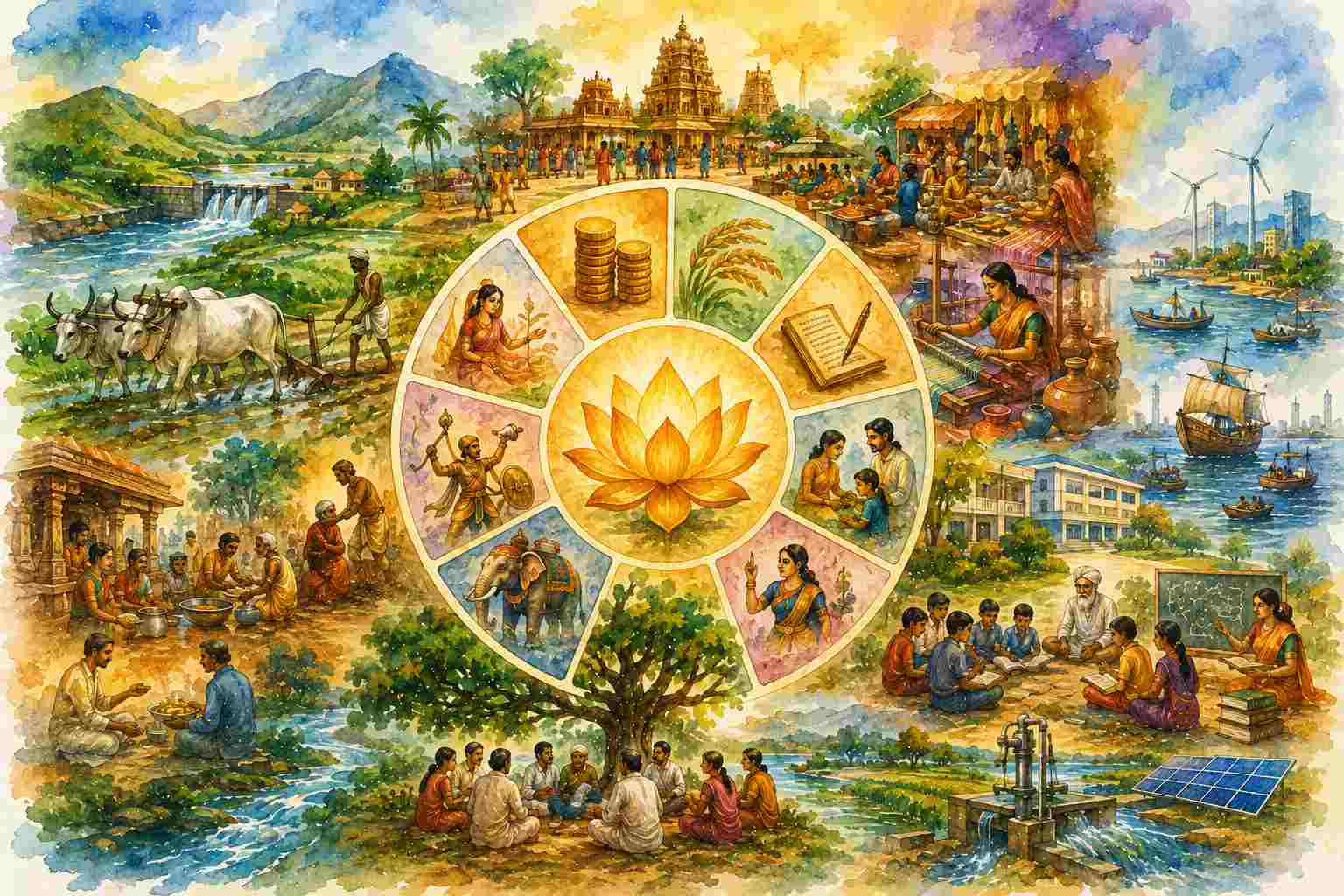
The idea of Ashtalakshmi offers perhaps the most powerful symbolic expansion of the concept of prosperity. In popular tradition, the eight forms include Adi Lakshmi, Dhana Lakshmi, Dhanya Lakshmi, Gaja Lakshmi, Santana Lakshmi, Veera Lakshmi, Vijaya Lakshmi and Vidya Lakshmi.
The point is not that this devotional classification was originally constructed as an economic theory. It was not. But it can provide a powerful framework for reconstructing an Indic theory of prosperity.
Dhana Lakshmi reminds us of financial wealth. Dhanya Lakshmi connects prosperity with food and agricultural abundance. Vidya Lakshmi represents knowledge. Santana Lakshmi directs attention toward continuity across generations. Veera Lakshmi reminds us that courage and collective capacity are also forms of civilizational strength. Gaja Lakshmi traditionally signifies royal and material abundance. Vijaya Lakshmi represents achievement and success, while Adi Lakshmi directs prosperity toward its deeper sustaining foundation.
Together, they suggest a profound question.
What if wealth is not one thing? A society may possess enormous financial capital while losing food security. It may have rising incomes while its knowledge systems decline. It may possess technological sophistication but suffer demographic insecurity. It may have luxurious consumption but no social trust.
The Ashtalakshmi Model of Artha Studies can therefore become a modern analytical framework for studying multiple forms of prosperity. Material wealth matters, but so does food security. Knowledge is wealth. Ecological abundance is wealth. Institutional continuity is wealth. Human capability is wealth. Social trust is wealth. Courage and collective resilience are forms of wealth. A civilization that measures only money may fail to notice the depletion of the other forms until the financial wealth itself becomes incapable of protecting society.
Indriya Nigraha and the Problem of Endless Desire
The deepest distinction between an embedded and disembedded economy may ultimately concern desire.
Modern consumer economies possess a structural problem. Economic growth frequently depends upon increasing consumption, while increasing consumption often depends upon the continuous production of new desires. But what happens when desire becomes economically limitless? No amount of production can permanently satisfy a civilization whose aspirations are continuously converted into new consumption. Wealth expands, but so do expectations. Comfort improves, but satisfaction does not necessarily follow.
Indic traditions therefore place Indriya Nigraha, self-restraint and control of desire within the larger framework of human flourishing. This does not mean asceticism for every person. Nor does it mean the rejection of comfort, beauty or enjoyment. Kama itself remains one of the legitimate Purusharthas. The problem emerges when desire becomes the sole principle organizing economic life.
An economy without restraint ultimately requires no concept of “enough.” An embedded economy asks the opposite question: What level and form of prosperity allows human beings, society and nature to flourish together?
Economic Circulation as Civilizational Circulation
The final feature of the Indic embedded economy is circulation.
Wealth did not move only through markets and the state. It also moved through Dana, temples, educational institutions, monasteries, pilgrimage networks, feeding houses, guilds and local communities. The Arthashastra itself refers to land, public works, reservoirs, roads, places of pilgrimage and structures associated with feeding and water provision as part of the broader administrative and productive landscape.
This creates an important distinction between economic concentration and economic circulation. Wealth concentrated in a treasury or private account has one function. The same wealth used for irrigation creates another function. When invested in education, it creates human capability. When used for food and medicine, it creates social welfare. When it supports artisans, institutions and knowledge, it becomes cultural capital.
The same economic resource can therefore produce radically different civilizational outcomes depending upon how it moves. This is why the study of wealth must become the study of relationships. Who produces wealth? Who controls it? How is it accumulated? Where does it circulate? Which institutions receive it? Does it regenerate ecological and social systems, or merely extract from them?
These are not questions outside economics. They are the deeper questions of economics.
From GDP to Civilizational Prosperity
The Indic concept of embedded economy does not ask us to abandon economic measurement. GDP, productivity, income and investment remain important. Poverty reduction matters. Infrastructure matters. Employment matters. Trade and technological innovation matter.
But they are insufficient by themselves. A civilization must also ask whether wealth strengthens the family, the community, the environment, knowledge and institutional continuity. It must ask whether economic activity produces resilience or dependency. It must ask whether consumption strengthens life or becomes an endless substitute for meaning.
The Indic model therefore proposes that Artha must be studied as a relationship rather than merely as a quantity.
Wealth is related to Dharma because the means and consequences of acquisition matter. It is related to Kama because human desire drives economic activity. It is related to Moksha because unlimited material accumulation cannot exhaust the human search for meaning. The economy is therefore embedded within the human being, the family, the community, the ecology and the civilization.
The future of Indic economic thought may lie precisely in recovering this broader understanding. An Ashtalakshmi framework of prosperity can help us study material, agricultural, intellectual, social, ecological, cultural and civilizational wealth together. Dharma can provide the ethical framework within which Artha is pursued. Dana can help us study circulation and social responsibility. Aparigraha can introduce the question of limits. Yajña can provide the principle of reciprocity.
The resulting model is neither anti-market nor anti-state. It does not glorify poverty, and it does not condemn wealth. Its central proposition is much more fundamental.
An economy becomes healthy when wealth strengthens the relationships that make prosperity possible in the first place.
When wealth destroys the soil that produces food, weakens the communities that sustain social trust, commercializes every relationship, exhausts human desire and erodes the cultural institutions that give life meaning, economic growth begins to consume its own foundations.
But when Artha remains embedded in Dharma, responsibility, restraint, reciprocity and multiple forms of prosperity, wealth can become more than accumulation. It can become a means through which society renews itself. That is the foundation of the Indic concept of Embedded Economy: not the rejection of wealth, but the civilizational discipline of ensuring that wealth serves life rather than life being reorganized solely in the service of wealth.
