
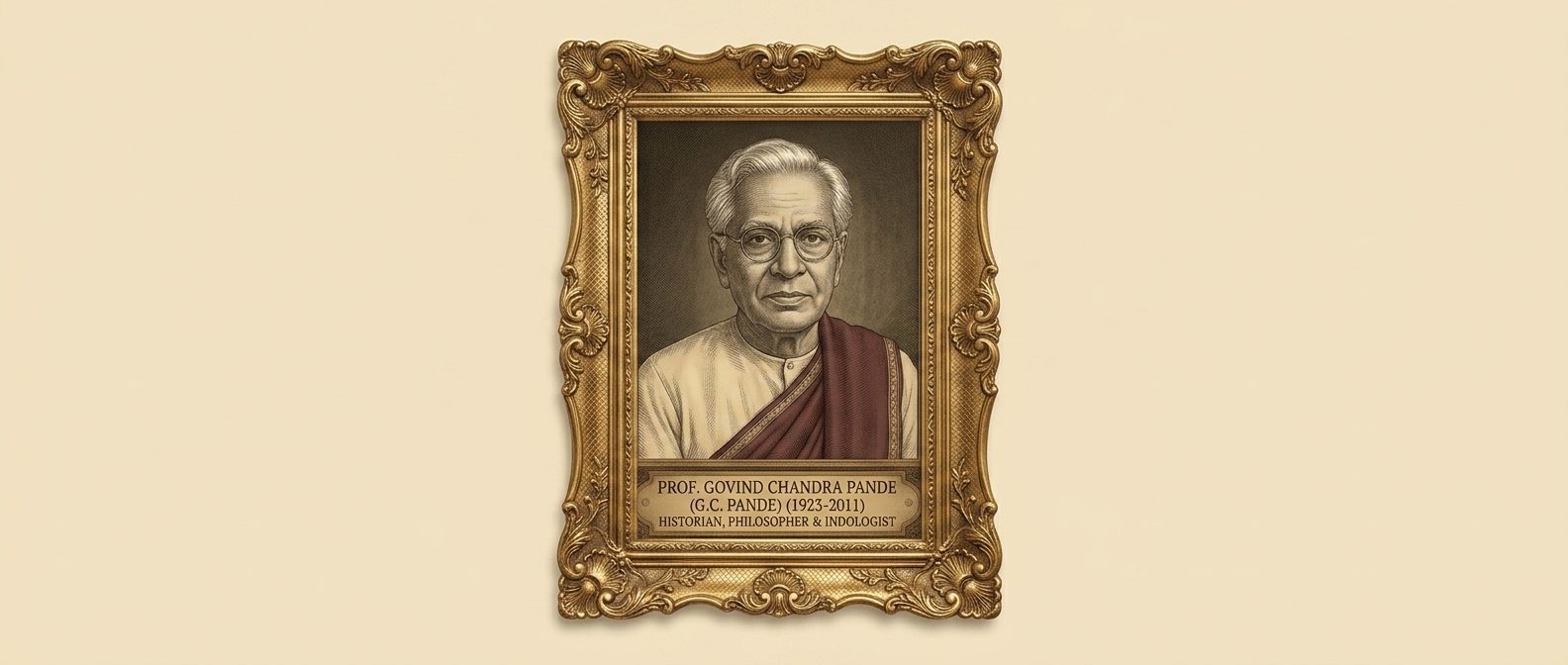
A Historian of Indian Culture and Civilisation
There are historians who reconstruct the past from inscriptions, coins, texts and archaeological remains. There are others who ask a different question: what did a civilisation think it was? G. C. Pande belongs to the second category, though he was also a careful historian in the first sense. His work repeatedly moves between history, philosophy, Sanskrit, Buddhism, social thought and the study of Indian culture. That breadth is what makes him particularly important today.
Govind Chandra Pande (1923–2011) was one of the major Indian scholars of the twentieth century. His scholarship covered Indian history, Buddhism, Vedic culture, philosophy, Sanskrit literature, aesthetics and the history of ideas. He also wrote poetry and translated the Ṛgveda into Hindi. His Foundations of Indian Culture, published in two volumes, remains one of his most important attempts to understand Indian civilisation as a unity of vision, symbolic forms and social reality.
His Major Works
His major works include:
- Foundations of Indian Culture,
- Sramana Tradition,
- Studies in the Origins of Buddhism,
- Bauddha Dharma ke Vikas ka Itihas,
- Jaina Political Thought,
- Life and Thought of Sankaracharya,
- Bharatiya Parampara ke Mool Swara,
- Bharatiya Samaj: Ek Tattvik Vivechan,
- Vaidik Sanskriti and his later work on the Ṛgveda.
Among these, Foundations of Indian Culture is perhaps the clearest expression of his larger intellectual project. Volume II, Dimensions of Ancient Indian Social History, is especially interesting because Pande does not treat society as merely an arrangement of institutions. He tries to understand the relationship between ideas, values, social practices and historical change. The volume is organised around geographical identity, population, economy, livelihood, village and city life, standards of living, socio-ethical ideas, social order and political thought.
And this is where Pande becomes particularly relevant. He is not merely asking, What was ancient Indian society like? He is asking something deeper: what ideas made that society intelligible to itself?
Quotes and Insights from his writings
1. Pande’s method: history is not only what society does, but how society understands itself
One of the most interesting features of the book is his insistence that social history cannot be reduced to external facts. Geography, economy, population and institutions certainly matter, but they become historically meaningful only when we understand how human beings perceive and interpret them. Pande therefore makes a distinction between social reality and social consciousness.
For him, the historian of ancient India has a particularly difficult task because the available evidence does not simply provide a neutral description of society. Texts themselves are expressions of a civilisation’s ideas about society. A Dharmasūtra tells us what ought to be done; an epic presents ethical dilemmas; a political treatise discusses what a ruler should do; a ritual text presents an ordered cosmos. None of these can automatically be treated as photographic descriptions of actual social conditions.
Pande puts the methodological problem very clearly: the important question is whether the historian can represent the historical articulations of “ancient Indian social self-consciousness.”
This is a crucial point. A historian who looks only at institutions may conclude that ancient India had a rigid social hierarchy. A historian who looks only at philosophical ideals may conclude that society was perfectly harmonious. Pande is interested in the tension between the two. This is why his discussion of varṇa is particularly important. He does not simply reproduce the Brahmanical theoretical model. He compares it with Buddhist and Jaina evidence and with changing occupational and social realities. His approach can therefore be described as civilisational historical analysis: ideas shape institutions, institutions shape behaviour, historical circumstances modify institutions, and society subsequently develops new ideas to understand those changes.
2. Geographical Identity: India as a historical and cultural space (Read full article here)
The first chapter begins with geography, but Pande’s geography is not merely physical geography. The important question is not simply: Where was ancient India?
It is: How did geographical space become part of India’s historical consciousness?
A civilisation does not experience geography as a collection of mountains, rivers and plains alone. It creates an understanding of its own spatial world. Rivers become sacred; regions acquire historical identities; pilgrimage networks connect distant places; political boundaries expand and contract; myths connect landscapes with cosmic narratives.
Pande’s opening discussion is therefore foundational to the entire book.
Geography creates possibilities, but human consciousness transforms geographical space into cultural space. The land becomes deśa, not merely territory. This is particularly significant for understanding Indian civilisation because political boundaries changed repeatedly while cultural geography displayed a remarkable capacity for expansion and integration. The question of Indian identity therefore cannot be reduced to the existence of a single political state. The historical India that emerges from Pande’s discussion is a space that is continually being interpreted, inhabited and connected. This also explains why Pande begins with geography rather than with the king or the state.
Civilisation precedes political centralisation.
The political state occupies territory, but cultural identity can extend beyond the boundaries of any particular state. That distinction becomes important again in the final chapter when Pande discusses political order.
3. Population: the material foundations of civilisation (Read full Article Here)
The second chapter turns to population.
Here Pande brings ancient Indian history into conversation with demographic theory, including the Malthusian discussion of population and the relationship between birth rates, death rates and available resources. He observes that settled agriculture changes the demographic equilibrium because food production makes larger populations possible. Yet pre-modern societies also experienced disease, famine, warfare and environmental fluctuations.
Pande therefore suggests that ancient India can broadly be understood through what demographic history calls a high-stationary pattern: both birth and death rates remained high, producing comparatively limited long-term population growth.
The important point is that ancient population history cannot simply be reconstructed from later figures. Pande explicitly warns that evidence is indirect and fragmentary, and that the historian must therefore avoid false precision. This has an important consequence for the rest of the book.
Population pressure was not uniformly experienced across India. Large areas remained forested. New settlements could be established. Agricultural land could be expanded. The relationship between population and land was therefore different from the demographic conditions of densely populated modern societies.
This helps explain something that repeatedly appears in Pande’s later chapters: ancient Indian villages were not necessarily characterised by chronic scarcity. That point becomes particularly important in his discussion of rural life and standards of living.
4. Economic Ideas: wealth as instrument, not ultimate purpose (Read full article here)
The third chapter is among the most philosophically important chapters of the book. Pande examines a question that is still central to modern political economy:
What is wealth for?
Modern economic thinking often treats wealth accumulation, production and consumption as ends that can be analysed through efficiency and utility. Pande argues that the Indian tradition generally placed economic activity within a larger ethical and spiritual framework.
His most important formulation is:
“Wealth is a means to living, not an end nor the means to fulfilment.” — p. 64
The sentence is short, but its implications are enormous. Pande is not saying that Indian civilisation rejected wealth. Quite the opposite. Agriculture, cattle-rearing, commerce, mining, manufacture, taxation and political economy were all recognised as legitimate and necessary activities. The issue was the moral status of wealth. Wealth was necessary for life, family, social responsibility and public welfare. But wealth could not become the final measure of human fulfilment.
This distinction allows Pande to reinterpret the apparent tension between artha and mokṣa. Artha is not rejected by mokṣa. Rather, artha is subordinated to a wider conception of human purpose. This is why Pande discusses samyag-ājīva, right livelihood. Economic activity itself possesses an ethical quality. The question is not merely how much wealth has been produced, but:
- how it was acquired,
- whether the means were legitimate,
- whether violence or deception was involved,
- whether accumulation remained proportionate,
- and how wealth was subsequently used.
Pande’s discussion of Manu is especially revealing. He explains the hierarchy of livelihoods and notes that violence, dependence and falsehood were to be avoided. He summarises the ideal of right livelihood in terms of “minimality and purity.” This is very different from an economic system in which the morality of production is separated from production itself. For Pande, economics is already embedded in ethics.
5. The Vedic Pattern of Livelihood: agriculture, cattle and commerce
The fourth chapter develops this economic argument by examining actual forms of livelihood. Pande challenges the simplistic idea that Vedic society was exclusively pastoral. He draws attention to the complexity of livelihood and to the development of vārta, the science or systematic knowledge of livelihood. The major occupations included: agriculture, cattle-rearing and commerce.
Later, money-lending and manufacture became increasingly differentiated. Pande’s discussion is important because it shows that technical knowledge was not absent from the Indian tradition. Agriculture involved specialised knowledge; cattle-rearing involved veterinary knowledge; forests, mining, metallurgy and trade all developed their own bodies of expertise.
This means that the traditional Indian economic world should not be imagined as technologically static. There was a body of practical knowledge associated with livelihood. At the same time, Pande identifies a change between the Vedic and post-Vedic moral frameworks.
His formulation is:
“If the Vedic pattern of life was governed by the notion of Rta”
he contrasts this with the later dominance of dharma, custom and social obligation. The significance is deeper than a change in vocabulary. Ṛta represents an order of existence; dharma increasingly becomes an order of conduct. The transition therefore represents a movement from a cosmically articulated order toward an increasingly social and institutional articulation of obligation. This becomes central to Pande’s later chapters.
6. The Rural Agrarian Pattern: the village as a civilisational institution
The fifth chapter is particularly valuable because it challenges modern assumptions about the Indian village. Pande identifies the enduring characteristics of rural life in a striking formulation:
“self-sufficiency, isolation, harmony and unchanging rhythm” — p. 89
The Indian village was not merely a geographical settlement. It was an economic, social and moral unit. Agriculture, caste organisation, kinship, customary obligations and local institutions combined to create a relatively stable form of community. Pande nevertheless does not romanticise this world.
Population pressure sometimes required new land to be brought under cultivation. New settlements were established. Political authorities increasingly intervened. Taxes and administrative demands could become more complex. But there was also a major structural difference between ancient Indian rural society and later European feudal arrangements. Pande points to the continuing importance of peasant proprietorship and corporate village life. He also notes the absence, in general, of a huge class of serfs or permanently landless agricultural labourers comparable to those found in some other historical societies. The significance of this observation is enormous. The village was not simply a unit of production. It was a form of social organisation capable of reproducing itself. That is why the ideas of self-sufficiency and customary continuity become so important.
7. The Urban Pattern: challenging the modern worship of the city
Pande’s sixth chapter is one of the most provocative. Modern histories of civilisation frequently assume a progression: village → town → city → civilisation → progress.
Pande refuses to accept this automatically.
Discussing the Vedic attitude toward cities, he writes:
“the city as the fount of civilization and progress” — p. 99
The point is not that cities were absent. Ancient India certainly developed important urban centres, particularly in the post-Vedic and classical periods. The point is that urbanisation was not necessarily regarded as synonymous with civilisation.
This is a very important distinction. A city represents occupational differentiation, specialised crafts, commerce, administration and political concentration. It creates new forms of wealth and knowledge. But it can also create dependence, inequality and social fragmentation. The village, by contrast, may appear economically limited but can possess a high degree of internal integration. Pande therefore forces us to ask a question that modern development theory often avoids: Is economic complexity necessarily equivalent to civilisational progress?
His answer is clearly: not automatically. The urban pattern represents a transformation of society, but its civilisational value must be judged by the values it serves.
8. Standards of Living: prosperity without the cult of accumulation
The seventh chapter brings the previous arguments together. Pande examines food, clothing, housing, agricultural resources, taxation, wealth and inequality. He does not present ancient India as an egalitarian society. There were substantial differences between rich and poor. At the same time, he argues that the material conditions of ordinary life were not necessarily characterised by permanent scarcity. There was considerable agricultural production. There was no general shortage of land. Coarse food and ordinary clothing were not necessarily inaccessible to large sections of the population.
Most importantly, Pande makes a distinction between poverty and relative inequality. A society can contain very wealthy and very poor people without the majority being in absolute material deprivation. He therefore argues that economic life largely remained governed by customary patterns and that “wealth was not overvalued.”
That statement should not be misunderstood as an argument that Indians did not value prosperity. Rather, it means that prosperity did not necessarily acquire the cultural status of the highest human good. This returns us to the earlier distinction between artha as instrument and wealth as final purpose.
The civilisational question is not simply: How much does society produce?
It is: What does society consider a successful human life?
9. Dharma: the moral architecture of society
The eighth chapter moves from material life to the moral structure that holds society together. Here Pande identifies dharma as one of the most distinctive concepts of Indian civilisation. Dharma is not simply religion.
It encompasses morality, law, custom, social obligation, proper conduct and the norms through which social relationships become intelligible. Pande describes it beautifully as one of the “golden threads” connecting the elite and ordinary people and linking everyday life with the larger sacred order.
This explains why dharma appears everywhere in Indian social thought. A person does not live merely as an isolated individual.
He or she occupies relationships: child, parent, spouse, student, teacher, householder, elder, ruler, subject, member of a community. Each relationship generates obligations. This is where Pande’s discussion of āśrama becomes important. The āśrama system can be interpreted as a theory of human development.
Human beings begin with desires and attachments. Rather than simply suppressing them, Indian thought creates stages through which desire can gradually be disciplined and transformed.
The movement is therefore not simply: desire → repression
but: desire → responsible fulfilment → detachment → transcendence.
Pande describes the purpose as movement from “instinctive and appetitive life to desirelessness.” This gives the Indian social order a developmental character. The social institution is not merely designed to control the individual. Ideally, it helps transform the individual.
10. Svadharma and the moral value of work
Pande’s discussion of the Mahābhārata introduces another important dimension. If dharma is an obligation appropriate to one’s situation, then moral worth cannot be determined simply by the external prestige of an occupation. The story of Dharma-vyādha becomes important in this context. The butcher’s occupation does not automatically make him morally inferior. What matters is the manner in which the person performs his obligation. This leads to the concept of svadharma. One’s work becomes ethically meaningful when it is performed as a duty rather than merely as an instrument of selfish gain. This also allows Pande to distinguish social hierarchy from moral hierarchy. A person may occupy a low social position while possessing great moral and spiritual excellence. Conversely, birth into a prestigious social category does not guarantee virtue. This becomes explicit in his discussion of Yudhiṣṭhira. The Mahābhārata’s ethical reasoning eventually moves toward the proposition that conduct is more fundamental than birth in determining moral worth.
That is why Pande gives particular attention to the statement:
“It is conduct, therefore, that really distinguishes the varnas.” — p. 163
The importance of this passage is that it prevents us from reading Indian social thought as a single, internally uniform doctrine. There are hierarchical tendencies, but there are also powerful internal arguments about conduct, merit, character and spiritual excellence. Pande’s project is to recover both.
11. Vedic Social Order: society as a reflection of cosmic order
The ninth chapter is perhaps the conceptual centre of Volume II. Here Pande examines the Vedic social order through the relationship between ṛta, ritual, hierarchy, Brahmana and Kṣatriya. He argues that early Vedic society should not simply be explained through the opposition between conquering Aryans and conquered non-Aryans.
That interpretation is too mechanical. Instead, Pande emphasises what may be called ritual harmony. The human order is conceived as corresponding to a larger divine order.
Society therefore acquires legitimacy not merely through political coercion but through its relationship to a sacred conception of reality. This is why the distinction between Brahmana and Kṣatriya is so important. The Brahmana represents knowledge, sacred authority and wisdom. The Kṣatriya represents political power. Neither is supposed ideally to absorb the other.
The political order requires their relationship. This produces one of Pande’s deepest observations:
“Social philosophy is here grounded in cosmology.” — p. 209
That sentence deserves to be treated almost as a key to the entire book. Modern social science often begins with society and then asks how religion influences it. Pande reverses the perspective.
In the Indian tradition, the very conception of society can emerge from a conception of cosmos. The social order is meaningful because reality itself is imagined as ordered.
12. Post-Vedic Society: theory and social reality begin to diverge
The tenth chapter introduces an essential corrective. If one reads only Brahmanical normative texts, one might imagine that the varṇa system perfectly described social reality. Pande argues that the Buddhist and Jaina records reveal something considerably more complicated. The rise of cities, mahājanapadas, commerce and specialised occupations changed society. New groups appeared. Occupations diversified. Guilds became important. Traders gained greater prominence. Craft specialists became socially significant. Different kinds of social identity became difficult to fit neatly into the fourfold varṇa model. Pande therefore distinguishes between varṇa, jāti and śilpa in discussing Buddhist evidence.
The distinction matters because:
- varṇa represents a broad normative classification,
- jāti represents hereditary social groupings,
- śilpa represents occupational organisation.
The three cannot simply be collapsed into one another. Pande’s larger argument is that there was a growing distance between social theory and social reality. This is one of the most useful ideas in the entire volume. A social ideology can survive even after the society it describes has changed. It then begins to perform a different function: rather than simply describing reality, it interprets, categorises and legitimises reality.
This means that the historian must never assume: “The text says X, therefore society was X.” The text may instead tell us what a particular intellectual tradition thought society ought to be. Buddhist and Jaina critiques are therefore historically valuable not merely because they oppose Brahmanical ideas but because they provide evidence of the social complexity that those ideas were attempting to comprehend. Pande specifically notes that Buddhist and Jaina sources show a difference between the Brahmanical conception of varṇa and actual social divisions.
13. The Political Order: wisdom and power
The final chapter brings the whole argument together. Pande’s interpretation of Indian political philosophy begins with a deceptively simple principle:
“wisdom and power” — pp. 262–263
The political problem is therefore not simply: Who rules?
It is: How should knowledge and power relate to one another?
In the Vedic formulation this appears through the relationship between: Brahman and Kṣattra.
In the later tradition it becomes: Dharma and Nīti.
Dharma represents justice, moral order and the normative structure of society. Nīti represents policy, prudence and the practical means by which power is exercised. Pande does not regard either as sufficient by itself. Pure moralism without political intelligence can become ineffective. Power without moral restraint can become tyranny. Therefore political wisdom requires the coordination of both.
His famous formulation is:
“Right governance thus requires the regulation of force by intelligent policy and of policy by moral reason.” — p. 263
This is arguably one of the most important political propositions in the entire volume. It also allows us to understand why Pande refuses to reduce ancient Indian political thought either to spiritual idealism or to ruthless statecraft. The Arthaśāstra tradition contains realism, strategy, administration, taxation, military organisation and political calculation. The Dharmaśāstra tradition contains moral obligation and social norms. Pande sees Indian political thought as attempting to hold these dimensions together. The state must be effective. But effectiveness must be directed toward hita, welfare, and governed by moral reason.
14. The education of the ruler: politics begins with self-government
Pande takes this argument one step further. A political system cannot be better than the people who operate it. Therefore the problem of political order ultimately becomes a problem of education and character. The ruler requires prudence, discipline, determination and respect for law. But these qualities cannot simply be manufactured through constitutional rules.
They require education. Pande cites the traditional formula “Vinayo rāja-mūlam”, connecting kingship with discipline and education, and argues that the ideal ruler must possess self-control and a commitment to public good.
This is another place where Pande’s political philosophy differs from modern institutionalism. A modern constitutional approach may ask:
- What institutions prevent abuse?
- What checks and balances exist?
- What laws regulate power?
Pande asks an additional question: What kind of human being exercises power? This is not an argument against institutions. It is an argument that institutions alone cannot substitute for character. The ruler must possess inner government before external government can be sound. Hence Pande’s discussion of Yoga and self-control is not an irrelevant spiritual digression. It is part of his theory of governance.
15. Arthaśāstra and the welfare state
Pande’s discussion of the Arthaśāstra is especially interesting because it shows that ancient Indian political economy was much broader than taxation and warfare. The domain of artha included:
- agriculture,
- irrigation,
- mining,
- trade,
- industry,
- forests,
- taxation,
- prices,
- wages,
- interest,
- state factories,
- markets,
- employment and public welfare.
Pande describes administration as the adjustment of a complex and diversified social and economic order, rather than merely the collection of taxes. This is a strikingly modern-sounding conception of the state. But Pande’s interpretation does not make the ancient Indian state identical to the modern welfare state. The important difference is the underlying philosophical framework. Economic policy remains embedded in the larger relationship between artha, dharma and social welfare. The state exists partly because political order creates the conditions within which society can pursue prosperity, morality and happiness. Pande notes that the Arthaśāstra occupies a middle position between purely cynical power politics and an exclusively moralistic conception of governance. That middle position is crucial.
Indian political thought, in Pande’s interpretation, recognises the autonomy of political technique without granting political power ultimate moral sovereignty.
16. The deeper architecture of Volume II
When all eleven chapters are read together, an underlying architecture becomes visible. Pande begins with geography because civilisation must inhabit a world. He then discusses population because human beings reproduce within material constraints. He moves to economy because people must produce and distribute the necessities of life. He examines livelihood because economic activity is not morally neutral. He studies the village because rural society was one of the principal institutions through which ordinary life was organised. He turns to the city because urbanisation transforms occupations, commerce, power and social relations. He examines standards of living because civilisation must finally be judged in terms of the actual conditions of human beings. He then introduces dharma because material organisation requires moral norms. He analyses varṇa because Indian society attempted to conceptualise social differentiation through a normative framework. He then compares that theory with post-Vedic social reality, showing that historical change constantly creates tensions between ideals and institutions. Finally, he reaches political order, where the entire civilisational problem comes together.
The state has to govern a geographical territory, a population, an economy, villages and cities, social groups and competing interests. But Pande argues that it cannot govern adequately through force alone. It requires wisdom.
17. Pande’s central insight: civilisation is a relationship between reality and ideality
Perhaps the most important contribution of Volume II is methodological. Pande does not ask us to choose between two simplistic pictures of ancient India.
The first says:
Ancient Indian society was an ideal civilisation perfectly governed by dharma.
The second says:
Ancient Indian society was simply a system of exploitation, hierarchy and material interests disguised by religious ideology.
Pande’s analysis is more complicated. There was a normative civilisation and there was a historical society. They interacted. The ideals were not merely decorative. They shaped institutions, conduct and social expectations. But institutions did not always conform to ideals. Historical change created new circumstances. Those circumstances forced the tradition to reinterpret itself.
This is why Pande’s distinction between social reality and social consciousness is so important. He argues that the historian must reconstruct the “historical articulations” of Indian social consciousness and examine the dialectic between ideas and practical life. In other words, ideas are historical forces. They are not merely reflections of economic conditions.
