
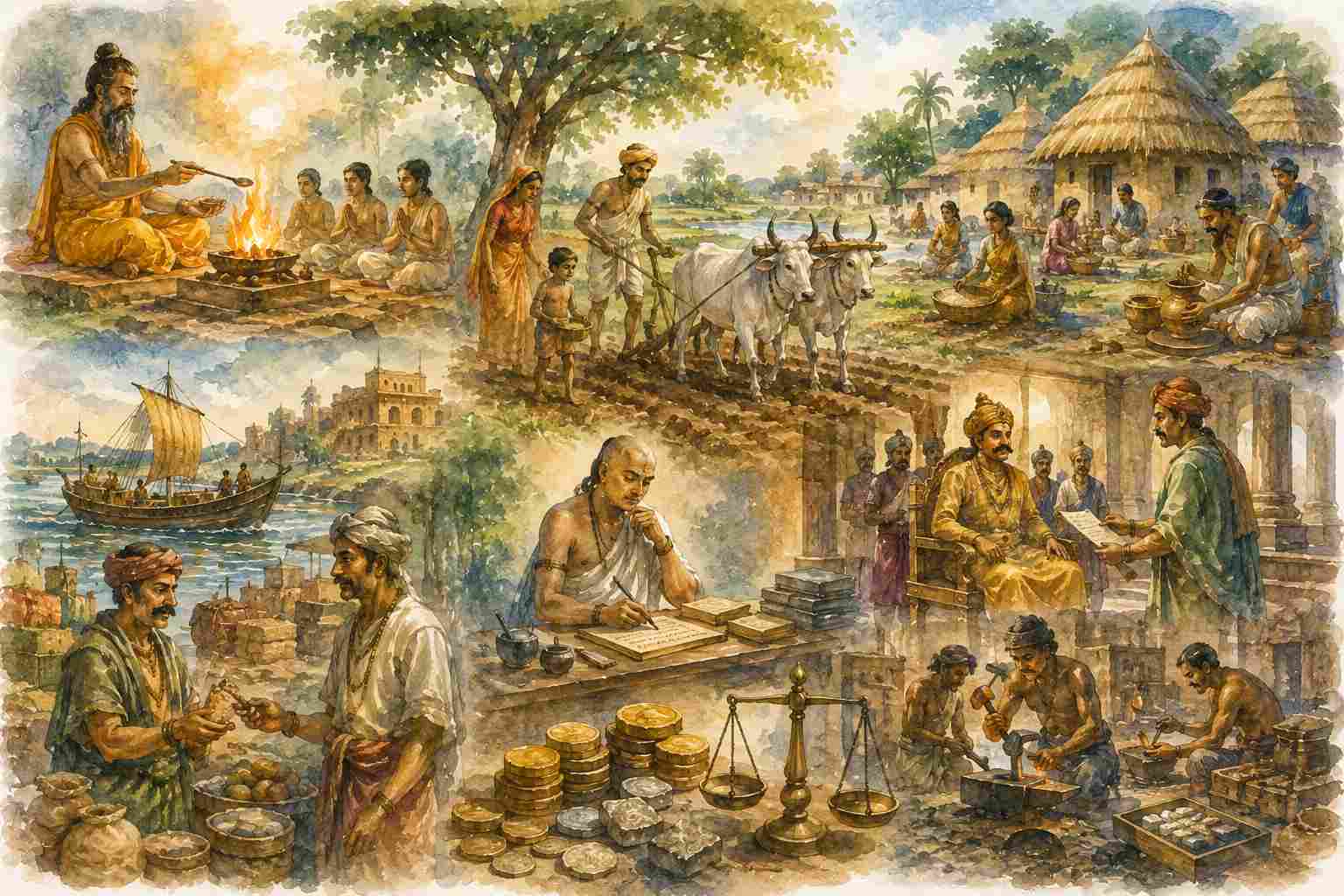
Wealth, Livelihood and the Moral Organisation of Economic Life
When we speak of an economy today, we usually begin with production, consumption, income, markets, employment, capital, prices and growth. Ancient Indian thought did not lack concepts corresponding to these activities, but it placed them within a different intellectual frame. Economic life was not conceived as an autonomous sphere whose primary objective was the continuous expansion of wealth. It was connected with dharma, social obligation, household welfare, political order and ultimately human fulfilment.
This is the central argument of G. C. Pande’s discussion of “Economic Ideas and Attitudes” in Dimensions of Ancient Indian Social History. Pande begins by contrasting the modern ideal of economic development with what he sees as the broad stability of the traditional Indian economy. He describes an economy in which agriculture remained predominantly traditional, villages were numerous and relatively self-sufficient, transport was slow, cities comparatively few, and crafts were strongly dependent upon inherited skills and guild organisation. Different economic levels could coexist—tribal settlements, villages and towns—without the assumption that the entire society had to move continuously towards a single higher level of material consumption.
The important question, therefore, is not whether ancient India had an economy. It clearly did. The question is what idea of economic life organised that economy.
1. Yajña: The First Economic Principle
Pande begins with the Vedic conception because, in his reading, the deepest economic attitude of the tradition is already visible in the idea of yajña. The Vedic worldview did not sharply separate nature from spirit, production from worship, or material welfare from religious fulfilment. Human beings lived through the bounty of nature and were expected to participate in the same principle of giving through which the cosmic order itself operated. The gods represented creative and beneficent forces; human beings, in turn, were expected to give, sacrifice and participate in the maintenance of ṛta.
This gives yajña an economic significance which is easy to miss if it is reduced to ritual sacrifice. Pande writes that “Yajña provided the basic model of social activity.” Work itself could be understood as an offering, while its fruits were not simply the result of individual effort but part of a larger reciprocal process between human beings, nature and the divine.
The Bhagavad Gītā gives the classical formulation of this cycle: beings depend upon food, food depends upon rain, rain is connected with yajña, and yajña arises from action. What matters economically is the underlying idea of reciprocity. Production does not terminate in private possession. What one receives creates an obligation to return, redistribute and participate in the larger cycle.
This is why the Vedic ideal could welcome prosperity without making possession itself the final measure of success. Pande notes that the Vedic ethos emphasised generosity, condemned niggardliness, and understood production and consumption through the relationship of giving and receiving.
The economic question was therefore already a moral question: What is produced? By what means? For whom? And how is what is received used?
2. From Wealth to Welfare
It is very important to understand that the Vedic conception of artha did not simply mean accumulation. Pande has emphasised the close relationship between value, wealth and welfare. We believe that the prosperity was desirable because it contributed to a full and ordered life, not because unlimited acquisition was itself considered the highest good.
This distinction becomes sharper in the Upaniṣadic period. The Upaniṣads do not deny the importance of material sustenance. On the contrary, anna—food—is treated with extraordinary seriousness. The Taittirīya Upaniṣad says:
“Annaṃ na nindyāt; tad vratam.”
One should not despise food; that is the discipline.
Pande specifically refers to Taittirīya Upaniṣad 3.7.10, where food is praised as fundamental to life. Yet the same tradition simultaneously questions whether material abundance can produce ultimate fulfilment. In the Bṛhadāraṇyaka Upaniṣad, Maitreyi’s famous question about wealth and immortality leads to the conclusion:
“Amṛtatvasya tu nāśāsti vittena.”
Wealth cannot provide immortality.
The Kaṭha Upaniṣad expresses the same intuition through Naciketas: “na vittena tarpaṇīyo manuṣyaḥ”—a human being cannot be satisfied by wealth. This does not produce an anti-economic philosophy. Rather, it establishes a hierarchy. Food is necessary; wealth is useful; possession is limited; fulfilment is something more.
That distinction is fundamental to an Indian Economic Dṛṣṭi.
3. Alpaparigraha: The Ethics of Possession
The next development is particularly significant because it moves from the value of wealth to the psychology of possession. The ascetic traditions of Buddhism and Jainism developed the ideal of aparigraha, non-possession. But Pande makes an important distinction: the householder did not necessarily have to become a mendicant. For the householder, aparigraha could take the form of alpaparigraha—limited possession. This is a much more subtle economic principle than simple poverty.
It does not say: wealth is evil.
It asks instead: how much possession is enough, and what happens when possession becomes attachment?
Buddhist and Jaina lay communities could contain wealthy merchants. Wealth could be earned, invested and used for charitable purposes. What was criticised was not necessarily prosperity itself but the uncontrolled desire for possession, attachment to wealth and improper means of acquisition.
Pande captures this through the distinction between wealth as a means and wealth as property. Wealth can support life, family, social obligations and public welfare. But attachment to wealth for its own sake produces a different moral condition. The concept of samyag-ājīva, right livelihood, therefore becomes central.
Economic ethics thus operates at two levels: the means by which wealth is acquired and the manner in which wealth is possessed and used.
4. Pramṛta, Satyānṛta and Svavṛtti: A Classification of Livelihood
One of the most revealing passages concerns the traditional classification of ways of earning a livelihood. Pande cites the Brahmanical classification of: ṛta — amṛta — mṛta — pramṛta — satyānṛta — svavṛtti. The categories distinguish different ways of obtaining sustenance. Pramṛta is cultivation; satyānṛta is business or trade; svavṛtti is service. The classification is fascinating because it refuses to treat all income-generating activities as morally identical.
Cultivation involves working upon the earth and, in the traditional moral reasoning, inevitably involves some violence. Trade contains both satya and anṛta—truth and falsehood—because exchange can be honest or deceptive. Service occupies another position in the hierarchy. Pande stresses that the concern was to minimise violence, dependence, falsehood and excessive attachment in the choice of livelihood.
This is a very different starting point from the modern assumption that the primary question is simply how much income an occupation generates.
The older question was also:
- Is the occupation ethically legitimate?
- Does it sustain life without corrupting the person?
- Does it involve excessive violence or deception?
- Does it create dependence?
Economic activity was therefore evaluated not only through productivity but through the quality of livelihood.
5. Vārtā: When Economic Activity Becomes a Science
The most important conceptual development in Pande’s chapter is perhaps the emergence of vārtā. The word originally carried the meaning of livelihood, profession or means of living. The major occupations associated with it were agriculture, cattle-rearing and commerce; later traditions expanded the field to include money-lending and manufacture.
But vārtā eventually became much more than a list of occupations. It became a systematic body of knowledge concerning the management of productive resources. Pande notes that ancient India possessed specialised knowledge concerning agriculture, veterinary science, forestry, trade, mining, metallurgy and related activities. The Arthaśāstra refers to experienced supervisors or adhyakṣas as authorities in these practical fields. Their knowledge was not merely theoretical: it represented accumulated technical experience organised into a systematic framework.
This is where the term adhyakṣapracāra becomes important.
The Arthaśāstra does not treat economic life as a vague sphere of “wealth.” It breaks it down into administratively intelligible sectors. Janapada-niveśa—the settlement of the countryside—includes the organisation of villages, allocation of land, agricultural problems, pastures and forests. Fortification, town planning and the treatment of foreigners also enter this larger field. The economy is becoming observable, classifiable and administrable.
6. The Economy of the Arthaśāstra
The scope of vārtā in the Arthaśāstra is remarkably broad. It includes: agriculture, forests, mining, metallurgy, trade, weights and measures, customs and tolls, textiles, shipping, cattle, horses, elephants, pasture, coinage and the circulation of money. Public finance includes revenue, expenditure, budgeting and record-keeping. The state also concerns itself with prices, wages, rent, interest, taxation and fines.
The important point is not simply that the Mauryan or post-Mauryan state regulated economic activity. It is the degree of empirical attention implied by this organisation. There must be records. There must be officials. There must be standards. There must be information about production and circulation. There must be mechanisms for preventing corruption. There must be knowledge of prices and scarcity. There must be regulation of coinage and weights. Economic governance therefore becomes an exercise in knowledge. Pande describes vārtā as ultimately integrated with daṇḍanīti within the Arthaśāstra. Its objective was not simply to enrich the ruler but to organise socially available resources for security and welfare.
This is why Economic Dṛṣṭi cannot be reduced to “ancient Indian economics.” It includes a conception of the relationship between livelihood, society and state.
7. Amarakosha and the Vocabulary of Economic Life
The vocabulary itself tells us something about the conceptual world. Pande cites Amarakośa 2.9.7 in connection with vārtā.
The importance of such lexical evidence is often underestimated. A civilisation’s economic thought does not exist only in formal treatises. It is also embedded in the vocabulary through which occupations, wealth, exchange and social roles are named. The transition from vṛtti as livelihood to vārtā as a systematic field is especially significant. The economy is no longer simply a collection of things people do. It becomes an object of organised knowledge. That conceptual movement—from livelihood to economic science—is one of the strongest themes in Pande’s chapter.
8. The Gṛhapati and the Rise of Economic Agency
Economic development also produced new social actors. Pande draws attention to the gṛhapatis mentioned in early Buddhist and Jaina literature. The exact historical meaning of gṛhapati and śreṣṭhin remains debated, but they clearly point towards a prosperous class associated with landholding and/or commerce. Pande mentions figures such as Mendaka and Anāthapiṇḍika as examples.
The Jātaka literature gives us another dimension: the businessman who rises through initiative, investment and profitable buying and selling. Pande refers specifically to the Cullaseṭṭhi Jātaka, where economic success is associated with intelligence, enterprise and commercial judgement. This is important because it prevents us from imagining ancient Indian economic life as entirely static or purely subsistence-oriented. There was enterprise. There was investment. There was market calculation. There was wealth generated through commerce. And there was a social class capable of deploying capital and employing specialised expertise.
The traditional economy was therefore not without economic dynamism. Its dynamism operated within a different normative framework.
9. Coinage, Taxation and the State
The emergence of coinage adds another layer. Pande notes that the Arthaśāstra gives specific attention to precious metals, coinage and the circulation of coins, alongside weights and measures, customs and tolls. Money therefore did not simply emerge as a private instrument of exchange. Its circulation was also a matter of public regulation.
The same applies to taxation. The state had a legitimate claim upon economic production, but taxation was not theoretically unlimited. Pande observes that the Arthaśāstra sought to maximise state revenue without damaging the people or their economic activity. Prices were related to production costs and scarcity, while taxation was connected with both revenue requirements and public welfare. This produces a useful distinction: taxation is not merely extraction; it is part of the relationship between state, production and social security. The king requires revenue because the state requires resources. But if taxation destroys the productive base, it defeats its own purpose.
Economic policy consequently has to balance revenue, production, security and welfare.
10. Economic Dṛṣṭi
Pande’s discussion allows us to construct a broader framework of Economic Dṛṣṭi.
- It begins with yajña: economic life is reciprocal rather than purely possessive.
- It develops through anna: food and material sustenance are fundamental and must be respected.
- It is restrained through alpaparigraha: possession should not become unlimited attachment.
- It is ethically evaluated through samyag-ājīva: the means of livelihood matter.
- It differentiates livelihoods through pramṛta, satyānṛta and svavṛtti.
- It becomes technically organised through vārtā. It becomes administratively intelligible through adhyakṣapracāra.
- It becomes socially embodied through the gṛhapati, śreṣṭhin, farmer, trader, artisan and specialised official.
- It becomes monetarily organised through coinage, weights, measures and regulated exchange.
- And it becomes politically consequential through taxation, public finance and state regulation.
The result is neither a rejection of wealth nor an unrestricted celebration of wealth. It is an attempt to place artha within an order of life. Pande himself concludes that traditional Indian political economy combined utilitarian and ethical considerations. Economic institutions were simultaneously instruments of public welfare and parts of a moral order carrying duties and obligations. That may be the most useful starting point for an Economic Dṛṣṭi: not asking only how much an economy produces, but asking what kind of human life its economic arrangements are intended to sustain.
And this also explains why the Indian tradition could simultaneously praise anna, encourage prosperity, regulate markets, recognise private property, organise taxation and support merchants, while still warning that wealth cannot by itself satisfy the human being.
Economic life was necessary. Economic knowledge was necessary. Economic prosperity was desirable. But artha was never the whole of life.
Primary textual architecture
- For this article, the principal foundation is Pande’s “Economic Ideas and Attitudes,” especially pp. 58–69 of Foundations of Indian Culture, Vol. II. The chapter draws upon the Vedic corpus, Bhagavad Gītā, Taittirīya Upaniṣad 3.7.10, Bṛhadāraṇyaka and Chāndogya Upaniṣads, Buddhist and Jaina traditions, Manu, Amarakośa 2.9.7, Vāyu Purāṇa, Kauṭilya’s Arthaśāstra, Śukranīti and related sources. Pande’s own references also include Śaṅkarācārya’s commentary on Kāmandakīya Nītisāra, Bhaṭṭasvāmin’s commentary on the Arthaśāstra, N. N. Law, K. V. R. Aiyangar’s Aspects of Ancient Indian Economic Thought and K. T. Shah’s Ancient Foundations of Economics.
