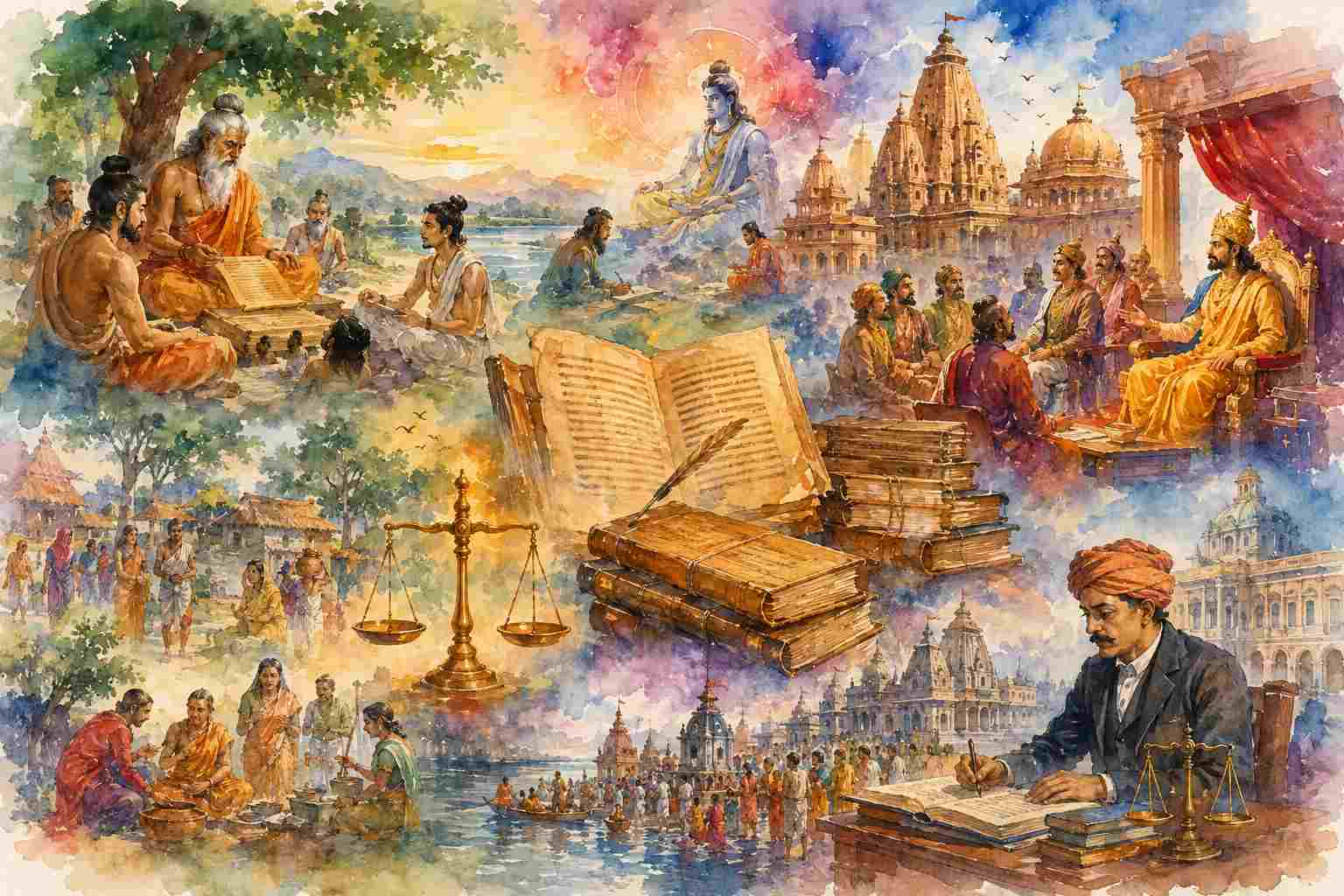
What happens when a civilisation begins asking a deceptively simple question: How should human beings live together? The Indian answer did not begin with a single lawgiver sitting down to write a code. It emerged gradually, through a long conversation about dharma—about conduct, obligation, justice, kingship, family, property, punishment, ritual, inheritance, social duties and the countless situations in which human beings must decide what ought to be done. This conversation is preserved in one of the most extensive intellectual traditions of Bharat: Dharmaśāstra.
Its earliest surviving layer takes us not to a court or a royal palace, but to the world of the śākhās, households, teachers and students. Here the question was not merely, “What is the law?” It was much larger: What sustains order in individual life, family life and society?
The journey begins with the Dharmasūtras. (Indepth- read Here and Here)
(1) Āpastamba Dharmasūtra (Āpastamba; c. 300–200 BCE) represents one of the earliest systematic attempts to organise rules of conduct. Alongside it came (2) Gautama Dharmasūtra (Gautama; c. 200–150 BCE), (3) Baudhāyana Dharmasūtra (Baudhāyana; c. 150–100 BCE) and (4) Vasiṣṭha Dharmasūtra (Vasiṣṭha; c. 100 BCE–100 CE). These works speak about students, householders, marriage, food, purity, inheritance, punishment, king ship and social obligations. But notice what is already happening. Dharma is not being reduced to one narrow sphere called “law.” The same intellectual framework is concerned with the conduct of the individual, the responsibilities of the household, the functioning of society and the duties of the ruler. The tradition continued through works such as (5) Vaikhānasa Dharmasūtra (Vaikhānasa tradition; date uncertain) and (6) Hiraṇyakeśi Dharmasūtra (Hiraṇyakeśin tradition; date uncertain), while (7) Viṣṇu Dharmasūtra / Vaiṣṇava Dharmaśāstra (Viṣṇu tradition; c. 600–700 CE) represents a later and more developed form of Dharmaśāstra literature.
And then something important happened. The social world had become more complicated. Questions accumulated. Earlier teachings had to be remembered, organised and interpreted for circumstances that earlier authors could not have described individually.
This is where the great Smṛti tradition emerges.
(8) Mānava Dharmaśāstra / Manusmṛti (Manu; c. 100–200 CE) gives perhaps the most famous articulation of this world. It speaks about ācāra, social duties, the king, punishment, evidence, property, inheritance, marriage, occupations, penance and the organisation of society. Manu is therefore not simply a book of prohibitions. It is an attempt to understand the relationship between individual conduct, social order and political authority. Then comes (9) Yājñavalkya Dharmaśāstra / Yājñavalkya Smṛti (Yājñavalkya; c. 300–500 CE). Its organisation into Ācāra, Vyavahāra and Prāyaścitta gives Dharmaśāstra an especially clear architecture: how one should live, how disputes should be adjudicated, and how transgressions should be addressed. (10) Nārada Smṛti (Nārada; c. 400–600 CE) moves particularly deeply into Vyavahāra—dispute resolution, judicial procedure, evidence, debts, contracts, property, inheritance and other matters that arise when human beings inevitably disagree.
But Nārada was not alone. The tradition remembered (11) Bṛhaspati Smṛti (Bṛhaspati tradition; date uncertain), (12) Kātyāyana Smṛti (Kātyāyana; date uncertain), (13) Parāśara Smṛti (Parāśara; c. 600–800 CE), (14) Dakṣa Smṛti (Dakṣa; date uncertain), (15) Atri Smṛti (Atri; date uncertain), (16) Laghu Atri Smṛti (Atri tradition; date uncertain), (17) Hārīta Smṛti (Hārīta; date uncertain), (18) Laghu Hārīta Smṛti (Hārīta tradition; date uncertain), and (19) Vṛddha Hārīta Smṛti (Hārīta tradition; date uncertain).
The names continue: (20) Aṅgiras Smṛti (Aṅgiras; date uncertain), (21) Aushanasa / Uśanas Smṛti (Uśanas/Śukra; date uncertain), (22) Devala Smṛti (Devala; date uncertain), (23) Gobhila Smṛti (Gobhila; date uncertain), (24) Gautama Smṛti (Gautama tradition; date uncertain), (25) Kāśyapa Smṛti (Kāśyapa; date uncertain), (26) Prajāpati Smṛti (Prajāpati tradition; date uncertain), (27) Saṃvarta Smṛti (Saṃvarta; date uncertain), (28) Śaṅkha Smṛti (Śaṅkha; date uncertain), (29) Laghu Śaṅkha Smṛti (Śaṅkha tradition; date uncertain), (30) Likhita Smṛti (Likhita; date uncertain), (31) Śaṅkha-Likhita Smṛti (Śaṅkha and Likhita; date uncertain), (32) Śātātapa Smṛti (Śātātapa; date uncertain), (33) Vasiṣṭha Smṛti (Vasiṣṭha tradition; date uncertain), (34) Vyāsa Smṛti (Vyāsa tradition; date uncertain), (35) Laghu Viṣṇu Smṛti (Viṣṇu tradition; date uncertain), (36) Yama Smṛti (Yama; date uncertain) and (37) Vṛddha Ātreya Smṛti (Ātreya tradition; date uncertain).
Why so many authorities? Because the Indian tradition did not assume that one text must erase all previous texts. Different authorities could preserve different formulations. Different regions and historical circumstances could raise different questions. Later scholars therefore inherited not a single book, but a conversation among authorities. Some of those authorities themselves disappeared as independent works. Yet their voices did not necessarily disappear.
(38) Budha Smṛti (Budha; lost), (39) Chhāgaleya Smṛti (Chhāgaleya; lost), (40) Cyāvana Smṛti (Cyāvana; lost), (41) Jāmadagni Smṛti (Jāmadagni; lost), (42) Jābāla Smṛti (Jābāla; lost/fragmentary), (43) Mārīci Smṛti (Mārīci; lost), (44) Prācetasa Smṛti (Prācetasa; lost), (45) Pitāmaha Smṛti (Pitāmaha; lost), (46) Paiṭhinasi Smṛti (Paiṭhinasi; lost), (47) Ṛṣyaśṛṅga Smṛti (Ṛṣyaśṛṅga; lost), (48) Sumantu Smṛti (Sumantu; lost), (49) Śaunaka Smṛti (Śaunaka; lost) and (50) Viśvāmitra Smṛti (Viśvāmitra; lost) survive substantially through later quotations and references.
This is where the history of Dharmaśāstra becomes particularly fascinating. A civilisation’s intellectual memory is not preserved only in complete books. Sometimes one scholar quotes another. A later digest preserves an older verse. A Commentary explains an earlier rule. Centuries later, the fragment still speaks.
And then the commentators arrive. The question is no longer simply, “What did Manu say?” It becomes: What did Manu mean? When does a particular rule apply? How should apparently different authorities be reconciled?
(51) Maskarī / Maskarin’s Commentary on the Gautama Dharmasūtra (Maskarin; early medieval) and (52) Mitākṣarā of Haradatta on the Gautama Dharmasūtra (Haradatta; medieval) revisit the older Dharmasūtra tradition. (53) Ujjvalā on the Āpastamba Dharmasūtra (Haradatta; medieval) performs a similar work for Āpastamba.
The Manu tradition becomes even richer.
(55) Manu-Śāstra-Vivaraṇa (Bhāruci; c. 600–650 CE) is followed centuries later by (56) Manubhāṣya (Medhātithi; c. 850–900 CE), (57) Govindarāja’s Commentary on the Manusmṛti (Govindarāja; c. 11th century), (58) Kullūka’s Manvarthamuktāvalī (Kullūka Bhaṭṭa; c. 13th–15th century), (59) Sarvajñanārāyaṇa’s Commentary on Manu (Sarvajñanārāyaṇa; medieval), (60) Nārāyaṇa’s Commentary on Manu (Nārāyaṇa; medieval), (61) Nandana’s Commentary on Manu (Nandana; medieval), (62) Rāghavānanda’s Commentary on Manu (Rāghavānanda; later medieval) and (63) Rāmacandra’s Commentary on Manu (Rāmacandra; later tradition).
Think about what this means. Manu was not frozen in the century in which the text was composed. Generation after generation returned to it. The same process transformed Yājñavalkya.
(64) Bālakrīḍā (Viśvarūpa; c. 800–850 CE) interprets Yājñavalkya. Then comes perhaps the most influential work in the history of Indian jurisprudential thought: (65) Mitākṣarā (Vijñāneśvara; c. 1075–1125 CE). Alongside it stands (66) Aparārka’s Commentary on the Yājñavalkya Dharmaśāstra (Aparārka; c. 1125–1175 CE), followed by (67) Śūlapāṇi’s Commentary on Yājñavalkya (Śūlapāṇi; c. 14th–15th century).
The tradition keeps moving.
(70) Pārāśara-mādhavīya (Mādhava/Vidyāraṇya; c. 14th century) revisits Parāśara, while (71) Nandapaṇḍita’s Commentary on Parāśara (Nandapaṇḍita; later medieval) continues that interpretative process. (72) Vaijayantī (Nandapaṇḍita; c. 17th century) represents the continuing habit of returning to inherited authorities rather than abandoning them. But eventually even commentaries were not enough.
By the medieval period, the accumulated material had become enormous. Scholars now needed to bring together many authorities and organise them around practical questions.
Thus emerged the great Nibandha tradition.
(73) Kṛtyakalpataru (Lakṣmīdhara; c. 1110–1150 CE) represents this new encyclopaedic impulse. It gathers material across areas of Dharma and creates an organised intellectual resource. (74) Dāyabhāga (Jīmūtavāhana; c. 1075–1125 CE) turns particularly toward inheritance and family property. (75) Smṛtyarthasāra (Śrīdhara; c. 1150–1200 CE) and (76) Smṛticandrikā (Devaṇabhaṭṭa; c. 1175–1225 CE) further systematise the inherited tradition. Then comes the monumental (77) Caturvargacintāmaṇi (Hemādri; c. 1260–1275 CE), followed by (78) Smṛtiratnākara (Caṇḍeśvara; c. 14th century), (79) Madanapārijāta (Madanapāla; c. 14th century), (80) Vyavahāranirṇaya (Varadarāja; medieval), (81) Vyavahāracintāmaṇi (Vācaspati Miśra; medieval), and (82) Tīrthacintāmaṇi (Vācaspati Miśra; medieval).
The range itself tells us something. Dharmaśāstra was now dealing with pilgrimage, judicial procedure, inheritance, ritual, gifts, penance, asceticism and kingship—not as unrelated subjects, but as interconnected dimensions of social life.
The tradition continued through (83) Yatidharmasamuccaya (Yādava Prakāśa; medieval), (84) Sarasvatīvilāsa (Pratāparudra; c. 16th century), (85) Divyatattva (Raghunandana Bhaṭṭācārya; c. 16th century), (86) Śuddhitattva (Raghunandana; c. 16th century), (87) Smṛtitattva (Raghunandana; c. 16th century) and (88) Śūdradharmatattvaprakāśa / Śūdrakamalākara (Raghunandana tradition; medieval/early modern).
Then comes the extraordinary seventeenth-century synthesis.
(89) Vīramitrodaya (Mitramiśra; c. 17th century) gathers an immense range of earlier authorities. (90) Nirṇayasindhu (Kamalākara Bhaṭṭa; 1612 CE) continues the process of determining Dharma through accumulated textual reasoning. (91) Smṛtikaustubha (Anantadeva; c. 17th century) and (92) Rājadharmakaustubha (Anantadeva; c. 17th century) bring the tradition toward questions of practical Dharma and kingship. (93) Vyavahāramayūkha (Nīlakaṇṭha Bhaṭṭa; c. 17th century), (94) Dānamayūkha (Nīlakaṇṭha Bhaṭṭa; c. 17th century) and (95) Bhagavanta-bhāskara (Nīlakaṇṭha Bhaṭṭa; c. 17th century) show how specialised these traditions had become.
And even by the eighteenth century, the conversation had not ended.
(96) Dharmasindhu (Kāśīnātha Upādhyāya; c. 1790–1791 CE) stands near the end of this long premodern trajectory, preserving and organising a vast inherited ritual and normative tradition. But there was another feature of this literature: specialisation.
The question of dāna alone generated an impressive textual lineage. (97) Dāna-Kalpataru (Lakṣmīdhara; c. 1110 CE), (98) Dānasāgara (Ballālasena; c. 1168 CE), (99) Dānakhaṇḍa (Hemādri; c. 1270 CE), (100) Dānaratnākara (Caṇḍeśvara; c. 1300 CE), (101) Dānaratna / Dānavivekoddyota (Madanasiṃha; c. 1425 CE), (102) Dānasāra (Dalapati; c. 1500 CE), (103) Dānakriyākaumudī (Govindānanda; c. 1500 CE), (104) Dānatattva (Raghunandana; c. 1550 CE), (105) Dānasukha (Ṭoḍaramalla; c. 1580 CE), (106) Dānakautuka (Nandapaṇḍita; c. 1600 CE), (107) Dāna-Kamalākara (Kamalākara Bhaṭṭa; c. 1625 CE), (108) Dānaprakāśa (Mitramiśra; c. 1625 CE), (109) Dānakāustubha (Anantadeva; c. 1650 CE) and (110) Dāna-hīrāvalī-prakāśa (Divākara; c. 1685 CE) demonstrate how a single field could become its own intellectual tradition.
The same happened with judicial procedure, kingship, inheritance, purification, pilgrimage, rites and adoption. (111) Dāyabhāga (Jīmūtavāhana; c. 1075–1125 CE), (112) Vyavahāracintāmaṇi (Vācaspati Miśra; medieval), (113) Vyavahāranirṇaya (Varadarāja; medieval), (114) Madanapārijāta — Vyavahāra section (Madanapāla; medieval), (115) Sarasvatīvilāsa — Vyavahāra section (Pratāparudra; c. 16th century), and (116) Vyavahāramayūkha (Nīlakaṇṭha Bhaṭṭa; c. 17th century) show the continuing concern with dispute and adjudication. For kingship we find (117) Rājadharmakāṇḍa of Kṛtyakalpataru (Lakṣmīdhara; c. 12th century), (118) Rājadharmaratnākara (Caṇḍeśvara; c. 14th century) and (119) Rājadharmakaustubha (Anantadeva; c. 17th century).
For ritual and social practice come (120) Saṃskāramayūkha (Nīlakaṇṭha Bhaṭṭa; c. 17th century), (121) Śuddhimayūkha (Nīlakaṇṭha Bhaṭṭa; c. 17th century), (122) Tīrthacintāmaṇi (Vācaspati Miśra; medieval), (123) Sāmānya-praghaṭṭaka of Tristhalīsetu (Nārāyaṇa Bhaṭṭa; c. 16th century), (124) Yatidharmasamuccaya (Yādava Prakāśa; medieval), (125) Śrāddha-related sections of Caturvargacintāmaṇi (Hemādri; c. 13th century), (126) Vrata-khaṇḍa of Caturvargacintāmaṇi (Hemādri; c. 13th century), (127) Prāyaścitta-khaṇḍa of Caturvargacintāmaṇi (Hemādri; c. 13th century), (128) Dattakamīmāṃsā (Nandapaṇḍita; c. 16th–17th century), (129) Dattakacandrikā (Devīnāraṇa Bhaṭṭa; later medieval) and (130) Ṭoḍarānanda (Ṭoḍaramalla’s scholarly project; c. 1572–1589 CE).
So what, finally, was Dharmaśāstra? Was it simply “ancient Indian law”? That description is far too small.
Dharmaśāstra was an evolving knowledge tradition concerned with the ordering of human life. It asked how the individual should conduct himself, how families should function, how property should pass, how disputes should be resolved, how kings should rule, how punishment should be imposed, how obligations should be discharged and how social order could be maintained without separating law, ethics, ritual and social responsibility into completely isolated worlds. More importantly, it developed through continuity and interpretation.
Āpastamba did not have to disappear for Manu to emerge. Manu did not have to disappear for Yājñavalkya to become influential. Yājñavalkya did not have to be abandoned when Vijñāneśvara interpreted him. And the commentators did not bring the tradition to an end; the nibandhakāras gathered them, compared them and carried them into new circumstances. Perhaps that is the most important lesson hidden in this enormous textual journey.
The Indian tradition did not preserve Dharma by refusing to change. It preserved Dharma by continuously thinking about how inherited principles should speak to changing circumstances. That is why the journey from the Dharmasūtras to the Smṛtis, from Manu to Yājñavalkya, from Medhātithi to Vijñāneśvara, from Lakṣmīdhara to Hemādri, from Raghunandana to Mitramiśra and Nīlakaṇṭha is not merely a history of books. It is the history of a civilisation repeatedly asking one of its oldest questions: When human beings live together, what does it mean to live rightly? And the answer was never written only once. It was remembered, debated, interpreted, reorganised and carried forward—generation after generation.
