
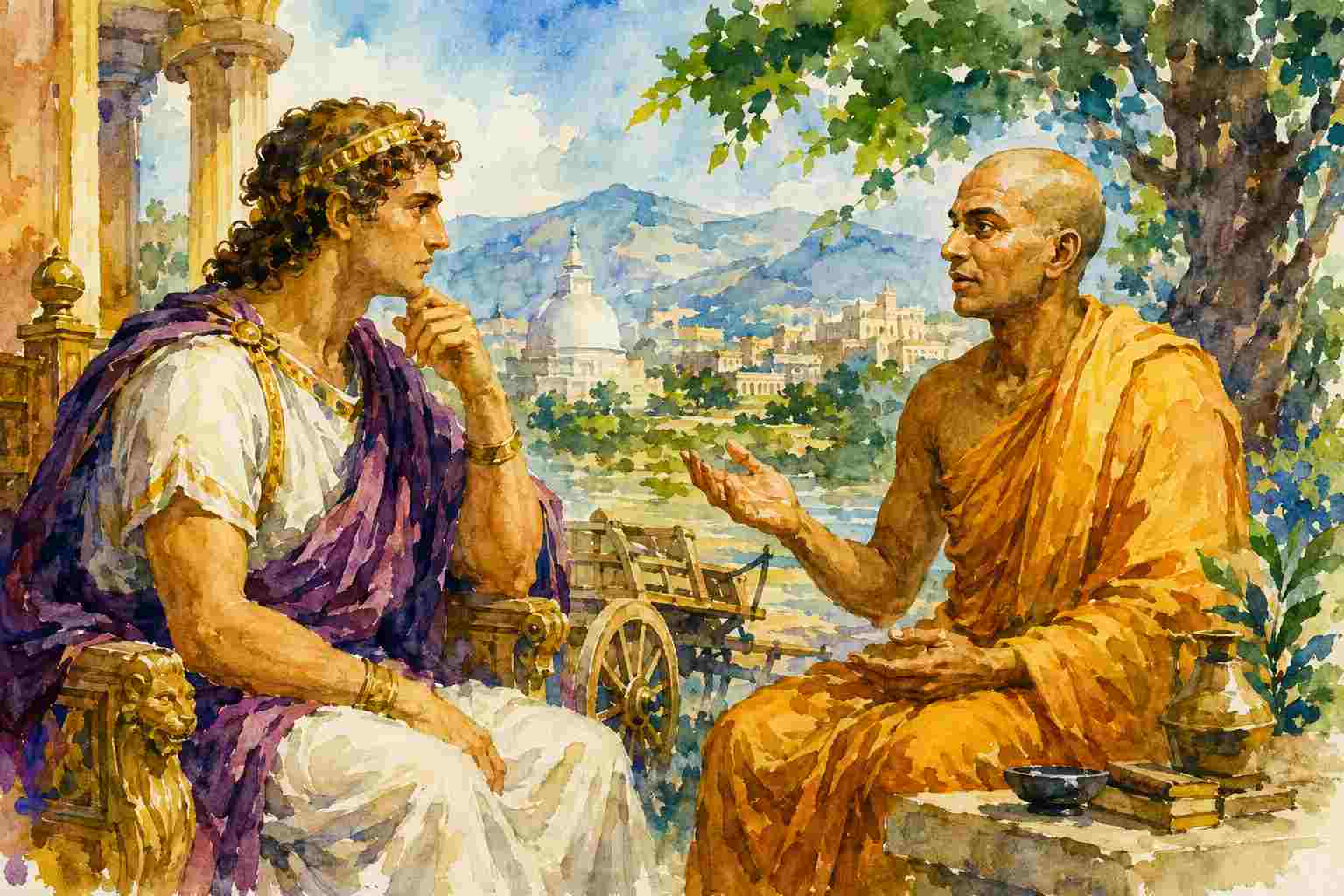
Introduction: From the Question of the Self to the Question of the World
The first part (part I) of the Milindapañha begins with an apparently simple question: Who is Nāgasena? From a name, the dialogue moves towards the problem of identity; from identity, it reaches continuity and responsibility. But as I continued reading, another feature of the text became increasingly clear. The Milindapañha is not concerned only with what a person is. It is also concerned with how knowledge itself should be approached.
Milinda does not merely ask questions; he learns what kind of questions deserve what kind of answers. Nāgasena, meanwhile, does not simply defend Buddhist doctrine. He distinguishes between questions that can be answered directly, questions that require analysis, questions that must be answered with another question and questions that should be set aside altogether. As Nāgasena explains: “There are four kinds of ways in which a problem may be explained.”
The text then identifies four methods: a direct and definitive answer, an analytical answer, a counter-question and a question that should be set aside. Milindapañha, Book IV; Rhys Davids, The Questions of King Milinda, Part II.
This is a remarkable moment in the dialogue. Nāgasena is not saying that every question must receive an answer merely because a powerful king has asked it. Some questions demand a different form of reasoning; some may be wrongly framed from the beginning. Knowledge therefore requires not only answers but the ability to understand what kind of question one is asking.
The Milindapañha, then, becomes more than a Buddhist dialogue about metaphysical problems. It becomes a reflection on reasoning itself.
The Problem Milinda Refuses to Leave Behind
The problem of continuity remains central. If there is no permanent self, how can actions produce consequences? Why are human beings different from one another? Why does one person experience prosperity and another suffering?
Milinda asks why people are not alike: “Why is it… that all men are not alike, but some are short-lived and some long-lived, some sickly and some healthy, some ugly and some beautiful, some without influence and some of great power, some poor and some wealthy?”
Nāgasena responds with a comparison to plants: “Why is it that all vegetables are not alike, but some sour, and some salt, and some pungent… and some sweet?”
Milinda replies that the difference comes from different seeds. Nāgasena then makes his point: differences among beings must similarly be understood through the causal logic of karma. Milindapañha, Book III, Chapter 4, Rhys Davids, pp. 100–101. The passage is interesting because Nāgasena once again refuses a simple answer. The diversity of human life is not explained through a single permanent essence. Instead, it is explained through causation. What a person experiences belongs within a larger chain of conditions and actions.
This does not make the Milindapañha a modern social theory, and we should not impose modern ideas upon it. Yet Milinda’s question itself is revealing. The text is interested in the visible inequalities of human life: health and illness, poverty and wealth, power and weakness, longevity and premature death. Nāgasena’s response may be theological and moral, but the question begins with society.
The distinction remains crucial: the person is not permanent, but actions are not meaningless. Nāgasena’s world is a world of change, yet it is not a world without consequences. The causal chain continues even when no permanent self can be located within it.
A King, a Monk and the Authority to Know
The more I read the dialogue, the more striking the relationship between Milinda and Nāgasena appeared. Milinda possesses political power. Nāgasena possesses intellectual and religious authority. Yet neither form of authority completely absorbs the other.
The king can question the monk. The monk can reject the king’s reasoning. More importantly, Nāgasena can tell the king that a question has been incorrectly framed. This is perhaps one of the most significant features of the Milindapañha. Political power does not automatically become intellectual authority. Milinda is a ruler, but the dialogue does not allow him to command truth into existence.
This becomes especially important in the text’s treatment of Buddhist dilemmas. Milinda repeatedly constructs difficult questions, sometimes presenting two statements that appear to contradict one another. The challenge is not merely to repeat scripture but to explain how apparently contradictory claims may be understood. Nāgasena is repeatedly required to resolve these problems.
The intellectual culture imagined here is therefore not one in which authority ends discussion. Authority must survive discussion.
Milinda’s famous response after many explanations is: “Very good, Nāgasena! That is so, and I accept it as you say.”
The formula appears repeatedly throughout the text. But it is important to recognise what precedes it. Milinda does not begin with acceptance. Acceptance follows questioning. This is why the king’s presence matters. Nāgasena’s wisdom is repeatedly tested against objections. The text’s intellectual confidence does not lie in preventing difficult questions but in confronting them.
The Everyday World as a Way of Thinking
Another lesson became increasingly clear as the dialogue moved through its many problems: the Milindapañha thinks through the ordinary world. Chariots, seeds, plants, lamps, fire, water and countless other objects become instruments of reasoning. A monk’s philosophical explanation does not remain suspended above social and material life. The familiar world supplies the language through which difficult concepts are examined.
This is particularly visible in the discussion of karma. Milinda’s question about human inequality is answered through seeds. Different results emerge from different causal conditions, just as different plants emerge from different kinds of seed. The analogy is not merely poetic. It provides a structure for reasoning. Elsewhere, the text uses fire to explain continuity, objects of trade to explain spiritual exchange, and everyday occupations to illuminate ethical and intellectual discipline. The material world is therefore not opposed to philosophy. It becomes one of philosophy’s principal resources.
This is one reason I find the Milindapañha difficult to place within modern disciplinary categories. Is it religion? Certainly. Is it philosophy? Equally certainly. But its questions also move into ethics, social difference, political authority and ordinary economic life. The text does not recognise our modern habit of separating these into entirely independent disciplines.
What Does It Mean That the King Is Greek?
The larger civilisational question, however, remains. Why is Milinda a Greek king? The answer is not simply that Greek and Indian civilisations had “met.” That had already happened politically, commercially and culturally across the northwestern regions of the subcontinent. The more interesting question is how the Milindapañha represents that encounter.
Milinda is not erased. His foreignness is part of the identity of the dialogue. The text remembers him as the ruler of the Yonakas. Yet he is also not permanently kept outside the Buddhist intellectual world. He can enter, question and object and, gradually, he can understand. But this inclusion does not require the Buddhist tradition to abandon its own conceptual framework. The categories through which the questions are ultimately answered remain Buddhist. The text therefore presents neither complete exclusion nor intellectual surrender.
This is why I would resist both extreme interpretations. The Milindapañha is neither evidence of an isolated Indic world refusing foreign encounter, nor a story in which Indic intellectual traditions simply dissolved before an external civilisation. The dialogue presents something more complex: encounter without conceptual erasure.
The foreign ruler becomes a participant in the intellectual world of the text without becoming the source of its philosophical categories. Perhaps this is the most important civilisational lesson of the Milindapañha. A tradition can absorb the presence of another without ceasing to think in its own categories. Engagement does not always mean assimilation.
Conclusion: When the Questions Become the Encounter
By the end of this reading, the question I began with had changed. I initially wondered what happened when a Greek king encountered a Buddhist monk. The Milindapañha suggests that the more important question may be: what happens when an intellectual tradition allows an outsider’s questions to become part of its own way of thinking?
Milinda does not merely receive Buddhist answers. His questions force Nāgasena to explain identity, responsibility, causation and knowledge with increasing precision. Yet the dialogue does not become a fusion in which every distinction disappears. The king remains the questioner; Nāgasena remains the teacher; political power remains distinct from intellectual authority. The Milindapañha therefore offers a remarkable model of intellectual encounter. The foreign king is not silenced, but neither does his participation require the Indic tradition to surrender its conceptual independence. He is given something more demanding than passive inclusion: The right to ask difficult questions and the responsibility to follow the answers wherever they lead.
That is perhaps why the text remains so intellectually alive. Its deepest achievement is not that Nāgasena answers every question. It is that the dialogue demonstrates why serious traditions should not fear being questioned.
Primary texts used: Milindapañha, especially Book III, Chapter 4 and the later discussion of the modes of answering questions, in T. W. Rhys Davids’s translation, The Questions of King Milinda, Sacred Books of the East, Vols. XXXV–XXXVI; see also the later Pali Text Society translation by I. B. Horner.
