
THE MILINDOPANHA
Introduction: Before the Questions Begin
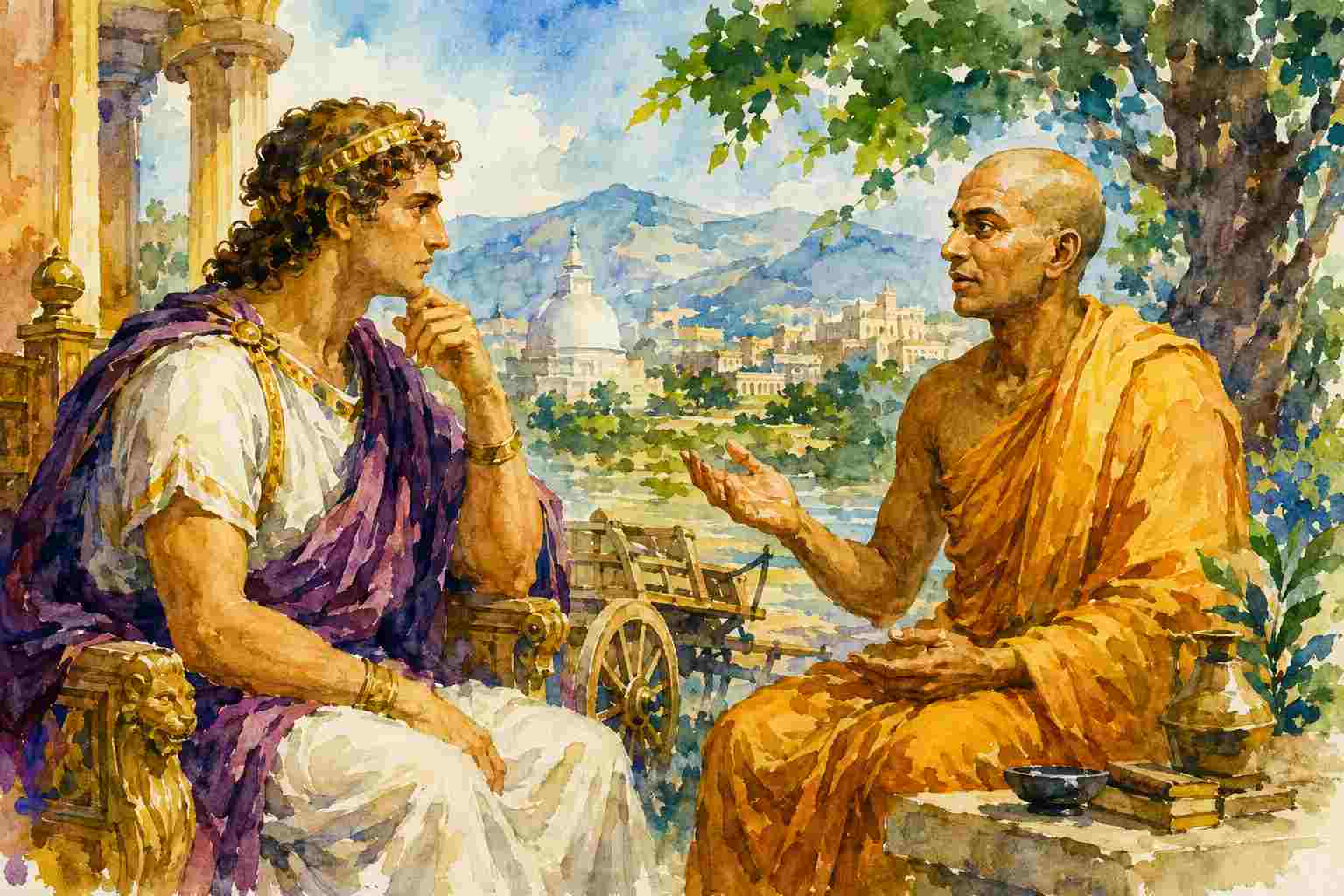
When I first approached the Milindapañha, I knew it through its most familiar description: a dialogue between the Indo-Greek king Menander, remembered in the text as Milinda, and the Buddhist monk Nāgasena. Yet reading the text more carefully made that simple description increasingly inadequate. The Milindapañha is not a conversation in which a foreign king passively receives Buddhist doctrine. Milinda questions, objects and follows arguments to their difficult consequences. The text itself is built around those questions.
The historical Menander and the literary Milinda should not, of course, be collapsed into one another. The Milindapañha is a transmitted Buddhist text of uncertain authorship and composition, although its central figure is conventionally identified with the historical Indo-Greek ruler. As the Pali Text Society describes it, the work is a dialogue between King Milinda and Nāgasena, preserved in a two-volume translation by I. B. Horner.
What interested me, however, was not simply the historical question of whether Menander actually asked Nāgasena these questions. The more interesting question was this: Why did a Buddhist intellectual tradition preserve a dialogue in which a Greek king was allowed to ask them at all?
The encounter begins in Sāgala, a prosperous city described in the text as “a great centre of trade.” Before there is philosophy, therefore, there is a social world—a city, a kingdom and a meeting of different intellectual traditions. Milindapañha, Part I, T. W. Rhys Davids trans., Sacred Books of the East, Vol. XXXV (Oxford, 1890).
But the first real philosophical question is not about Greece, India or Buddhism. It is much simpler. What is your name?
The First Question: Who Is Nāgasena?
Milinda asks the monk: “How is your reverence known, and what, sir, is your name?”
Nāgasena replies that he is known by the name Nāgasena, but immediately qualifies the answer. The name is only: “a generally understood term, a designation in common use.”
For, Nāgasena adds, “no permanent individual can be found.” Milindapañha, I.1; Rhys Davids, pp. 40–41.
This is the point at which the dialogue becomes more interesting than a simple statement of the Buddhist doctrine of anattā. Nāgasena does not say that the name is meaningless. People do call him Nāgasena; the name functions in ordinary life. What he questions is the assumption that the name must therefore refer to a permanent and independent entity.
Milinda immediately presses the difficulty. If there is no permanent Nāgasena, then who is standing before him?
Nāgasena responds with the famous chariot analogy. Since Milinda arrived by chariot, Nāgasena asks whether the pole is the chariot. Milinda says no. Are the wheels the chariot? No. The axle? No. The frame? No. Each individual component can be identified, but none of them is, by itself, the chariot.
Nāgasena then asks whether something called “the chariot” exists separately from all its components. Again, Milinda says no.
The monk then turns the argument against him: “Then thus, ask as I may, I can discover no chariot.”
Milinda, however, recognises the point and explains that the name chariot is applied because of the organised presence of all its components: “It is on account of its having all these things—the pole, and the axle, the wheels, and the framework, the ropes, the yoke, the spokes, and the goad—that it comes under the generally understood term, the designation in common use, of ‘chariot.’”
Nāgasena then draws the parallel: “And just even so it is… that I come under the generally understood term, the designation in common use, of ‘Nāgasena.’”
Milindapañha, I.1; Rhys Davids, pp. 43–44.
The familiarity of the chariot analogy can make us overlook its precision. I initially read it as a simple statement that “the self does not exist.” But Nāgasena’s argument is more subtle. He does not deny the existence of persons in the ordinary world, just as he does not deny that Milinda travelled to the meeting in something everyone conventionally calls a chariot. His point is that the name should not be mistaken for evidence of a permanent essence. A person, like the chariot, is intelligible as a changing arrangement of elements. The name remains useful, but the permanent self supposedly hidden behind the name cannot be found.
Yet Milinda’s next question makes the real difficulty unavoidable.
If There Is No Permanent Self, Who Is Responsible?
If Nāgasena is only a conventional designation, then who performs actions? Who acts rightly or wrongly? Who experiences the consequences? This is where I began to see Milinda’s importance more clearly. He does not allow the philosophical argument to remain abstract. If Nāgasena is right about the absence of a permanent self, then the question of identity immediately becomes a question of responsibility.
Nāgasena’s answer is not to restore an eternal soul. Nor does he deny continuity. Instead, the Milindapañha develops a different logic: continuity without permanence.
The person changes from moment to moment, yet later states arise from earlier ones. The present person is therefore neither completely identical with the past person nor entirely disconnected from him. This causal relationship allows actions to have consequences without requiring an unchanging entity to pass untouched through time.
The philosophical movement is therefore more complex than either “the self exists” or “nothing exists.” The Milindapañha asks whether causation can preserve responsibility without preserving a permanent self. This is one of the reasons Milinda’s questions matter so much. He repeatedly identifies the consequences of Nāgasena’s claims. Every answer creates another difficulty, and that difficulty forces the argument to become more precise.
The text therefore does not treat questioning as the opposite of knowledge. The question is what reveals where an explanation remains incomplete.
How Does the Dialogue Think?
The more I read the opening encounter, the more important the method of the Milindapañha became. Nāgasena does not simply tell Milinda what to believe. He makes him examine something familiar. The chariot becomes a philosophical instrument because Milinda already understands its parts. The analogy is not merely decoration added after the argument; it is how the argument becomes intelligible.
The movement is strikingly consistent: a question is raised, an answer is challenged, an analogy is introduced, and the question returns in a more precise form. This also shapes the relationship between the king and the monk. Milinda possesses political power, but political authority cannot settle a philosophical question. Nāgasena possesses intellectual authority, but authority does not exempt him from explanation. The king is allowed to be wrong; The monk is required to explain.
That distinction may be the political significance of the dialogue. The Milindapañha does not question kingship itself in the modern democratic sense, but it clearly distinguishes between the authority to rule and the authority to establish an argument. Milinda’s throne gives him power over the kingdom; it does not make the pole of a chariot into the chariot.
More importantly, his foreignness does not exclude him from intellectual participation. Milinda is permitted to question one of the deepest assumptions of the Buddhist tradition. Yet the tradition does not surrender its own conceptual language in order to accommodate him. This is why the familiar formula of “Greek philosophy meets Indian spirituality” is misleading. The surviving text remains fundamentally Buddhist in its intellectual grammar. But the foreign king is not silenced or absorbed into an indistinguishable whole. He remains a questioner.
And the text thinks through his questions.
What Changes When a Greek King Begins Asking Questions?
The first encounter in the Milindapañha moves with remarkable economy. A king asks a monk his name. The name leads to the person. The person leads to the chariot. The chariot leads to the problem of identity. And identity finally leads to the question of responsibility. What I learned from reading this opening slowly was that the Milindapañha is not simply interested in giving answers. It is interested in what a serious question can do to an answer.
Milinda’s foreignness does not prevent him from entering the dialogue, but neither does his presence force the Buddhist tradition to abandon its conceptual autonomy. The encounter therefore suggests something more complex than either isolation or assimilation. A foreign ruler can participate in an Indic intellectual tradition without the tradition dissolving itself into him.
Perhaps that is the deeper significance of the Milindapañha. Nāgasena’s authority does not depend upon silencing the king, and Milinda’s authority does not allow him to silence the monk. The dialogue proceeds because questions are allowed to reach their full difficulty.
Part II will follow that difficulty further: from identity to causation, responsibility and rebirth, and from the intellectual encounter between king and monk to the larger questions of political authority and civilisational exchange.
Primary text used: T. W. Rhys Davids (trans.), The Questions of King Milinda, Part I, Sacred Books of the East, Vol. XXXV (Oxford: Clarendon Press, 1890), especially the opening dialogue and chariot passage, pp. 40–44. A later scholarly translation is I. B. Horner’s Milinda’s Questions, Vols. I–II, published by the Pali Text Society.
