
Reading the Thirukkural as an Indic Social Text
The Thirukkural is one of those books whose familiarity can sometimes prevent us from asking the most basic question about it: what kind of book are we actually reading?
It is frequently introduced as a work of ethics, a book of universal wisdom, a collection of moral aphorisms, or a Tamil classic. All of these descriptions are true, but none is sufficient. Read as a whole, the Thirukkural is more ambitious than a collection of isolated moral sayings. It attempts to think about the human world in a particular sequence: how one should live, how society and power should be organised, and how love belongs within human life.
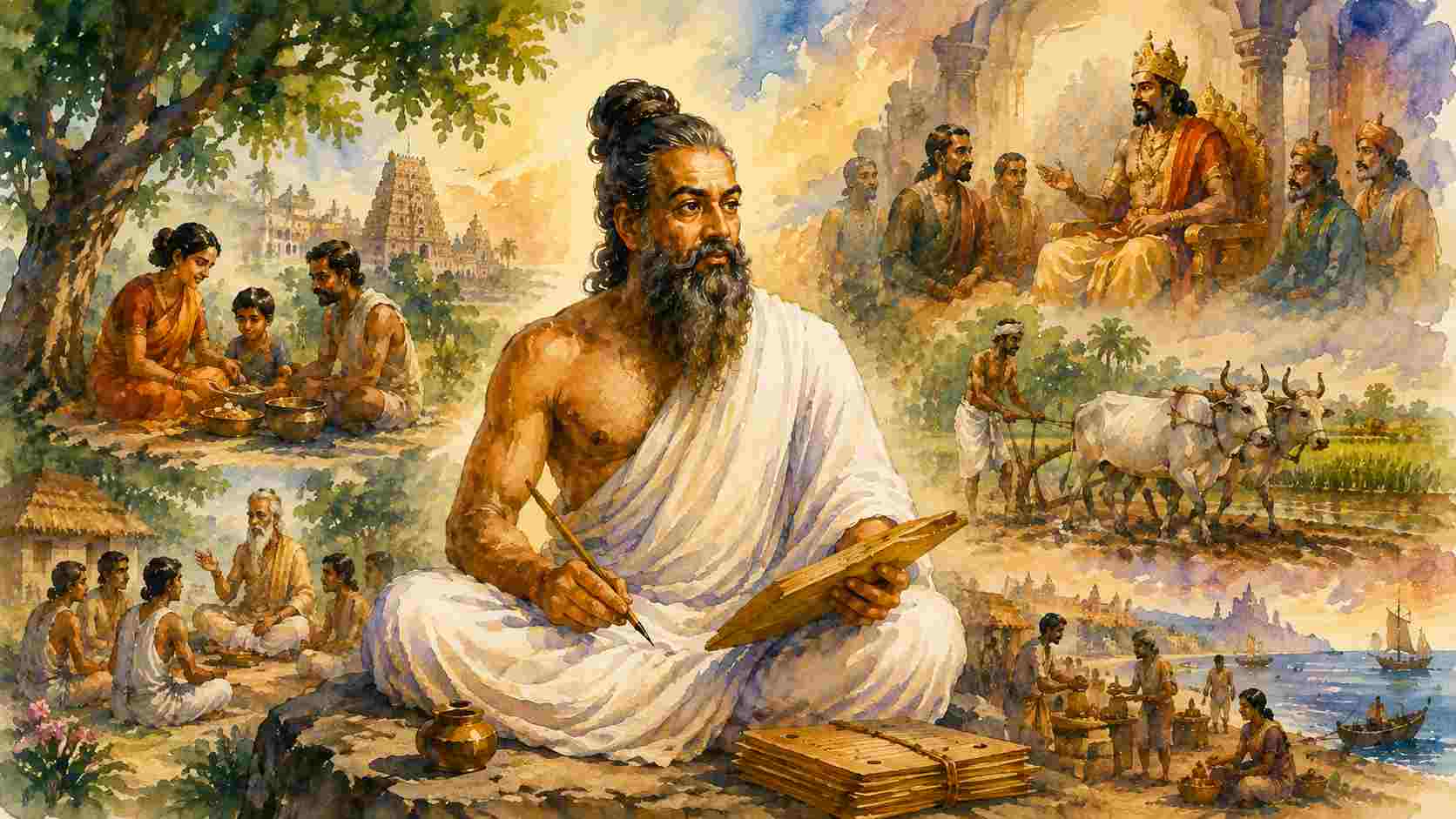
The structure itself is striking. The text contains 1,330 couplets arranged into 133 chapters, with ten couplets in each chapter. These are organised into three great divisions: அறம் (Aṟam), பொருள் (Poruḷ) and இன்பம் (Iṉbam). Conventionally translated as Virtue, Wealth and Love, these English words are useful, but they should not be mistaken for complete equivalents of the Tamil categories. The second and largest division alone contains 700 couplets and moves through kingship, ministers, fortifications, justice, agriculture, wealth, friendship, social relations and the wider organisation of the human world. The architecture of the text is therefore itself an argument: morality, society, power, material life and love do not appear as unrelated disciplines.
This is how I want to read the Thirukkural: not as a treasury from which we extract quotations, but as a carefully constructed intellectual world.
A Book Built in Two Lines
The first difficulty for a modern reader is the form of the work itself. We are accustomed to books developing arguments through long chapters. The Thirukkural does the opposite. It compresses each proposition into the tiny form of the kural veṇpā. Every kural is a two-line poem; in the conventional metrical description, the first line contains four metrical units and the second three. Yet these extremely brief verses are arranged into thematic chapters, and those chapters into a much larger architecture.
This means that the text must be read at two levels. A single couplet can stand independently, but it also belongs to a chapter. A chapter belongs to a larger division, and that division belongs to an overall vision of human life. To remove a famous kural from its context may therefore preserve its words while losing part of its intellectual significance.
The opening couplet itself reveals the problem of translation:
அகர முதல எழுத்தெல்லாம் ஆதி
பகவன் முதற்றே உலகுAgaram mudhala ezhuththellām ādi
Bhagavan mudhatṛē ulagu.“As all letters begin with ‘A’, so the world begins with the Primal Lord.”
— Thirukkural, 1
The verse is simple enough to remember, yet interpretation immediately begins. What precisely does ஆதி பகவன் (Ādi Bhagavan) signify? How should ulagu, “world,” be understood? Different commentators and translators have answered differently. The point is not that one translation must be declared permanently correct, but that the brevity of the original creates an intellectual density that commentary must unpack.
The Thirukkural, therefore, does not merely contain short sayings. It demands long reading.
The Man We Call Thiruvalluvar
If the text itself is compact, the history of its author is remarkably open. The life of Thiruvalluvar remains difficult to reconstruct with certainty. His exact dates are disputed, and the traditions surrounding his birthplace, occupation, caste and religious affiliation are extensive but cannot simply be treated as historical biography. Dating proposed for the text and its author varies widely across modern scholarship and tradition. What can be said with confidence is that the Thirukkural belongs to the great corpus of classical Tamil literature and is associated with the Patiṉeṇkīḻkaṇakku, the Eighteen Lesser Texts.
The historical silence around Thiruvalluvar has produced an extraordinary abundance of memory. Different traditions have sought to identify him with particular communities, occupations and religious worlds. This has often led modern readers to ask: Was Valluvar Hindu, Jain or Buddhist? Was he a weaver, a priest, a merchant or something else?
These questions are understandable, but they can also become traps. They often assume that the text can only be understood once we successfully place its author within one fixed modern category. Yet, it is true that he was Indic in his way of life and way of thinking. The Thirukkural itself, however, gives us something more substantial than a biography: 1,330 verses through which an authorial intelligence constructs a world.
For this reason, I think it is more useful to begin with a distinction. Thiruvalluvar, the Indic sage, the historical individual remains partly hidden; Thiruvalluvar the intellectual author is unmistakably present through the organisation of the text. We may not know his complete biography, but we can still ask what kind of society his work imagines, what institutions it considers important and how it understands the relationship between virtue, wealth and power.
The absence of a detailed biography should not become an excuse for ignoring the text. If anything, it requires us to read the text more closely.
How the Thirukkural Is Built
The Thirukkural is conventionally divided into three pāl or major books:
அறம் — Aṟam
பொருள் — Poruḷ
இன்பம் — Iṉbam
The first contains 38 chapters, the second 70, and the third 25. Together, they form 133 chapters and 1,330 couplets. This numerical architecture has remained central to the received form of the text. Manuscript traditions and commentarial traditions, particularly those associated with medieval commentators such as Parimelazhagar, show that the Thirukkural has been preserved not simply as an isolated set of verses but through sustained traditions of interpretation.
The English translations—Virtue, Wealth and Love—are useful, but they should make us cautious rather than comfortable. Aṟam is not merely “morality” in the modern sense. Poruḷ cannot be reduced simply to money or private wealth. Iṉbam is more than the romantic emotion suggested by the English word “love.”
The three categories invite comparison with broader Indic categories such as dharma, artha and kāma, and such comparison is certainly important and while reading The Thirukkural, we must also, first allow the book to speak through its own conceptual vocabulary.
One structural feature immediately stands out: the largest section of the book is Poruḷ.
Seven hundred couplets—more than half of the entire text—are devoted to the human and political world. Here we encounter kings, ministers, learning, friendship, agriculture, armies, diplomacy, fortifications and wealth. The Thirukkural therefore cannot be reduced to the image of India as interested only in spiritual or otherworldly questions. Its intellectual universe is deeply concerned with the organisation of society and the practical conditions that allow human life to flourish.
Yet Poruḷ does not come first. The text begins with Aṟam.
This sequence is important. Before political power, there is conduct. Before the king, there is the moral and social person. Before wealth is discussed, the text asks how human relationships should be sustained. The household, hospitality, gratitude, compassion and truthfulness are not marginal concerns; they form part of the world within which political and economic life will later be considered.
And after Poruḷ, the work does not end with the state. It turns to Iṉbam.
The architecture itself therefore raises a question that will guide our entire reading: what kind of civilisation imagines human life through virtue, material and political order, and love?
More Than a Book of Quotations
The Thirukkural is perhaps one of the most quoted texts in South Asia. Its verses appear in speeches, schoolbooks, calendars and public life. That popularity is a sign of its living tradition, but it can also produce a particular problem. A text of 1,330 couplets can become reduced to fifty famous ones.
Our approach will therefore be different. We will not merely ask, “What does this couplet mean?” We will also ask: Why does it appear in this chapter? Why is this chapter placed here? What social world is assumed by this verse?
Consider the famous couplet on agriculture:
சுழன்றும் ஏர்ப்பின்னது உலகம் அதனால்
உழந்தும் உழவே தலைSuḻandrum ērp-pinnatu ulagam; ataṉāl
uḻantum uḻavē talai.“Though the world goes round following many occupations, it follows behind the plough; therefore agriculture is foremost.”
— Thirukkural, 1031
The couplet is often cited simply to prove that Valluvar respected farmers. But read within the Poruḷ section, a larger question emerges. Why does a text that has already discussed kings, ministers and political power return to agriculture? What does this suggest about the material foundations of political order? Does the state stand above production, or does political power ultimately depend upon the society that cultivates, produces and sustains life?
These are the kinds of questions that an Indic Cultural and Social Studies reading should pursue. The same approach will apply to the household, friendship, kingship and wealth. Rather than translating the Thirukkural into ready-made modern categories, we should first reconstruct the relationships between its own categories. The text may then speak to contemporary questions, but only after we have allowed it to remain historically and conceptually difficult.
The Thirukkural is not a modern textbook on sociology, economics or political science. It would be absurd to claim otherwise. Yet this does not make it irrelevant to those fields. Perhaps the more interesting possibility is the reverse: what happens when we allow a classical Indic text to disturb the categories through which modern disciplines have learned to divide social life? The Thirukkural does not separate ethics from the household, the household from society, society from production, or political power from the conditions that sustain collective life. Its categories move through one another.
That is where our reading will begin. The next part will enter Aṟam, not simply as “morality,” but as the beginning of a social world. Before the Thirukkural asks who should rule, it asks a prior question: what kinds of persons, households and relationships make society itself possible? That question will take us from virtue to domestic life, hospitality, gratitude and the moral foundations of collective existence.
