
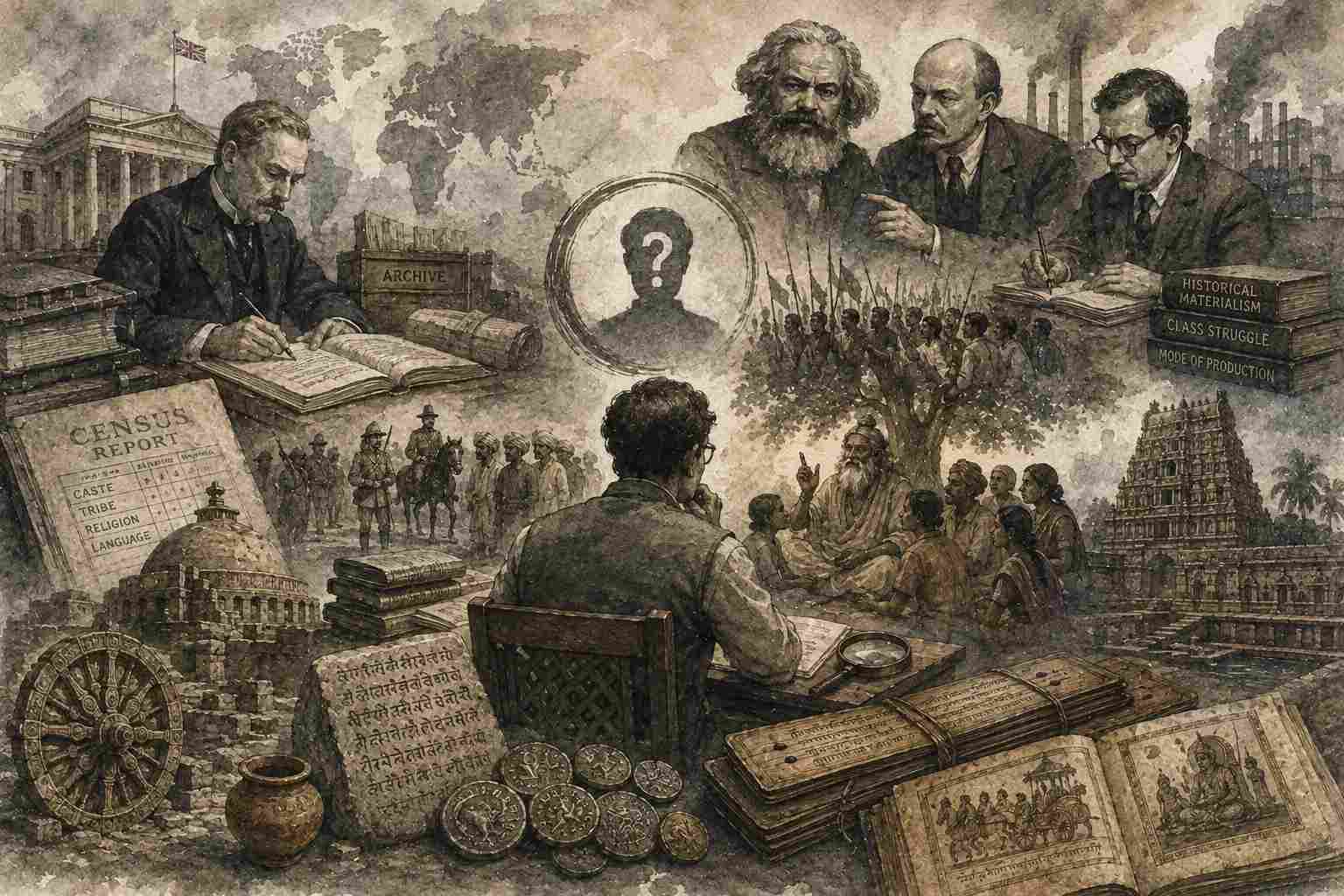
The Historian, the Source and the Story
History is often presented to students as though the historian simply opens the archive, collects the facts and arranges them into a truthful account of the past. This image is comforting because it makes History appear objective in the simplest sense: the past happened, evidence survives and the historian reports what happened. But this is not how historical writing actually works.
The past is vast. Only fragments survive. Most human conversations were never recorded. Most people left no written documents. Buildings collapse, manuscripts disappear, oral traditions change and archives preserve what particular institutions considered important enough to preserve. Before a historian writes a single sentence, therefore, a selection has already taken place.
Then the historian selects again.
Which source matters? Which event is important? Which category explains the evidence? Does a political conquest represent the beginning of a new historical period? Is a social institution primarily religious, economic, cultural or political? Is a text historical memory, mythology, ideology or evidence? The historian must make choices at every stage.
This does not mean that History is fictional. It means that historical writing is always a relationship between evidence and interpretation. The central question, therefore, is not simply whether history is true or false. It is: who has possessed the authority to decide which version of the past becomes the authoritative history?
The Past Does Not Speak for Itself
E. H. Carr famously challenged the idea that historical facts exist independently in the same way as objects lying on a table, waiting for historians to pick them up. A fact becomes historically significant when it enters an argument about the past. Carr did not mean that historians are free to invent facts. He meant that the past contains an almost unlimited number of events, while historical writing necessarily selects a smaller number and arranges them into an explanation.
This is where power enters historiography. A ruler’s death may be carefully recorded while the lives of ordinary people remain invisible. A colonial government may preserve thousands of reports on taxation while recording very little about how those policies were experienced within local society. A temple inscription may preserve the memory of a patron, while oral traditions preserve a community’s experience of the same region in an entirely different form.
The historian must therefore ask not only “What does the source say?” but also “Why did this source survive, while another disappeared?”
The archive itself has a history. This question becomes particularly important for Bharat because Indian history was not simply discovered by modern historians. It was extensively classified, divided and reconstructed under colonial conditions.
When Colonial Power Became Historical Authority
Colonial rule required knowledge. The British administration had to know whom it governed, how land was organized, which communities existed, what languages were spoken and how political authority had functioned. This produced surveys, censuses, gazetteers, ethnographies and administrative reports of extraordinary scale.
But knowledge was never entirely separate from governance. James Mill’s History of British India is one of the clearest examples of the problem. Mill divided Indian history into Hindu, Muslim and British periods, establishing a political-religious periodization that profoundly influenced later understandings of Indian history. Yet this framework did not simply recover the structure of India’s past. It reorganized the past through categories that were useful to a colonial understanding of India.
A civilization that had experienced countless regional political formations, linguistic worlds, philosophical traditions, social institutions and cultural continuities could now be imagined primarily through three successive political categories.
The consequence was enormous. “Hindu India” became a distant past. “Muslim India” became a period of political conflict and transformation. British rule became the beginning of modern administration, rationality and historical progress. Even when individual historians criticised this narrative, the basic structure remained extraordinarily influential.
This is what historiographical hegemony does. It does not necessarily destroy every indigenous source. It changes the categories through which those sources are read.
The Western Narrative as the Universal Narrative
The same process occurred beyond India. Western historical experience gradually became the universal structure through which other civilizations were expected to understand themselves.
Ancient, Medieval and Modern became universal periods despite emerging from European historical experience. The Renaissance became a decisive intellectual transformation despite many civilizations possessing their own histories of knowledge. The Industrial Revolution became a measure of modernity. The nation-state became the normative political destination.
Other societies were then studied through a simple question: how far had they progressed toward the historical condition already achieved by Europe? This is why decolonizing History cannot merely involve adding Indian heroes to an existing syllabus. If the basic narrative remains unchanged, the addition changes little.
A syllabus may include Ashoka, the Guptas, the Cholas, the Marathas, the Vijayanagara Empire and the freedom movement, yet still treat Europe as the location where historical categories are produced and Bharat as the place where those categories are merely applied. The deeper challenge is therefore epistemological: Can Bharat’s historical experience generate categories through which history itself can be studied?
This does not mean that every indigenous category should automatically replace modern historiography. It means that the historian should not assume that only categories produced in Europe possess analytical legitimacy.
The Marxist Challenge—and Its Own Problem
Marxist historiography entered this field as a major critique of older political and colonial history. It rightly challenged the obsession with kings, dynasties and great individuals by asking historians to study labour, production, property, class, agrarian relations and material conditions.
This was a major contribution.
Historians such as D. D. Kosambi, R. S. Sharma and Irfan Habib expanded historical inquiry into areas that older dynastic narratives often neglected. Archaeology, numismatics, settlement patterns, land relations and economic structures became central to historical analysis. Their work demonstrated that history could not simply be the biography of rulers. Yet the expansion of evidence did not automatically free Indian history from theoretical hegemony.
Marxist historiography often approached the Indian past through universal categories of historical development. Questions emerged about primitive society, slavery, feudalism, class formation and modes of production. These could generate productive debates, but the methodological difficulty appeared when the historical question became secondary to the theoretical sequence.
Did India have feudalism? If so, when did it begin? Was a particular social institution evidence of class relations? Could jati be adequately explained through economic structures? Did changes in religion primarily express material contradictions?
Such questions are legitimate. But a problem emerges when Indian institutions become historically meaningful only after they are translated into categories derived from European history.
A jati does not become understandable merely because we call it a class. Dharma is not simply ideology. A grama is not merely a unit within a mode of production. A temple is not reducible only to an economic institution, even though it may possess economic functions. Political, social, economic, religious and civilizational dimensions often coexist.
The problem is therefore not material history itself.
The problem is the monopolization of interpretation by a theory that already knows what kind of society it expects to find.
Colonial historiography frequently asked whether India had become sufficiently modern. Marxist historiography sometimes asked where India could be placed within a universal material progression. The vocabulary differed, but both could make Indian history intelligible only after it entered a theoretical framework developed elsewhere.
That is precisely the methodological issue that requires scrutiny.
Does Interpretation Mean “Anything Can Be History”?
No.
The fact that historians interpret evidence does not mean that every interpretation is equally valid. Evidence places limits on imagination. A historian cannot simply invent a kingdom, a battle or a social institution because it supports a preferred political narrative. Historical interpretation must remain accountable to sources.
But evidence alone does not eliminate interpretation. Two historians may examine the same inscription and reach different conclusions about its political significance. One may interpret a land grant primarily through economic change; another may study its religious and institutional context. Neither interpretation should be accepted merely because of the historian’s reputation. Both must explain the evidence more convincingly.
This is why historical disagreement is not necessarily a weakness. It can be a sign that the evidence is being examined from different questions. The danger begins when one school acquires a monopoly over what counts as a legitimate question. For decades, certain interpretations of Indian history acquired exceptional institutional influence. University departments, textbook committees, research centres and academic networks could create intellectual environments in which particular questions were considered “serious” while others were dismissed as ideological before being examined.
The irony, of course, is that every historical school has an ideology of selection, including those that claim to have transcended ideology.
Colonial history had imperial assumptions. Nationalist history had political purposes. Marxist history had a theory of historical change. Subaltern history questioned elite archives. Postmodern history questioned the possibility of stable representation. Why, then, should only one of these traditions be treated as neutral History?
Recovering the Past or Reconstructing It?
Perhaps historians must distinguish between two processes. The first is recovery: finding inscriptions, excavating settlements, locating manuscripts, recording oral traditions and preserving material evidence. The second is interpretation: deciding what these sources mean. Neither process is entirely neutral. Even the decision to excavate one site rather than another reflects historical priorities. But interpretation is where the historian’s intellectual framework becomes most visible.
A decolonized history of Bharat should therefore neither accept colonial narratives nor merely reverse them. Replacing every colonial villain with a nationalist hero would not change the method. Nor would replacing every Marxist interpretation with civilizational celebration.
The task is more difficult. It requires recovering the plurality of India’s sources while also recovering the plurality of its historical categories. Itihasa, Purana, smriti, parampara, vamsha, desha, dharma, rajya, janapada, samaj and jati should not simply be translated and placed inside pre-existing Western concepts.
They should be studied seriously enough to ask whether they reveal dimensions of historical life that existing categories have overlooked. This does not mean abandoning criticism. It means applying criticism everywhere.
Colonial claims must be examined. Marxist claims must be examined. Nationalist claims must be examined. Indic sources must be examined. No historical tradition should demand immunity. But there is a difference between critical examination and pre-judgment.
For too long, the historian of Bharat has often been permitted to study indigenous traditions only as an object of suspicion. The moment a source claimed historical continuity, civilizational memory or indigenous knowledge, it was frequently expected to prove its legitimacy before entering serious academic discussion. Imported categories, by contrast, could enter the analysis as theory.
That asymmetry itself must be questioned.
Who Gets to Decide?
History is not written by the past alone. It is written by historians, institutions, universities, archives, governments, publishers and intellectual traditions. A textbook is therefore never merely a summary of facts. It represents decisions about what students should remember, which questions matter and what kind of historical consciousness a society should possess.
This is why the question “Who writes history?” is not a conspiracy theory.
It is a question about power over interpretation. Who selects the evidence? Who controls access to archives? Who defines historical methodology? Who determines which questions are ideological? Who decides whether an indigenous source is evidence, mythology or memory? Who has the authority to interpret Bharat for Bharat?
A mature historical discipline should not fear these questions.
The goal is not to establish a new monopoly. The goal is to break the old assumption that a small number of intellectual traditions possess the permanent right to define what history should be. Perhaps that is where the decolonization of History truly begins—not when we replace one official story with another, but when we refuse to allow any school, colonial, Marxist, nationalist or otherwise, to become the unquestioned owner of the past.
The past belongs to no historian. But every historian must answer for the way they choose to interpret it.
