
Beyond the Written Archive
History is often introduced through a deceptively simple image of the past: documents preserved in an archive, inscriptions recorded on stone, official reports maintained by states and manuscripts carefully examined by historians. This naturally gives the impression that history begins where the written record begins. A society that produces more documents appears to possess more history, while a society that preserves its past through memory, performance, genealogy, ritual, material culture and inherited traditions appears to possess less.
But is the archive simply where history is found? Or is the archive itself the result of a civilization’s particular way of deciding what was worth preserving in the first place?
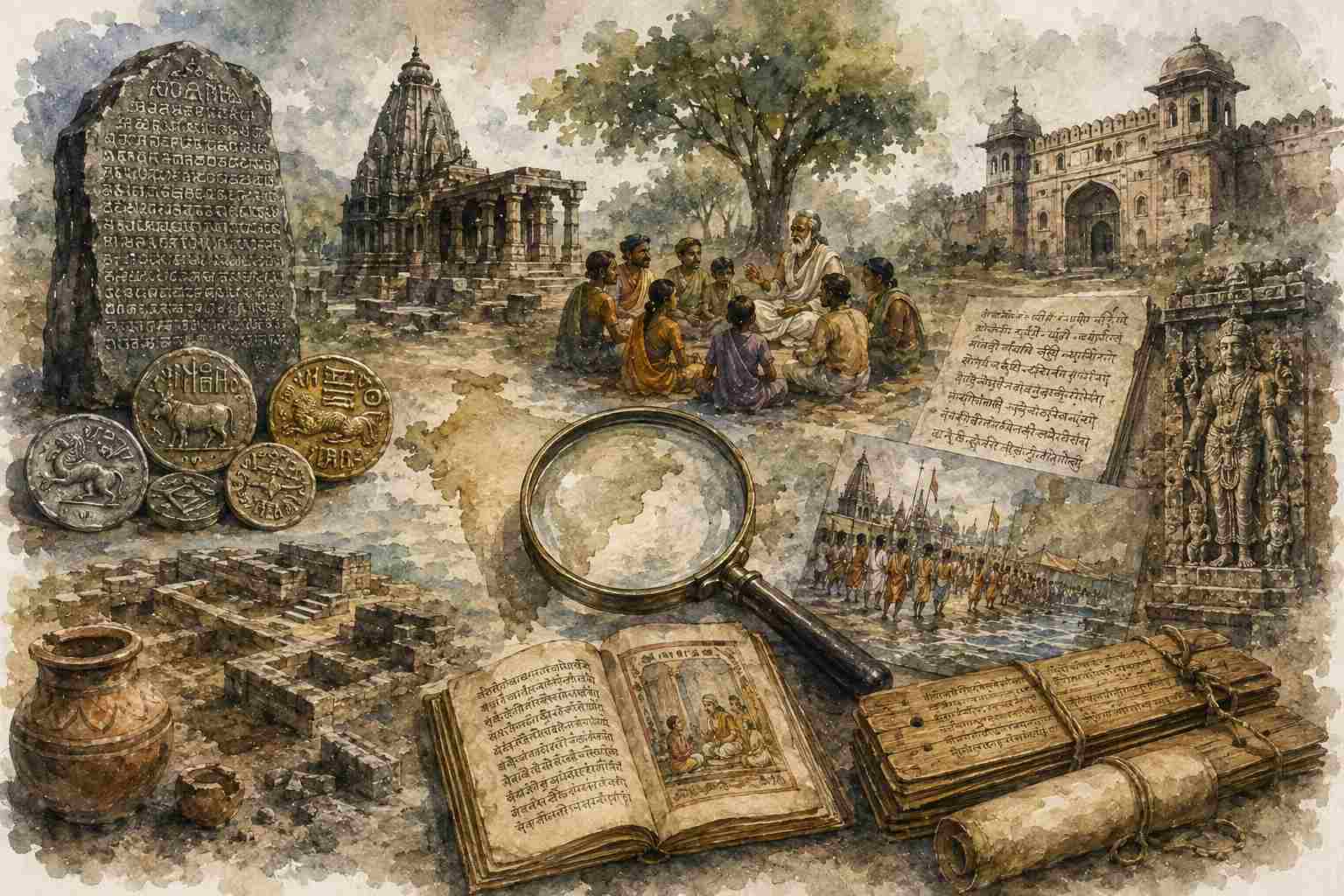
This question becomes particularly important in the study of Bharat. The Indian past survives through an extraordinary variety of sources—archaeological remains, inscriptions, coins, monuments, manuscripts, literary works, genealogies, oral traditions, sacred geography, temple records, ritual practices and living communities. Yet the modern discipline of History developed standards of evidence largely through European experiences of state archives, diplomatic records and documentary criticism. The problem was not the development of rigorous methods. The problem emerged when one particular form of preserving the past was gradually treated as the universal model of historical consciousness.
A serious decolonization of History must therefore ask not whether we should abandon critical methods in favour of tradition, but whether the definition of evidence itself has sometimes been shaped by historical power.
The Archive Is Not Neutral
Modern historical method owes much to the development of archival criticism. Leopold von Ranke’s insistence on examining sources critically helped establish an important principle: historians should not simply repeat inherited stories but investigate the available evidence. This was an intellectual advance. Yet the professionalization of History also created a hierarchy of sources in which official written documents acquired exceptional authority.
The difficulty is obvious once we ask who produced most surviving official records.
Kings, colonial administrators, religious establishments, merchants and bureaucratic institutions were far more likely to leave written archives than agricultural communities, forest-dwelling populations, women, occupational groups and communities whose knowledge was transmitted orally. A history constructed primarily from official archives therefore risks reproducing the perspective of those who possessed the power to document.
This is not an argument against written evidence. It is an argument against confusing the survival of a document with the totality of the past.
Colonial archives illustrate the problem clearly. British officials produced enormous quantities of information about India: censuses, gazetteers, ethnographic surveys, settlement reports and administrative classifications. These documents are indispensable for historians. But they must also be studied as acts of classification. When the colonial state recorded a community as a caste, tribe, criminal group or religious category, it was not always merely discovering a pre-existing social reality. In many cases, it was selecting from complex local identities and reorganizing them into administrative categories.
The archive, therefore, may preserve both information and the process through which power produced knowledge.
This is why the historian’s first responsibility is not simply to ask whether a source is written. It is to ask who created it, for what purpose, within what institutional context, and through what categories of understanding.
The Problem of Applying One Historical Model to All Civilizations
The question becomes even more serious when historians study civilizations that did not preserve their past according to the same conventions as modern Europe.
Bharat developed multiple traditions for preserving memory and historical knowledge. The Itihasa-Purana tradition, vamshavalis, charitas, inscriptions, temple records, Buddhist and Jaina chronicles, court literature, regional narratives and oral genealogies all preserved different forms of historical consciousness. They cannot all be treated as modern chronicles, and no serious historian should attempt to do so. A text composed for religious instruction may combine historical memory with cosmological time. A genealogy may be extended to establish legitimacy. A court chronicle may exaggerate royal achievement.
But why should the presence of these elements automatically disqualify such sources from historical study?
European medieval chronicles also contain miracle stories, theological interpretations and dynastic claims. Ancient Greek and Roman historians were shaped by literary conventions and political loyalties. Biblical traditions contain complex relationships between memory, theology and history. Historians do not simply discard these traditions because they are not modern archives; they examine their composition, context and layers.
The same intellectual seriousness must be extended to Indic sources.
The question should not be whether a Purana is a history book in the modern textbook sense. It clearly is not. The question should be: what kind of memory does it preserve, how was that memory organized, what political or cultural claims does it make, and can particular information be compared with inscriptions, archaeology, numismatics or other literary traditions?
This distinction between using a source critically and dismissing it because it does not resemble a European archive is fundamental.
D. D. Kosambi and the Expansion of Indian Evidence
The Indian historical tradition itself provides important examples of scholars who expanded the field of evidence. D. D. Kosambi was one of the most significant. Although deeply influenced by Marxist historical materialism, his actual historical method was far broader than a narrow reading of texts or dynastic chronicles. He used archaeology, coins, inscriptions, field observations, settlement patterns and living practices to reconstruct historical processes.
Kosambi’s methodological contribution was important precisely because he understood that the Indian past could not be reconstructed from court documents alone. His study of coins, megalithic remains, village structures and local traditions helped demonstrate the importance of material evidence.
But this is also where methodological caution becomes necessary.
Kosambi and later Marxist historians frequently attempted to interpret Indian historical developments through categories derived from historical materialism—tribe, class, slavery, feudalism and modes of production. These concepts can produce important questions about labour, inequality, property and economic power. But problems emerge when the category begins to govern the evidence rather than emerge from it.
Did Bharat experience European-style feudalism? Were Indian social relations adequately explained through a universal transition from tribal society to slavery, feudalism and capitalism? Did the jati system operate primarily as a mechanism of class organization? Could every historical institution be translated into an economic structure beneath which its indigenous meaning became secondary?
These questions remain contested.
The methodological problem is not that Marxist historians asked about economic power. Every historian should. The problem arises when an external theoretical sequence becomes the invisible ruler of historical interpretation. Evidence is then selected primarily to establish whether India fits a predetermined stage.
Decolonizing History must therefore apply to Marxist historiography the same critical scrutiny that has been applied to colonial historiography. Colonial historians frequently made India fit an evolutionary model in which Europe represented modernity. Marxist historians could, in different ways, make India fit a universal material progression. The political conclusions differed, but the methodological danger was sometimes similar: Bharat was expected to become intelligible only after entering a theory created elsewhere.
Material Evidence Is Not Ideologically Neutral Either
It would nevertheless be a mistake to respond by rejecting archaeology, economic history or material analysis in the name of Indic tradition. That would simply replace one reductionism with another.
R. S. Sharma’s emphasis on archaeology, inscriptions and material conditions, for example, expanded the evidence available for reconstructing ancient Indian society. The use of coins can reveal political authority and commercial circulation. Inscriptions can establish land grants, patronage and institutional networks. Archaeology can recover settlements and production patterns that literary sources never mention.
The problem begins only when material evidence is treated as the only real evidence, while ideas, rituals, cultural memory and indigenous categories are dismissed as secondary ideology.
A coin can establish that a ruler existed. It cannot independently explain what dharma meant within that ruler’s political world. Archaeology can recover the physical remains of a settlement. It cannot automatically reveal how its inhabitants understood kinship, sacred space or political obligation.
Different forms of evidence answer different questions.
The historian therefore requires a method of corroboration rather than a hierarchy of contempt.
| Historical Evidence | What It Can Help Us Understand | Its Major Limitation |
|---|---|---|
| Archaeology | Settlement, material culture, production, food and habitation | Meaning must often be inferred |
| Inscriptions | Patronage, political authority, grants and institutional networks | Often represent elite or official perspectives |
| Coins | Political symbols, economy, chronology and circulation | Cannot independently explain entire social structures |
| Literary texts | Intellectual traditions, social ideals and historical memory | Genre and purpose must be critically examined |
| Oral traditions | Collective memory, migration and community experience | Change over time requires careful contextualization |
| Genealogies | Lineage and remembered political relationships | May be extended for legitimacy |
| Living traditions | Continuity, transformation and cultural memory | Present practices cannot automatically be projected into the distant past |
The crucial point is that no source is automatically self-explanatory. Even a written state document requires interpretation.
Romila Thapar and the Question of Historical Tradition
Romila Thapar’s work is important because she challenged the old colonial claim that India lacked historical consciousness. She demonstrated that Indian societies possessed different traditions of remembering and representing the past, including Itihasa-Purana, Buddhist and Jaina traditions and other historical narratives.
This was an important correction.
Yet the study of these traditions must not end by treating Indic categories merely as objects for modern theory. The next step is more difficult: can these categories themselves participate in historical interpretation?
For example, itihasa should not be casually translated as “myth” merely because it does not conform to modern chronological history. Nor should it be declared literal history simply because it is indigenous. The category must be studied on its own terms and through its own intellectual context.
The same applies to smriti, parampara, purana and vamsha. These are not identical ways of preserving the past. A civilization that possesses multiple categories of memory should not be reduced to a single Western distinction between “history” and “mythology” without asking whether the distinction itself captures what is actually happening.
The Archaeological Evidence of Living Civilization
One of the most neglected dimensions of Indian historiography is that many historical practices remain alive.
A pilgrimage route may preserve patterns of movement across centuries. A temple may contain architectural layers, inscriptions, local memory and continuing ritual practices. A community may preserve genealogical traditions while simultaneously appearing in colonial census records. A village may retain ecological practices that can be studied alongside archaeological evidence.
This does not mean that present-day practice proves an unchanged ancient origin. Continuity must never be confused with sameness. Traditions transform, disappear, revive and acquire new meanings.
But a living tradition can itself be evidence of historical transformation.
The historian should ask when the practice first appears in textual or material evidence, how it changed, what its participants say about it and how those claims relate to other available sources. This is a much richer method than either blindly believing tradition or dismissing it as “unscientific.”
Beyond Ideological Archives
Every school of History creates its preferred archive.
Colonial historians privileged official records and racial classifications. Nationalist historians often sought political heroes and civilizational achievements. Marxist historians gave central importance to class, labour, production and material structures. Subaltern historians attempted to recover the experiences of groups marginalized within elite archives. Postmodern approaches questioned whether historical representation could ever escape the structures of language and power.
Each expanded something. Each also produced its own limitations.
The danger begins when one historical method is allowed to decide in advance what the evidence must prove.
A decolonized history of Bharat should therefore be neither a rejection of critical scholarship nor a restoration of civilizational pride through uncritical claims. It should be more demanding than both.
It must allow archaeology to question literary memory, inscriptions to question political narratives, oral traditions to preserve experiences absent from official archives, and indigenous categories to question the conceptual assumptions of modern historiography.
The purpose is not to declare every ancient tradition historically correct. The purpose is to ask why some traditions were considered evidence before examination while others were considered mythology before examination.
That distinction has consequences.
If a civilization preserved its past in stone, metal, memory, genealogy, literature, ritual, landscape and institutional continuity, then the historian cannot simply enter with a single archive and announce that everything outside it is unreliable.
Historical criticism is necessary. Corroboration is necessary. Dating is necessary. Evidence must be questioned.
But critical history does not begin by deciding which civilization was capable of preserving history.
It begins by asking how human societies preserved the past, why they preserved it in particular forms and how those forms can speak to one another.
For the historian of Bharat, therefore, the central methodological question is not merely “What evidence do we have?”
It is also:
“What intellectual and political assumptions taught us, before we examined the evidence, what was allowed to count as evidence in the first place?”
