
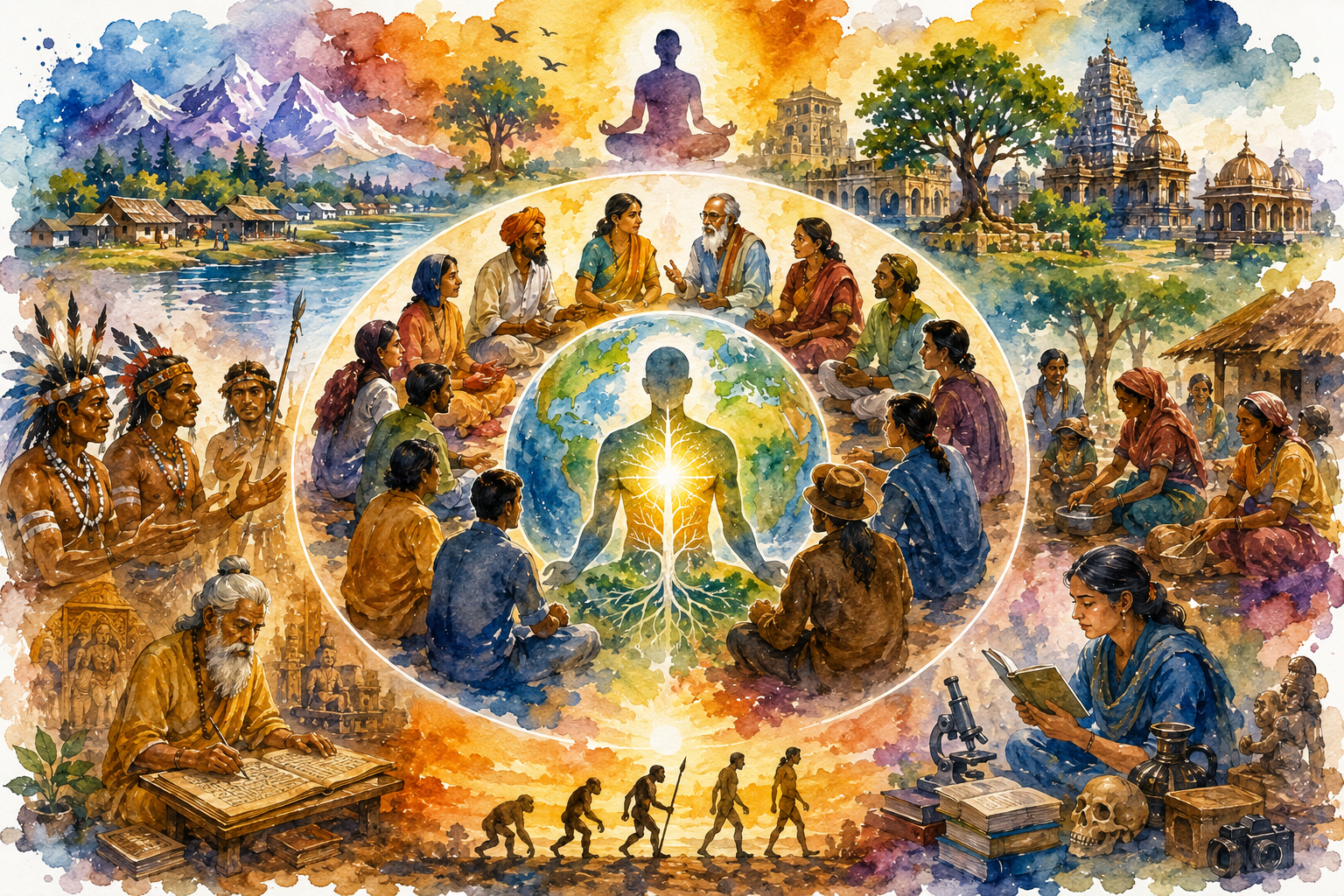
Re-examining the Universal Human
Anthropology appears to begin with a simple object of inquiry: the human being.
But who is this “human”? Is the human being primarily a biological organism? A rational individual? A social actor? A product of culture? A creature driven by survival and reproduction? Or a consciousness capable of asking what its own existence means?
The question becomes especially important because anthropology developed during a period when Europe increasingly presented its own historical experience as a model of human development itself. Societies were placed along evolutionary hierarchies—civilized and primitive, modern and traditional, developed and backward. The “Other” became an object to be observed, classified and explained.
The problem was not comparison itself. The problem was turning one historical experience into the universal human trajectory.
The Human and the “Other”
Classical anthropology often constructed knowledge through a distinction between the observer and the observed. The anthropologist represented the modern scientific subject; the community being studied became the cultural “Other.”
This history has been extensively criticized, but the deeper epistemological problem remains. What if the supposedly universal human is itself culturally constructed? What if anthropology has often assumed an answer to the question “What is a human being?” before beginning its inquiry?
An Indic anthropology would begin differently—not by assuming that manushya is an exhausted category, but by recognizing that Indian intellectual traditions have developed several overlapping concepts of human existence: manuṣya, puruṣa, jīva and ātman.
These are not interchangeable words for “human.” And that is precisely why they matter.
Manuṣya: The Human as a Moral Being
The Bhagavad Gītā repeatedly uses manuṣya in contexts that involve choice, discipline, knowledge and action.
In the famous sixth chapter, Kṛṣṇa tells Arjuna:
उद्धरेदात्मनात्मानं नात्मानमवसादयेत् ।
Uddhared ātmanātmānaṃ nātmānam avasādayet.
“Let one raise oneself by oneself; let one not degrade oneself.”
The significance for anthropology is profound. The human being is not merely made by society. The human being possesses a capacity for self-formation. The person can discipline the mind, transform conduct and participate consciously in his or her own becoming. The Gītā’s formulation therefore complicates the familiar opposition between biological determination and socialization.
Human beings are formed—but they can also form themselves. This is central to the Indic Constructivist framework.
Puruṣa: The Human Within a Larger Whole
The category of puruṣa takes us further. The Puruṣa Sūkta of the Ṛgveda presents Puruṣa as an immense cosmic being from whom the differentiated universe emerges. Its famous imagery describes the cosmos and social order through the body of Puruṣa.
Whatever one’s interpretation of the hymn, one important conceptual possibility is clear: the human cannot automatically be understood as an isolated individual standing outside the cosmos and society.
The person exists within a larger order. This is fundamentally different from beginning anthropology with the autonomous individual and then asking how society is added to him.
The Indic question can instead be: What relationships constitute the person?
Jīva and Ātman: Beyond the Observable Human
The distinction becomes still sharper with jīva and ātman. The Bṛhadāraṇyaka Upaniṣad does not simply ask what human beings do. It asks what the Self is.
Its famous declaration,
अहं ब्रह्मास्मि — Aham Brahmāsmi
“I am Brahman,” appears in the context of realizing the Self as Brahman.
The point is not that anthropology should suddenly become metaphysics. The point is methodological.
What happens when the people we study possess theories of the human that include dimensions our disciplinary categories do not recognize?
If a community understands the person through body, mind, action, consciousness, duty and transcendence, should anthropology reduce that person to “social identity,” “belief system” or “religious worldview”? Perhaps the first task is to understand the category on its own terms.
The Human Is Not One Thing
The Taittirīya Upaniṣad’s account of the pañcakośa offers another striking example. Human existence is approached through successive dimensions rather than being reduced to the physical body alone. Its discussion moves from the material human, constituted through food, toward subtler dimensions of vitality, mind, understanding and bliss.
Again, this need not be presented as an ancient substitute for contemporary psychology.
It is something more interesting: An alternative anthropology of the human.
It asks questions that contemporary anthropology can investigate without necessarily accepting its metaphysical claims:
- How do people understand the relationship between body and mind?
- How do cultures define personhood?
- How is consciousness conceptualized?
- What constitutes a fulfilled human life?
- Where does individual identity end and collective identity begin?
These are anthropological questions precisely because communities everywhere answer them differently.
From One Universal Human to Many Understandings of the Human
This leads to the central argument. Anthropology should not abandon the search for common human patterns. Comparison remains essential. But comparison becomes more rigorous when we stop assuming that one civilization has already defined the universal human for everyone else. An Indic anthropology can therefore place manuṣya, puruṣa, jīva and ātman into dialogue with concepts such as the individual, person, self, organism and social actor.
The objective is not to declare one vocabulary superior. It is to ask what becomes visible when different civilizations are allowed to define the human before being measured against a supposedly universal standard.
The shift is subtle but revolutionary. Instead of anthropology asking:
“Why are these people different from us?”
it begins asking:
“What different understandings of being human have human civilizations produced?”
And suddenly the “Other” disappears. There are no longer simply modern humans studying primitive humans. There are human beings studying human beings—each carrying a theory of what it means to be human. That may be the beginning of a genuinely plural anthropology. Because perhaps the greatest mistake anthropology can make is not misunderstanding another culture. It is assuming that it already knows what a human being is.
