
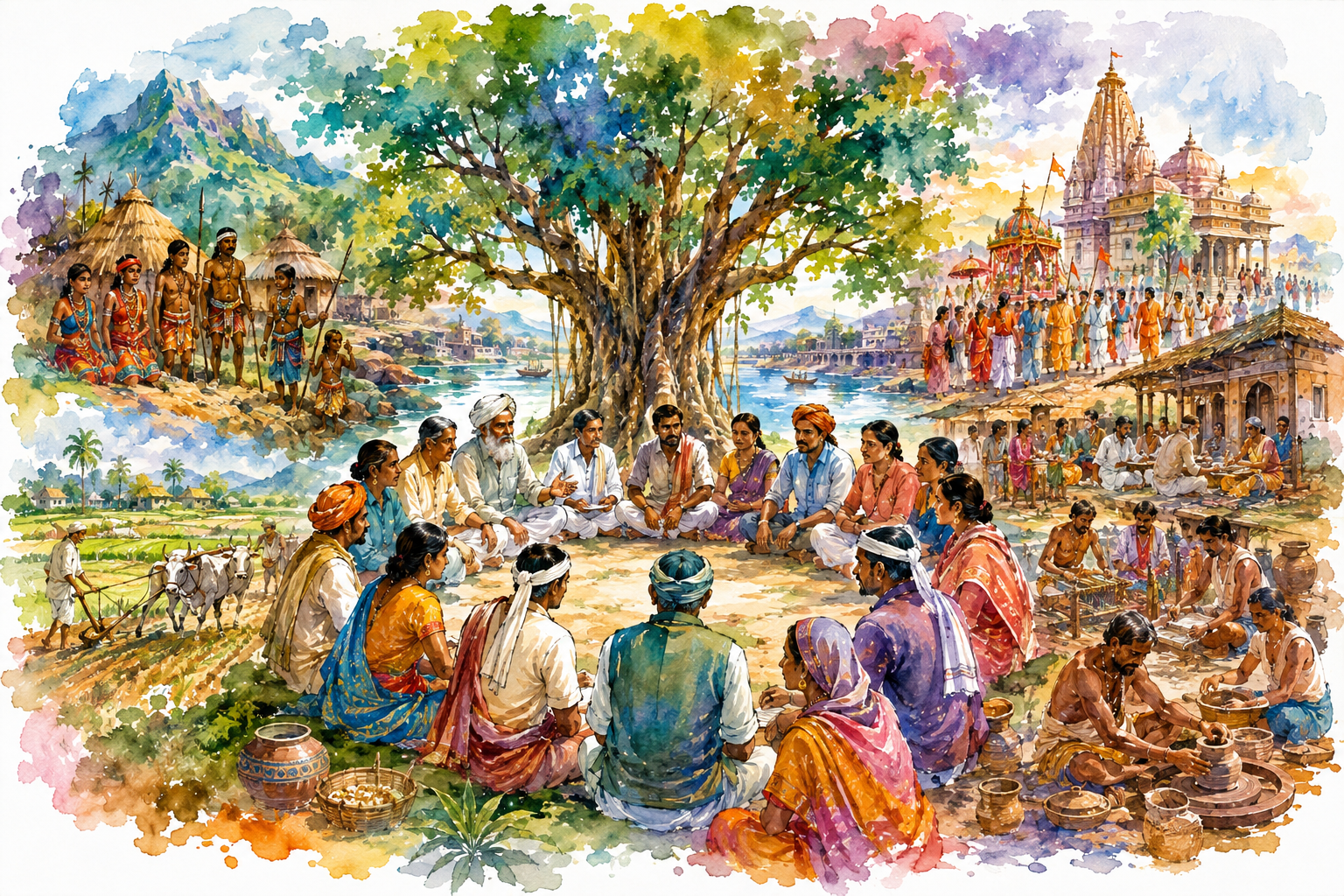
When Categories Become Conclusions
Anthropology begins with a seemingly innocent act: naming what it observes.
But what happens when the name becomes more powerful than the reality? In India, categories such as tribe, caste, primitive, folk and peasant have played an enormous role in anthropology. Some have been useful for comparison and administration; others emerged from colonial attempts to classify India’s extraordinary social diversity. The problem begins when an analytical category becomes a conclusion—when a living community is reduced to the label through which an administrator, census official or anthropologist first encountered it.
The question for a decolonized anthropology is therefore not simply:
“What is a tribe?”
It is:
“What happens when we decide in advance what kind of social entity a community is?”
From Classification to Relationship
Colonial anthropology often sought to classify communities according to supposedly stable characteristics—race, occupation, religion, language, territory and social customs. The result was an enormous classificatory archive, but classification could also freeze fluid social realities into rigid categories. Indian anthropologists themselves began questioning such simplifications.
G.S. Ghurye, whose Caste and Race in India challenged racial explanations of caste, approached Indian social formations through historical and integrative perspectives rather than treating groups as isolated racial types.
Nirmal Kumar Bose went further in another direction. His extensive work on Indian society emphasized interpenetration and cultural interaction. His Peasant Life in India, based on information from 311 of 322 districts, identified substantial similarities in material culture across rural India that could not simply be explained by language or physical type.
This is a crucial insight.
Indian communities have historically been connected more deeply than our categories sometimes suggest.
The Village Was Never an Island
McKim Marriott’s work provides another important turning point.
In Village India, Marriott examined the relationship between what he called “little communities” and “greater communities.” His analysis showed that the village could not be understood as an isolated social universe: local institutions and practices were connected with wider political and cultural structures.
His later work on universalization and parochialization was particularly significant. Cultural forms could move from wider civilizational traditions into local communities, but local communities also modified, absorbed and transformed those forms. The relationship was therefore not simply top-down.
This gives us a powerful alternative to the image of Indian society as a collection of sealed communities. The village was connected to the region. The caste was connected to other castes. The ritual was connected to wider traditions. The local was connected to the civilizational.
Community was produced through interaction.
From “Tribe” to Community
This is particularly important for the category tribe. The word may be administratively useful. The Constitution requires categories for governance and affirmative policy. Census and legal systems inevitably classify populations. But an administrative category and an anthropological category are not necessarily the same thing.
A community identified as a “tribe” may simultaneously possess its own samudāya, kinship networks, territory, customary practices, economic relationships, ritual traditions and historical connections with neighbouring populations.
Nirmal Kumar Bose’s Tribal Life in India itself explored tribal communities alongside questions of agriculture, artisans, caste, trade, religion and changing relationships with wider society.
The point is not to deny tribal distinctiveness. It is to ask whether distinctiveness must imply isolation.
Perhaps the more productive question is:
How does a community maintain identity while participating in larger social and civilizational networks?
That question moves us from “tribe versus society” toward community within society.
The Categories We Need
An Indic anthropology can therefore take indigenous categories seriously:
- Jāti — a historically embedded social community.
- Janajāti — a modern Indian category with important administrative and political uses.
- Samudāya — a community bound through shared relationships and practices.
- Grāma — not merely a geographical settlement, but a social world.
- Lokācāra — lived customary practice.
These should not simply replace “tribe,” “caste” or “community.” They should enter into conceptual dialogue with them.
That is where the work of M.N. Srinivas also becomes important. His concepts of Sanskritization and dominant caste emerged from close engagement with Indian social realities and demonstrated that communities were not static entities but participants in processes of social mobility and transformation.
The larger lesson is clear:
Indian society is not a museum of fixed categories. It is a field of interaction.
When Categories Become Conclusions
This is ultimately the methodological problem. A category should help us see society.
It should not prevent us from seeing what does not fit the category.
- If “tribe” makes us overlook economic exchange with neighbouring communities, it has become restrictive.
- If “caste” prevents us from seeing regional mobility and political transformation, it has become restrictive.
- If “folk” makes local knowledge appear inferior to textual knowledge, it has become restrictive.
- If “primitive” assumes a hierarchy of civilization before research even begins, it has ceased to be an analytical category altogether.
The task of decolonizing anthropology is therefore deeper than replacing European scholars with Indian scholars. It requires questioning the categories through which society becomes visible in the first place.
And perhaps the most important shift is this:
Do not begin by asking what category a community belongs to. Begin by asking what relationships constitute the community.
That movement—from classification to relationship, from tribe to community, from isolation to interaction—may provide one of the foundations for an genuinely Indic anthropology. Because communities are not merely objects waiting to be classified.
They are historical actors, knowledge-holders and participants in the making of civilization.
