
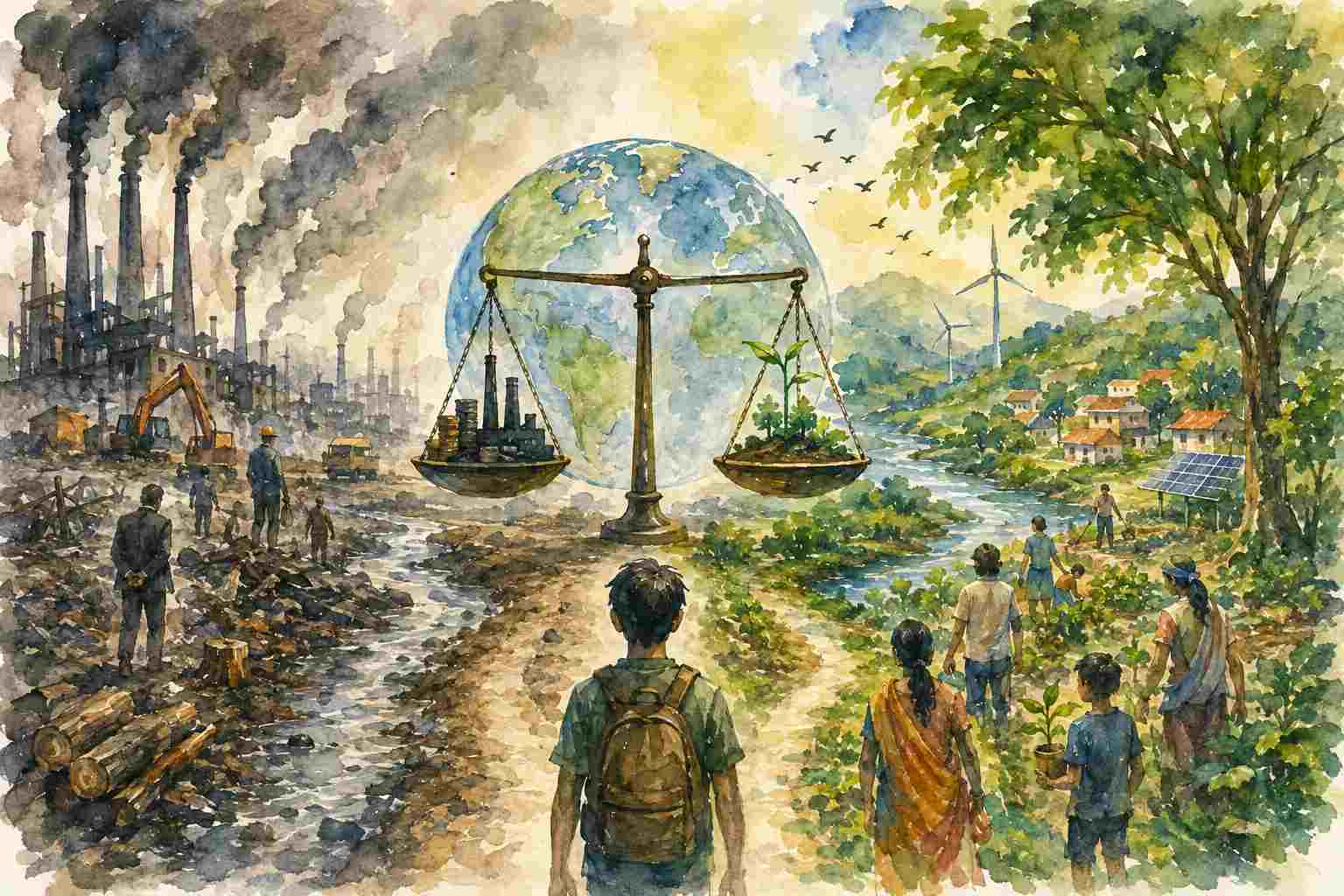
Beyond Growth, Green Labels and Environmental Management
“Sustainable development” sounds like one of the least controversial ideas in environmental studies. Who could oppose development that is sustainable?
Yet the phrase deserves much more scrutiny than it usually receives in the curriculum. Sustainable development has become so universally acceptable that we rarely ask what exactly is being sustained, who defines sustainability, and whether the development model itself is being questioned.
The modern formulation gained global prominence through the 1987 Brundtland Report, which defined sustainable development around meeting present needs without compromising the ability of future generations to meet their own. The formulation was politically powerful because it attempted to reconcile two objectives that had increasingly come into conflict: economic development and environmental protection. The later Sustainable Development Goals (SDGs) expanded this into seventeen global goals covering poverty, health, education, inequality, energy, cities, climate and ecosystems.
The achievement is considerable. But there is a contradiction at the heart of the framework.
Can the same model of development that creates ecological pressure become sustainable simply by becoming more efficient?
This question is rarely placed at the centre of the curriculum. Instead, students are introduced to concepts such as sustainable cities, sustainable consumption, green technology, renewable energy, carbon neutrality and ESG. The language becomes increasingly sophisticated, while the underlying assumption often remains untouched: Economic growth continues; environmental damage should be reduced.
That is not necessarily sustainability. It may simply be making the existing development model less destructive.
The Politics Hidden Inside “Sustainable”
The word sustainable appears neutral, but sustainability always involves a political decision. Sustainable for whom? Sustainable at what scale? Sustainable for how long? Sustainable according to which indicators?
A mining project may generate employment, government revenue and infrastructure while damaging forests and water systems. A dam may provide electricity and irrigation while displacing communities and transforming river ecology. A city may become a “smart city” while consuming enormous amounts of water and energy from distant regions.
Which part do we count? The answer depends upon the framework of measurement. This is why sustainable development has become not merely an environmental concept but a language of governance. Governments, corporations, international organisations and financial institutions can present projects through sustainability indicators without necessarily questioning the deeper economic model behind them.
- A factory can reduce emissions per unit of production while increasing total production enormously.
- A corporation can become “carbon efficient” while continuing an ever-expanding consumption model.
- A city can plant millions of trees while destroying wetlands.
- A product can be labelled “green” while encouraging people to consume more of it.
This is where sustainability can become greenwashing: environmental language is used to legitimise activities whose fundamental ecological consequences remain insufficiently examined. The problem is not sustainability itself.
The problem is when the adjective becomes more important than the noun. We celebrate “sustainable development” without asking whether the underlying conception of development is itself sustainable.
The Technology Trap
The curriculum also tends to present technology as the great reconciler between development and ecology. Renewable energy will solve energy problems. Electric vehicles will solve transport emissions. Precision agriculture will solve resource constraints. Carbon capture will solve climate change. Artificial intelligence will optimise resource use. Technology can certainly be part of the solution. But technology cannot abolish ecological limits. An electric vehicle still requires minerals, electricity, roads and manufacturing. A solar panel still requires land, materials and eventually disposal. Desalination still requires energy. Precision agriculture cannot manufacture fertile soil indefinitely.
The danger is therefore a technological optimism in which every ecological limit becomes a technical problem waiting for innovation. What if some ecological problems are actually problems of scale, consumption and restraint? That question deserves much greater attention in environmental education.
An Indic Correction: From Sustainability to Regeneration
This is where an Indic Drishti can add something more fundamental.
The earlier ecological concepts of Rta, Prakriti and Bhoomi do not begin with the question of how to make unlimited development sustainable. They begin with the relationship between human activity and the larger systems that sustain life.
The distinction is important:
Sustainability asks:
Can we continue what we are doing?
Regeneration asks:
Does what we are doing restore the capacity of the system to continue?
That is a much harder standard. A sustainable agriculture system should not merely produce crops with fewer emissions. It should maintain soil fertility. A sustainable water system should not merely reduce consumption. It should restore groundwater and watershed capacity. A sustainable forest economy should not merely reduce logging. It should maintain the forest as a living ecosystem. A sustainable city should not merely reduce carbon intensity. It should preserve the ecological systems that make the city habitable.
This is closer to the logic of Rta: human activity must remain compatible with the larger order that sustains it.
The Curriculum Problem
Environmental Studies should therefore stop teaching sustainable development as though it were the final answer. Students should first be taught to interrogate the concept itself.
- Who created the global development vocabulary?
- Why did development become synonymous with rising production and consumption?
- Why is GDP still so central to national progress?
- Why are ecological losses often treated as externalities?
- Who decides what counts as a “green” project?
- Why are Indigenous and civilizational ecological practices often introduced as cultural knowledge rather than as intellectual frameworks?
And perhaps the most uncomfortable question: Can a civilization consume more every year and still claim to have solved sustainability merely because its technology has become more efficient?
These questions do not require rejecting the SDGs, modern environmental science or technological innovation. They require placing them within a larger critical framework.
The Western development tradition has produced extraordinary scientific and technological capabilities, but the ecological crisis itself demonstrates that capability without restraint can become destructive. At the same time, Indic, African and other Indigenous traditions should not be romanticised as perfectly ecological societies. They too must be critically examined. The point is comparative: different civilizations have offered different ideas about limits, reciprocity, land, community and human responsibility.
The environmental curriculum should allow these traditions to speak as sources of thought, not merely as examples of “traditional practices”.
Perhaps the greatest weakness of sustainable development is that it often asks: How can we make development less damaging?
A deeper ecological question is: What forms of prosperity can regenerate the conditions upon which prosperity itself depends?
That moves us from growth versus environment to something more fundamental:
production → consumption → depletion → regeneration.
If regeneration is missing, the system is not sustainable. It is merely delaying depletion. And this brings us back to the central question. A society may have higher GDP, better technology, greener buildings and more sustainability reports. But if its soil is exhausted, groundwater declining, biodiversity collapsing and ecological debt being transferred to future generations, what exactly has been sustained?
Perhaps sustainable development should therefore not be the endpoint of Environmental Studies. It should be the beginning of a harder conversation about limits, responsibility and regeneration.
Because putting a green label on an extractive model does not transform the model. Sustainability is not the art of making depletion look responsible. It is the discipline of ensuring that what sustains life is itself sustained.
