
Beyond “Environment”
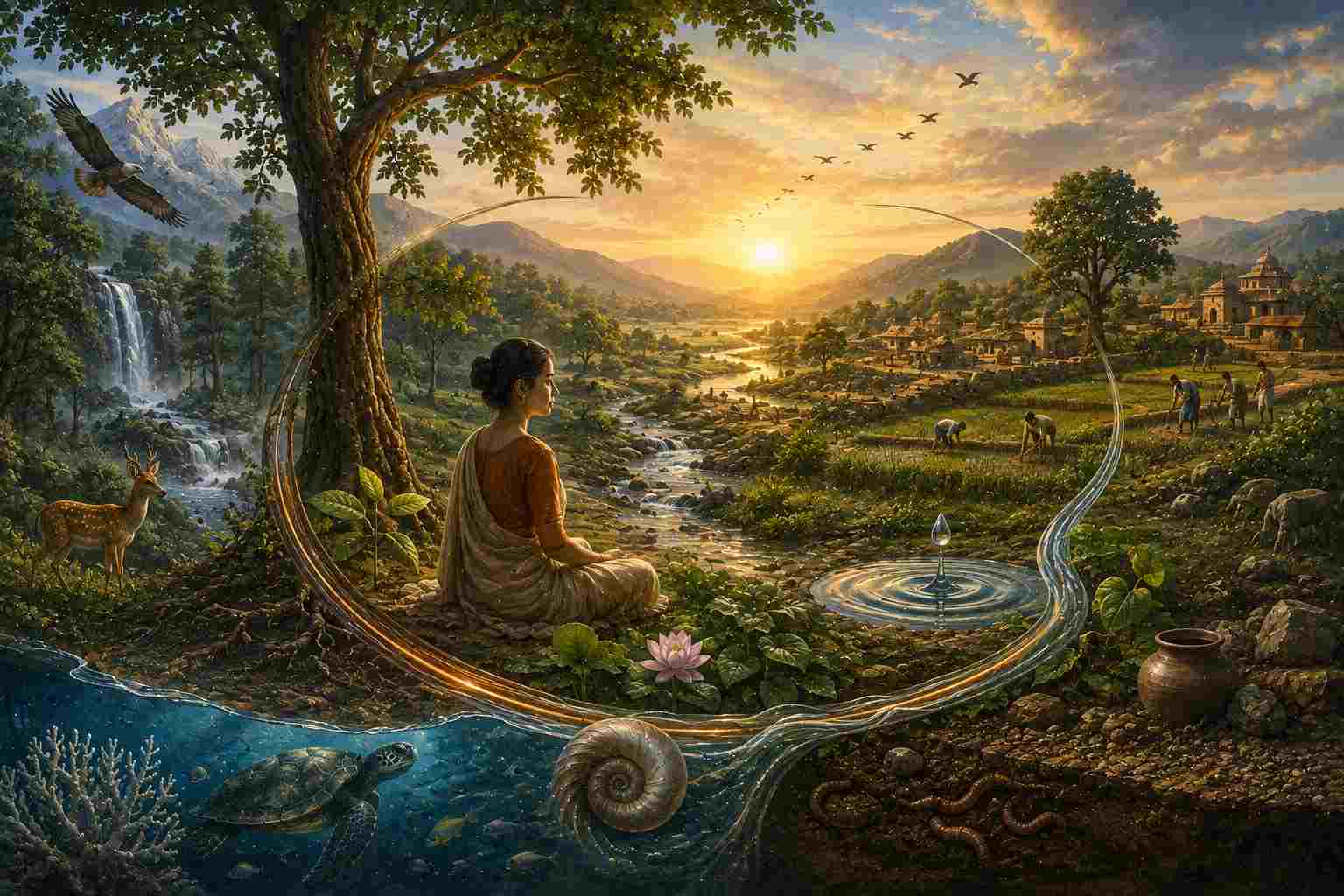
What changes when nature is not understood as something outside us, but as the larger order within which we exist?
Modern environmental studies usually speaks of “the environment”—air, water, forests, biodiversity, climate and natural resources. The terminology is useful, but it subtly creates a distance: human beings on one side, environment on the other. The Indic category of Prakriti begins from a different possibility.
Prakriti is not simply a Sanskrit word for “nature”. In the Samkhya tradition, it refers to primordial material nature and the dynamic field from which the manifest world emerges. It is therefore a much more comprehensive philosophical category than the modern idea of “environment”. It places human existence within a larger process rather than treating nature as a surrounding object.
This distinction matters enormously for ecological thinking.
If nature is an environment, the question becomes: How should we manage it?
If nature is Prakriti, the question becomes: How should we live within it?
The first encourages management. The second demands relationship.
Modern environmental policy often assumes that human beings can intervene in nature and then correct the consequences through technology, regulation or restoration. There is considerable value in this approach. But the deeper ecological problem appears when intervention itself becomes the default assumption: rivers are redirected, forests are cleared, soils are chemically intensified and landscapes are redesigned according to human requirements, while ecological consequences are treated as “externalities”.
The Indic Drishti asks us to begin with observation and alignment. Agriculture must respond to soil and seasons. Water systems must respond to watersheds. Settlements must recognise drainage, rainfall and local ecology. Forests must be understood as living systems rather than merely timber reserves. Human consumption must recognise limits. This is not a rejection of technology. It is a rejection of the assumption that technology makes ecological limits irrelevant.
The distinction can be put simply:
| Nature as object | Prakriti as larger order |
|---|---|
| Resource | Living system |
| Environment around us | Order within which we exist |
| Management | Relationship |
| Extraction | Participation |
| Control | Adaptation |
| Short-term productivity | Long-term regeneration |
| Nature as externality | Nature as foundation |
The Bhagavad Gita provides another useful dimension.
In Chapter 3, Krishna describes the interconnected cycle of yajña, rain, food and life. The important ecological insight is not that the verse provides a modern climate model. It is that human production and consumption are placed within a cycle of reciprocity. Food depends upon natural processes; human action participates in those processes; therefore human beings cannot understand prosperity independently of the systems that sustain it. This is very different from treating nature merely as an input into production.
Yet we should avoid romanticising the past. Traditional societies also altered landscapes, cleared forests, irrigated land and sometimes damaged ecosystems. An Indic ecological framework should therefore not claim that everything ancient was automatically sustainable. Its value lies elsewhere: it provides categories through which human action can be evaluated according to its relationship with the larger order of life.
That can become practical today.
- Before constructing, understand the watershed.
- Before intensifying agriculture, understand the soil.
- Before extracting groundwater, understand recharge.
- Before replacing a local ecosystem, understand what functions it performs.
- Before calling something “waste”, ask whether it can return to a productive cycle.
- Before measuring economic growth, examine whether the ecological foundations of that growth are becoming weaker.
This is where Prakriti can contribute to environmental studies without becoming a slogan.
The objective is not to return to a pre-modern world. Nor is it to reject contemporary environmental science. Modern ecology provides the empirical tools to understand ecosystems; satellite imagery can monitor forests, hydrology can measure watersheds, climate science can model atmospheric change, and environmental economics can quantify ecological costs.
But measurement alone does not determine the right relationship.
- Science can tell us that groundwater is declining.
- Economics can calculate the cost.
- Policy can regulate extraction.
- Prakriti asks a prior civilizational question:
Why did we organise human activity as though the groundwater existed only for our extraction?
That is the shift from environmental management to ecological Drishti. Perhaps the most important lesson is that humans do not stand outside nature and negotiate with it from a position of complete control. We are biological, social and material beings embedded within ecological processes. Our cities, economies and civilizations ultimately depend upon soil, water, sunlight, biodiversity and climate.
We can transform nature. But we cannot abolish our dependence upon it.
So the question of ecological civilisation is not: “How can humanity conquer nature more efficiently?”
It is: “How can human intelligence become sufficiently disciplined to work with the systems upon which human life depends?”
That is what changes when nature is understood as Prakriti.
Nature is no longer merely the world around us. It is the larger process of which our own existence is a part.
