From the Individual to the Puruṣa
Anthropology begins with the human being, but it rarely begins by asking what a human being is. The discipline has inherited a powerful analytical figure: the Individual — a bounded, autonomous person whose preferences, actions, relationships and institutions can be studied as observable social facts.
There is nothing inherently wrong with studying individuals. The problem begins when the individual becomes the universal model of personhood.
What if the human being is not adequately described as an isolated individual? What if a person is simultaneously a body, a mind, a moral agent, a family member, a social participant, a bearer of memory, a seeker of meaning and, in some Indic traditions, a conscious self situated within a larger cosmic order?
This is where an Anthropological Dṛṣṭi becomes necessary.
The Individual Is Not the Whole Person
Western social thought has produced several influential images of the human being: homo economicus, the rational actor, the political actor, the psychological subject and the autonomous individual. Anthropology itself has complicated these models by demonstrating how deeply human behaviour is embedded in culture, kinship and social institutions.
Louis Dumont made the contrast especially explicit in his interpretation of India. In Homo Hierarchicus, he contrasted modern Western individualism with what he called the more holistic orientation of Indian society. His work became enormously influential precisely because it asked whether the Western individual could be treated as a universal social category. But Dumont’s formulation also created a problem of its own. If the Indian person is defined primarily through caste, hierarchy and social embeddedness, do we not risk replacing one reduction with another?
Indian anthropology itself has long resisted such simplification.
Nirmal Kumar Bose, for instance, studied Indian society through culture zones, communities, institutions, material practices and processes of cultural interaction rather than reducing Indian civilization to a single organizing principle. His Culture and Society in India explored the geographical, cultural, economic and social diversity through which Indian life is constituted.
McKim Marriott similarly demonstrated that the Indian village could not be treated as an isolated social unit. His concepts of universalization and parochialization described the continuous interaction between local traditions and wider civilizational traditions.
The implication is important: The person cannot be separated from the relationships through which the person becomes a person. But neither should the person be dissolved completely into those relationships. This is where Indic categories offer another possibility.
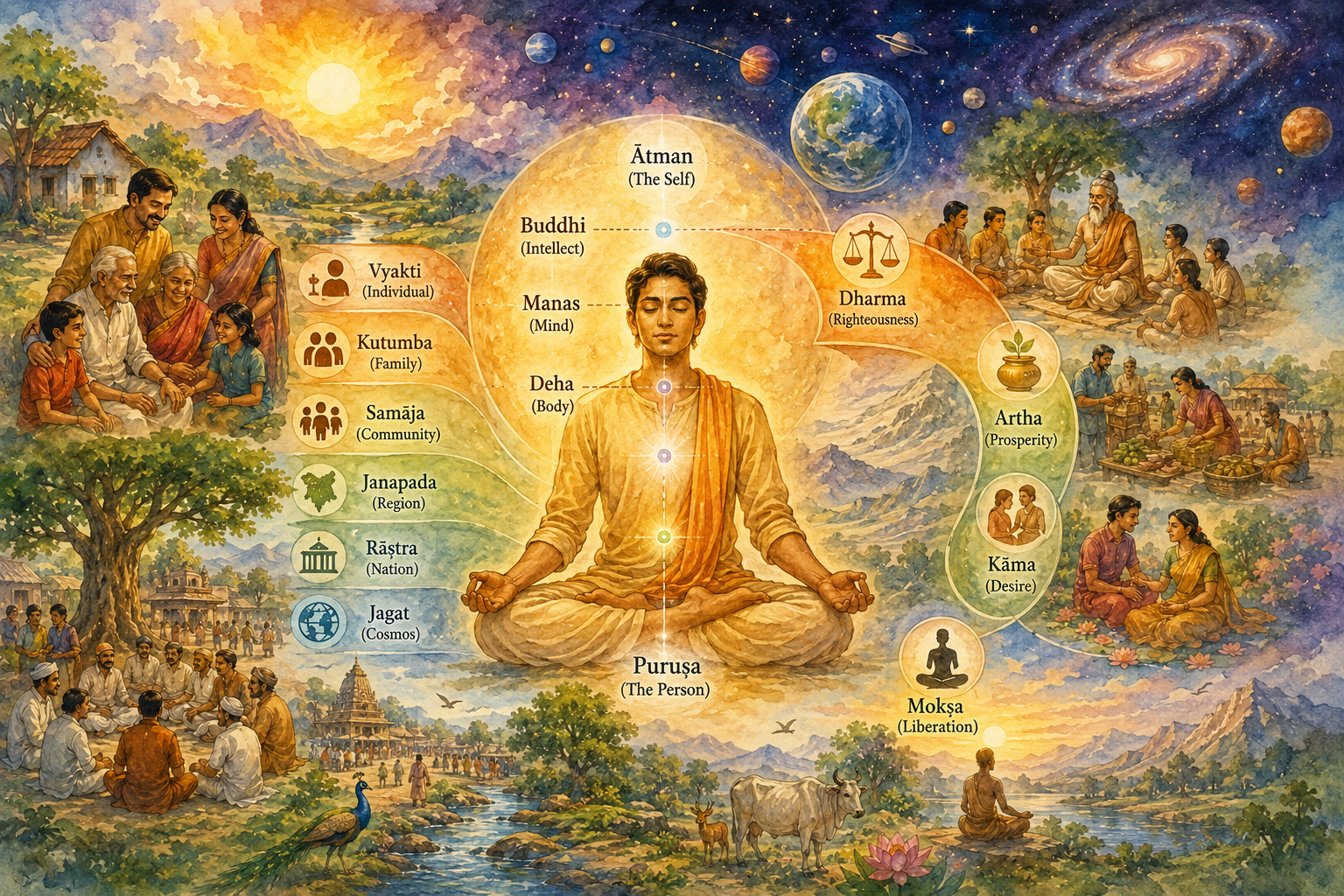
Deha, Manas, Buddhi and Ātman
Indic traditions do not possess one single theory of the human being. Sāṃkhya, Vedānta, Yoga, Buddhism, Jainism, Āyurveda and other traditions developed different and sometimes competing accounts. That plurality itself is important. Yet across several traditions we encounter an analytical vocabulary that refuses to reduce the person to the physical body.
- Deha points toward the embodied dimension.
- Manas concerns the mind and its relation to sensory experience.
- Buddhi concerns discernment, determination and intellectual discrimination.
- Ahaṃkāra concerns the construction of “I”-ness and individuation, And
- Ātman refers, in several Upaniṣadic and Vedāntic traditions, to the deeper Self.
In Sāṃkhya, for example, puruṣa is distinguished from prakṛti, while buddhi, ahaṃkāra and manas belong to the evolving apparatus of prakṛti. The distinction is not simply between “body” and “soul”; it constitutes a sophisticated account of consciousness, cognition and individuation. This becomes especially interesting for anthropology because the categories through which a society understands the person become themselves anthropological data.
If a community understands the human being through body, mind, consciousness and Self, anthropology should not prematurely translate all of these into “belief.”
It should first ask: What kind of person becomes visible through these categories?
Puruṣa: Person Rather Than Isolated Individual
The category of puruṣa takes the inquiry further. Recent scholarship has specifically returned to puruṣa as a category of ancient Indian personhood. Matthew I. Robertson argues that Indic personhood cannot simply be equated with the modern Western individual: the person is relational, permeable and expansive, connected to the world rather than necessarily imagined as a sealed autonomous unit.
This is crucial. The question is not whether the Indic person has individuality. Of course people have individual identities. The question is whether individuality exhausts personhood. It does not.
The Āyurvedic tradition provides an extraordinary example. Classical Āyurveda conceptualizes puruṣa through bodily and mental constitution and also through its relationship to ātman. Robertson’s study of the Caraka and Suśruta Saṃhitās shows how person and world are related through a logic of correspondence and shared constitution.
The human being is therefore not simply inside the world. The human being is understood in relationship with the world. This has enormous implications for anthropology.
The Person Has a Social Location
The Indic person is also situated within relationships. The individual is born into a Kutumba, participates in Samāja, occupies roles within community, encounters institutions and pursues different aims through the course of life.
This is why the earlier Indic framework of:
Vyakti → Kutumba → Samāja → Janapada → Rāṣṭra → Jagat
is more than a sociological hierarchy. It represents an expanding field of belonging. The person begins as an embodied individual but is never merely that individual. Family gives identity. Community gives relationships. Culture gives meaning. Institutions give responsibilities. Nature provides the material conditions of existence. And the larger cosmos provides, in many Indic traditions, the ultimate horizon of meaning. The anthropological question consequently changes from:
“What does an individual want?” to: “How does a person understand his or her place within these overlapping worlds?”
Puruṣārtha: What Is Human Life For?
This becomes clearest through Puruṣārtha.
Classical Hindu thought identifies four major ends of human endeavour: Dharma, Artha, Kāma and Mokṣa. Arvind Sharma notes that puruṣārtha literally concerns human endeavour and, in this framework, refers to the goals toward which human action is directed. This gives anthropology something that purely behavioural models often struggle to capture:
purpose.
A human being does not merely behave. A human being asks:
- What should I pursue?
- What is right?
- What do I desire?
- What constitutes a good life?
- What ultimately gives life meaning?
– Artha acknowledges material prosperity.
– Kāma acknowledges desire and enjoyment.
– Dharma places action within a normative order.
– Mokṣa introduces the possibility that even worldly achievement is not the final horizon of human existence.
The human being therefore cannot be reduced to an economic actor maximizing utility. The person is a meaning-seeking being.
Beyond the Human–Nature Divide
There is another consequence. If the human is understood only as an autonomous individual, nature easily becomes an external environment: something outside the person, available for use, protection or management. But several Indic traditions imagine the human–nature relationship differently. The idea that puruṣa and loka can be understood through correspondence appears explicitly in Āyurvedic theory.
This does not mean that traditional Indian society was always ecologically harmonious—history provides plenty of evidence against such romanticization. It means that the conceptual boundary between human and world was not necessarily drawn in the same place as in modern Western thought.
That difference itself deserves anthropological investigation.
The Anthropological Implication
This is ultimately what an Indic dṛṣṭi can contribute. It does not ask anthropology to abandon the individual. It asks anthropology to decentre the individual as the only possible starting point.
The human being can simultaneously be understood as:
- Deha — embodied existence
- Manas — mental experience
- Buddhi — discernment
- Jīva — embodied living being
- Puruṣa — person/conscious principle in diverse Indic traditions
- Ātman — Self in specific philosophical traditions
- Vyakti — the socially situated individual
These concepts should not be collapsed into one another. Their differences matter. Indeed, the diversity among Sāṃkhya, Vedānta, Buddhism, Jainism and other traditions should prevent us from speaking casually of “the Indian view of man.”
But that diversity is precisely the opportunity. Anthropology can study multiple theories of personhood rather than imposing one theory of the person upon all cultures. And perhaps that is the real movement from the individual to the puruṣa. Not the rejection of individuality. But the realization that an individual is only one dimension of what a human being can mean.
The deeper question for anthropology, therefore, is no longer simply:
“How does society shape the individual?”
It becomes:
“What conception of the human makes a particular society, family, economy, morality and civilization intelligible in the first place?”
Once we ask that question, anthropology becomes more than the study of human behaviour. It becomes the study of how human civilizations have imagined what it means to be human. And that is where an Anthropological Dṛṣṭi truly begins.
