
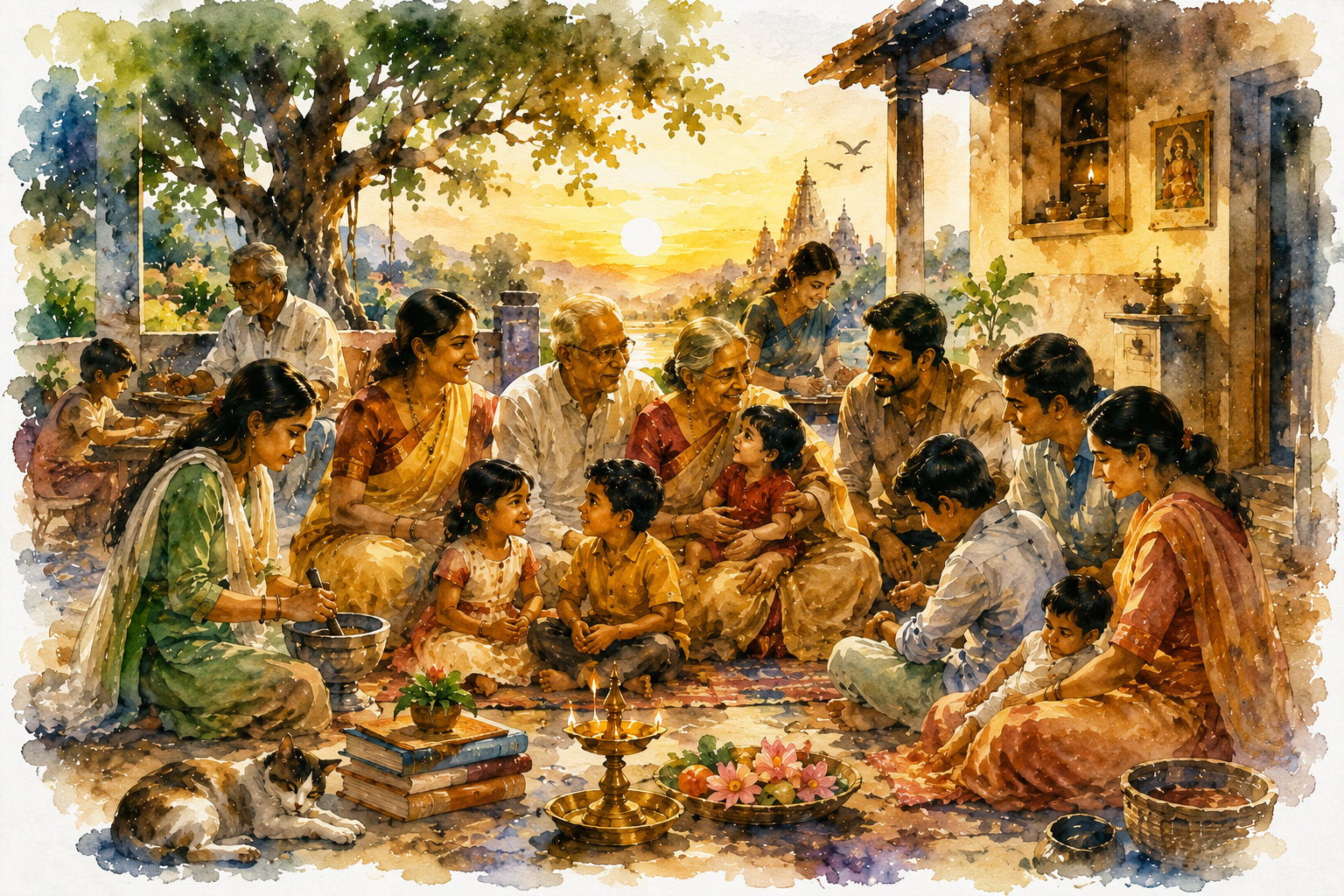
Beyond the Individual–Society Binary
Modern social science often begins with a deceptively simple question: Is the individual shaped by society, or does the individual shape society? The binary itself may be the problem.
The Indic concept of Kutumba offers another starting point. Kutumba is not simply a demographic unit, nor is it identical to the modern “household” or even the sociological category of “family.” It points toward a network of relationships through which the person is formed, located and given responsibility.
The crucial difference is this:
Society does not merely surround the individual. Relationships constitute the individual.
A child does not first exist as an autonomous person and then enter a family. The child becomes someone through relationships—with parents, grandparents, siblings, teachers, ancestors and community. Identity is therefore not merely possessed; it is relationally produced.
This becomes visible in everyday life. Who are you? A name is rarely enough. You are someone’s child, someone’s sibling, someone’s parent, someone’s student, someone’s friend, someone’s neighbour. These are not simply “roles” imposed upon an otherwise complete individual. They create obligations, memories, expectations and forms of belonging through which the person understands himself.
This is why Kutumba must be distinguished from the modern household.
A household can be counted. A Kutumba must be understood. The household may be a statistical unit of residence. Kutumba encompasses continuity, affection, obligation, inheritance, care and intergenerational memory. And this changes how we think about social institutions.
Take care. Modern welfare systems often conceptualize care as a service that can be delivered by an institution. The Kutumba begins with another possibility: care is also a relationship of obligation.
Take inheritance. It is not merely the transfer of property. It can also involve the transmission of knowledge, reputation, occupation, ritual practice and memory.
Take children. They are not simply dependants requiring investment. They are also future carriers of the family’s continuity.
Take elders. They are not merely a demographic category called “the elderly.” They can represent accumulated memory and experience.
This makes the Kutumba simultaneously a social, economic, educational, welfare and cultural institution.
The insight also challenges the familiar individual–society binary. Perhaps the basic unit of social analysis should not always be the individual. Perhaps it should sometimes be the relationship.
This is close to the relational emphasis found in the work of thinkers such as Nirmal Kumar Bose, whose studies of Indian society repeatedly drew attention to cultural interaction and social interdependence, and it also resonates with McKim Marriott’s understanding of Indian communities as embedded within wider networks rather than functioning as isolated units.
The Indic proposition goes deeper still.
Vyakti emerges through Kutumba; Kutumba participates in Samāja; Samāja sustains wider civilizational relationships.
The self is therefore neither completely autonomous nor completely absorbed into society. It is relationally situated. And perhaps this gives anthropology a more interesting question than “individual versus society”:
What if the person is not a solitary unit who enters relationships, but a relational being who becomes a person through them?
That is the anthropology of Kutumba.
