
How does a civilisation become a historical object?
For much of modern historiography, the answer was not simply through the memories, texts and institutions of the people who lived it. History increasingly became an organised intellectual enterprise: societies were classified, periods were constructed, economies were analysed, communities were divided into categories, and historical change was explained through theories developed in particular intellectual settings. When these frameworks were brought to Bharat, they did not merely describe the past. They also determined what counted as historically important.
The story begins with the colonial construction of Indian history.
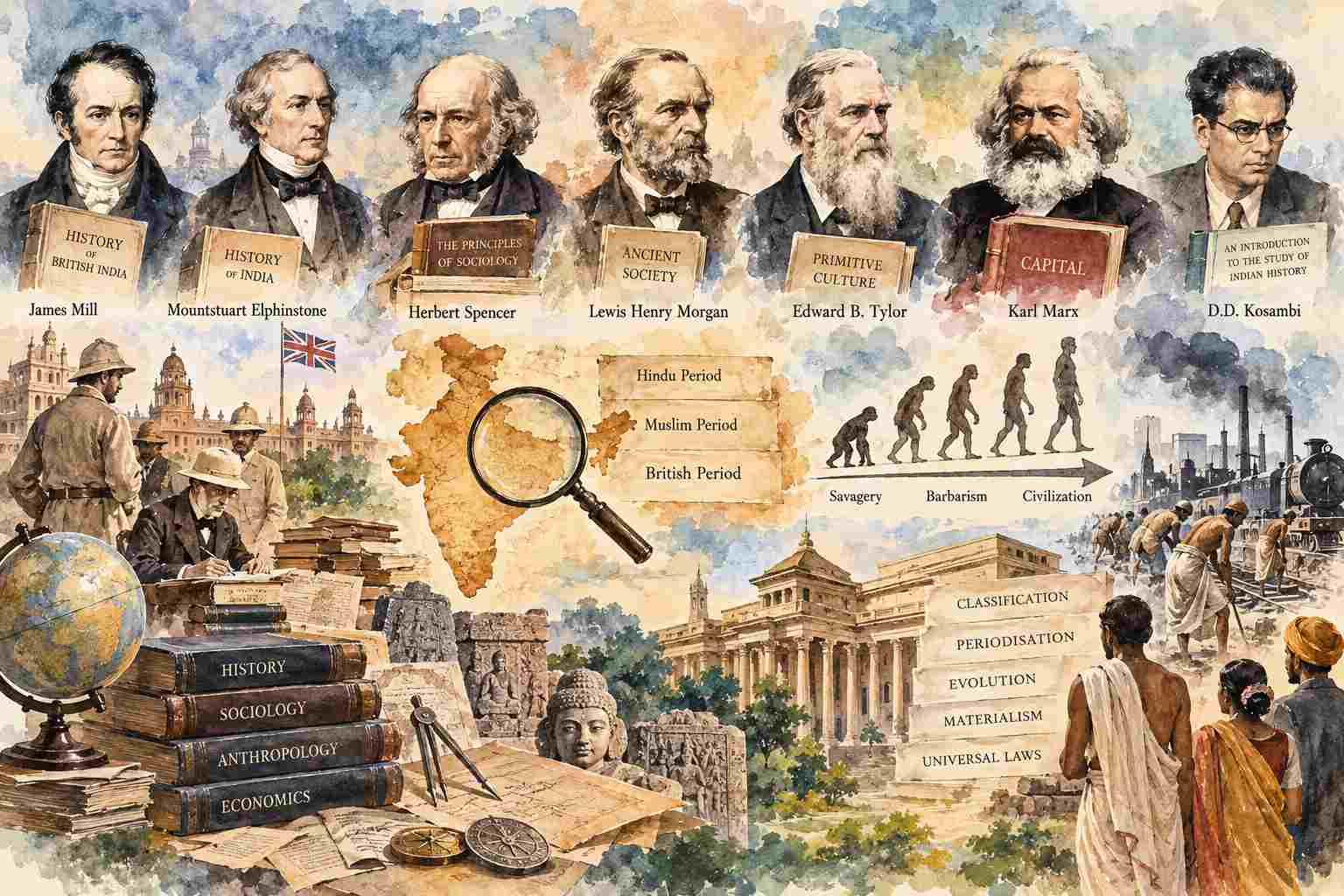
James Mill (1773–1836, The History of British India, 1817) offered one of the most influential early frameworks. India was divided into Hindu, Muslim and British periods, creating a chronological architecture in which the political identity of the ruling power became the principal organising principle. Indian history could therefore be narrated as a succession of civilizational and political regimes. The simplicity of this framework made it enormously influential, but its weakness was equally clear: the extraordinary continuity of Indian society could easily disappear behind a sequence of ruling dynasties. Mountstuart Elphinstone (1779–1859, The History of India, 1841) produced a more detailed historical account and drew extensively upon Indian sources, yet the framework remained closely connected to the colonial project of describing and classifying Indian society. Indian political institutions were examined largely through the categories available to European historical scholarship. The result was a history of India that was increasingly documented, but also increasingly viewed from outside.
The nineteenth century then brought a powerful new idea: evolution.
European intellectual thought increasingly imagined history as movement—from simple to complex, from primitive to advanced, from traditional to modern. Herbert Spencer (1820–1903, The Principles of Sociology, 1876–1896) extended evolutionary thinking to society, encouraging historians and social theorists to look for stages through which human societies supposedly progressed. When such ideas entered the study of India, Indian communities could be positioned on an imagined universal ladder of development. The attraction was obvious. A single model could seemingly explain the diversity of human societies. Its weakness was that the ladder had already been designed before India was placed upon it. Historical difference could easily become historical inferiority.
Lewis Henry Morgan (1818–1881, Ancient Society, 1877) developed an influential evolutionary scheme in which societies moved through stages of “savagery,” “barbarism” and “civilization.” His framework influenced later social and historical thinking even though it was not specifically designed for India. Applied to Indian history, however, such categories encouraged the tendency to interpret institutions as remnants of earlier stages rather than as products of India’s own historical development. Edward B. Tylor (1832–1917, Primitive Culture, 1871) similarly approached culture through evolutionary anthropology. Religion, custom and social practices could be arranged within a developmental sequence. Indian traditions could therefore be interpreted as evidence for particular stages in the supposed evolution of human culture. The problem was that living traditions were frequently transformed into archaeological specimens: something to be explained as a survival of the past rather than understood as a continuing social reality.
The evolutionary approach gradually gave way to more sophisticated forms of historical explanation, but the desire to discover universal laws remained. Karl Marx (1818–1883, Capital, 1867; A Contribution to the Critique of Political Economy, 1859) provided one of the most powerful alternatives. Historical change could be understood through material production, class relations and contradictions within economic systems. His scattered observations on India were not a complete history of the subcontinent, but they became highly influential in later interpretations of Indian society and colonialism. The Marxist historian consequently approached Indian history with a different question. Who controlled land? Who produced wealth? How was labour organised? What class relations sustained political power? What changes did colonial capitalism introduce?
This was a major shift in emphasis. But the danger was that history could become excessively economic: religion, philosophy, cultural memory and civilizational ideas could be treated primarily as reflections of material structures rather than as forces that themselves shaped historical action.
In India, D.D. Kosambi (1907–1966, An Introduction to the Study of Indian History, 1956) became one of the most influential representatives of this materialist approach. Combining archaeology, numismatics, textual evidence and social theory, Kosambi attempted to reconstruct Indian history through changes in technology, production, settlement and social organisation. The village, peasant economy and material conditions entered a historical narrative previously dominated by dynasties. Yet the explanatory centre remained material change. The question was increasingly not what Indians believed history meant, but how economic structures produced particular forms of society.
R.S. Sharma (1920–2011, Indian Feudalism, 1965) developed this approach further. Land grants, agrarian relations, political authority and economic transformation became central to his interpretation of early medieval India. His use of the category “feudalism” generated enormous historical debate. It provided a comparative framework for understanding land and political relations, but critics questioned whether a category derived largely from European history could adequately describe India’s distinctive institutional arrangements.
Romila Thapar (1931–, Aśoka and the Decline of the Mauryas, 1961; Early India, 2002) brought social, political and ideological analysis into the study of ancient India. Rather than presenting ancient India as a static civilization, she emphasised processes of change, political formation, social differentiation and the construction of historical traditions. Her work made ancient Indian history substantially more complex than a succession of kings. The criticism of this approach is not that it asks about social structures—it is that structural explanations can sometimes become so dominant that civilizational continuity, religious meaning and the internal intellectual categories of historical actors receive less explanatory weight.
The Marxist lens became particularly influential in medieval and modern history. Irfan Habib (1931–, The Agrarian System of Mughal India, 1963) reconstructed Mughal India through agrarian production, taxation, landholding and relations between the state and rural society. The Mughal Empire could now be studied from the perspective of the economic system that sustained it rather than only through emperors and court chronicles.
Bipan Chandra (1928–2014, The Rise and Growth of Economic Nationalism in India, 1966) interpreted colonial India through political economy, particularly the development of economic nationalism. A.R. Desai (1915–1994, Social Background of Indian Nationalism, 1948) similarly examined nationalism through social classes, colonial capitalism and structural transformation.
The Indian past was increasingly becoming a laboratory for explaining colonialism, capitalism, class formation and nationalism. But another question was waiting: what about those whom these large structures themselves had marginalised? This opened the door to histories of caste, oppression and social exclusion.
B.R. Ambedkar (1891–1956, Who Were the Shudras?, 1946; The Untouchables, 1948) placed caste and social exclusion at the centre of historical inquiry. His historical writings challenged conventional accounts of Indian society by asking how particular social groups had become subordinated. His work cannot simply be reduced to Marxism; nevertheless, it became foundational for later historiographies concerned with caste, inequality and marginalised communities.
Gail Omvedt (1941–2021, Cultural Revolt in a Colonial Society, 1976) examined anti-caste movements and social struggles through the language of structural inequality and collective mobilisation. Eleanor Zelliot (1926–2016, From Untouchable to Dalit, 1992) documented the emergence of Dalit political consciousness and the history of social movements. This changed the historical subject. The historian no longer had to begin with the king, court or state. Social protest, caste movements and marginalised communities could become the centre of historical narration. But the lens could also reduce enormously diverse historical experiences to the binary of oppressor and oppressed. The categories of hierarchy and resistance could become so dominant that other motivations—religion, locality, kinship, duty, cultural identity or intellectual tradition—received less attention.
Then another absence became increasingly visible: where were women? Much of conventional political and economic history had been written around rulers, wars, institutions, production and public political movements. Feminist historiography questioned this architecture itself.
Uma Chakravarti (1941–, Rewriting History: The Life and Times of Pandita Ramabai, 1998) examined the intersections of caste, gender and social power. Kumkum Sangari (1946–, Recasting Women, 1989), with Sudesh Vaid, explored the construction of women and gender relations in colonial India. Tanika Sarkar (1949–, Hindu Wife, Hindu Nation, 2001) examined the relationship between gender, religion, nationalism and political identity. The feminist lens expanded the historical archive. Family, marriage, sexuality, domesticity, education and women’s experiences could no longer be treated as peripheral.
Its limitation emerged when categories developed within modern feminist theory were sometimes treated as universal historical categories. Indian women lived within particular religious, familial, caste, occupational and regional worlds, and these contexts could not always be adequately represented through a single theoretical vocabulary of patriarchy and oppression.
Then history moved further downward.
Ranajit Guha (1923–2023, Elementary Aspects of Peasant Insurgency in Colonial India, 1983) and the Subaltern Studies collective questioned elite-centred history itself. Colonial historians had their rulers; nationalist historians had their leaders; Marxist historians had their classes. But where were the peasants who rebelled, the workers who resisted, the villagers who acted politically without waiting for elite leadership? The “subaltern” became the new historical subject.
Shahid Amin (1947–, Event, Metaphor, Memory, 1995) explored the relationship between historical events and popular memory. Gyanendra Pandey (1949–, The Construction of Communalism in Colonial North India, 1990) examined how communal identities were historically produced and represented. Their work shifted attention toward local experience, memory, identity and the politics of representation. Yet Subaltern Studies carried an interesting tension within itself. It sought to challenge elite and Eurocentric historical narratives while drawing heavily upon European theoretical traditions, particularly Antonio Gramsci, Michel Foucault and post-structuralist thought. The intellectual vocabulary changed, but the theoretical centre often remained outside the historical world being studied.
Dipesh Chakrabarty (1948–, Provincializing Europe, 2000) made this tension explicit. He questioned the assumption that European historical experience should function as the universal model of modernity. Indian history, he argued, could not simply be forced into a European sequence of historical development. This was perhaps the point at which the Westernized historiographical tradition began examining not merely India’s past but the categories through which India’s past had been constructed. Bernard Cohn (1928–2003, Colonialism and Its Forms of Knowledge, 1996) examined how colonial institutions generated knowledge about Indian society. Census operations, ethnographic classifications, administrative categories and legal systems did not merely describe India; they helped organise the colonial understanding of India. Nicholas Dirks (1951–, Castes of Mind, 2001) similarly argued that colonial knowledge played a major role in the codification and reorganisation of caste identities. The historian was now asking a new kind of question: when a colonial administration classifies a society, does that classification simply record reality—or does it also change the reality being classified?
The journey had therefore moved a long way from the old dynastic history. History had become economic history, social history, caste history, women’s history, peasant history, memory history and the history of knowledge itself. Each new lens had brought previously neglected subjects into view. Yet each also risked making its own category the master explanation.
And this is perhaps the defining characteristic of the Westernized historiographical gaze upon Bharat.
It repeatedly changes what it looks for. The colonial historian looked for dynasties and political divisions. The evolutionist looked for stages of development. The Marxist looked for class and material production. The social historian looked for structures. The feminist historian looked for gender and patriarchy. The subaltern historian looked for the voices and agency of those below elite structures. The postcolonial historian increasingly looked at the production of knowledge itself.
With every change, something previously invisible became visible. But something else could disappear. A civilisation can be read as an economy. It can be read as a collection of classes. It can be read through caste. It can be read through gender. It can be read through colonial power. It can be read through resistance and subalternity. Each reading may reveal something real. But a lens, however sophisticated, remains a lens.
And the history of Westernized historiography in Bharat is, in many ways, the history of increasingly sophisticated lenses being placed between the historian and the civilisation being studied.
