What happens when a civilisation that has remembered its past for thousands of years encounters a modern discipline called “History”?
The question is more difficult than it first appears. If History means simply recording the sequence of kings, battles, treaties and dates, then India certainly had histories. But if History means a particular modern academic discipline—with its own assumptions about evidence, chronology, society, progress and historical change—then the story becomes more complicated. For the Indian civilisation did not suddenly begin remembering its past when the modern university arrived. Its memory had already been preserved through Itihāsa, Purāṇa, vaṃśāvalī, charita, prabandha, inscriptions, temple records, genealogies, biographies, pilgrimage traditions and regional chronicles.
The first task, therefore, is not to ask whether India had history. It is to ask how India remembered and understood history.
One of the most remarkable examples is Kalhaṇa (12th century, Rājataraṅgiṇī). Writing the history of Kashmir, Kalhaṇa did not merely celebrate kings. He consulted earlier chronicles, inscriptions, genealogical material and other records, while also distinguishing between reliable and unreliable accounts. His history moved through rulers and political events, but it was also concerned with the moral consequences of political conduct. History was not simply a warehouse of facts; it was a reflection on rāja-dharma, power, fortune and human action.
The tradition continued in many forms. Bilhaṇa (11th century, Vikramāṅkadevacarita) preserved the memory of kingship through royal biography, while Sandhyākara Nandi (11th–12th century, Rāmacaritam) intertwined political events with literary and cultural memory. Jain intellectual traditions produced their own historical narratives, among them Merutuṅga (14th century, Prabandhacintāmaṇi), Jinaprabha Sūri (14th century, Vividha Tīrtha Kalpa) and Nayacandra Sūri (15th century, Hammīra Mahākāvya). These works remind us that historical memory in India did not have a single institutional home. It lived in courts, monasteries, temples, scholarly lineages, regional traditions and sacred geographies.
The Purāṇas themselves preserve another enormous layer of this historical consciousness through genealogies, dynastic traditions, descriptions of regions, sacred places and changing political orders. The form may not resemble the modern European history textbook, but that does not make it historically meaningless. It means that the civilisation organised memory differently.
Then the modern age arrived, and the problem changed.
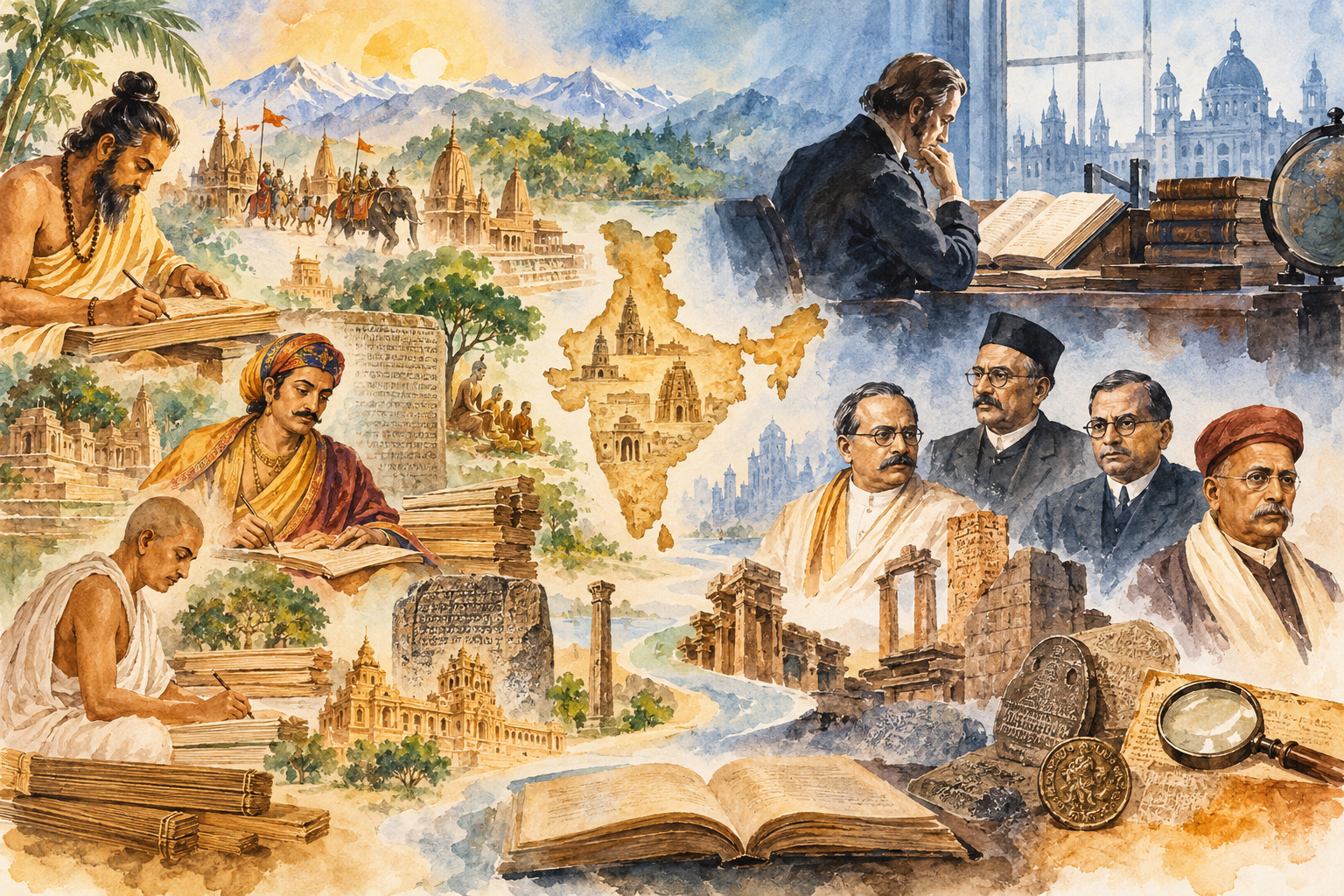
European scholars, administrators, missionaries and Orientalists began collecting Indian manuscripts, inscriptions, coins and monuments. India was increasingly being described through categories created outside the civilisation. The past was divided, classified and periodised. Ancient, medieval and modern became standard historical compartments. Dynasties were reconstructed. Languages were classified. Texts were translated. Archaeological remains were catalogued.
Much of this work produced valuable knowledge. But it also created a fundamental problem: who would interpret the evidence, and through which intellectual categories?
Indian scholars increasingly entered this field themselves. Rajendralal Mitra (1822–1891, The Indo-Aryans) was among the pioneers of modern Indian historical scholarship. His work on manuscripts, archaeology, architecture and ancient society demonstrated that Indians could investigate their own past through documentary and material evidence rather than merely receiving interpretations produced elsewhere. Bhagwanlal Indraji (1839–1888) similarly became a pioneering epigraphist, archaeologist and numismatist, showing how inscriptions and coins could illuminate India’s past. R.G. Bhandarkar (1837–1925, Vaishnavism, Saivism and Minor Religious Systems) brought rigorous historical investigation to India’s religious and social traditions. His scholarship demonstrated that Indian intellectual traditions could be studied historically without reducing them to mythology or treating them merely as survivals from an irrational past.
But perhaps the most fascinating development was taking place outside the metropolitan centres of colonial scholarship. Vishwanath Kashinath Rajwade (1863–1926) travelled extensively in search of historical documents and manuscripts. He collected thousands of Marathi records and correspondence, helping reconstruct Maratha history through indigenous documentary sources. His work represented something more than archival enthusiasm. It reflected a conviction that a people must recover its own historical memory from the records it had actually produced. Then came K.P. Jayaswal (1881–1937, Hindu Polity), who asked a politically uncomfortable question: did ancient India really lack sophisticated political institutions? Jayaswal examined ancient texts, inscriptions and other evidence to reconstruct gaṇa, saṅgha, kingship, assemblies and political organisation. His argument challenged the assumption that political modernity had to be measured against European experience. Ancient Indian political life had its own institutional vocabulary and therefore had to be understood through that vocabulary.
The recovery of political history was accompanied by a recovery of civilizational unity.
Radhakumud Mukherjee (1884–1963, Hindu Civilization) explored India’s institutions and cultural development across long periods of history, while R.K. Mookerji (1886–1964, Fundamental Unity of India) examined the cultural forces connecting India’s regions despite their enormous linguistic and political diversity. The question was no longer merely which king ruled which territory. It was becoming: what held this civilisation together across centuries of political fragmentation?
This was an important change in historical imagination. A civilisation does not cease to exist because dynasties change.
That insight is visible in the work of H.C. Raychaudhuri (1892–1957, Political History of Ancient India), who reconstructed ancient Indian political history through textual and archaeological evidence; D.R. Bhandarkar (1875–1950, Some Aspects of Ancient Hindu Polity), who examined ancient political institutions; and U.N. Ghoshal (1886–1969, A History of Indian Political Ideas), who traced the development of Indian political thought through its own textual traditions.
Meanwhile, the history of regions was being recovered with equal seriousness.
G.S. Sardesai (1865–1959, New History of the Marathas) reconstructed Maratha history from an enormous documentary base. Jadunath Sarkar (1870–1958, History of Aurangzib; Shivaji and His Times) became renowned for his meticulous use of Persian, Marathi and European sources. His work demonstrated that civilizationally rooted historical scholarship need not mean abandoning rigorous source criticism. Indeed, the opposite could be true: one could challenge established narratives precisely by returning to the archives. In southern India, K.A. Nilakanta Sastri (1892–1975, A History of South India) restored South Indian political and cultural history to the centre of the national historical narrative. T.V. Mahalingam (1907–1980, South Indian Polity) similarly examined institutions and political organisation in the South. This was important because an Indian history centred overwhelmingly on Delhi, the Mughals and the British could never adequately represent the civilisation as a whole.
A.S. Altekar (1898–1960, Education in Ancient India) widened the field further by examining education, social institutions and the position of women within ancient Indian society. P.V. Kane (1880–1972, History of Dharmaśāstra) produced perhaps one of the most extraordinary documentary achievements in modern Indian scholarship. Across five enormous volumes, Kane traced the development of dharma, law, social practices, religious institutions and normative traditions through an immense Sanskrit textual corpus. Here history was not simply political history; it was the history of institutions, ideas, practices and social norms.
Then came the monumental figure of R.C. Majumdar (1888–1980, The History and Culture of the Indian People). Majumdar’s importance lies partly in scale. The eleven-volume History and Culture of the Indian People attempted to tell India’s story across its vast chronological and cultural expanse. Political events mattered, but they existed alongside literature, religion, society, art, economy and intellectual life. History became civilizational rather than merely dynastic.
Yet Majumdar also represented something important methodologically. Challenging a dominant historical narrative did not, in his view, mean replacing scholarship with patriotic assertion. Evidence still mattered. Sources still had to be examined. Interpretations still had to be defended. The Indian historian could therefore be civilizational without abandoning historical discipline. At this point the story moves beyond professional historians.
Bankim Chandra Chattopadhyay (1838–1894) interpreted India’s past through questions of civilizational self-consciousness and cultural regeneration. Swami Vivekananda (1863–1902) saw Indian history as the long unfolding of a civilisation whose spiritual, social and intellectual traditions could not be understood through political chronology alone. Sri Aurobindo (1872–1950, The Foundations of Indian Culture) went even deeper. For him, the central question of Indian history was not merely what India had done but what kind of civilisation India represented. The past was not dead matter; it was a living civilizational inheritance.
Ananda K. Coomaraswamy (1877–1947, The History of Indian and Indonesian Art) approached history through art, symbolism and civilisation. Indian artistic forms were not simply decorative objects produced in the past; they expressed an entire metaphysical and social vision. S. Radhakrishnan (1888–1975, Indian Philosophy) similarly reconstructed India’s intellectual history as a continuous philosophical tradition rather than as disconnected schools.
K.M. Munshi (1887–1971) carried this civilizational approach into the institutional project of Bharatiya Vidya Bhavan, helping produce and support historical works that presented India’s past as a long cultural continuum. The question of history had now expanded beyond academic reconstruction: could historical scholarship also become an instrument of civilizational remembrance?
This question became particularly powerful after Independence. The archives themselves began to tell stories that had received comparatively little attention. Dharampal (1922–2006, The Beautiful Tree; Indian Science and Technology in the Eighteenth Century) searched British archival records for evidence about indigenous education, science and technology. His method was provocative precisely because he did not depend only on Indian claims. He went into colonial records and asked what they themselves revealed about Indian institutions before colonial transformation.
Other scholars took up contested questions of medieval and modern history. Sita Ram Goel (1921–2003, The Story of Islamic Imperialism in India), K.S. Lal (1921–2002, Growth of Muslim Population in Medieval India) and Harsh Narain (1921–1995, Myth of Composite Culture) developed strongly civilizational interpretations of India’s medieval past. Their works are more polemical than the archival scholarship of Majumdar or Sarkar, and therefore require careful source-by-source evaluation, but they remain part of the history of the attempt to challenge established narratives.
In the contemporary period, Meenakshi Jain (1946–, The India They Saw; The Battle for Rama) has continued this process through extensive engagement with primary sources, colonial accounts, archaeology and historiographical debates. Her work illustrates an important development: the contest over Indian history is no longer simply between colonial accounts and nationalist accounts. It is also a contest over which sources deserve attention, which interpretations survive scrutiny and whether the categories used to describe India’s past actually fit the historical evidence.
And perhaps that is where the Indic historical project stands today. It does not require rejecting every method developed outside India. Archaeology remains archaeology; inscriptions remain inscriptions; chronology still matters; documents still have to be authenticated and compared. The deeper question is different. Can the Indian past be understood without reducing it to categories that were created to explain someone else’s historical experience?
An Indic approach to history begins by taking seriously India’s own historical vocabulary and its own forms of memory. It recognises Itihāsa and Purāṇa, genealogies and chronicles, inscriptions and temple records, philosophical traditions and regional memories. It studies kings and battles, but it also studies dharma, rāṣṭra, pilgrimage, knowledge, family, community, sacred geography, art, literature and the transmission of civilisation across generations.
From Kalhaṇa’s Kashmir to Rajwade’s archives, from Jayaswal’s political institutions to Kane’s Dharmaśāstra, from Majumdar’s civilizational history to Dharampal’s archival recovery, and from Aurobindo’s interpretation of Indian civilisation to contemporary historical scholarship, one question keeps returning in different forms: What happens when Indians cease to be merely the subjects of history and begin once again to become its interpreters?
Perhaps that is the real beginning of Indic historiography—not the invention of a new past, but the recovery of the capacity to see the old one through its own civilizational eyes.
