
How did Indic civilization manage common resources without excessive central control?
The history of modern governance is often written through a simple assumption: resources are either controlled by private owners or managed by the state. Forests belong to government departments, water is supplied through public authorities, land is regulated by the state and markets determine access to many other resources. But this binary does not adequately explain how communities historically governed resources in Bharat.
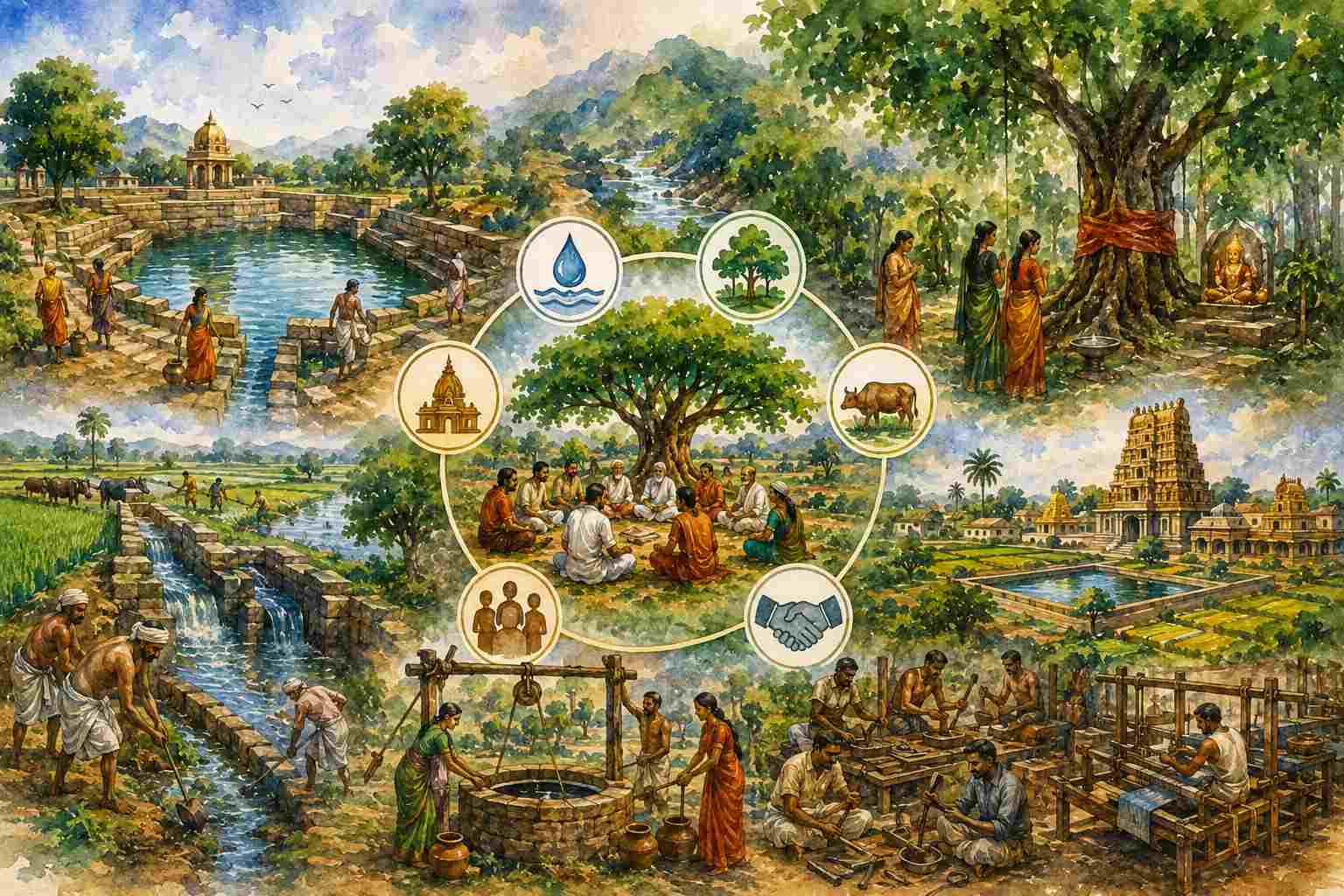
For centuries, the management of water, grazing land, forests and agricultural infrastructure was embedded within local institutions. Resources were governed through custom, religious norms, collective labour, local decision-making and overlapping responsibilities. The village, temple, community, occupational network and political authority could all play a role.
The resource was therefore rarely just a physical object.
A tank was a system of water, land, labour, agriculture, rules and social relationships. A forest could be simultaneously a source of ecological protection, grazing, water conservation and sacred significance. An irrigation channel required not only engineering but also collective decisions regarding maintenance and distribution.
The central question, therefore, is not simply whether Bharat had public or private resources. The deeper question is: what institutions made collective resources governable? The answer reveals an important civilizational principle: resource governance was often embedded in society itself.
Water Was Not Simply Stored. It Was Governed.
Consider the diversity of traditional water systems across Bharat. These were not replicas of a single national model. Communities developed technologies suited to their own ecological conditions.
Ahar-Pyne System:
South Bihar developed the Ahar-Pyne system, combining ahars—water-storage structures—with pynes, channels that diverted water and distributed it to agricultural fields. The system could respond both to seasonal flooding and dry periods. Historically, its maintenance depended upon collective labour, known in some areas as goam, including desilting and repairing embankments and channels.
The system is important because it demonstrates that a water technology cannot be separated from the social organization required to maintain it. A canal does not clean itself. An embankment does not repair itself. Water distribution requires rules, labour and institutions.
At the same time, the example also provides an important warning. Recent research has shown that community management should not automatically be romanticized. In the Ahar-Pyne system, labour and benefits could be unequally distributed, and marginalized communities, including Beldars, historically carried much of the labour-intensive maintenance work.
This is an important lesson for the Indic framework. Community governance is not automatically just merely because it is local. Institutions must be studied historically, including their internal inequalities. Polycentric autonomy requires responsibility and accountability; otherwise, decentralization can simply decentralize hierarchy.
Phad irrigation system:
The same relationship between ecology and local governance appears in the Phad irrigation system of Maharashtra. In Khandesh and other parts of the region, communities developed small-scale irrigation systems that diverted water from rivers and streams through locally managed channels. A phad could consist of multiple farmers’ land parcels, with water allocation and cropping decisions requiring collective coordination.
This is precisely what makes the example significant. The resource was not governed simply through unrestricted private choice. One farmer could not necessarily maximize his water use without affecting everyone else. Individual cultivation depended upon a collectively maintained system.
The commons required rules because the resource connected individuals to one another.
Across Bharat, comparable systems developed according to local ecology: kuhls in Himachal Pradesh, zabo in Nagaland, ahar-pyne in Bihar, khadins in Rajasthan and numerous other diversion-based or rainwater-harvesting systems. Their diversity itself is significant. Bharat did not produce one universal water technology because its ecological conditions did not permit one.
The Village Tank Was a Social Institution
The great tank systems of South India provide another powerful example.
A tank was not merely an engineering structure. It was connected with agriculture, groundwater, local labour, revenue, land and institutions of maintenance. Historical evidence from South India shows that local bodies such as the sabha and ur could be responsible for tank maintenance, while inscriptions also refer to endowments of land, paddy and gold for activities such as raising bunds, removing silt and deepening tank beds.
This matters because it shows the existence of institutional plurality. Maintenance did not depend exclusively upon the permanent administrative intervention of a distant state. Local assemblies, donors, land revenues and other institutions could participate.
kudimaramathu:
The principle of kudimaramathu, historically associated with community participation in maintaining irrigation structures, continues to inform contemporary Tamil Nadu policy. The state’s modern participatory programmes have used the idea of involving village-level institutions in restoring and maintaining minor irrigation tanks, ponds and ooranies.
The historical and contemporary significance is clear: infrastructure can be constructed by the state, but long-term maintenance often requires institutions closer to the resource.
A civilization does not become self-reliant merely by constructing assets. It becomes self-reliant when communities possess the capacity to maintain them.
Sacred Groves: When Ecology Became a Cultural Responsibility
The management of forests demonstrates another dimension of the Indic approach.
A sacred grove was not simply a forest waiting to be legally protected by the state. It could be protected through cultural norms that made ecological destruction a violation of collective and sacred responsibility.
In Meghalaya, sacred groves remain one of the strongest surviving examples. The Meghalaya Biodiversity Board describes these forests as a long tradition of environmental conservation based on indigenous knowledge. Restrictions on cutting trees or removing biological material helped preserve ecologically rich forest patches, and surveys have documented substantial biodiversity within these community-protected landscapes.
The mechanism here deserves attention. The forest was not protected only because it possessed a market price. Nor was its protection dependent entirely upon a distant enforcement agency. Ecology was embedded within a social and cultural order. This represents a fundamentally different relationship between society and nature. The sacred was not merely symbolic. It could produce rules of restraint.
The same principle can be seen in Rajasthan’s Orans and Deobanis. These community-conserved sacred landscapes have served ecological functions while also supporting grazing and water conservation. Their rules of protection were embedded within community norms and sacred associations. The contemporary recognition and legal protection of Orans demonstrates that older community-conserved systems continue to have relevance in present environmental governance.
The crucial point is not that religion automatically produces ecological sustainability. It does not.
The point is that cultural institutions can create ecological norms. Modern environmental policy often asks how to regulate human behaviour after ecological damage occurs. Sacred groves reveal another possibility: cultural norms can place restraint within behaviour before extraction reaches the point of collapse.
Temple Lands and the Institutional Ecology of Resources
The role of temples provides another example of institutional complexity.
Temples were not merely places of worship. Historical evidence from South India shows connections between temples, land endowments, irrigation and agricultural production. Temple tanks could be used for multiple purposes, while endowments could support the maintenance of tanks and irrigation channels. In some cases, the agricultural productivity of temple lands was directly linked to these water systems.
This does not mean every temple was economically identical, nor that all historical temple-land systems should be treated uncritically. The point is analytical. The same institution could operate simultaneously within cultural, economic and ecological systems. Modern governance tends to separate these functions into different departments: religion, agriculture, irrigation, welfare and culture. The historical Indic institution was often less compartmentalized. A temple could be connected to land. Land could finance ritual and public activity. Water could sustain agricultural production. Endowments could fund maintenance.
The resource system was therefore embedded within institutions of society.
From Commons to Self-Reliance
This is where the idea of self-reliance must be reconsidered. Self-reliance is often interpreted as individual or national economic independence. But a community cannot be self-reliant merely because every household acts independently.
A village dependent upon a collapsing water system is not self-reliant. A community that has lost the knowledge required to maintain its commons is not self-reliant. A society in which every ecological problem must wait for intervention from a distant administrative centre is not fully self-reliant either. True self-reliance requires local capacity.
It requires the knowledge to understand local conditions, institutions capable of collective action and a culture in which responsibility for common resources is socially recognized. This is why the commons are important to civilizational studies.
The commons demonstrate that the individual, community and state need not be treated as mutually exclusive categories. A resource can involve multiple layers of authority. The community may maintain it. Local institutions may establish rules. Religious norms may reinforce restraint. The state may provide legal protection or technical support.
The question is not state or society. The question is: how should responsibility be distributed?
Beyond the Market–State Binary
Modern political debates often move between two extremes. The first is the assumption that private ownership and markets will efficiently allocate resources. The second is the assumption that the centralized state must control and administer the resource.
The historical experience of Bharat suggests a third possibility: embedded resource governance. Resources were often governed through networks of relationships. Ownership, access, use, maintenance and responsibility did not always belong to the same actor. Multiple institutions could possess different roles.
This is the deeper ecological meaning of the commons. A community-managed resource does not belong to everyone in the sense that anyone can exploit it without restraint. Nor does it belong only to the state because it serves a collective purpose.
It belongs within a structure of rights, obligations, access and responsibility.
That distinction is fundamental. The tragedy of the commons does not occur merely because a resource is collectively used. It occurs when a resource is collectively used without institutions capable of creating responsibility and restraint. Bharat’s historical systems therefore deserve study not because they provide ready-made models for the twenty-first century, but because they reveal a different political possibility.
The Civilizational Ecology of Responsibility
The deeper lesson is that sustainability cannot be produced by technology alone. A dam can be built. A forest can be legally notified. A tank can be restored. But who maintains them? Who uses them? Who possesses the knowledge to govern them? Who bears responsibility when they deteriorate?
These are institutional questions. The Indic experience suggests that environmental governance becomes more resilient when responsibility is embedded across society. Water is connected to agriculture. Forests are connected to culture. Land is connected to institutions. Economic activity is connected to ethical norms.
This is not a rejection of the modern state. Large-scale ecological crises, inter-regional conflicts and technological challenges require state capacity. But state capacity alone cannot replace community capacity. Nor can modern markets replace ethical restraint.
The future of sustainability may therefore depend upon recovering an insight that historical resource systems understood clearly: a civilization survives not only by possessing resources, but by developing institutions capable of governing them responsibly.
From the ahar and pyne of Bihar to the phad systems of Maharashtra, from South India’s tank networks to the sacred groves of Meghalaya and the Orans of Rajasthan, Bharat developed multiple answers to the same problem.
How can human beings use a shared resource without destroying the ecological and social relationships that make its use possible? There was no single Indian answer. That itself is the point. Bharat’s civilizational strength did not emerge from imposing one model across every landscape. It emerged from allowing diverse communities to develop resource systems appropriate to their own ecological conditions while embedding them within wider structures of responsibility.
From commons to civilization, the principle remained the same: a resource becomes sustainable when use is connected with responsibility, knowledge with local institutions, and autonomy with restraint. This is not merely an environmental lesson from the past. It is a framework for thinking about the future.
