How Do Societies Transform?
How does society change? Does history move toward a final destination, or does every transformation simply create new conditions that demand further change?
Modern political thought has often imagined history as a journey toward an ideal end. Liberalism has associated progress with the expansion of individual liberty and democratic institutions. Marxism imagined the revolutionary transition beyond capitalism toward a classless society. Socialist movements sought a more equal economic order. Technological visions increasingly promise a future in which innovation will eliminate scarcity, disease and perhaps even human limitations.
The details differ, but the structure of thought is often similar. History is moving somewhere. The present is imperfect because the ideal has not yet been achieved. Once the right system is established, humanity will move toward a higher and more complete social order.
The Indic civilizational perspective begins with a more difficult question. What if there is no final social arrangement that permanently resolves the problems of human life? What if every solution produces new tensions? What if prosperity creates new forms of excess, equality creates new debates about freedom, technological progress creates new dependencies, and political liberation produces new concentrations of power?
This is the foundation of an Indic theory of social change.
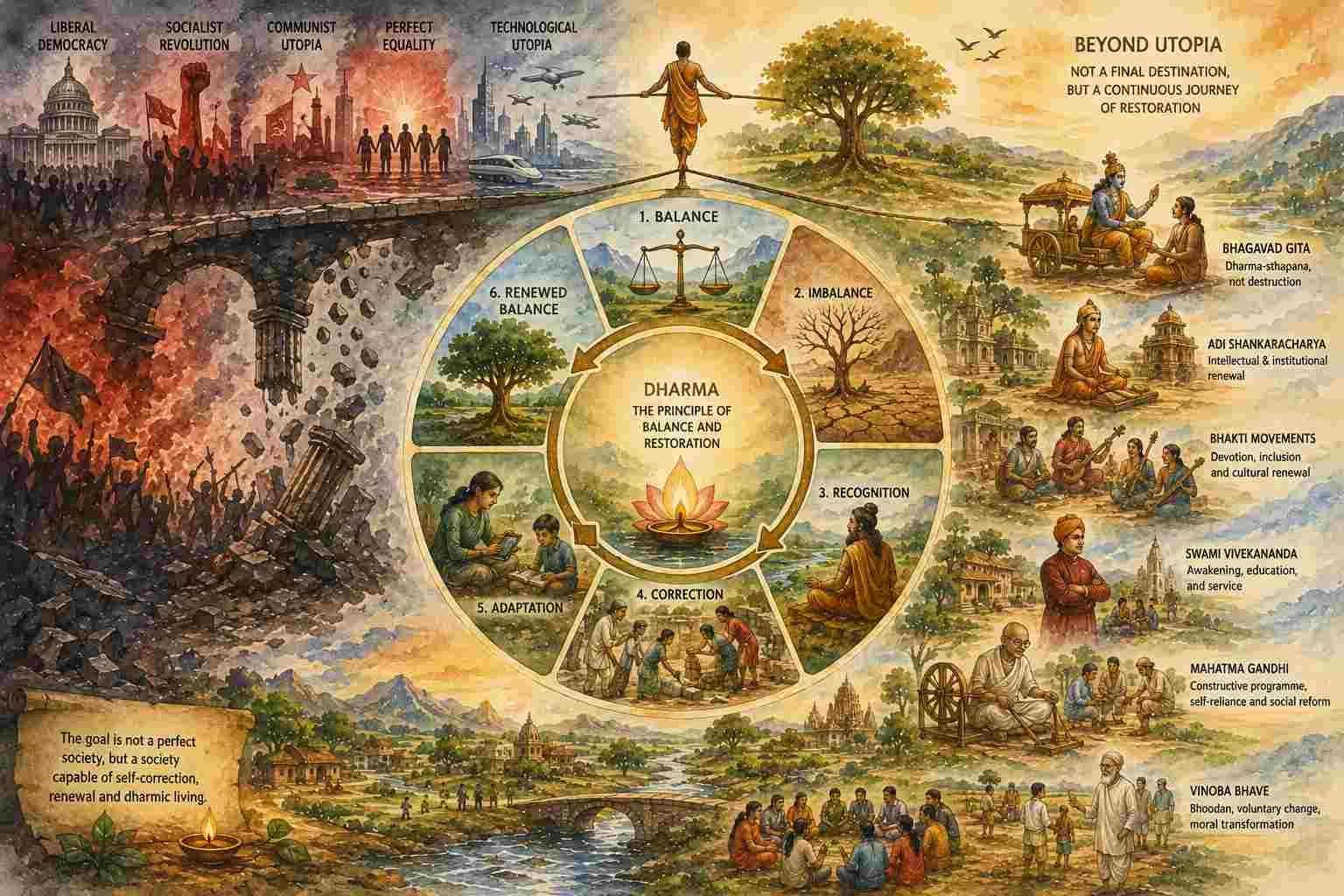
Society does not move in a straight line from darkness to perfection. It moves through recurring processes of balance, imbalance, adaptation and restoration.
The goal is not utopia. The goal is the continuing restoration of conditions in which society can remain dharmic.
The Utopian Logic of Modern Social Change
The modern idea of progress emerged from powerful historical experiences. Scientific advancement transformed the understanding of nature. Political revolutions challenged monarchy. Industrialization generated enormous wealth while creating new forms of inequality. The nineteenth and twentieth centuries produced ideologies that attempted to explain where history was going.
The attraction of these theories was understandable. If human suffering has identifiable causes, perhaps history itself can be organized toward their elimination.
But here emerged the problem of the final social blueprint.
The French revolutionary tradition attempted to reconstruct political order according to universal principles. Marxist traditions developed the idea that class conflict would eventually lead to the disappearance of class itself. Twentieth-century revolutionary states attempted to reorganize property, labour, culture and political power. More recently, technological utopianism has imagined that sufficient innovation can solve the fundamental problems of human existence.
Each vision identified genuine problems. Inequality is real. Political oppression is real. Poverty is real. Technological stagnation is real.
The Indic critique, therefore, need not reject the problems identified by modern ideologies. It asks a different question: Can the solution to one human problem become the source of another?
History strongly suggests that it can.
Economic equality can be pursued through institutions that suppress freedom. Unrestricted markets can produce prosperity while generating ecological destruction and inequality. Technology can connect societies while weakening local communities and creating new forms of dependence. Political revolutions can remove oppressive rulers while creating new political elites.
The problem is not that human beings should stop trying to improve society. The problem begins when one believes that history can reach a point at which its fundamental tensions disappear permanently.
The Indic Starting Point: Balance and Imbalance
Indic civilization possesses a fundamentally different temporal and social imagination. This does not mean that there is only one Indic theory of history, or that every Indian text presents the same model. But the civilizational traditions repeatedly emphasize cycles, recurrence, decline, renewal and the consequences of action.
Purāṇic ideas of the yugas, for example, do not present time as a simple march toward increasing perfection. They contain a conception of the decline of Dharma, followed by processes of restoration and renewal.
This does not provide a modern theory of social science. Yet it provides an important civilizational intuition: decline is possible, but decline is not necessarily final. Renewal is possible, but renewal does not end the possibility of future decline.
This is profoundly different from linear theories of inevitable progress.
The Bhagavad Gita provides the political and social vocabulary for this process through the idea of dharma-saṃsthāpana. When Dharma declines and disorder rises, the purpose is not to create a permanent utopia. The purpose is to re-establish a sustaining order.
The distinction is crucial. The utopian question asks: How do we finally perfect society? The Dharmic question asks: What has become imbalanced, and how should it be corrected?
The second question does not promise an end to history. It requires society to remain capable of continuous self-correction.
Why Dharma Is Different from a Perfect Social Blueprint
Dharma is not a complete institutional design that can simply be implemented once and for all. A political ideology can theoretically produce a constitution, a programme and a vision of an ideal future. Dharma works differently because it must be interpreted in relation to changing circumstances, responsibilities and consequences.
This is precisely why social transformation cannot be reduced to one permanent formula.
A prosperous society may need restraint. A poor society may need economic expansion. A highly centralized society may require decentralization, while a fragmented society may require stronger coordination. A tradition may preserve social wisdom in one context while requiring reform in another.
Therefore, the appropriate social response is contextual.
The Indic theory of social change is not that society should remain balanced forever. No society does. The theory is that imbalance is a permanent possibility, and therefore the capacity for correction must be permanent as well.
A civilization must repeatedly ask:
- What is increasing beyond proportion?
- What social relationship has become distorted?
- What institution has become incapable of fulfilling its function?
- What must be preserved?
- What must be reformed?
- What new capacity must be created?
This is a theory of continuous civilizational adjustment.
The Bhakti Example: Transformation Without Civilizational Destruction
The Bhakti traditions provide one of the most important historical examples of this process.
Across centuries and regions, devotional movements changed religious participation, literary culture and social relationships. Vernacular languages increasingly became important vehicles of spiritual and intellectual expression. New publics emerged through songs, storytelling, pilgrimage and devotional communities.
Yet this transformation did not require the destruction of the entire civilizational knowledge structure.
Recent scholarship has shown that Bhakti practices and vernacular traditions influenced Sanskrit intellectual life itself. Change moved from what might be called the social margins toward established intellectual traditions, reshaping conventions without requiring a wholesale civilizational replacement.
This is important for the Indic theory of social change. A modern revolutionary model might ask whether the old structure must be overthrown. The Bhakti example reveals another possibility: new forms of participation can gradually transform the larger structure from within and alongside it.
The older order does not remain untouched, but neither is the entire civilizational memory erased.
Social Change as a Cycle of Renewal
The Indic model can be represented as a continuous process:
| Linear-Utopian Model | Indic Model of Social Change |
|---|---|
| Existing society is fundamentally defective | Every society contains capacities and distortions |
| A final ideal is imagined | No permanent perfect social order is assumed |
| Transformation moves toward an end-state | Balance and imbalance recur |
| Revolution may create a new order | Renewal restores and adapts the social order |
| One principle may dominate the model | Multiple dimensions must be balanced |
| History ends in perfection | Social correction remains a continuous necessity |
The difference is not between change and no change. The real difference is between history as arrival and history as continuous adjustment.
Beyond the Myth of the Final Stage
The twentieth century repeatedly demonstrated that history does not end simply because a society reaches an important political milestone. The collapse of colonial rule did not end inequality. The expansion of democracy did not end polarization. The growth of welfare states did not end economic tension. The collapse of communist states did not end the search for economic justice.
Every apparent solution creates new questions. This does not mean progress is an illusion. Bharat’s social history contains real transformations in law, political representation, education, public health and technology. The problem is the assumption that progress means reaching a condition from which further correction will no longer be necessary.
The Indic theory is more demanding. A civilization is not successful because it reaches perfection. It is successful when it develops the capacity to recognize its failures and renew itself without losing the social capacities required for renewal.
This requires a society that is capable of criticism. A civilization that cannot criticize itself cannot restore itself. But a civilization that rejects everything inherited from the past also deprives itself of accumulated intellectual and moral resources. The challenge is neither blind tradition nor permanent rebellion.
It is self-renewal.
An Indic Theory of Social Change
The Indic theory proposed here rests upon a simple proposition: social change is not a journey toward utopia but a recurring process of imbalance, recognition, correction, adaptation and renewed balance.
Dharma provides the normative principle through which imbalance can be recognized. Social institutions provide the practical mechanisms through which change occurs. Communities preserve continuity while adapting practices. Individuals participate in moral and social transformation. New ideas emerge, old institutions are reformed and new institutions are created.
But none of these processes permanently ends the possibility of future imbalance. That is not pessimism. It is realism. A society that accepts the permanence of change does not need to wait for a final revolution. It can begin the work of correction now.
It can reform without pretending that reform will solve every future problem. It can preserve without becoming rigid. It can innovate without forgetting the social and ethical consequences of innovation.
This is perhaps the most important contribution of the Indic framework. Human history does not require a final perfect society in order for transformation to be meaningful. A society can become more just without becoming perfect. It can restore balance without imagining that balance will never again be disturbed. The future, then, is not a destination waiting at the end of history. It is the continuing responsibility of civilization to recognize imbalance and restore Dharma before imbalance becomes destruction.
