
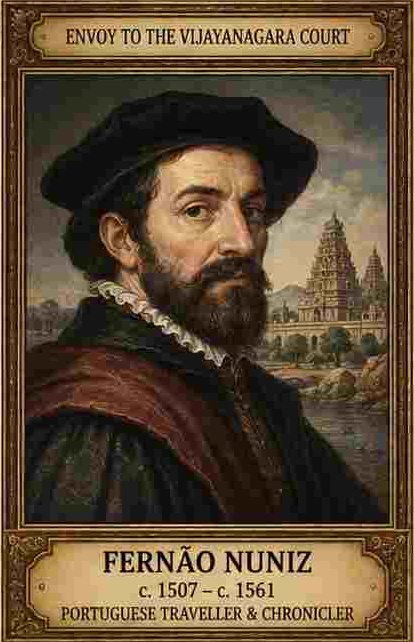
The Portuguese Chronicler Who Tried to Remember Vijayanagara’s Past
There is something fundamentally different about Fernão Nuniz from the travellers we have written about so far, because while Domingo Paes gave us the Vijayanagara he personally saw during the reign of Krishnadevaraya, Nuniz tried to do something more ambitious: he tried to recover the history of the kingdom that had existed before his own arrival. A Portuguese merchant or traveller active in India in the 1530s, Nuniz was in Vijayanagara probably around 1535–1537, only a few decades after Paes, and his account was written in the form of a chronicle of the kings of Bisnaga, the Portuguese name for Vijayanagara. His narrative is preserved together with Paes’s account in the manuscript known as Port. No. 65 in the Bibliothèque Nationale in Paris, and Robert Sewell published the English translation in A Forgotten Empire in 1900. Importantly, Sewell established that the surviving manuscript contains copies rather than the original papers, and that Nuniz’s chronicle was probably written around 1535–37.
That difference makes Nuniz especially valuable for our civilizational series. He was not merely interested in what the capital looked like; he wanted to know who had ruled before, how dynasties succeeded one another, how wars had changed the kingdom, how the capital had been rebuilt, and how the political order had evolved. His account therefore moves us from the traveller’s gaze towards something closer to historical memory. But there is an important warning here: Nuniz’s chronology is not always reliable, some of his names are difficult to identify with certainty, and his narrative contains traditions that cannot simply be accepted as literal fact. Even Sewell recognised these problems. Yet the very attempt made by Nuniz—to reconstruct the past of a civilization from information gathered in the place where that civilization still lived—makes his work indispensable.
Major Source
Chronicle of Fernão Nuniz
The account is generally known through Robert Sewell’s A Forgotten Empire: Vijayanagar: A Contribution to the History of India, where it appears after the narrative of Domingo Paes. Sewell dates it probably to 1535–1537. The two accounts were preserved together, and their historical value lies partly in their complementarity: Paes gives us a more immediate description of the city and court around 1520–22, while Nuniz provides a much longer historical narrative extending back into the earlier Vijayanagara dynasties.
Nuniz begins with an extraordinary claim about the antiquity and power of the kingdom:
“In the year twelve hundred and thirty these parts of India were ruled by a greater monarch than had ever reigned.”
— Fernão Nuniz, Chronicle of the Kings of Bisnaga, as translated by Sewell.
The chronology here is problematic and should not be taken literally, but the statement itself tells us something about the kind of history Nuniz was trying to construct: a history of kings, succession, conquest and political transformation.
1. Nuniz Was Trying to Recover a Lost Past
This is perhaps his greatest importance. Paes essentially says: “I saw this.”
Nuniz says: “This is what happened before I arrived.”
That difference changes everything. A traveller can describe a market. A chronicler attempts to explain how the market came to exist. A traveller can describe a king. A chronicler asks who ruled before him. A traveller can see a temple. A chronicler asks which ruler built it and why. Nuniz therefore takes us from observation towards historical memory. And this is one of the foundational questions of Civilizational Studies: How does a civilization remember itself?
2. He Begins With a Great King
Nuniz’s opening narrative tells us of a powerful ruler of Delhi whom he calls the King of Dili, describing him as greater than any monarch who had previously ruled those parts.
He then recounts the expansion of his power into the south and the disturbances that followed. The chronology is confused, and his identification of rulers cannot always be reconciled with securely established chronology. But behind the errors is an important historical memory:
The emergence of Vijayanagara was understood in relation to the political upheavals of northern India.
In other words, Nuniz does not imagine Vijayanagara as appearing from nowhere. He places its origins within a wider history of political disruption. That is already significant.
3. The Founding of Vijayanagara
Nuniz preserves a tradition concerning the brothers who established the kingdom and the role of Vidyaranya in the foundation of the new political order. The account associates the foundation with the brothers Harihara and Bukka, though the chronology and details in Nuniz’s narrative require comparison with inscriptions and other sources. What matters for us is that the foundation was remembered not merely as the creation of a new palace or dynasty.
It was remembered as the establishment of a new political order. The city and kingdom were connected. Political authority was connected with sacred authority. The founding narrative itself carried a civilizational memory. This is important because civilizations rarely remember their beginnings as mere administrative events. They create stories of origin.
4. The Sacred and the Political Were Connected
Nuniz’s account preserves traditions in which Vidyaranya appears in connection with the founding of Vijayanagara. Whether every detail of this tradition can be historically verified is another matter. But the memory itself tells us something important about how the kingdom’s origins were understood. The foundation of political authority was not remembered solely through military conquest.
It was also connected with: knowledge, religious authority, sacred geography, and the legitimacy of kingship.
This is exactly the kind of relationship that conventional political history can miss if it treats religion as something added to politics afterwards. In Nuniz’s narrative, the sacred is part of the memory of political foundation itself.
5. Dynasties Were Remembered Through Succession
Nuniz then moves through a succession of rulers, attempting to establish the order of kings who governed Bisnaga.
The names are sometimes difficult to identify because Portuguese transcription distorted Indian names, and Nuniz’s chronology does not always correspond neatly with inscriptions and other sources. But this problem itself is revealing.
We have: Portuguese transcription → oral information → local names → historical memory → written chronicle.
The historian therefore has to reconstruct the original political names from fragments. And this is precisely why primary-source criticism matters. A name in a traveller’s account is not automatically equivalent to a name in an inscription. We need to compare them.
6. The Chronicle Preserves Political Memory That Would Otherwise Be Difficult to Recover
Sewell considered Nuniz particularly valuable because his chronicle provides information about the succession and political history of Vijayanagara that was not readily available from other contemporary European accounts. This is one of the reasons the chronicle remains important even when individual details are disputed.
It contains historical traditions that can be tested against: inscriptions, temple records, coins, regional chronicles, Persian histories, and archaeology.
The value of a source does not depend upon its being perfect. Sometimes the source is valuable precisely because it gives us something that can then be tested against independent evidence.
7. Deva Raya I and the Military State
Nuniz’s narrative contains stories of the earlier rulers of Vijayanagara and their wars with neighbouring powers. The kingdom repeatedly appears as a state operating within a highly competitive political environment. The Deccan was not politically empty. The Vijayanagara rulers confronted: Bahmani power, Orissa, regional chiefs, fortified cities, and rival claimants.
This means that Vijayanagara’s political system had to remain permanently capable of mobilisation. The army was not an occasional instrument. It was part of the structure of kingship.
8. The Story of Deva Raya II
Nuniz’s account of Deva Raya II is particularly interesting because it shows a kingdom attempting to respond institutionally to military competition. The chronicler records that the king recognised the strength of the Muslim cavalry and sought to strengthen his own forces by incorporating Muslim horsemen and archers.
The king, according to Nuniz, granted them lands and required them to serve him. This is an extraordinarily important observation. Because it challenges the simplistic assumption that political systems in medieval India were organised purely along religious lines.
The king could recognise: military expertise → recruit specialists → grant land → integrate them into the army → strengthen the state.
This is political pragmatism. And it is worth studying as such.
9. Military Institutions Could Cross Religious Boundaries
The significance of Nuniz’s account goes beyond the specific story. It reveals a larger pattern of medieval statecraft. Military skill could be valued independently of religious identity.
A Hindu ruler could employ Muslim soldiers. Muslim rulers could employ Hindu commanders. Merchants could operate across political and religious boundaries. Diplomatic alliances could cross religious lines. The political world was therefore considerably more complex than the modern categories of “Hindu state” and “Muslim state” sometimes suggest.
This does not erase religious conflict. There was plenty of it. But conflict and cooperation existed simultaneously. That complexity is precisely what historical analysis should preserve.
10. The Kingdom Was a Military-Economic System
Nuniz’s descriptions of campaigns reveal something else. An army required: horses, elephants, food, weapons, artisans, transport, money, and administrative organisation.
Therefore, when the chronicle describes a military campaign, it is indirectly describing the economic system that supported it. This becomes particularly visible in his account of the Raichur campaign under Krishnadevaraya. And here Nuniz becomes almost an eyewitness.
11. The Raichur Campaign
The campaign against Raichur is among the most valuable portions of Nuniz’s narrative. The Vijayanagara army advances towards the fortress with enormous numbers of troops, elephants, horses, camp followers, artisans and merchants. The description becomes extraordinary.
Nuniz writes that in the camp: “you could find everything that you wanted.”
He then describes goldsmiths and artisans working: “as if in a city.”
And he observes that: “you will find all kinds of precious stones offered for sale.”
This is perhaps one of the most remarkable descriptions in the entire traveller collection. A battlefield looked like a city.
Think about what that means. The army was not simply thousands of soldiers marching with weapons. It carried an entire economic ecosystem with it.
12. The Army Had Its Own Economy
Nuniz’s description reveals: goldsmiths, artisans, merchants, precious-stone sellers, food suppliers, animals, transporters, and numerous service providers.
This is enormously significant. The military camp was a mobile city. The army carried production and commerce with it. People could buy goods. Artisans could work. Food could be obtained. Luxury goods could be purchased. The camp reproduced elements of urban life.
This is a perfect example of why civilizational analysis must examine institutions in relationship. The army was also an economy. The economy was also a social system. The social system was also a mobile settlement.
13. “No One Would Think That a War Was Going On”
Nuniz gives us one of the most extraordinary lines in the entire Vijayanagara corpus:
“No one who did not understand the meaning of what he saw would ever dream that a war was going on, but would think that he was in a prosperous city.”
This is an extraordinary observation. Imagine the scene. An enormous army has marched to war. But inside the camp: goldsmiths are working, merchants are selling, artisans are producing, precious stones are being displayed, food is being prepared, animals are being managed, people are buying and selling. The military machine has become a temporary urban economy.
That tells us something profound about the organisational capacity of Vijayanagara.
14. The Sound of the Army
Nuniz then describes the noise.
He speaks of: “drums, trumpets, and shouts of the men” and says: “it seemed as if the sky would fall to the earth.”
He even records that: “if you asked anything, you could not hear yourself speak, and you had to ask by signs.”
This is history through the senses. We can almost hear the army. The drums. The trumpets. The shouting. The animals. The movement. The dust. The enormous concentration of people. And this is one reason traveller accounts remain invaluable.
A formal military chronicle can tell us: “the army advanced.”
Nuniz tells us what the army sounded like.
15. Krishnadevaraya as Commander
Nuniz’s narrative repeatedly presents Krishnadevaraya as an active military ruler. This is significant because the king is not simply sitting in the capital issuing orders. He is associated directly with campaigns. The chronicle describes his decisions, movements, negotiations and interaction with the army.
Sewell himself emphasised that both Paes and Nuniz provide strong evidence for Krishnadevaraya’s personal importance in military affairs. This helps us move beyond the simplistic image of kingship as ceremonial.
Here, kingship involved personal military leadership.
16. The Fall of Raichur
The siege of Raichur is described in detail. The fortress is attacked. Artillery is employed. The walls are breached. The defenders resist. Eventually the city falls. Nuniz describes the reaction of the inhabitants and the king’s treatment of the conquered population.
One particularly striking episode concerns Christovão de Figueiredo, the Portuguese commander whose artillerymen played a significant role in the siege.
When the city surrendered, Nuniz records that Krishnadevaraya looked towards him and told the people to observe: “what great things could be effected by one good man.” Whether the exact wording should be accepted literally or understood as part of Nuniz’s narrative tradition, the episode is revealing.
The king recognised technical military expertise, even when it came from a foreigner.
17. Technology Was Absorbed, Not Simply Rejected
The Portuguese artillerymen in the Raichur campaign provide an important example of technological exchange. The Vijayanagara state was not operating in a sealed civilizational world.
It was capable of using: foreign soldiers, foreign weapons, foreign technologies, and foreign commercial networks
when useful. This is important because civilizational continuity does not require technological isolation. A civilization can adopt something foreign without abandoning its own identity. This distinction is crucial.
Adaptation is not necessarily imitation.
18. The Camp Reveals a Polycentric Society
Look at who appears in Nuniz’s military camp: soldiers, merchants, artisans, goldsmiths, animal handlers, food suppliers, foreigners, local communities, and political elites. No single category explains the camp.
The military campaign becomes a temporary civilizational crossroads. Different occupations meet. Different regions meet. Different technologies meet. Different communities meet. This is why the Raichur campaign is much more than military history.
It is a window into the organisation of society itself.
19. The City of Vijayanagara Had Sacred Satellite Centres
Nuniz also describes cities and sacred centres around Vijayanagara. One particularly interesting passage concerns Crisnapor, which he identifies as a city connected to Bisnaga and containing important temples:
“all their pagodas, those in which they most worship.”
He says the revenues assigned to them were enormous, claiming:
“a hundred thousand pardaos of gold.”
The number should be treated cautiously. But the institutional relationship is fascinating. Temples possessed revenue. Cities supported temples. Political authority assigned resources. Sacred institutions therefore had an economic base.
Again: religion → land → revenue → institution → social organisation.
20. The Sacred Economy Was Part of the State
The passage concerning temple revenues challenges a modern habit of treating religion as a private sphere. The temples described by Nuniz were not simply places where individuals went to pray. They possessed: land, revenues, buildings, ritual specialists, pilgrims, and economic activity.
The temple was therefore embedded in the political economy of the kingdom. This does not mean that the state controlled every temple. Nor does it mean that every temple performed the same function. It means that sacred institutions had material infrastructures.
That is an important area for civilizational research.
21. The City Was Rebuilt After War
Nuniz records that a city destroyed during the Bahmani attack was:
“already again rebuilt.”
That small sentence is actually very powerful. War destroys. Society rebuilds. Political power can recover. Urban institutions can return. Markets can reopen. Temples can be reconstructed. People can return. This suggests another way of thinking about civilizational resilience. Resilience is not the absence of destruction. It is the ability to reconstruct after destruction. A civilization’s strength may therefore be measured not only by what it builds during peace but by what it is capable of rebuilding after crisis.
22. Nuniz Gives Us a Civilization That Remembers
This is perhaps the greatest difference between Nuniz and the other travellers.
Paes tells us: what he saw.
Nuniz tries to tell us: what people remembered.
And these are not necessarily the same thing. Memory can preserve things archaeology cannot. Memory can distort chronology. Memory can exaggerate. Memory can turn rulers into heroes or villains. But memory also preserves the meaning that a society attaches to its past. That is why Nuniz should be read not merely as a chronicle of “facts” but as a source for the study of historical consciousness.
23. The Problem of Nuniz’s Chronology
This is where we have to be particularly careful. Nuniz’s sequence of rulers contains difficulties. Portuguese renderings of Indian names are sometimes difficult to identify. His dates are not always correct. Some stories appear to have been transmitted orally. Some events may have been confused. Modern epigraphy has corrected or complicated several of his identifications. Therefore, a serious researcher should never use Nuniz alone to establish a chronology.
Instead: Nuniz + inscriptions + coins + local literary traditions + Persian chronicles + archaeology.
That is the correct method. But there is an important point here. A flawed source can still contain valuable evidence. We simply have to know what kind.
24. Nuniz and the Limits of the Traveller’s Gaze
Nuniz was a European Christian. He interpreted Hindu practices through his own religious vocabulary. He sometimes uses words such as “pagoda” for temples and describes rituals in terms that reveal his unfamiliarity with Indic categories. Therefore, when he writes about a temple, we should not assume that he understood the institution as its participants understood it.
The traveller could see: a ritual.
But he might not understand: its philosophical meaning.
He could see: a temple procession.
But not necessarily understand: the civilizational network connecting temple, community, pilgrimage and sacred geography.
This is why the traveller is evidence—but not the final interpreter.
25. Yet He Saw What Many Others Did Not
Despite these limitations, Nuniz gives us details that are extraordinarily difficult to obtain elsewhere.
He describes: military camps, fortresses, markets, temple revenues, succession, dynastic conflict, Portuguese soldiers, artisans, merchants, elephants, horses, and the daily organisation of war.
He gives us not only the palace but the infrastructure surrounding power. And that is why his account remains indispensable.
Why Fernão Nuniz Matters for Civilizational Studies
Nuniz changes the question.
After Paes, we could ask: “What did Vijayanagara look like at the height of Krishnadevaraya’s power?”
After Nuniz, we can ask: “How did that civilization remember the generations that made such power possible?”
His chronicle gives us a civilization in historical depth. He shows us dynasties rising and falling. Political centres being destroyed and rebuilt. Military institutions adapting. Foreign soldiers being recruited. Technologies being absorbed. Temples receiving revenues. Cities recovering from war. Armies carrying entire markets with them. And kings using ritual, military power and patronage to sustain political authority. Perhaps his most important contribution is therefore methodological.
Civilization cannot be studied only in the moment.
A civilization has a memory. It carries stories of its origins. It remembers kings. It remembers wars. It remembers destruction. It remembers reconstruction. It remembers sacred foundations. It remembers victories. And those memories themselves become part of how the civilization understands its present.
Nuniz arrived in Vijayanagara more than a century after its foundation. Yet the kingdom he encountered was still living through the accumulated consequences of everything that had happened before him. That is why his chronicle matters.
He did not merely describe Vijayanagara the city. He attempted to describe Vijayanagara the historical process.
And perhaps that is the distinction we should carry forward into Civilizational Studies: a civilization is not only what a traveller sees when he arrives; it is everything that had to happen before he could arrive and see it. Nuniz helps us recover that deeper layer—the memory, conflict, adaptation, institution-building and reconstruction behind the visible civilization. And that is why, alongside Paes, his account remains one of our most valuable external windows into the Vijayanagara world.
