
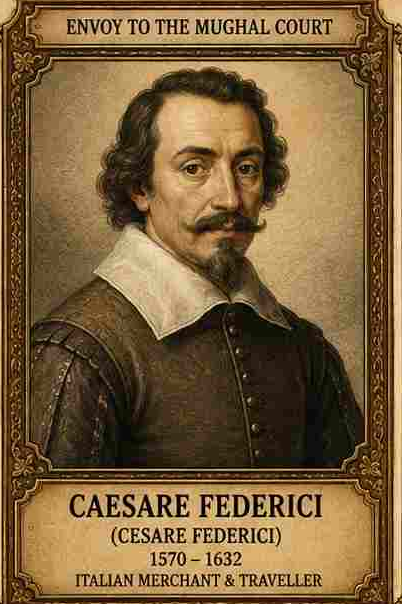
The Venetian Merchant Who Saw Vijayanagara After Its Great Rupture
There is a particular sadness in the account of Cesare Federici because, unlike Domingo Paes, who entered Vijayanagara when Krishnadevaraya’s empire stood at the height of its splendour, Federici arrived in South India after the great political rupture of 1565, when the combined forces of the Deccan Sultanates had defeated Vijayanagara at the Battle of Talikota and the capital had suffered enormous destruction. He was a Venetian merchant who travelled through the Indian Ocean and spent several years in Asia, reaching India around 1563 and returning to Venice in 1581; his account was published in Venice in 1587 as part of a collection of voyages and became an important European source for the geography and commerce of the East. What makes Federici particularly valuable for our series is therefore not simply what he saw, but when he saw it. He entered a landscape that had been described by Paes and Nuniz only a few decades earlier as one of the wealthiest and most magnificent political centres of the world, and he found a capital that had suffered catastrophic destruction. His account consequently becomes an unexpected bridge between two civilizational moments: Vijayanagara at its imperial height and Vijayanagara after political catastrophe.
Federici’s observations are particularly useful because he was a merchant, and therefore his attention repeatedly returns to ports, commodities, markets, distances, roads and the movement of goods. He travelled through the western and southern parts of India, visited Goa and Vijayanagara, and continued through the wider Indian Ocean world. His account allows us to ask a question that is central to Civilizational Studies: what happens to the economic and social networks of a civilization when its political centre is destroyed? A capital can be burned, a dynasty can lose power and a palace can become a ruin, but does the civilization itself disappear with them? Federici’s account suggests that the answer is much more complicated.
Major Work
Viaggio di M. Cesare de’ Federici, nell’India Orientale, et oltre
Federici’s travel account was first published in Italian in 1587, and later translations circulated widely in Europe. His observations became especially important for European knowledge of the Indian Ocean because he described not only India but also parts of Burma, Pegu and the wider commercial world of Asia. His account is therefore best read not as a history of one kingdom but as a merchant’s map of interconnected Asian societies.
1. Federici Arrived After the Great Catastrophe
The most important fact about Cesare Federici is the date of his journey. He travelled in India in the decades after 1565, which means that he was not looking at the Vijayanagara that Domingo Paes had seen at the height of its power. He was looking at what remained after the Battle of Talikota and the catastrophe that followed it. This difference is historically extraordinary because Paes had walked through a capital filled with markets, temples, gardens, soldiers, merchants and festivals, whereas Federici encountered the consequences of war and political destruction. When their accounts are read together, they provide something that very few travellers can offer: a before-and-after comparison of a major civilizational system. Paes shows us the system at work, while Federici allows us to see what happened when its political centre was shattered.
2. His Description of Vijayanagara Is Almost Haunting
Federici’s description of Vijayanagara is particularly powerful because it preserves both the memory of the city’s former greatness and the visible reality of its destruction. He records that the city had been:
“very large, and very populous, and very rich.”
Yet he also describes what had happened to it, observing that it had been:
“destroyed and burnt.”
He further adds that:
“the city is not altogether destroyed, but the houses are all overthrown.”
— Cesare Federici, account of Vijayanagara.
The contrast is remarkable. Only a few decades earlier, Paes had described the magnificence of Vijayanagara as a living imperial capital. Federici was now walking among its remains. The city had not merely become poorer or politically weaker; it had suffered physical destruction on an extraordinary scale. Yet the significance of Federici’s account lies precisely in the fact that destruction was not equivalent to complete disappearance. Even after catastrophe, the city remained sufficiently present in its physical form to preserve the memory of what it had once been.
3. The Ruins Were Still Enormous
Federici does not describe a small or insignificant abandoned settlement. Even after destruction, he encountered a place whose scale remained extraordinary. He records:
“The city is very great, and hath many streets and places.”
Even in its damaged state, the physical remains were extensive enough to impress a European merchant. This tells us something important about monumental civilizations: political collapse can happen far more quickly than physical disappearance. A dynasty may lose power, an army may be defeated and a capital may be abandoned, yet buildings, roads, tanks, temples and agricultural landscapes can survive for generations. Social memories also persist. Civilization, therefore, does not disappear at the exact moment when political sovereignty is lost. The event of political collapse may be sudden, but its consequences unfold over a much longer historical period.
4. What Exactly Had Fallen?
This is perhaps the most important question that Federici forces us to ask. When historians say that “Vijayanagara fell in 1565,” what exactly do they mean? Did the people disappear? Did the Kannada, Telugu and Tamil social worlds disappear? Did temple traditions vanish? Did agriculture cease? Did commerce end? Did every political institution suddenly collapse? The answer, of course, is no.
What suffered catastrophic destruction was principally the political centre and the immense urban concentration of power associated with it. This distinction is fundamental because a state can fall, a capital can fall and a dynasty can fall without the civilization itself disappearing. The destruction of Vijayanagara’s imperial centre was a genuine catastrophe, but political collapse and civilizational extinction are not the same historical process. Federici’s account is therefore particularly valuable because it provides evidence for distinguishing between these two categories.
5. The City Had Become a Memory
There is a profound difference between Paes’s Vijayanagara and Federici’s Vijayanagara. Paes describes a city in the present tense, alive with crowds, institutions, royal power and commercial activity. Federici describes a city that had entered something like a historical afterlife. Its streets were still present, but the political world that had animated them had been displaced. Buildings survived, but their earlier institutional functions had disappeared. Temples remained, but the imperial court was gone. Infrastructure remained visible, but the political centre had shifted elsewhere.
This is what makes ruins so important for civilizational study. They reveal the difference between structure and function. A building can survive after the institution that created it has disappeared, just as a road can remain after the political order that maintained it has collapsed. A temple can continue to exist after the dynasty that endowed it has vanished. Physical structures can therefore outlive political systems, preserving traces of earlier worlds even after their original institutional configurations have disappeared.
6. But Federici Was Still Looking for Commerce
Federici’s perspective was also fundamentally shaped by his identity as a merchant. Even while encountering the consequences of destruction, he remained interested in the commercial possibilities of the region. He records the markets and commodities of South India and pays attention to the movement of goods between inland centres and coastal ports. This is important because it demonstrates that economic life was not extinguished simply because the imperial capital had been destroyed.
Commercial networks could reorganise, merchants could move, markets could relocate and political centres could shift. Ports could continue functioning even when the political geography of the interior changed. This suggests an important principle for understanding civilizational resilience: networks can survive the destruction of particular nodes. The capital may fall, but the wider network does not necessarily disappear with it. Instead, it can reorganise around other centres and adapt to new political circumstances.
7. The Empire Did Not End in One Day
The traditional date of 1565 is politically convenient, but civilizationally it is inadequate. After Talikota, the Aravidu dynasty continued to rule from other centres, and Vijayanagara’s political authority survived in altered forms for decades. The political system changed, the capital shifted and the older imperial structure weakened, but the civilization did not simply switch off. There was no single morning after which “Vijayanagara civilization” ceased to exist.
Federici’s account helps us understand this longer process of transformation. What followed the catastrophe was not immediate extinction but a sequence of destruction, displacement, political reorganisation, economic adaptation, institutional continuity and gradual transformation. This is historically much more interesting than the simple formula of rise, peak, fall and extinction because it asks us to study what happens after the political centre has been shattered.
8. The Capital Was Not the Civilization
Perhaps the most important lesson Federici gives us is that the capital was never identical to the civilization. We often reduce Vijayanagara to Hampi because Hampi was its great imperial centre, but historically Vijayanagara was much larger than Hampi. It represented a political system, a military system, an agricultural system, networks of temples and markets, systems of roads, regional centres, ruling lineages and a much wider cultural world.
When Hampi was devastated, not every one of these systems disappeared. Some moved, some adapted, some survived locally, some transformed and some eventually declined. The destruction of the imperial centre was therefore real and catastrophic, but the wider relationship between political power and civilization had already demonstrated that they were not identical. The capital was the greatest concentration of imperial power, but it was not the sum total of the civilization that had produced it.
9. The Sacred Landscape Survived the Political Catastrophe
The temples and sacred sites of the Vijayanagara region did not simply become meaningless because the political capital was destroyed. Some suffered damage, some lost patronage, some continued and others shifted in importance. This points towards a recurring feature of civilizational continuity in Bharat: political authority can move far more rapidly than sacred geography.
A pilgrimage route can survive a dynasty, a temple tradition can survive a king and a ritual can survive political conquest. Local communities can preserve practices long after the court that once supported them has disappeared. This is why sacred geography must be treated as a civilizational institution rather than merely as a collection of religious monuments. Its continuity depends not only on state patronage but also on communities, practices, memory, pilgrimage and ritual reproduction across generations.
10. The Merchant Shows Us What Political Histories Miss
Federici’s great contribution is that his perspective does not stop with the conventional political question: who won the war? As a merchant and traveller, he was equally interested in what happened to the places through which people continued to live, move and trade. This gives us another way to understand historical catastrophe. A battle may be politically decisive, but its civilizational consequences unfold through migration, trade, agriculture, temple patronage, urban decline, the emergence of new political centres and changes in commercial routes.
The battle is an event, but the transformation of civilization is a process. Political history often privileges the first because battles have dates, victors and defeated rulers. Civilizational history must also examine the longer processes that follow: where people moved, which institutions survived, how networks adapted and which social and economic systems continued under new political conditions.
11. The Indian Ocean Remained Connected
Federici’s wider journey demonstrates that even while political configurations were changing within South India, the larger Indian Ocean commercial system remained active. Goods continued to move between India, Arabia, Persia, Southeast Asia, Ceylon and Europe. The collapse or weakening of one political centre did not destroy this wider oceanic network because it was not dependent upon a single city.
The network possessed multiple ports, merchants, routes and political patrons. This distributed structure gave it a capacity for resilience. When one node was damaged, other nodes could continue functioning. The Vijayanagara catastrophe therefore has to be understood within the context of wider networks that both preceded the empire and continued beyond the destruction of its great capital.
12. This Is Where Civilizational Analytics Becomes Interesting
Consider the scale of what had happened. A major imperial capital had been destroyed, yet agriculture continued, people continued living, merchants continued trading, temples continued existing, languages continued, regional political authorities survived, craft traditions persisted, pilgrimage continued and commercial networks reorganised. What had been destroyed, therefore, was not simply “everything.” What had collapsed was a particular configuration of political power.
This distinction should become fundamental to the study of civilizations. A civilization is not identical to its state. A state may be one of the institutions through which a civilization organizes political power, but civilization also exists through communities, social practices, sacred institutions, languages, economic networks, ecological relationships and cultural memory. When the state collapses, some of these institutions may be severely damaged, but they do not necessarily disappear simultaneously.
13. Political Centralisation Can Create Vulnerability
Federici’s account also allows us to ask another important question. If a civilization concentrates enormous political, economic and cultural resources in one imperial capital, does this concentration produce strength, or can it also create vulnerability? Vijayanagara’s concentration of wealth made the city spectacular, but it may also have made the destruction of the capital particularly consequential. When the city was attacked, the palace, treasury, markets, elite residences and the political symbolism of the empire were all vulnerable to attack at the same time.
This does not mean that centralisation caused the fall. Such an argument would be far too simplistic. However, it does raise a legitimate civilizational question about the relationship between the distribution of institutions and resilience. How much of a society’s capacity is concentrated in one centre, and how much exists across multiple regions and institutions? When a single node is destroyed, what remains capable of continuing elsewhere? Federici’s account encourages us to ask these questions without reducing the complex history of Vijayanagara to a single explanation.
14. The Civilizational Network Was Wider Than the Capital
The broader civilizational network was clearly wider than the capital itself. Although Hampi was devastated, other centres survived. The Aravidu rulers shifted their political base, regional powers continued, temple networks continued, commercial ports remained active and agricultural communities persisted. The broader system therefore possessed a degree of redundancy: one major node could fail without every other node failing simultaneously.
This resembles what we now recognize in complex systems, where resilience often depends upon distributed capacity. A system that depends entirely upon one centre is far more vulnerable to the destruction of that centre than a system in which institutions, communities and productive capacities exist across multiple locations. Perhaps this is one of the most important lessons that can be drawn from the Vijayanagara experience: the civilization had concentrated immense symbolic and political power in its capital, but its deeper social and cultural networks extended far beyond it.
15. Federici Was Seeing the Difference Between Ruin and Extinction
A ruin is not necessarily evidence of civilizational death. It may instead indicate political displacement, the relocation of institutions, the survival of communities, the persistence of memory or the continuation of practices without their original physical structures. For this reason, the presence of ruins should never automatically lead us to conclude that the civilization itself had ended.
The better historical question is not simply, “What was destroyed?” but “What survived the destruction?” This is a more difficult question because survival is rarely concentrated in one visible monument or institution. It may exist in communities, practices, markets, languages, memories, agricultural systems and sacred networks. Yet it is precisely this broader inquiry that makes the study of civilization different from the simple study of political succession.
16. The Merchant’s Memory Is Different From the Chronicler’s
Different observers preserve different traces of civilization. Nuniz was deeply concerned with kings and political memory, Paes described the city as a living experience and Federici sought to understand what he could still see and what could still be traded. These differences are not weaknesses; they are methodological resources. A civilization leaves different kinds of evidence depending upon who is observing it and why.
The chronicler may preserve political memory, the traveller may preserve experience, the merchant may preserve circulation, the archaeologist may preserve material remains, the inscription may preserve institutional memory and the temple may preserve ritual continuity. No single source is sufficient. Civilizational studies begins when these different forms of evidence are brought into conversation with one another rather than allowing any one observer to become the complete history of a society.
17. Read Federici Against Paes
The most important methodological exercise is therefore to read Paes and Federici against one another. Paes famously encountered Vijayanagara at the height of its magnificence and compared its scale to Rome, while Federici arrived later and found its urban world transformed by destruction. Paes saw markets in operation; Federici encountered the consequences of their disappearance and transformation. Paes saw royal power concentrated in the imperial capital; Federici saw the consequences of its displacement. Paes encountered a city alive with imperial confidence; Federici encountered the same world after catastrophe.
Together, these accounts produce something that neither can provide alone: a civilizational before-and-after. The comparison allows us to move beyond the question of whether either traveller was individually “correct” and instead examine what becomes visible when their accounts are placed in sequence. Through Paes we can understand the functioning of the system; through Federici we can study what remained after its greatest political centre had been devastated.
18. What Does a Civilization Do After Catastrophe?
This is ultimately the question that Federici leaves us with. The question “Why did Vijayanagara fall?” is important, but it is incomplete. The deeper question is what happened after the fall. Where did people go? Where did political authority move? Which institutions survived? Which temples continued? Which markets relocated? Which languages remained dominant? Which communities preserved their practices? Which new political centres emerged? Which commercial routes changed? Which memories survived?
These questions take us beyond the battle and into what may be called the afterlife of civilization. They force us to study historical catastrophe not merely as an ending but as a transformation whose consequences are distributed unevenly across time and space. Some institutions disappear immediately, others move and others survive with altered functions. A civilizational study of decline must therefore investigate both destruction and continuity.
Why Cesare Federici Matters for Civilizational Studies
Federici gives us something profoundly different from Paes and Nuniz because he gives us decline from the perspective of someone who arrived after the catastrophe. That makes his account one of the most useful sources for understanding the distinction between civilizational collapse and political collapse. Vijayanagara had lost its great capital, its earlier political configuration had been shattered and its monumental centre had suffered extraordinary destruction. Yet Bharat did not disappear. The people did not disappear, languages did not disappear, temples did not disappear, agricultural systems did not disappear, the commercial world did not disappear and sacred geography did not disappear. The civilization reorganised.
We are often taught to imagine civilizations through a simple curve of rise, peak, fall and extinction. History, however, is rarely so neat. Perhaps a civilization does not simply “fall.” Perhaps one configuration of civilization falls while another begins to emerge. A capital may disappear while networks survive, a dynasty may change while memory survives, markets may move while economic life continues, temples may continue without their former political patrons and communities may adapt to new centres of power. Continuity is often reconstructed slowly and almost invisibly through these processes rather than through a dramatic restoration of what previously existed.
That is why Federici matters. He walked through the ruins of one of the greatest cities of the medieval world and, perhaps without intending to, provided one of the most important lessons in civilizational history:
“A city can be destroyed without destroying everything that made the civilization possible.”
Therefore, when we study civilizational decline, perhaps we should stop asking only, “When did it fall?” We should ask the more difficult questions: What exactly fell? What survived? What moved? What adapted? Which institutions continued to function? Which memories remained? How did people reconstruct continuity after the political centre had disappeared?
Federici’s importance lies precisely in forcing us to examine the space between ruin and extinction. The ruins were silent, but the civilization was not.
