
A Venetian Merchant’s View of a Wealthy, Maritime and Urban Civilization
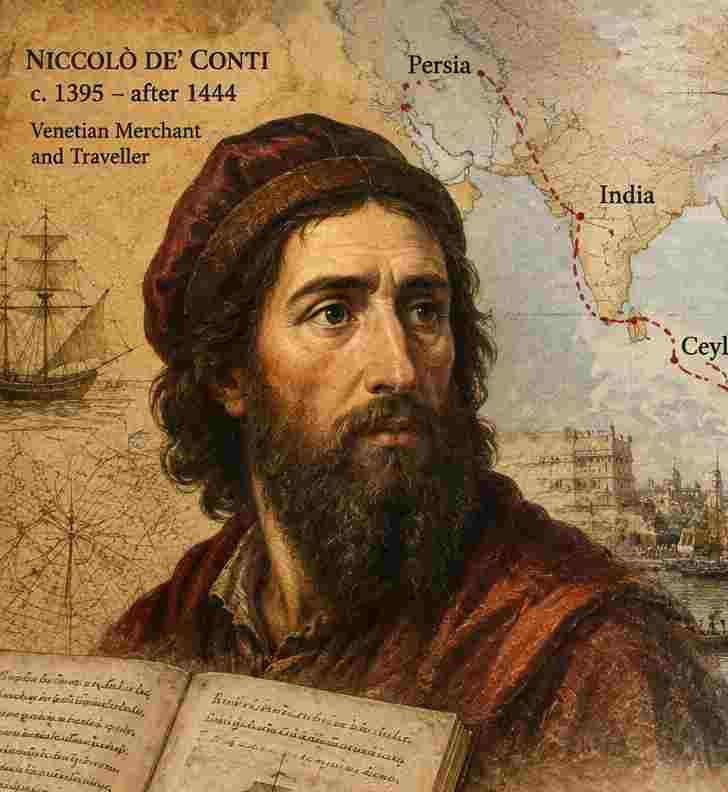
There is something especially valuable about Niccolò de’ Conti’s account because he did not look at Bharat with the eyes of a diplomat or court chronicler. A Venetian merchant, Conti had spent years travelling through Persia, India, Ceylon and Southeast Asia before returning to Europe in 1444. He therefore noticed things that other travellers often passed over: merchants, ships, wealth, domestic refinement, ports, commodities, cities and festivals. His perspective is particularly useful when compared with Abdur Razzaq. Razzaq was struck by the political and architectural scale of Vijayanagara; Conti, while also astonished by its size, was especially attentive to its material and commercial world.
There is, however, an important problem with the source. The surviving account was not written by Conti himself. After his return to Europe, he narrated his experiences to Poggio Bracciolini, who recorded them in Latin; that original Latin text was subsequently lost, and the account survived through later translations and versions. Therefore, the familiar English sentences attributed to Conti should more accurately be understood as translated representations of an account transmitted through Conti’s narration to Poggio and then through later textual traditions. The account must therefore be read carefully, but this does not reduce its importance. It simply means that Conti’s observations have to be treated as historical evidence rather than as mechanically precise testimony.
Major Source
The Travels of Niccolò de’ Conti
Conti’s experiences were recorded by Poggio Bracciolini, and the passages concerning Vijayanagara were later reproduced in Robert Sewell’s A Forgotten Empire alongside accounts by Abdur Razzaq and Portuguese travellers. The source is particularly valuable because Conti’s journey through Bharat moved from Cambay and the western coast towards Vijayanagara and the Coromandel region, before continuing to Ceylon and Southeast Asia. He therefore encountered not a single isolated kingdom, but an interconnected commercial and civilizational geography.
1. Vijayanagara Was Vast
Conti’s description of Vijayanagara begins with geography:
“The great city of Bizenegalia is situated near very steep mountains.”
He then makes the extraordinary claim:
“The circumference of the city is sixty miles.”
Its walls, he says,
“are carried up to the mountains and enclose the valleys at their foot, so that its extent is thereby increased.”
The figure of sixty miles should not be treated as a modern measurement, but Conti’s larger point is unmistakable. He encountered a city whose scale astonished him and whose urban geography extended beyond a compact fortified core into a wider landscape of valleys, settlements and defended space.
What did Conti actually see? Not the ruined monuments with which modern visitors are familiar, but a living urban world centred on one of the most powerful political formations of fifteenth-century South India. His account is therefore an important reminder that Vijayanagara must be understood not simply as a collection of surviving ruins but as an urban landscape of political power, population and economic activity.
2. A City of Extraordinary Military Capacity
Conti records that:
“In this city there are estimated to be ninety thousand men fit to bear arms.”
The precise number must again be treated cautiously. Medieval travellers frequently exaggerated populations and military forces, and this cannot be converted into an exact military census. Yet the observation remains historically significant because it reveals the scale of the military population that Conti believed the city could sustain.
Such military power could not exist independently of the wider economy. Armies required agricultural production, taxation, transport, craftsmen, horses, weapons and administrative systems. Thus, even if Conti’s number is approximate, the larger civilizational question remains valid: what kind of economic and institutional system could support a city that appeared to a foreign observer capable of mobilising such enormous military resources?
3. Wealth, Refinement and Domestic Life
One of Conti’s most interesting observations concerns the wealth and refinement he encountered in India. He describes one region as:
“far surpass[ing] the rest in wealth, humanity and magnificence”
and as being:
“equal to us in mode of life and governance.”
He writes of:
“sumptuous houses, and polished residences, and household goods of great refinement”
and describes the inhabitants as:
“courteous people and extremely rich merchants.”
This is significant because Conti was not merely describing an exotic land. He was comparing what he encountered with Europe, and the comparison was often favourable. A Venetian merchant understood wealth, cities and commerce; when such an observer repeatedly notices refinement and commercial capacity, the evidence deserves serious attention.
4. Merchants Who Commanded Fleets
Conti records an extraordinary merchant who possessed:
“forty ships for his own trade, each valued at 50,000 pieces of gold.”
The precise valuation should obviously be treated with caution, and it is impossible to know whether this represented a typical merchant or an exceptional individual. But the observation itself is important. Conti was a Venetian merchant from one of Europe’s great maritime commercial civilizations. He understood the capital and organisation required to operate ships, and he encountered Indian merchants functioning on a scale that impressed him.
This changes how we should understand pre-modern Bharat. Commerce was not a marginal activity taking place outside the main structure of civilization. Merchants could accumulate capital, maintain fleets and connect Indian production with the wider maritime world. Bharat was therefore not simply a land of kingdoms placed beside one another. It was also part of a large commercial civilization connected through ports, ships, markets and merchant communities.
5. Indian Ships Were Built for the Indian Ocean
Conti describes Indian ships as:
“large as houses and … unlike ours.”
He records that they possessed:
“ten or twelve sails”
and carried large:
“cisterns of water.”
The account also preserves observations about vessels divided into multiple compartments, allowing damage in one part of the ship without necessarily sinking the entire vessel.
The importance of this observation lies in what it tells us about indigenous maritime knowledge. Ships are not simply technologies that can be judged abstractly as advanced or primitive. They emerge within particular environments. The Indian Ocean required vessels capable of long-distance travel, monsoon navigation and the transportation of water and cargo. Conti’s ships were therefore part of a technological system adapted to a particular maritime ecology.
The question, then, is not merely, “How did these ships compare with European ships?” A more interesting question is: what problems had Indian shipbuilders learned to solve within the environmental conditions of the Indian Ocean?
6. The Merchant Also Noticed Everyday Life
Conti’s attention was not confined to kings and monuments. In one striking passage, he observes:
“They are the only people of India who like us, eat off tables and tablecloths, on which they place dishes of silver, for all the other Indians eat on a mat placed on the ground.”
The generalisation is clearly his own and should not be accepted as a universal description of Indian society. Yet the passage is valuable because of what Conti chooses to notice: domestic practices, silver utensils, tables, tablecloths and the social meaning of eating.
This reveals an important principle of historical interpretation. A traveller never simply records reality. He records what appears significant to him. A merchant notices wealth and domestic refinement; a diplomat notices courts; a religious scholar notices beliefs. Every traveller carries his own civilizational categories into the society he encounters.
7. Festivals Organised Collective Life
Conti also records festivals in and around Vijayanagara. During one annual celebration:
“at a certain time of the year, their idol is carried through the city”
while women in decorated chariots:
“sing hymns to the god.”
He describes another celebration during which:
“the males and females of all ages, having bathed in the rivers or the sea, clad themselves in new garments, and spend three entire days in singing, dancing, and feasting.”
These descriptions reveal something that purely political history often misses. The festival was not only a religious event. It organised time, clothing, food, music, public movement and social participation. Sacred images moved through urban space, while the entire city became involved in a collective rhythm.
Religion, therefore, was not confined to the temple. It entered streets, markets, calendars and social life. The city itself could periodically become a ritual landscape.
8. The Sacred and the Urban Were Interwoven
Conti’s festival descriptions show that sacred life was physically embedded within the urban environment. The deity moved through the city; crowds gathered; music and dance accompanied the procession; women participated; streets became ritual routes.
This is an important civilizational category. A city cannot be understood only as an administrative or commercial space. It may also possess a sacred geography. Streets can become processional routes, seasons can structure collective activity and recurring festivals can create forms of social synchronisation across communities.
In other words, urban life can have a sacred rhythm, and pre-modern Indian cities cannot be understood adequately if this dimension is removed from their history.
9. Conti and the Problem of Sati
Conti recorded widow-burning in the region of Cambay, making his account one of the early European descriptions of the practice in western India. This is precisely the kind of passage that must be handled critically. It should neither be suppressed nor accepted without questioning the circumstances of what Conti actually witnessed or learned from others.
The historian must ask: Was Conti describing an event he personally witnessed? Was it exceptional or widespread? How did he understand it through his own Christian-European categories? How does his account compare with inscriptions, Indian literary traditions and other contemporary evidence?
This is the difference between using a traveller as evidence and merely collecting dramatic quotations. A source becomes more useful when it is questioned, not when it is blindly celebrated or rejected.
10. Brahmins and Religious Specialists
Conti also comments on Brahmins and their position within social and religious life. His observations reflect the recurring curiosity of European travellers about India’s learned and ritual specialists, although his understanding remained shaped by his own cultural and religious categories.
This is where comparison becomes useful. Al-Biruni approached Indian intellectual categories with a far more systematic attempt to understand concepts and texts, while Conti was primarily a merchant recording the world he experienced. The two observers therefore reveal different dimensions of the same civilization.
11. He Saw Bharat Through Commerce
The greatest difference between Conti and Abdur Razzaq lies in their dṛṣṭi. Razzaq was repeatedly struck by the scale, court and political grandeur of Vijayanagara. Conti notices merchants, ships, wealth, domestic life, festivals and commodities. This is hardly accidental. He had spent years moving through commercial networks and understood the world through the practical categories of a merchant.
The same civilization therefore appeared differently to different observers. A diplomat noticed courts. A merchant noticed markets. A soldier would notice armies. A scholar would notice texts. The civilization remained the same, but the angle of observation changed.
The observer does not merely see civilisation; he sees it through his own civilizational experience.
This is one of the most important methodological lessons of the traveller accounts. Their differences are not merely limitations. They are also evidence.
12. The Problem of the Source
Conti did not write the surviving account himself. The chain is:
Conti → oral narration → Poggio Bracciolini → Latin record → later translations.
This means that the exact English wording attributed to Conti should not be treated as if it came directly from a manuscript written in his own hand. The transmission history is itself part of the source’s history.
This does not make the account unusable. Rather, it tells us how it must be used. Large numbers should be treated cautiously. Exact wording should be attributed to the translated account. Descriptions of unfamiliar practices must be compared with other evidence. Yet when Conti’s observations converge with those of other travellers, archaeology, inscriptions or material evidence, the source becomes especially valuable.
13. What Conti Actually Reveals
Taken together, Conti’s account gives us a picture of fifteenth-century Bharat as urban, wealthy, maritime, commercial, ritually active and deeply connected to the wider world. He travelled through Cambay and the western coast, entered the world of Vijayanagara, continued towards the Coromandel and Ceylon, and then moved into Southeast Asia. His journey occurred before Portuguese naval power entered the Indian Ocean as a dominant force.
That chronology matters. The maritime and commercial networks later encountered by Portuguese travellers were not created by Europeans. They already existed. Ships were already crossing the Indian Ocean. Merchant communities were already operating across long distances. Ports were already connecting inland production with overseas markets. Religious and cultural networks were already moving people and ideas.
Europe did not create this world. It entered an existing world and eventually attempted to reshape and dominate parts of it.
Why Niccolò de’ Conti Matters for Civilizational Studies
Conti matters because he allows us to see Bharat through the eyes of a man for whom commerce was not an abstract concept but a lived reality. He encountered wealthy merchants, ships capable of long-distance navigation, prosperous cities, refined domestic life, sacred festivals and a Vijayanagara whose scale impressed him profoundly.
His account therefore allows us to ask a larger question. When we say merely that “India participated in global trade,” do we not make the phenomenon far too small? Trade connected ports with inland economies, merchants with rulers, agriculture with cities and Bharat with Persia, Arabia, Ceylon, Southeast Asia and beyond. Merchants carried not only goods but also information, customs and knowledge. Festivals connected sacred life with urban economies, while cities connected agriculture with commerce.
Perhaps the better question is this: what kind of civilization develops commercial networks extensive enough for a Venetian merchant to travel through them for years, encounter merchants commanding fleets, compare Indian wealth and refinement with Europe, and return carrying the memory of a society whose scale and commercial capacity impressed him?
Conti’s answer is scattered throughout his account. When those fragments are brought together, they reveal a Bharat that was already urban, commercially powerful, technologically adaptive and deeply embedded in a wider world of trade and cultural exchange long before Europe entered the Indian Ocean as a dominant naval power.
