
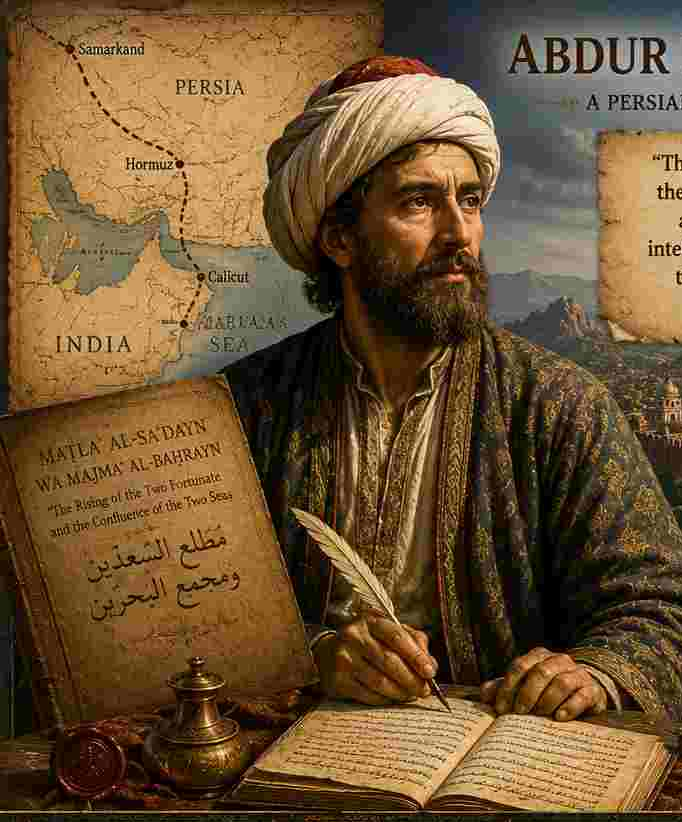
When Vijayanagara Appeared Before a Persian Ambassador
There are moments in travel writing when an observer seems to exhaust the comparisons available to him because what he encounters appears larger than the world he already knows. Abdur Razzaq Samarqandi, the fifteenth-century Persian scholar, diplomat and historian, encountered Vijayanagara at precisely such a moment. Sent by Shah Rukh, the Timurid ruler, on a diplomatic mission, he reached the Indian Ocean, arrived at Calicut and then travelled inland to the court of Deva Raya II around 1443. His account was preserved in his larger historical work, Maṭlaʿ al-Saʿdayn wa Majmaʿ al-Baḥrayn, and remains one of the most important external descriptions of Vijayanagara before the arrival of the Portuguese travellers of the sixteenth century.
Razzaq did not encounter Vijayanagara merely as a passing merchant. He entered it as an ambassador and was therefore attentive to political power and the royal court, but his observations also extended far beyond the palace. He noticed fortifications, cultivated fields, gardens, bazaars, occupational communities, wealth, agriculture, ports and military strength. What emerges from his account is not simply an image of an extraordinarily rich capital but the outline of a vast urban, agricultural and commercial system.
And then comes the sentence for which he is remembered:
“The city of Bijanagar is such that the pupil of the eye has never seen a place like it, and the ear of intelligence has never been informed that there existed anything to equal it in the world.”
The language is undoubtedly extravagant, shaped by Persian literary conventions and the astonishment of a foreign diplomat. Yet the very extravagance raises the historical question that matters most: what did Abdur Razzaq actually encounter that produced such astonishment?
Major Work
Maṭlaʿ al-Saʿdayn wa Majmaʿ al-Baḥrayn
Abdur Razzaq’s larger historical work covers the Timurid world and his diplomatic travels, while its Indian sections provide important observations on Calicut and Vijayanagara under Deva Raya II. For the study of Vijayanagara, the account is particularly valuable because it brings together observations on urban organisation, fortifications, agriculture, markets, political authority, maritime connections, wealth and court culture. At the same time, the source must be read with awareness of the observer himself. Razzaq came from a Persian diplomatic and Islamic intellectual milieu, and the vocabulary through which he interpreted Vijayanagara inevitably reflected the civilizational world from which he came.
1. Seven Walls and an Entire Urban World Within Them
The first major feature of Vijayanagara that impressed Razzaq was its system of fortification. He writes:
“It is so built that seven fortified walls, one within the other, enclose the city.”
Yet what makes the passage truly important is what he says about the spaces within those defensive layers:
“Between the first, second, and third walls, there are cultivated fields, gardens, and houses.”
As one moves further inward, the landscape becomes increasingly dense:
“From the third to the seventh is very crowded, with shops and bazaars.”
This is one of the most important observations in the entire account. The fortified city was not simply a palace surrounded by empty military walls. Agriculture existed within the defensive system. Gardens existed within it. Houses existed within it. Markets and commercial activity became increasingly concentrated towards the interior. Defence, food production, residence, commerce and political authority were therefore physically interconnected.
This is why Vijayanagara should not be imagined simply as a “medieval capital” in the narrow sense of a palace, a fort and a surrounding population. Razzaq’s description suggests something much more complex: a layered agro-urban system in which different functions were incorporated into the spatial structure of the city itself.
2. The Wealth of Vijayanagara Rested Upon Fertility
Razzaq repeatedly emphasised the cultivation and fertility of the surrounding country. He wrote:
“The country is for the most part well cultivated, very fertile.”
The observation appears simple, but it provides an essential foundation for understanding the splendour that astonished him. A city containing vast markets, soldiers, artisans, merchants, royal establishments and religious institutions required an enormous material base. Food had to be produced, water had to be managed, surplus had to be stored, goods had to be transported and revenue had to be collected.
The agricultural landscape was therefore not external to the prosperity of Vijayanagara. It was one of the conditions that made that prosperity possible. The city’s markets depended upon production, and political power depended upon the capacity to draw resources from a productive countryside. This is why Razzaq’s description of fields within and around the urban landscape is so important. It suggests that the countryside and the city were not separate worlds but interconnected components of the same political economy.
3. The Bazaars Were Enormous and Highly Specialised
Razzaq described the commercial landscape of Vijayanagara with equal emphasis:
“The bazaars are very broad and long.”
His account and related descriptions associated with the city indicate specialised commercial spaces and occupational quarters. Even flower sellers formed part of this urban economy, and the breadth of the bazaars was remembered as sufficient for shops and sellers to display their goods on either side.
The significance of this lies in what the market contained. Vijayanagara was not simply sustaining an economy of subsistence. A city capable of supporting specialised markets for flowers, ornaments and other non-essential goods possessed consumers with purchasing power and a commercial world sufficiently developed to sustain occupational specialisation.
The bazaar was therefore not an afterthought to political grandeur. It was one of the institutions through which the city functioned. The royal court could display wealth, but the market reveals how wealth circulated.
4. The City Was Organised Around Occupations and Communities
Razzaq’s account also records that particular professions and occupational groups occupied specific parts of the city. This gives us an important glimpse into the social organisation of Vijayanagara.
The city was not divided merely according to an abstract distinction between rich and poor. Economic function, occupation, community and urban space overlapped. Merchants, craftsmen, military groups and religious institutions formed part of different but interconnected zones within the larger urban world.
This is historically significant because the bazaar was not merely an economic institution. It was also a mechanism of social organisation. Where people worked, where they lived and the communities with which they were associated could intersect within the geography of the city itself.
5. The Palace Was Embedded Within a Commercial City
One of the striking features of Razzaq’s description is the proximity between the royal centre and the commercial world. He describes major bazaars extending from the palace area and outward through the city.
This challenges the simplistic image of a pre-modern capital as merely king, palace and subjects. The palace was the centre of sovereignty, but it stood within a much larger urban system that was cultivating, producing, transporting, trading and consuming.
The power of the king could not exist independently of these activities. A court of great wealth depended upon agricultural production and taxation. A large army depended upon food, transport, animals and administration. The palace, therefore, was not the city itself. It was the political centre of a far larger organism.
6. The Court Displayed Wealth as Political Power
Razzaq was deeply impressed by the wealth of the Vijayanagara court. His description of the throne is among the most famous passages in his account:
“It was of a prodigious size, made of gold, inlaid with beautiful jewels, and ornamented with exceeding delicacy and art.”
He added:
“This kind of manufacture is nowhere excelled in the other kingdoms of the earth.”
Before the throne he observed:
“a cushion of zaituni satin, round which three rows of most exquisite pearls were sewn.”
These descriptions should not simply be read as an inventory of luxury. They reveal the political language of sovereignty. Gold, pearls, silk, jewels and craftsmanship became visible expressions of royal authority. Wealth was not merely possessed; it was displayed, and through display it became part of the theatre of power.
But such a court also raises a larger question. Was the ruler merely displaying personal wealth, or was the court displaying the productive and extractive capacity of an entire political order? The answer was probably both.
7. The Treasury and the Representation of Abundance
Razzaq also described the treasury in extraordinary terms, including:
“chambers, with excavations in them, filled with molten gold, forming one mass.”
Such claims obviously require caution. No historian should treat a traveller’s description of royal treasure as a modern financial audit. A foreign ambassador might have been shown selected spaces, told impressive stories or interpreted ceremonial display through the language of exaggeration.
Yet the passage remains valuable because it reveals something beyond the literal quantity of gold: how wealth was represented at Vijayanagara. The treasury itself was part of political communication. Sovereignty was associated with visible abundance, and the ability of the court to concentrate precious wealth became one of the symbols through which political greatness was understood.
8. Wealth Was Visible Beyond the Palace
One of the most striking observations attributed to Razzaq concerns the material culture of the wider population:
“All the inhabitants of the country, whether high or low, even down to the artificers of the bazar, wear jewels and gilt ornaments in their ears and around their necks, arms, wrists, and fingers.”
The statement should not be converted into a statistical claim that every inhabitant of the empire was wealthy. Razzaq may have encountered particular social groups, and his language may reflect the visual impression produced by the city.
Nevertheless, the passage matters because he did not confine visible wealth to the royal court. He observed jewellery and ornament among people involved in ordinary occupations. Material culture, adornment and the display of precious objects were visibly important parts of social life.
The wealth of Vijayanagara, at least as it appeared to Razzaq, was therefore not represented only by palaces. It was also encountered in the material practices of the city.
9. “Three Hundred Ports” and a Maritime Kingdom
Perhaps the most astonishing geographical claim in Razzaq’s account concerns the maritime reach of Vijayanagara. He writes that the ruler’s dominions possessed:
“three hundred ports, each of which is equal to Calicut.”
The exact number should not be accepted literally. Medieval travel accounts frequently used enormous figures to communicate scale, and “equal to Calicut” is not a precise economic measurement.
But the broader observation is historically important. Razzaq did not encounter Vijayanagara as a purely inland power. Its political economy was connected to the coast, and its prosperity was linked to networks extending from agricultural interiors towards markets and seaports.
Vijayanagara must therefore be understood as more than a land empire. It was connected to the wider Indian Ocean world through a commercial geography in which inland production, urban consumption and maritime trade interacted.
10. Military Scale Required an Enormous System
Razzaq gives an enormous estimate for the Vijayanagara military, describing a force numbering around eleven lakh.
The number cannot be treated as a modern census, and the traveller’s numerical claims require independent comparison. Yet the larger point remains significant: Razzaq perceived the military power of Vijayanagara as immense.
And military power is never merely military. An army requires agricultural production, land revenue, transport, horses, elephants, weapons, fortifications and administrative organisation. The army was therefore the visible end of a much larger system.
The important question is not simply whether Razzaq’s numerical estimate was correct. The deeper question is: what kind of economic and institutional base was necessary to create the military scale that impressed a foreign diplomat so profoundly?
11. Vijayanagara Was an Agro-Urban Civilisation
Perhaps the most important insight in Razzaq’s account returns us to his description of the fortified landscape:
“cultivated fields, gardens, and houses”
and, closer towards the centre:
“shops and bazaars.”
Modern imagination often separates the urban and the rural. Here is the city; there is the countryside. Vijayanagara complicates that distinction. Agriculture entered the defended landscape. Gardens were integrated into settlement. Water systems sustained the city. Markets connected producers and consumers. Political authority stood at the centre of these relationships.
This makes Vijayanagara particularly important for Civilizational Studies. It offers an opportunity to examine a historical urban system in which food, water, defence, settlement, agriculture, commerce and sovereignty were physically and institutionally connected.
The city was not sustained by a countryside conceived as external to it. The city and its wider landscape formed a larger system.
12. Vijayanagara Was Also a Cosmopolitan Meeting Place
Although Razzaq was primarily concerned with the political court, his account and its comparison with later travellers reveal a city connected to wider networks of merchants, diplomats, craftsmen, pilgrims and military communities.
This is important because a great city becomes visible not only through what it produces but also through what it attracts. Vijayanagara attracted people, goods and information from beyond its immediate surroundings. Its commercial and political importance made it a meeting point between different regions.
The city was therefore not a closed capital. It belonged to a wider world of circulation in which commodities, people and knowledge moved across political and geographical boundaries.
13. What Abdur Razzaq Did Not See
The importance of Razzaq’s account should not tempt us into treating it as a complete description of Vijayanagara civilization. He stayed for a limited period and encountered the city primarily as a diplomat and foreign observer.
He cannot provide a complete account of village society, local institutions, agricultural communities across the entire empire, the internal functioning of temples, the nāyaka system or the everyday lives of most women and men.
This distinction is fundamental. The magnificent city encountered by the traveller was not the entire civilisation. It was one extraordinarily valuable window into it.
And that is precisely how traveller accounts should be used. They are not complete civilizational mirrors. They are partial perspectives, shaped by access, purpose, identity and astonishment.
Why Abdur Razzaq Matters for Civilizational Studies
Abdur Razzaq gives us a Vijayanagara far larger than the familiar image of temples and ruins. He describes a world in which cultivated fields existed within fortified spaces, gardens existed alongside houses, markets operated alongside royal institutions, occupational communities were integrated into the urban landscape, and political authority rested upon an extensive agricultural and commercial foundation.
What makes his account especially valuable is that it allows us to reconstruct relationships rather than merely list institutions. Agriculture required water. Markets depended upon production. Commerce connected interior regions with roads and ports. The army required food, revenue and transport. The court concentrated wealth produced and mobilised across a much larger political economy.
This is where Razzaq becomes more than a traveller. He becomes evidence for civilizational interconnectedness.
Perhaps we should therefore return to his most famous sentence:
“The city of Bijanagar is such that the pupil of the eye has never seen a place like it, and the ear of intelligence has never been informed that there existed anything to equal it in the world.”
It is easy to read this merely as praise. But perhaps it should instead become a question. What did he actually encounter? Was it simply an extraordinarily wealthy royal capital, or was he observing something more complex—a political order in which agriculture, water, fortification, commerce, craftsmanship, urban settlement and royal authority had been woven into a single, enormous system?
That is the question worth carrying forward. Vijayanagara was extraordinary not merely because it possessed magnificent buildings or a wealthy king. It was extraordinary because the structures that supported the city were themselves vast and interconnected. When Abdur Razzaq stood before that world, he could not easily find a comparison. He could only say that the eye had never seen anything like it before.
