
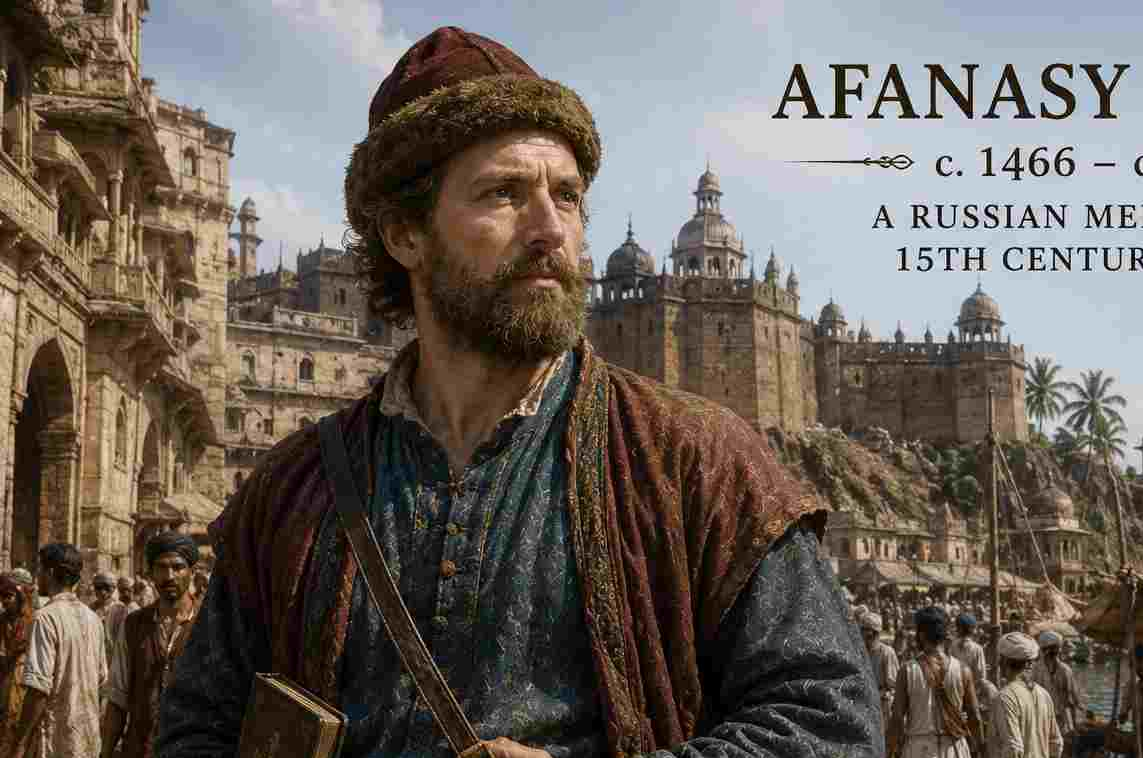
A Russian Traveller Who Did Not Come to Discover India, but Found Himself Living Within It
There is something unusually human about Afanasy Nikitin’s account. Unlike an ambassador arriving with royal authority or a traveller deliberately setting out to document a foreign civilization, Nikitin came as a merchant from Tver whose journey gradually escaped the purpose with which it had begun. He lost ships, property and commercial security, travelled through Persia and eventually entered Bharat, where he spent several years moving through the Deccan and the territories of the Bahmani Sultanate. What he left behind was therefore not simply a description of India. It was a record of commerce, monsoon, agriculture, animals, rulers, festivals, religious communities, fear, adaptation and the gradual transformation of the traveller himself.
His work, A Journey Beyond the Three Seas (Khozhdenie za tri morya), is among the earliest major Russian accounts of India. Nikitin introduces the journey with an intensely personal prayer:
“O Lord Jesus Christ, Son of God, have mercy on me, thy sinful servant, Afanasy, son of Nikita.”
He then explains the meaning of his journey:
“I, sinner, have recounted my voyage beyond the three seas.”
These opening words matter because they establish the character of the source. Nikitin is not writing from the detached position of someone who remains untouched by the world he studies. He knows that he has travelled beyond the familiar world of Rus, and his account gradually becomes a record of what happens when a merchant is compelled to live for years within another civilizational environment.
1. He Did Not Plan to Become an Explorer
Nikitin did not set out to “discover India.” He began as a merchant, and the direction of his journey was determined partly by commercial misfortune. After losing his property, he continued towards India because returning home empty-handed was not an attractive option. His own explanation is strikingly direct:
“I went to India because I had nothing to return to Rus with, left as I was without any goods.”
This gives Nikitin a very different relationship with the world he describes. He was not simply passing through as an observer. He had to understand local conditions because his survival and commercial prospects depended upon them. He observed prices, commodities, customs duties, horses, food, ports and markets not merely because these things were intellectually interesting, but because they were part of the practical world in which he now had to live.
His account therefore reveals an important historical fact: sometimes the most valuable witnesses are not those who consciously set out to record history. They are people whose ordinary lives carried them into historical worlds they never expected to enter.
2. The Monsoon Was an Agricultural Institution
When Nikitin reached Junnar, one of his most important observations concerned the monsoon. He writes:
“Day and night for four months the country is covered in water and mud.”
But he immediately connects this climatic condition with cultivation:
“During these days, they plough the land and sow wheat and rice, and legumes, and other edibles.”
This is a simple observation, yet it reveals something fundamental. The monsoon was not merely “weather” occurring outside society. It structured agricultural time. Water transformed the landscape, cultivation followed the seasonal cycle and food production was embedded within ecological rhythms.
Here Nikitin gives us an important civilizational insight almost without intending to do so. Climate shapes agriculture, agriculture shapes food and markets, and markets become part of the wider political and commercial order. Ecology is not the background against which civilization develops. It is one of the systems through which civilization is sustained.
3. Horses, Khichri and the Deccan Economy
Nikitin’s account becomes especially interesting when he notices what appears to be an ordinary detail:
“They prepare khichri, with sugar and butter, and feed it to the horses.”
He also records that:
“In India, horses are not bred.”
Whether every detail should be generalized to the entire subcontinent is another matter, but Nikitin had identified a major problem within the military economy of the Deccan. Large cavalry states required horses, while many of the most valued military horses were acquired through long-distance trade from regions such as Arabia, Persia and Central Asia.
The resulting system connected several worlds. Foreign horses entered through maritime routes, merchants and ports moved them, rulers and armies required them, while Indian agricultural and commercial systems sustained the wider society around them. Nikitin was therefore not merely writing about horses. He was unknowingly describing a military-commercial-ecological system.
4. Junnar and the Geography of Defence
Nikitin describes Junnar in memorable language:
“The town of Junnar stands on a rock cliff, unfortified, protected by God alone.”
He also notes:
“The road is so narrow that two people cannot pass each other.”
His phrase “protected by God alone” is rhetorical, but his geographical observation is significant. Terrain itself could function as defence. A settlement positioned upon difficult terrain, accessible through narrow approaches, did not need the same defensive arrangements as a city located on an open plain.
This is a useful reminder that pre-modern political history cannot be separated from geography. Mountains, rivers, forests, cliffs and passes shaped military movement and political strategy. The traveller simply trying to reach a town may therefore reveal things about geography that a royal chronicle never bothers to explain.
5. Bharat Was Part of an Already Connected Commercial World
Nikitin’s journey reveals a vast network extending across Hormuz, Gujarat, Cambay, Chaul, Dabhol, Kozhikode, Ceylon and beyond. He records commodities, ports, duties and routes, showing that the western coast of Bharat was deeply connected with Persia, Arabia, the Deccan, Sri Lanka and the wider Indian Ocean.
His description of Hormuz is particularly revealing:
“All kinds of goods are available here; whatever the world produces, Hormuz has it.”
As a merchant, he immediately notices the financial system as well:
“The duty is high: they take a tenth of every commodity.”
This is the merchant’s eye. He notices where goods are available, who pays duties, what routes are profitable and where danger lies. Through Nikitin, we see the Indian Ocean not simply as a geographical space but as a world of economic circulation.
Bharat was not a self-contained land waiting to be connected with the world. Its ports and merchants already belonged to an enormous commercial geography. What later European powers entered was not an empty ocean but a highly active system of routes, commodities and communities.
6. Trade Could Be Brutal
Nikitin does not romanticize commerce. He complains about misinformation, unequal advantages and piracy:
“They lied to me, those infidel dogs: they said that they had many goods, but there are none for our lands.”
He notes that:
“the pepper and the dyes”
were profitable within certain trading networks, while he himself faced commercial difficulties. He also records bluntly:
“The sea is filled with pirates.”
This is precisely why his testimony is so valuable. Nikitin gives us trade from the perspective of someone actually trying to survive within it. Commerce was not an abstract exchange between civilizations. It involved risks, taxation, competition, misinformation, piracy and unequal access to markets.
Nikitin therefore allows us to see the economy from below—not as a grand system viewed from a palace, but through the anxieties of a merchant who had to make the system work for himself.
7. The Bahmani World Was Connected to the Indian Ocean
Nikitin spent considerable time within the territories of the Bahmani Sultanate and describes its rulers, armies, elephants and cavalry. At Junnar, he records that horses associated with military power came from regions including Khorasan, Arabia and Central Asia, entering the Deccan through maritime trade.
This reveals an important relationship between military and commercial history. The Bahmani political world could not be understood purely through battles and dynasties. Its cavalry depended upon wider systems of trade, and those systems connected the Deccan to the Persian Gulf, Arabia and Central Asia.
Military power was therefore also dependent upon commercial circulation. The army was connected to the ship, the merchant and the port.
8. The Elephant Was Not Merely an Exotic Animal
Like many foreign travellers, Nikitin was fascinated by elephants. He records their military use and describes them as instruments of war. Yet an elephant was far more than a spectacular animal:
“an animal, a military technology, a symbol of power and an economic burden.”
An elephant required food, handlers, training, equipment and specialized knowledge. A state capable of maintaining war elephants was sustaining an entire institutional system around them.
This is why the traveller’s apparently exotic observation becomes historically useful. The elephant connects ecology with military technology, specialized knowledge with state capacity and the natural world with political power.
9. He Recorded What Ordinary People Wore
Nikitin also pays attention to clothing, noting:
“the commoners wear cloths over their loins, and another across their shoulders, a third on their heads.”
He contrasts this with princes and nobles, who wore:
“coats, and shirts and caftans.”
Such observations are important precisely because formal political records often ignore them. A royal inscription may preserve the king’s titles, but a traveller can tell us how people dressed. Clothing provides evidence about climate, materials, status, production and social differentiation.
Nikitin’s account therefore helps us move beyond the history of rulers. Civilizational life is also made of the material practices of ordinary people.
10. Festivals Were Part of Collective Civilization
Nikitin’s observations of a festival associated with Parvati reveal another important dimension of social life. He records public gatherings, religious activity, music and collective participation.
A festival should not be placed narrowly within a single category called “religion.” It is simultaneously religious, social, cultural, economic and spatial. Large gatherings bring people into common physical spaces, create periodic rhythms in social life and connect sacred practice with collective experience.
This is particularly important for civilizational analysis. The sacred does not always exist separately from social organization. A religious festival can simultaneously organize time, movement, economy, community and public culture.
11. The Most Personal Part of His Journey: Faith
Perhaps the deepest dimension of Nikitin’s account emerges when he writes about his own religious life. Living for years away from Rus, among Muslims and Hindus, he became increasingly uncertain about his ability to maintain the practices through which his Christian identity had previously been organized. He writes:
“I do not observe the Christian feasts, neither Easter nor Christmas; I do not keep the fast on Wednesdays and Fridays.”
The reason is painfully simple:
“I have no books. When I was robbed, my books were taken from me.”
His books were gone, and with them went more than possessions. The ability to calculate the religious calendar and maintain familiar ritual practices became uncertain. Yet he continued to pray:
“Lord God, You are the True God, the Great God, the Merciful God, the All-Merciful and All-Hallowed One, the One God, King of Glory, the Creator of Heaven and Earth.”
Here Nikitin becomes more than a source on Bharat. He becomes a source on civilizational encounter itself. What happens to a person’s identity when he lives for years within another civilizational environment? The answer, in Nikitin’s case, is neither simple conversion nor simple preservation.
12. Identity Could Become Uncertain
Nikitin records an episode in which a local authority threatened to take his horse unless he converted:
“I will return the colt and give you a thousand gold coins, but only if you convert to our faith, to Islam.”
The later text makes his religious condition even more complicated. His account contains Christian prayers alongside Islamic expressions, and scholars have debated whether he formally converted, adapted to his surroundings or remained fundamentally Christian while adopting the language and practices necessary for survival.
At one point, he writes:
“I have lost my faith.”
Yet he continues to pray to Christ.
This contradiction should not be treated as a flaw to be cleaned out of the historical record. It is part of the historical value of Nikitin’s journey. Identity is not always neat. A traveller can borrow words, adapt practices and live within another social world without entirely becoming someone else.
Nikitin’s uncertainty is therefore evidence. He shows us what prolonged civilizational encounter could do to an individual life.
13. Political Rule and Civilizational Life Were Not Identical
Nikitin travelled through the Bahmani political world, but he also encountered Hindu populations, festivals, local customs, agriculture and wider commercial communities. His account repeatedly reminds us that political sovereignty and civilizational life cannot simply be treated as the same thing.
A territory could be ruled by a Muslim dynasty while much of its social and religious life continued through older and wider Hindu traditions. Muslim courts, Hindu communities and commercial networks could coexist within the same geographical and economic world.
This complexity matters. Medieval Bharat cannot be reduced to a single binary between rulers and ruled or between Hindu and Muslim. Political authority, social life, religious practice and economic networks overlapped without always being identical.
Why Afanasy Nikitin Matters for Civilizational Studies
Nikitin gives us a remarkably broad view of fifteenth-century Bharat. He sees the monsoon and agriculture, horses and elephants, merchants and pirates, ports and taxes, food and clothing, Muslim courts and Hindu communities, festivals and religious practices.
But his greatest contribution is perhaps his position as a struggling merchant. He had lost property, watched prices, faced taxation, depended upon trade and experienced the practical risks of moving through an interconnected world. He does not merely tell us that trade existed. He reveals something of what it felt like to try to trade.
His final reflections are deeply personal:
“O Russians of the true Christian faith! He who travels to many lands, falls into many ills and loses the faith of Christ.”
The sentence tells us something larger than Nikitin’s personal crisis. Civilizational encounter changes people. Goods move, languages move, religious practices move and technologies move. But individuals also move through these systems, and they do not necessarily return unchanged.
Nikitin therefore matters because he gives us civilizational encounter from the inside. He did not simply observe Bharat. He had to live within it. He began as a merchant from Tver, but his journey gradually made him a witness to a far larger world—one connected by ecology, trade, military systems, religious communities and the Indian Ocean.
Primary Reference
Afanasy Nikitin, A Journey Beyond the Three Seas (Khozhdenie za tri morya), in Richard Henry Major (ed.), India in the Fifteenth Century, Hakluyt Society, 1857. (Book)
